2016 Indian Travels – Himalayas
The Singalila Ridge- Our Himalayan Trek


1st – 12th November 2015
Day 1
We land in Calcutta or Kolkata just before 8.00pm and go through a lengthy ‘Welcome to India’ process of fingerprints and eyeballs to get our visas validated and stamped in our passports. Once through we are met by a guide and taken with two fellow trekkers Rachel and Stewart for a wild noisy journey that introduced us to the city.
The journey, passing ‘Big Ben’ (a faithful replica), brings us to the Hotel VIP International where we meet our guide Sanjeev. The room in our hotel is basic but depressingly all wires, noisy air conditioning and fans; and a hot, mucky bathroom. After venturing out to get some money from an ATM, we try sorting bags before ordering some food which we eat in our room. We eventually sleep.
Day 2
Breakfast is served in a dark dingy disco/karaoke room and is not pleasant; Mistake no. 1. – Coffee comes with hot milk and sugar. We meet in the foyer with our fellow trekkers and Sanjeev our guide who briefs us on the day and takes £45 off each of us for tips. Apparently this is all very usual.
A coach with a guide picks us up and shows us the main colonial buildings and parks of note in the centre of Kolkata. It is very hot and humid
At the River Hooley, as the Ganges is called on this stretch, we watch people bathing and digging up clay to make chai cups. We walk through the flower market which has lovely flowers; the overriding smell is of cardamom and chai not the scent of flowers, but better than the smell of the river.


We visit, St Anthony’s Church with its memorial to the Black Hole of Calcutta,
and the Potters Quarter where preparation for Kali Puja, which coincides with Diwahli, involves making lots of clays models of Kali, who stands on her husband, the god Shiva, adorned by skulls.


The models are made by building straw models on frames, covering them with clay and then painting them. They are then sold to Clubs who compete for the best Puja display.
Back on the coach we make our way slowly through the heavy traffic, vehicles and people to the Victoria Memorial. The gardens are lovely but the building is closed; it is so colonial! We all have lunch together in the Blue Sky cafe; a mango lassi and a memorable Chicken Byriani which is mostly moist spiced rice with one piece of chicken on the bone and a whole potato hidden inside!!
We go off to find no less than the ‘Oxford bookshop’, before wandering on to a ‘green’ bookshop where we are greeted like long lost friends by an older man who insisted on giving us both a friendly hug.
The shop has an eclectic range of books many individually wrapped in cling film as are the books on book stalls on the streets of Kolkata.
At St Thomas’s Church we talk to the caretaker about the convent school attached to the church before finding the ‘Au Bon Pain’ cafe which serves ‘proper coffee’!
In the evening we join the others for a meal ‘with beer’ at the Fairlawn Hotel before going off to the Sealdah railway station.
The station forecourt is chaos. Pedestrians are amongst tuk-tuks, taxis, dogs, buses and coaches. It is amazing arriving in the dark as hundreds of people seem to be descending on the station. With much hooting our bus makes its way to the station entrance where amid the mayhem we collect our bags and walk to the crowded platform. A dazed looking English couple briefly attach themselves to our group before boarding the train.


Our Sleeper train comprises open carriages divided by two, three tier bunks one side of a corridor and a double bunk on the other side. Sheets, blanket, pillow and towel are all provided.
Six of us are in an open cabin and have great fun getting sorted; the floor covered with our luggage. Considering how many people there are on board the train it calms down quickly.
Day 3
Rain and heavy mist – Everyone starts moving around from about 6.00. We sort ourselves out and sit watching the villages along the track as they start their day. Unfortunately the train is delayed so we do not arrive at New Jalpaiguri station until 9am.
In torrential rain we run across a crowded car park to the small coach that has met us. Breakfast of curry and rice bread at a hotel on the outskirts of Siliguri, with a dodgy character watching us, is not an encouraging introduction to the area.
Our journey by coach through an army camp-come-nature reserve, tea plantations, passing water buffalos, continues across the plain to the Darjeeling hills which are hidden in the mist.


In the hills the road becomes busy and noisy with four-wheel drive vehicles, buses, tuk-tuks, scooters and people. The Darjeeling Himalayan narrow gauge railway line that has come up from Siliguri also runs in and parallel to the road. As we arrive in Darjeeling the mist is starting to break up and we can see colourful multi-storied houses clinging to hillsides.
The Sinclair Hotel we are staying in is much better than the previous hotel, although a bit smoky in the evenings when they light the log fire in the reception area!! Clean, spacious and cool, it is bliss to have a shower and a nice room.


A quick turn around and we’re off to visit the Zoo and Mountaineering Museum having a late lunch in a cafe within the Zoo. The museum is about the conquest of Everest with models that make the climb up to the Singalila Ridge look very steep!! It was funny going around a zoo without children but interesting to see the native animals of the area, the highlight of which are a family of red pandas.
In the evening we wander up to the town centre and listen to some live music before eating in Glenary’s an overrated trip advisor restaurant.
Day 4
We get up at 3.30 to drive up in three taxis to Tiger Hill to see the sun rise. It is misty at first followed by high cloud.There is no sun and it is very cold but we are with a happy, excited crowd of several hundred others. We sit in a large room (many others stood outside) waiting for the sun to rise! Unfortunately it is too misty and as the sky lightens the mist gets thicker!
Glimpses of the snow covered mountains are in short supply but as they occur they are greeted with roars from the crowds. The lack of a sunrise is compensated for by being part of a large crowd. ‘People watching’ is a delight.


As we descend Tiger Hill the sun suddenly comes out and we stop and have an excellent view of Kangchenjunga, the world’s third highest mountain, which makes the early morning rise worthwhile. On the way back down we visit the Buddhist Temple at Ghoom which is lovely and colourful. It belongs to the yellow hat sect!


Breakfast back at the hotel is very welcome. We then walk down to Darjeeling station and spend an enjoyable hour watching the steam trains sorting themselves out. We take the Darjeeling Himalayan Railway train to Ghoom. The train passes scarily close to the houses and shops along the track, an interesting experience as is the railway museum at Ghoom station.


The journey down to the Puttabong tea plantation is on really bumpy twisty roads in poor condition suitable only for four wheel drive vehicles. Here we see the process of producing tea using 19th century machines. We then taste the tea and buy some.


We visit a Tibetan Refugee Craft centre. The centre is closed but has interesting photographs. Here we bump into our ‘friends’ from Sealdah station who are looking slightly the worse for wear – we appreciate the benefit of a tour!
A good cup of coffee at the Himalayan Coffee Shop in town and a chance to pack our bags is welcome before eating at the Park Restaurant. We return to our rooms by 8.30, a very long day but good. A lovely appreciative group helps.
We climb the steps back up to Hotel too quickly forgetting the altitude is over 2000 metres, a salutary experience!
Day 5
It is misty with occasional sun. We sleep well, wake, read and enjoy a cup of tea, a real treat. Today we are driving to Rimbik, a large Sherpa village in the hills. We breakfast before going to Ghoom where we turn west to Manebhanjan. Here we stop to have our passports checked at the entrance to the Singalila National Park. Half the town is in India and half in Nepal so we are able to step over the drain that divides the two, from India into a noticeably cleaner and traffic free Nepal.


As we walk out of the town we see the first runner from the 100 mile Himalayan Race cross the finishing line to be met by his wife. They are a middle aged English couple; both are obviously very excited and made more so by the musicians, photographers and local school children waving flags.
We continue on up in our coach cheering as we pass more runners, some struggling, but all white and lucky to have the money and time to take part. The twisty uphill road leads through juniper forest and we get glimpses of remote hillside villages scattered around.
At a pass in the village of Dhotry we stop in a home stay for a simple lunch of momos, noodle soup or chapatti and dhal. We walk out of the village to a stupa by the side of the road passing by small tin or wooden homes set on terraced plots cultivated with crops such as corn and squash.


The coach picks us up and continues on twisting and turning, crossing a river and then climbing up a very very narrow road, with obstructions such as landslides, chairs and occasional on coming vehicles blocking our path. The driver was amazing, squeezing past with millimetres to spare.
We arrive in Rimbik, a large village high up in the hills (2280m), where our first camp has been set up in a recently ploughed vegetable patch next to the Green Hill Hotel. Good tents with thin foam mats are comfy enough but it is disappointingly misty and cold.


We are joined by our team of ‘lads’, the cook (Ganesh) and his assistant DK; four porters and a Sherpa; sixteen horses and eight horsemen; and Sanjay our local guide.
This first dinner they prepare for us is the start of some very good and varied food. The kitchens and dining room of the hotel are available to the Trek. We discover that this is common at other tea houses along our way where we also make used of their facilities.
At dinner Sanjeev talks about his inter marriage to a Hindu woman. They eloped rather than have her family forbid the marriage which seemed to have worked as it appeared he has a good relationship with his in-laws. After eating we all take a stroll around the town before going to bed.
Day 6
Although tents and sleeping mats are fine we have rather a disturbed night with dogs barking and fighting around the tents. It is misty with some morning sun.
We awake around 5.45am. The lads bring tea to the tent around 6.00am and bowls of hot water to wash with at 6.30, a ritual that continues for the rest of the six days of the trek.
After a hot breakfast we leave Rimbik around 9.30 stopping at the army checkpoint in town to sign in!!
We climb steadily up a lovely track passing through settlements, past scattered homesteads, which are well maintained with colourful arrays of potted chrysanthemums, Stupa’s, a holy pool and prayer flags into Rimbik forest. We stop at a dairy where milk is collected, cream churned and cheese strained by the family with no other than manual power.


We pass by a prayer wall beautifully decorated with colourful designs.On our way up we stop to watch a variety of butterflies and birds, two types of yellow, a ruddy coloured and lots of little ‘brown jobbies’. Next stop was a Buddhist community monastery where we have some lovely black tea and look inside the simple colourful interior.
We reach our campsite set out in a clearing in the forest. A few hundred metres before we get there we are met by one of the lads with Mango juice for us. Our tents have been put up and a latrine has been dug. It is lovely except that a mist comes down and there is a definite chill in the air.
Our bags including tables, chairs, kitchen tent, dining tent and tents, have been brought up by horses led by the horsemen and the food and kitchen equipment carried by the porters. Lunch is garlic and ginger based soup, apparently beneficial to prevent altitude sickness, followed by vegetable curry and bread washed down with black tea.


One of the horsemen lights a fire which we all sit by before supper. We are chuffed about this as Sanjeev had said that there would be no fires as we were on a Forestry Department land!
After supper we go to bed armed with hot water bottles provided by the lads as it is so cold.
Day 7
Tea at 6.00, wash 6.30, breakfast 7.00 and start walking by 8am so, with a pack lunch, we set of for Kalipochri (Black Pool) over the border in Nepal.There is warm sun but it is predominately misty but dry (just). The gradients vary. It is hard when steep because of the altitude, but we follow a lovely path through a forest with changing vegetation of bamboo and then scrub. Towards the end we come out on a ridge with occasional views each side and there is even warm sun at times.


We stop to have our packed lunch, views of the valleys below, before walking further along the ridge to the highest that we have ever been … so far (3,282m), before dropping down to Kalipochri and our camp at 2,800m. The site is in the grounds of a Nepalese Tea House right on the border close to an Indian Army check point.
We camp on terraces at the back of the tea house whilst the lads prepare and serve our meals inside. The lads then play football on the highest football pitch we have ever seen (3000m). The porters playing barefoot have finesse; the horseman in their boots brute strength. The porters win! No camp fire tonight!


We have some tea in the tea house and then walk to the Black Pond where a very misty sun is setting. There is hope for better visibility in the morning. We return to the tea house for dinner followed by a game of Uno until 8.30pm, when we go to our tents to find them frozen.
It is very cold. The saving grace is that after our meal the lads again bring us Hot Water Bottles.
Very welcome.
Day 8
Up early, there is frost on the tents and cloud in the valleys but we do start to get some longer views.Breakfast is in the tea house after which we go for a walk down to the Black Pond again as the sun is shining.We pass an interesting prayer wall in the village the second we have seen so far.


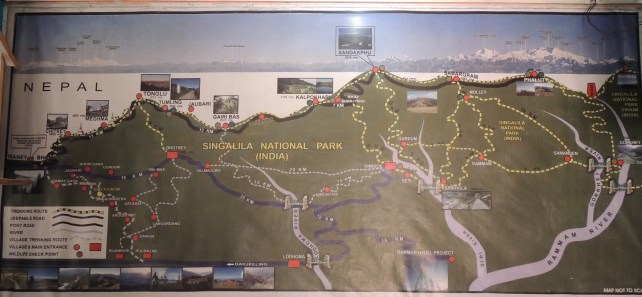
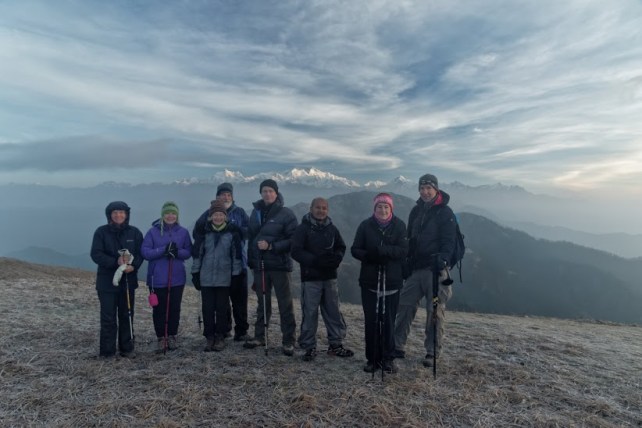
We set off mainly uphill for Sandakphu with lots of stops to look at the view and get our breath back. The sun shines occasionally as we walk up the rough track. We stop at the guard post to the Singalila National Park for a group photo and have a cup of tea in the snack chalet before going to our camp site for lunch.


It is a lovely setting in a bowl with stunning views from the rim. Janet sits and talks with Mary whilst Graham sketches. We are now on the ridge and although views are still limited by cloud we are getting more excited about being in the mountains. Gradually the mist clears and the horsemen light a fire. We stand around the fire keeping warm until dinner time. Sanjeev talks about the team and tips and extra money. We keep warm.
After dinner we all play Uno until it is time to go to bed. The ground and tents are frozen hard, thank goodness for hot water bottles.
Day 9
We wake up at 5.30 to find the tents stiff with the heaviest frost yet. Graham gets everyone up as the sky is clear; there is just a thin moon.


We go up to the high point on the ridge and watch the sunrise on the Everest (8848m) group of mountains : Changtse (7560m); Khumbutse (6665m); Nuptse (7861m); Lhotse (8516m); and our own Kangchenjunga at 8586 metres the third highest mountain in the world. Fantastically the lads bring tea up so we can drink and watch, this added to our overall excitement.


We eventually drag ourselves away to have breakfast which we eat in the sunshine in the open air the dining tent no longer being needed.


That day we walk along a lovely path which gently undulates for 21 km with spectacular views to Phalut further along the ridge. However it is hard going up any sort of slope because of the altitude. We stop at a tea house to eat our lunch and have a cup of tea. From here the ridge is narrow with steep drops either side.


There is quite a lot of up and down but we make it to Phalut by 4pm and have a welcome cup of tea. The campsite is high on a hill with lovely views but the mist is down! The Phalut tea house has inside accommodation and 2 inside toilets! There is an eating and cooking area which we use which provides shelter and warmth before another freezing night. We are in bed in the tents by 8.pm.
Day 10
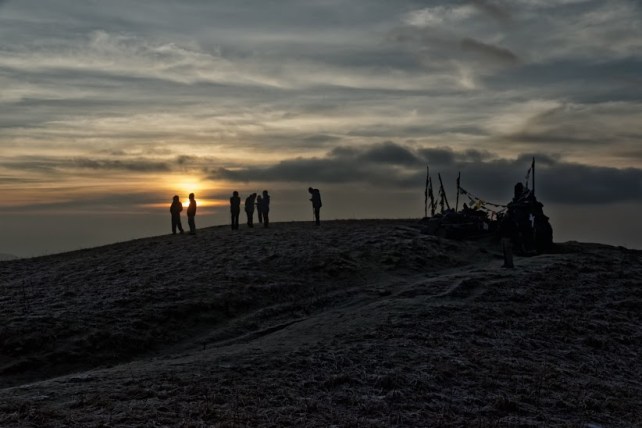
Wake up at 5am to a very cold and thick frost. We climb the hill for another fantastic sunrise over ‘our mountains’. A few dozen others who are staying at the lodge are with us.
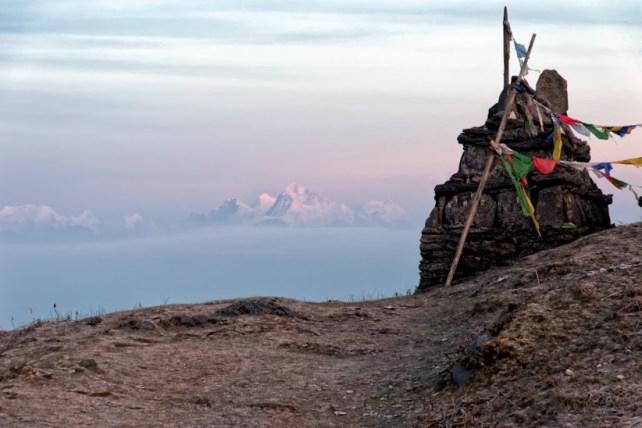
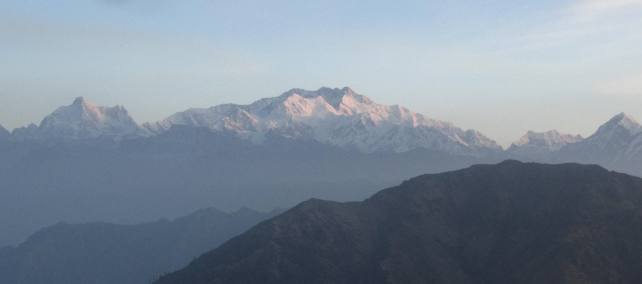
Kangchenjunga from Phalut looks just like a sleeping Budda.
After breakfast we descend into the warmth and sunshine of the valley leading back towards Rimbik. We go down a pleasant downhill path gradually passing from rough pasture to high bamboo forest, to giant pine trees, birch and then oak to shrubs like Photina, Berberis, Pyracantha and lots of Rhododendrons and Camelia’.


It is a delightful walk passing through settlements where garlands are being made for Diwali before ending down by the river at Gorky where the lads bring us hot pineapple juice. It is a lovely river with deep pools which would be ideal for swimming in.


We climb up to the village of Samanden situated on a small plateau where we will be staying at the Forest Home Stay Camp site. We have lunch and potter around relaxing outside our tents and Graham sketches.


The children are very interested and once Graham starts painting 3 boys and 2 girls join him and paint in his sketch pad. The boys soon leave and more girls come and stay on, getting very excited painting pictures of their houses and writing their names before going on to visit everyone’s tent !
We go for a walk with Mary around the village stopping at the local tea house which runs our campsite. Here they show us how their house is decorated outside with coloured patterns using cow dung and earth pigments. The village extends over a large area with groupings of buildings around tea houses and farms. A lot of the villagers are picking, making and hanging marigold garlands for Diwali.


In the evening the family at the tea house invite us back to sit by their stove. A hollow concrete structure in the corner of the room with a place for twigs to burn, two burner holes the hotter in the middle and a bowl shape where embers can be put for further cooking. The horsemen join us in the shop drinking millet beer whilst we eat popcorn cooked on the fire.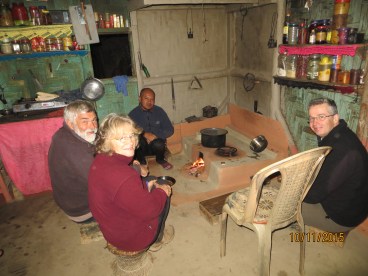
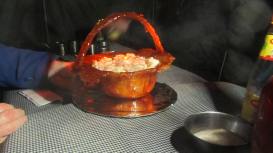
We have dinner finished off with an amazing toffee basket containing fruit salad which Ganesh has produced from his camp kitchen before playing Uno.
It was not quite as cold as the previous nights so we sleep alright until the dogs start barking around 3.00.
Day 11 – Diwali
We awake to sunshine, tea in bed and a bowl of hot water that we can really use now it is not freezing, Luxury! After breakfast we are invited back to the Tea House where they are celebrating Diwali. The granddaughter and her mum are dressed in their best clothes and we are welcomed with a bindi and a flower each. In exchange we give the girl a gift and sit with the family for a photograph.


We then get on our way following the track through the forest from Samanden down to the river then up to the village of Ramman. It is in the woods before the village that we spot a family of Macaque monkeys high up in the trees that are exciting to watch. In the village we stop at a tea house which has a lovely view across to Sikkim.


Onwards contouring the valley we pass by houses where many people are busy getting ready for the Diwali celebrations, sweeping, polishing lamps and making garlands as well cleaning. At one place they were drying black cardamoms.


We go steeply down to Shrikhola to another tea house where the lads make lunch before we cross the river on a rope slung bridge that takes us onto a ‘proper road’ that leads us into Rimbik. Along the way houses are decorated with garlands of flowers and clay oil lights are set out on surfaces outside. Again people are cleaning, lots of houses are decorated with fairy lights and everybody is preparing their houses for the celebrations tonight.


Entering Rimbik at the end of the trek it was a revelation to find it is built high up on the hillside. When we were here five days ago it had been engulfed in mist. It is lovely experiencing the Diwali festive atmosphere. Back at camp we have tea and present the horsemen with some money before they depart. Once dark the Diwali celebrations are in full flow with small children setting off fireworks everywhere and anywhere in the Main Street. They are jumping over horizontal Catherine Wheels, lighting crackers with loud bangs, sparklers and golden fountains are being held in small hands, a Health and Safety nightmare!


All the shops are open and have clay pot oil lamps burning outside. Women are dressed up and there is a real source of excitement. Rob and Graham sneak off to buy some fireworks which they let off with some of the local children. After supper we wander up the Main Street with Dave, Rob, Mary. Things are quieter, the shops are shutting but people are still around and we talk to a couple who had come back home with their children from Perth, Australia. There are groups of girls singing ‘carols’ at people houses a tradition of this part of West Bengal. It is great to be the only tourists in a town celebrating Diwali.
We negotiate a room in the Green Hill Hotel so that we can sort and shower before our return train journey. The room is very basic with limited hot water but it does give us space. We feel guilty as the others are camping but they will have a posh hotel the following night in the Sikkim capital Gangtok.
Day 12
We are surprised when we awoke at 6.00 am to have the lads at our room door with tea and then after we have showered with bowls of hot water!! Following breakfast and after a bit of hanging around we all present the cook, assistant cook, kitchens helpers with white silk scarves and their tips.
We say goodbye to our fellow trekkers and wave their mini bus off before getting into a taxi for our journey to Siliguri and New Jalpaiguri station. It feels strange without them. We stop for lunch at a Tourist Lodge in Kurseong a dire experience making us miss the lads and their simple food. What is really a shock is the poor food, slow service and white tour guides leading white tour parties.


Back in the taxi there is no low cloud so we get stunning views coming down from the Darjeeling hills to the plain. The driver takes as long as he can to get to Siliguri as we are so early. The city is manic but he picks up a guide who waits with us and a ‘ mixture of humanity’ at the station for the four hours until our train arrives!


The guide gets us onto the sleeper to Kolkata albeit in the wrong berth. We soon find our right berth which is only double bunks rather than the triple we had had previously. There is a girl and her mother being settled in by uniformed guards! It later transpires we are spending the night with the wife of the head of Bangladesh railway security and his daughter.
Day 13
We sleep well on the train and do not wake until 6.30 am. We watch out of the window during our arrival into Kolkata which takes about an hour and a half. There are lots of people on platforms, standing in the open doorways of moving trains and then jumping off. People are using the railway lines like roads completing their journey to the station on foot when the train stops at a signal.
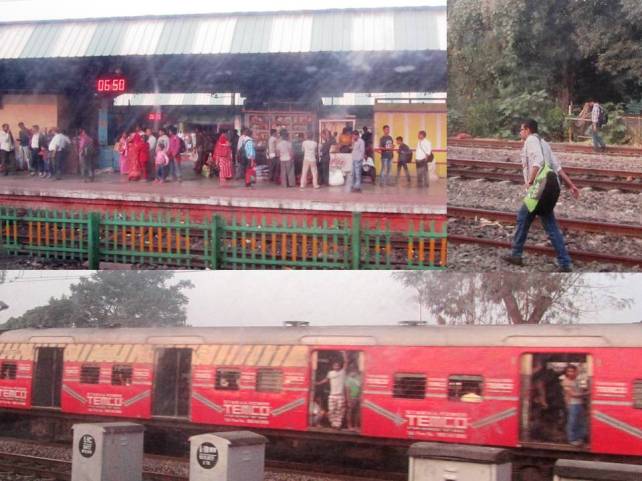
At 8am we are met by our guide as we step off the train. He has a car waiting for us to get us out of the chaos of the station to the hotel. Our room at least has a window and is clean but has not much else going for it. We sort out some very dirty washing for the laundry. Shamefully we return to Au Bon Pain for a cinnamon bun and ‘real’ coffee! We spend the morning walking through the crowded streets past numerous small ‘on the road’ shops and workshops to the flower market and over the Howrah Bridge, the busiest bridge in the world! It is packed with crowds of people many carrying large loads on their heads.


On the other side we find a ferry that brings us back across the river giving us a different perspective on the city. We try to hire a rickshaw back to our hotel but the skinny old men who pull them are not interested in taking us. We return on foot to the Blue Sky cafe for lunch and phone Leon to wish him Happy Birthday, 10 years old!!


In the afternoon we take a scary ride in a tuk tuk to the Park Street cemetery.
This is an amazingly tranquil area in the middle of this manic city with its tall trees, crumbling mausoleums, obelisks and graves; many are British people who had been in Calcutta at the end of the 18th century and beginning of the 19th century. It is noticeable that many of the women died in their early 20s and 30s and many babies did not survive.


We walk to the Oxford bookshop and buy books and have a civilised cup of tea before having a meal in the Fairlawn Hotel. As we return to the hotel that night we come across the Thoburn Methodist Church where 2 girls and a man, alone in the church, are singing ‘Abide With Me’. It is lovely to hear these voices in amongst the babble of the hectic street life of this amazing city.
 World Wide Webbs