2023 Our Balkan Trilogy
Bosnia, Croatia and Montenegro
Our 2023 Summer Holiday
Wednesday 21st June – Home to Beauvechain

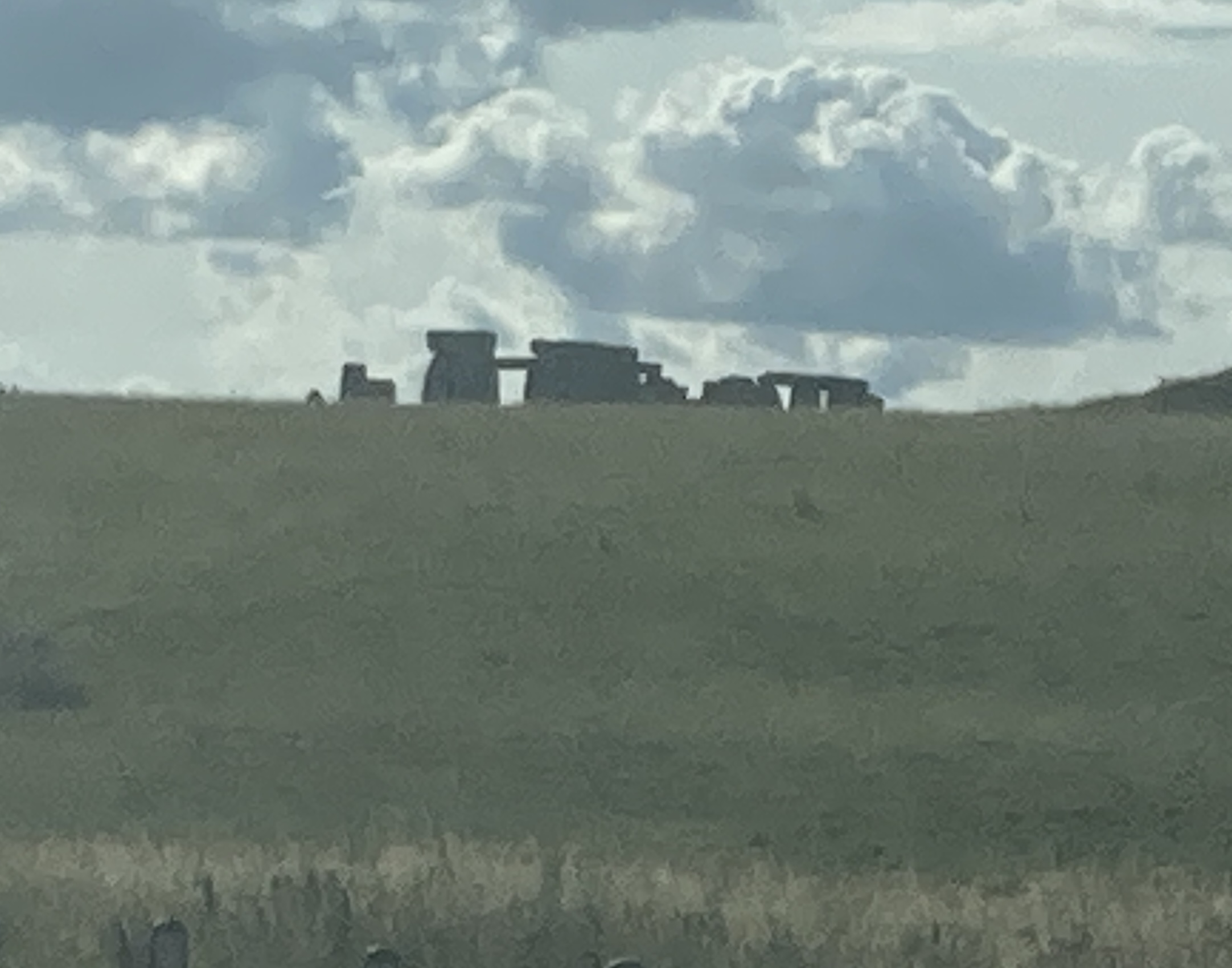
We were up at 6am on the road by. 6.45am passing Stonehenge which considering it was the summer solstice was remarkably quiet. We stopped for breakfast at Greggs just beyond Stonehenge.
We arrived at Dover around 1.20 and managed to get on the 2 0’clock ferry. We spent the journey planning where to spend the night as we could go further than camping by the canal.
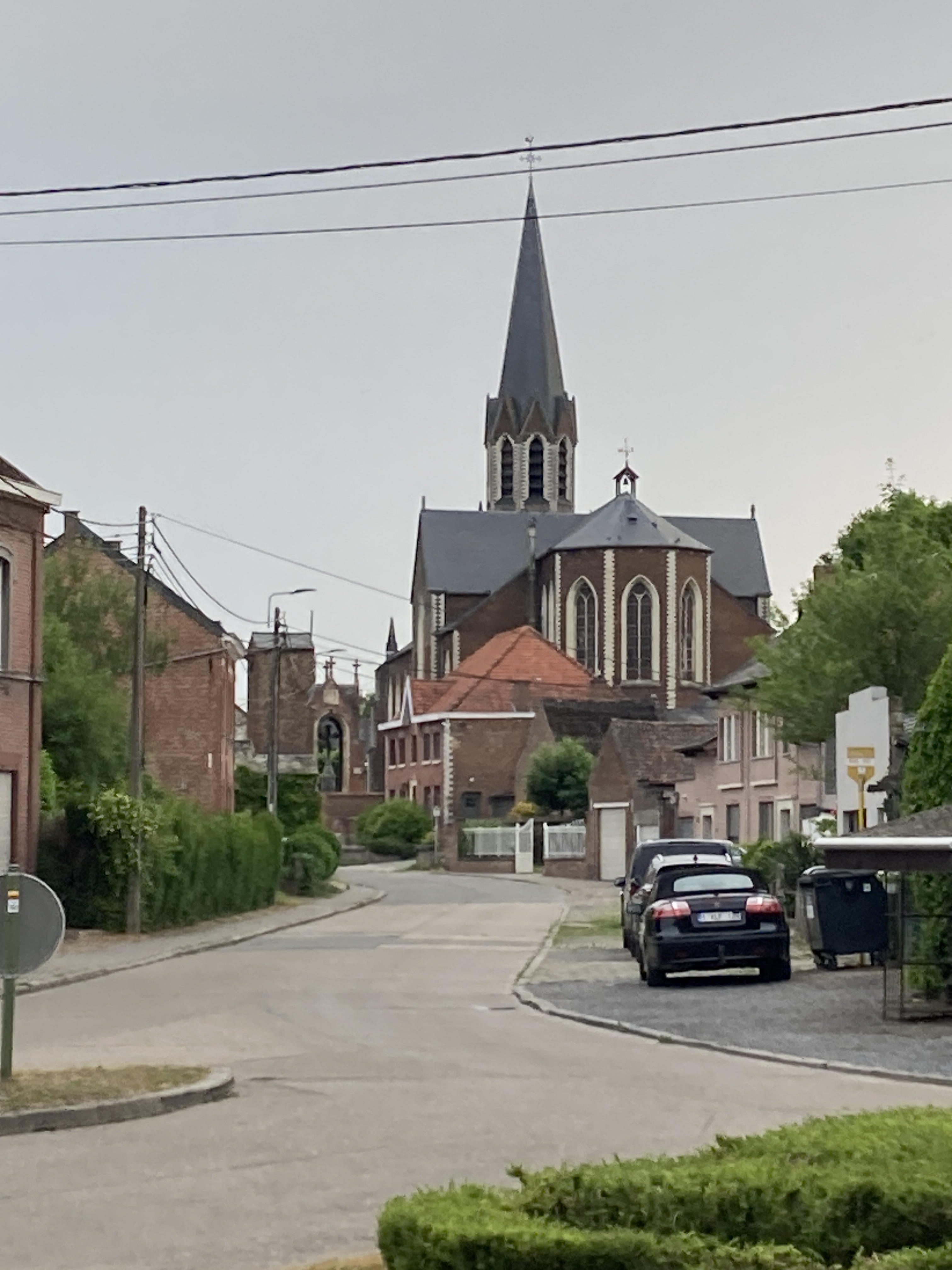
So off the ferry on time and headed for Brussels, just east of it we turned south to the village Beauvechain.
Here we located the grassed, treed car park with a designated camping car space where we parked the van.
We then headed back on foot to the busy restaurant, Le Renaissance, by the church where we ate outside overlooking the village with the locals chattering around us, which was lovely. We then wandered around the village before settling for the night with the roof up and toilet inside. Absolutely fine, a perfect night’s rest.
Thursday 22nd June – Beauvechain to Regensburg

We woke early and sorted ourselves out and were on the road by 7.45.The first stop were the services on the autoroute for toilet and coffee and then a mammoth 8 hour journey on the autobahns; Aachen; Koln; Frankfurt and Nuremberg stopping for lunch by the river in Wurzberg.
We parked up by the River Main in the centre of town picnicking amongst a lot of near naked students enjoying the river in a temperature of 35* .
Around Nuremberg the yellow coiled engine warning light came on on the van and it slowed to safe engine mode so the revs were cut down slowing us to around 40m.p.h., not good when overtaking enormous lorries!
 Eventually we turned off the E3 and cut across country to the Campinggaststatte Distelhausen near the village of Pielenhofen on the river Naab. When we arrived we restarted the engine which cleared the warning light and got a pitch beside the river.
After a beer, a swim, and a bite to eat in temps in the high 20s we relaxed sitting under an oak tree watching the river to the rumble of thunder and spots of rain .
Friday 23rd June – Regensburg
Awoke to cloud and light rain that continued all day.
Graham swam and after a leisurely breakfast we cycled the 15 km into Regensburg.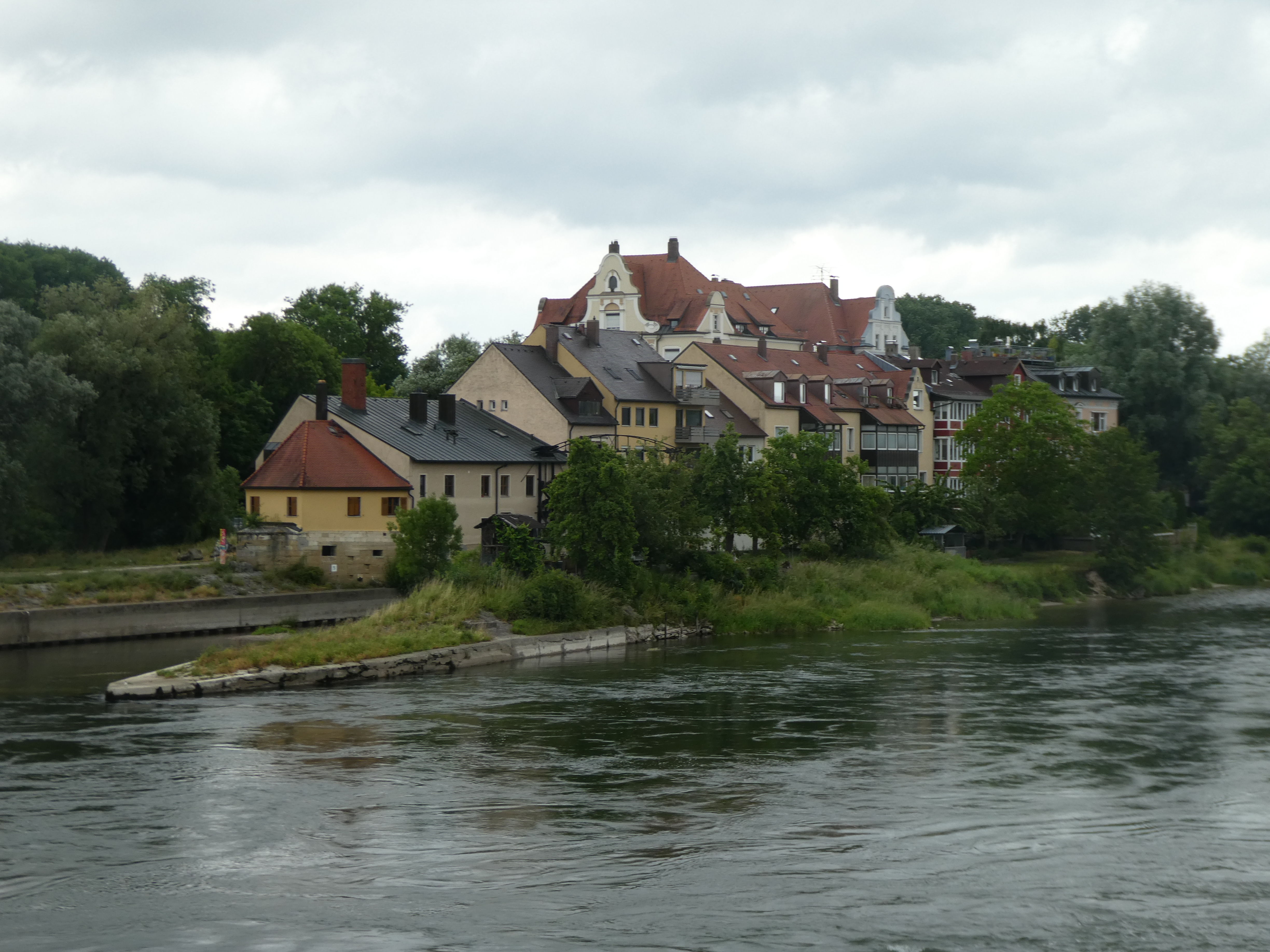
A lovely cycle path along the River Naab to its conjunction with the River Danube then following that into the City parking the bikes along the banks of the Danube.
The mediaeval centre of Regensburg is a World Heritage Site because of its well preserved architecture and its prominence as the largest mediaeval city north of the Aps.
 A Roman fortress was built in 179 and we saw the remains of the gateway the Porta Praetoria and the Roman wall.
After a coffee revival we went and walked across Steinern Bruckene, the first stone bridge to be built across the Danube east of Ulm. It also provided a strategic link to Stadtamhoff a competitor port on the other side of the river. The two ports pragmatically joined forces after the bridge was built.
As we walked around there were many examples of the old middle age merchant houses, they made their money from trading luxury goods from Venice and the Byzantium, furs from Russia and wine from Austria.


As we walked around there were many examples of the old middle age merchant houses, they made their money from trading luxury goods from Venice and the Byzantium, furs from Russia and wine from Austria.
There are also numerous stone towers that were patrician houses owned by the rich who then ruled different areas of the city in 14th and 15th centuries.
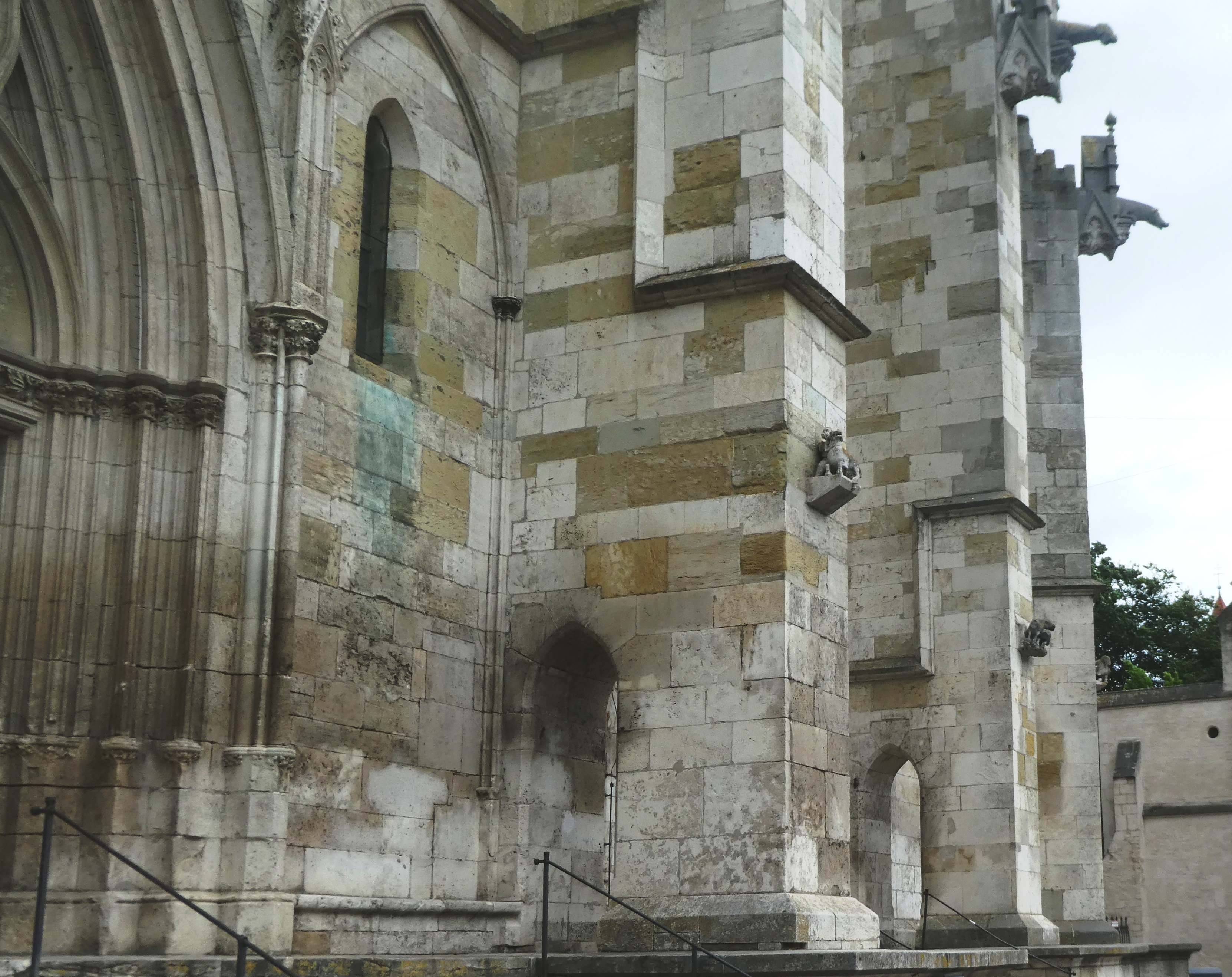
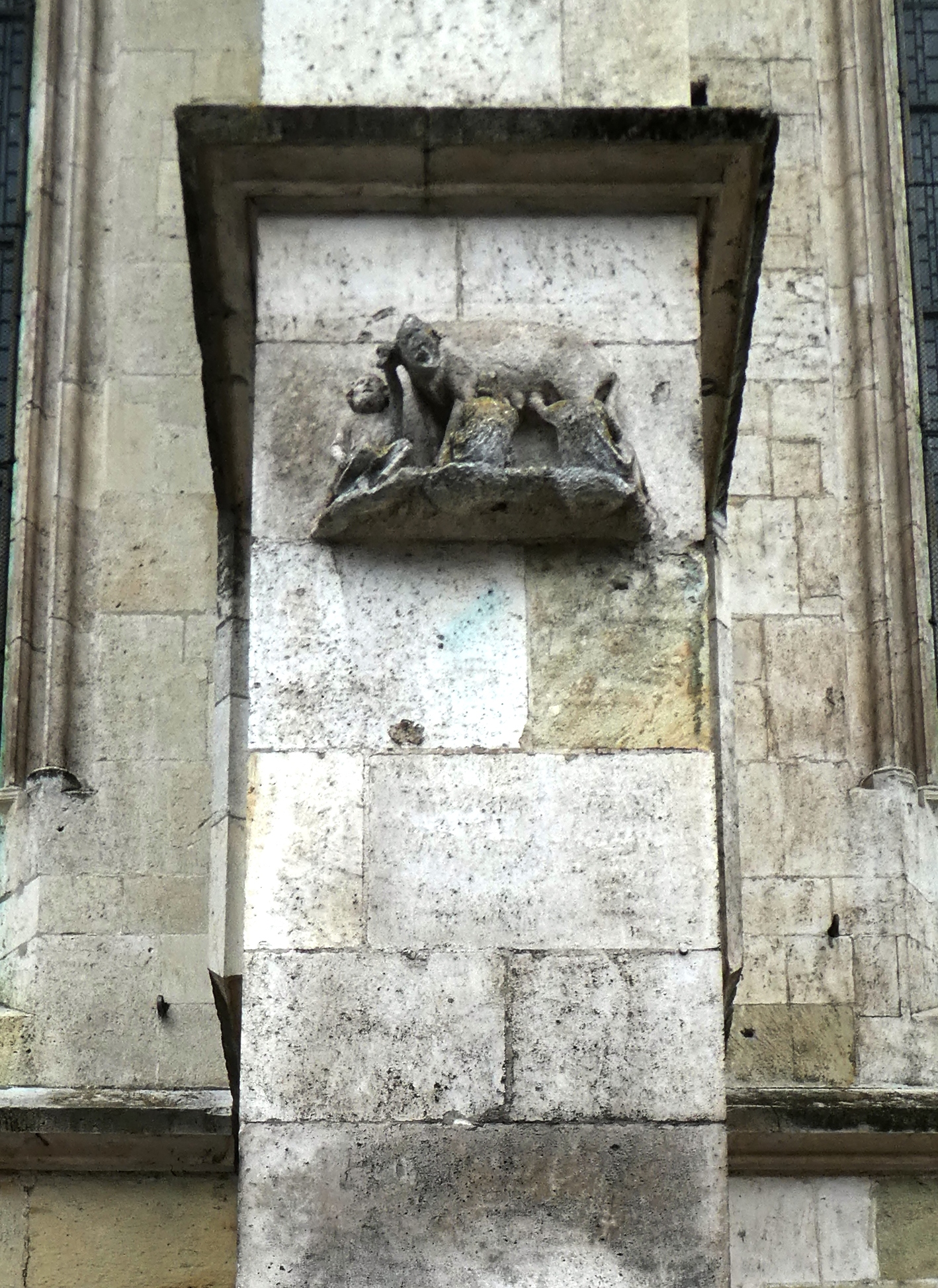 The dominant building built at the same time was the cathedral rebuilt in 1273. Its most noticeable feature are the sculptures of Judensau, depictions of Jews being suckled by a pig, which were placed on the side wall of the cathedral facing the Jewish Quarter.
In 2005 a sign was erected in German which merely stated that ‘the sculpture needs be seen in its historic context‘ , which is somewhat less than repentant. The outside was being repaired and inside it was very dark because the stained glass windows were made of extremely small panes of glass.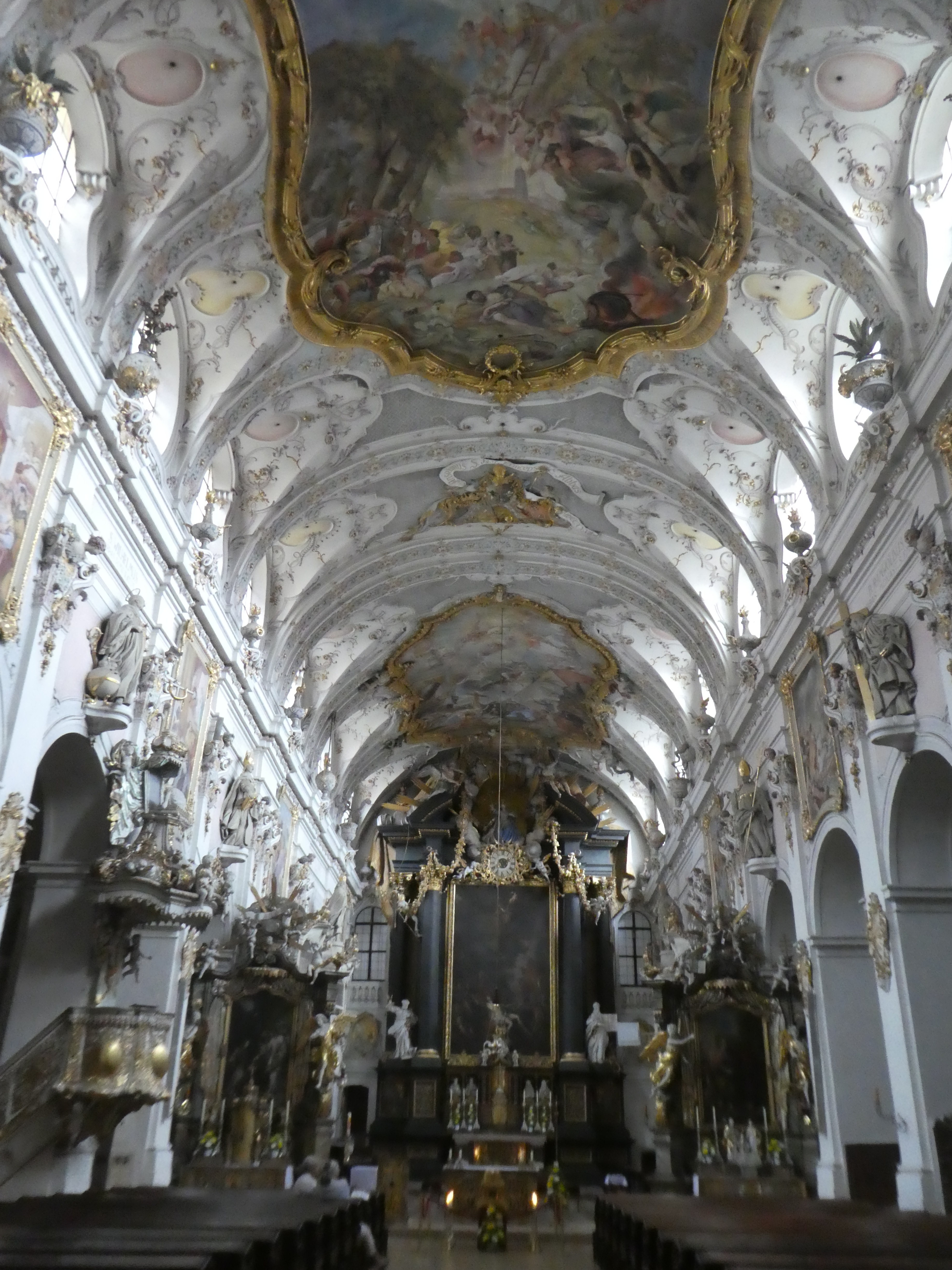
In contrast to the Byzantine St Emmeram’s church and crypt which contains the relics of Saint Wolfgang one of Germany’s three great saints.
The central nave of the church is particularly fine.
We went to the busy rather run down station and got a cable for this IPad and wandering back to the river we came across a busy restaurant called Hemingway. We both had lovely salads and admired the various black and white photos of the man.

We bought some food at a supermarket and managed to find a replacement rubber mat for the van the other we had left in the parking place in Beauvechain!, before returning to the campsite under thick grey cloud.
More people arrived and were huddled in coats, a real contrast to the night before!
A group near us were very loud and annoying so we walked into the village of Pielenhofen wandered around and walked back. Graham got out the bat detector, there was a lot of activity at 28khz frequency, and large bats were clearly seen circling over the river. We identified them as greater mouse-eared bats, extinct in the UK but found in central Europe.
Saturday 24th June – Regensburg to the Tyrol
We were up at 6am and had left the site just after 7.00 having filled up with water.
There were a lot of roads works on the route and traffic was heavy. At Munich we decided to follow the route through the centre of the city using the old ring road which worked well. We stopped at Kiefersfelen on the border and did some shopping, bought petrol, returned to motorway to buy a vignette only to find that we turned off the motorway system immediately and didn’t need it!
We were soon travelling through the mountains as we neared Matreil in Osttirol we went through a long tunnel which saw the weather change as on the other side there was blue sky and sun although it was very windy. We stopped in the town and ate burritos before heading down to Huber and up the Lesach valley to Burg and the National Park Camping site. We soon chose a pitch had a cup of tea and then wandered around the well-signed paths and trails.

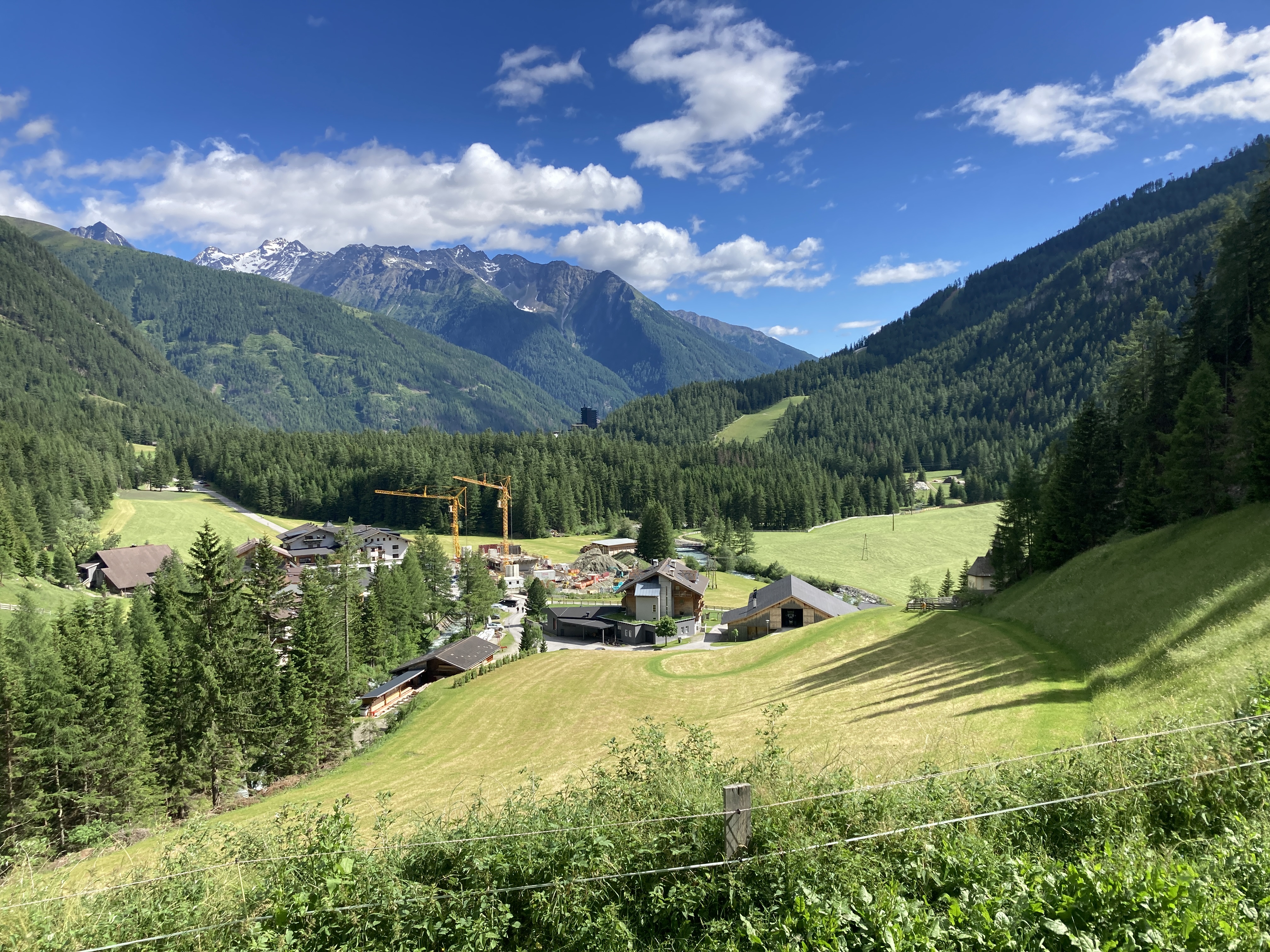
It was so nice to be back in proper Mountains again.
Sunday 25th June- Kals in Osttirol
Lovely to wake up to clear blue skies with the sun was shining on the van by 7am.
 A welcome shower and a leisurely breakfast, before a major clothing wash which we left to dry in the sunshine.
We walked from Burg up to Taurer following the Dorfer valley up to Dorfer See.
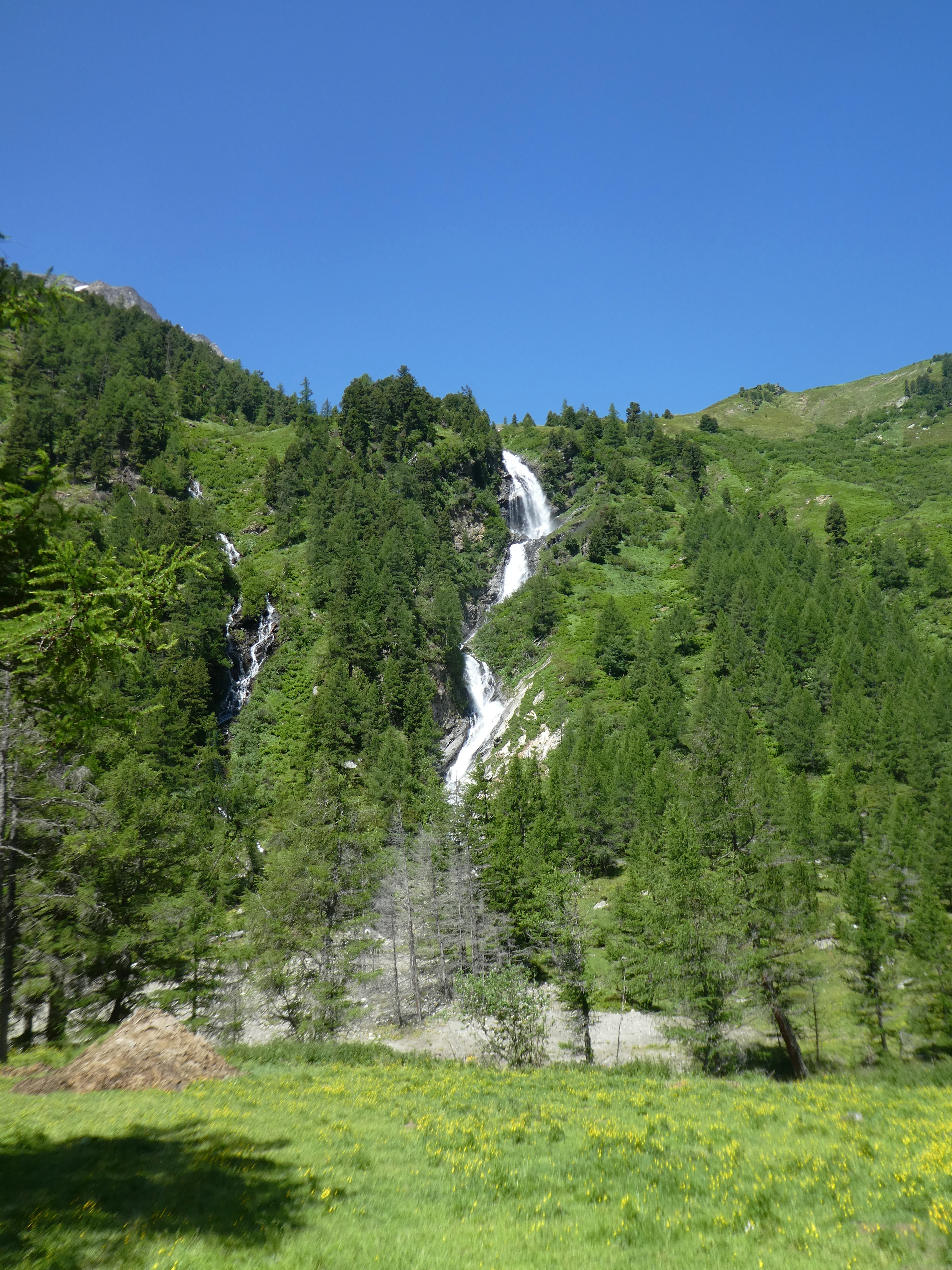
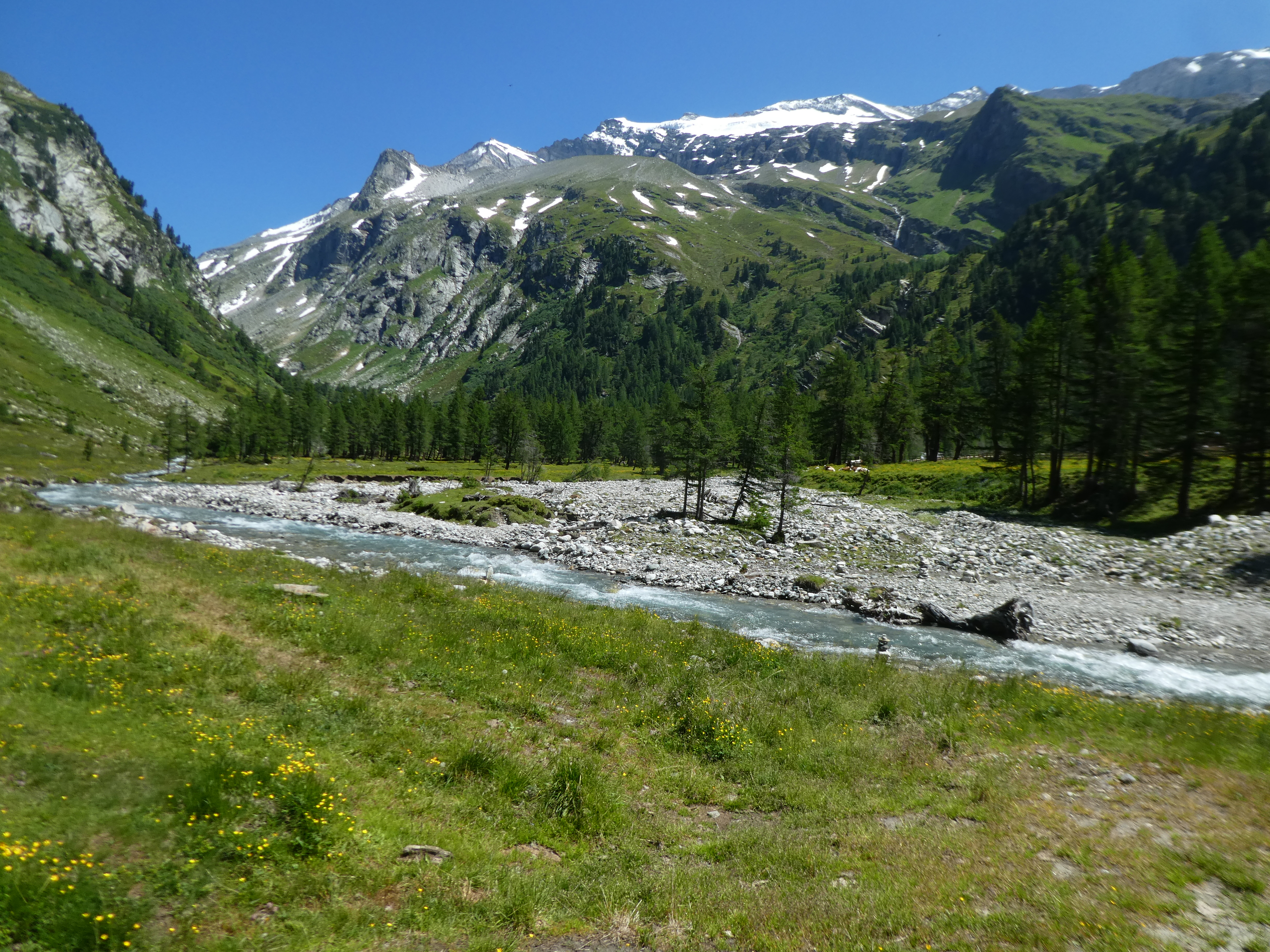

There were lots of flowers, lovely woods and towards the top the rocky path wound through small streams and lots of azaleas.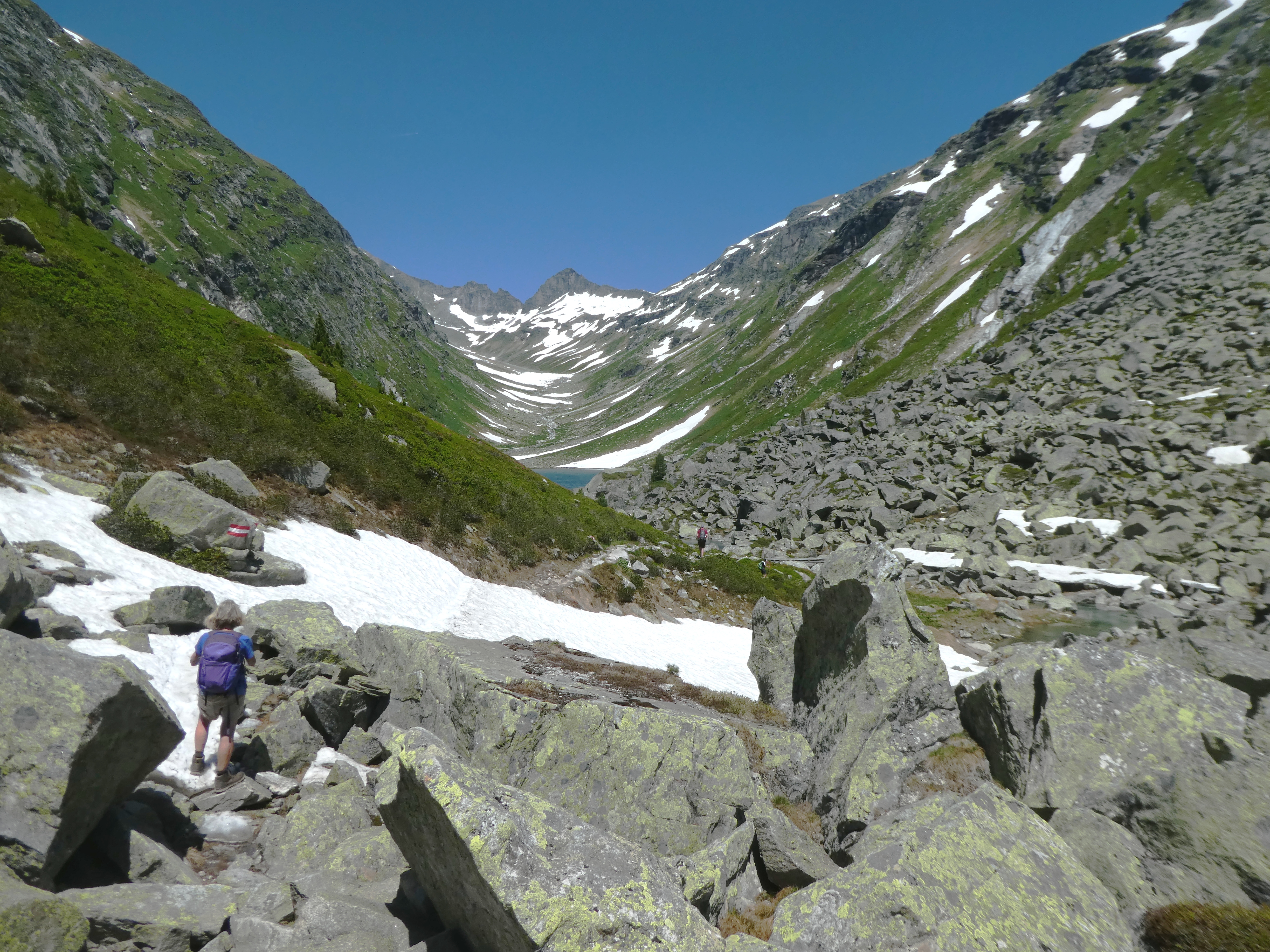
We had lunch sheltering from the wind in a nook overlooking the lake with the amazing mountains all around. Graham hesitated but then went for a skinny dip before we descended.
We had not realised how steep the path was in places on the way up.
We stopped at the Refuge Berger Alm. It had a cafe outside where we had coffee and Graham had apple strudel and Janet had an enormous ice cream.
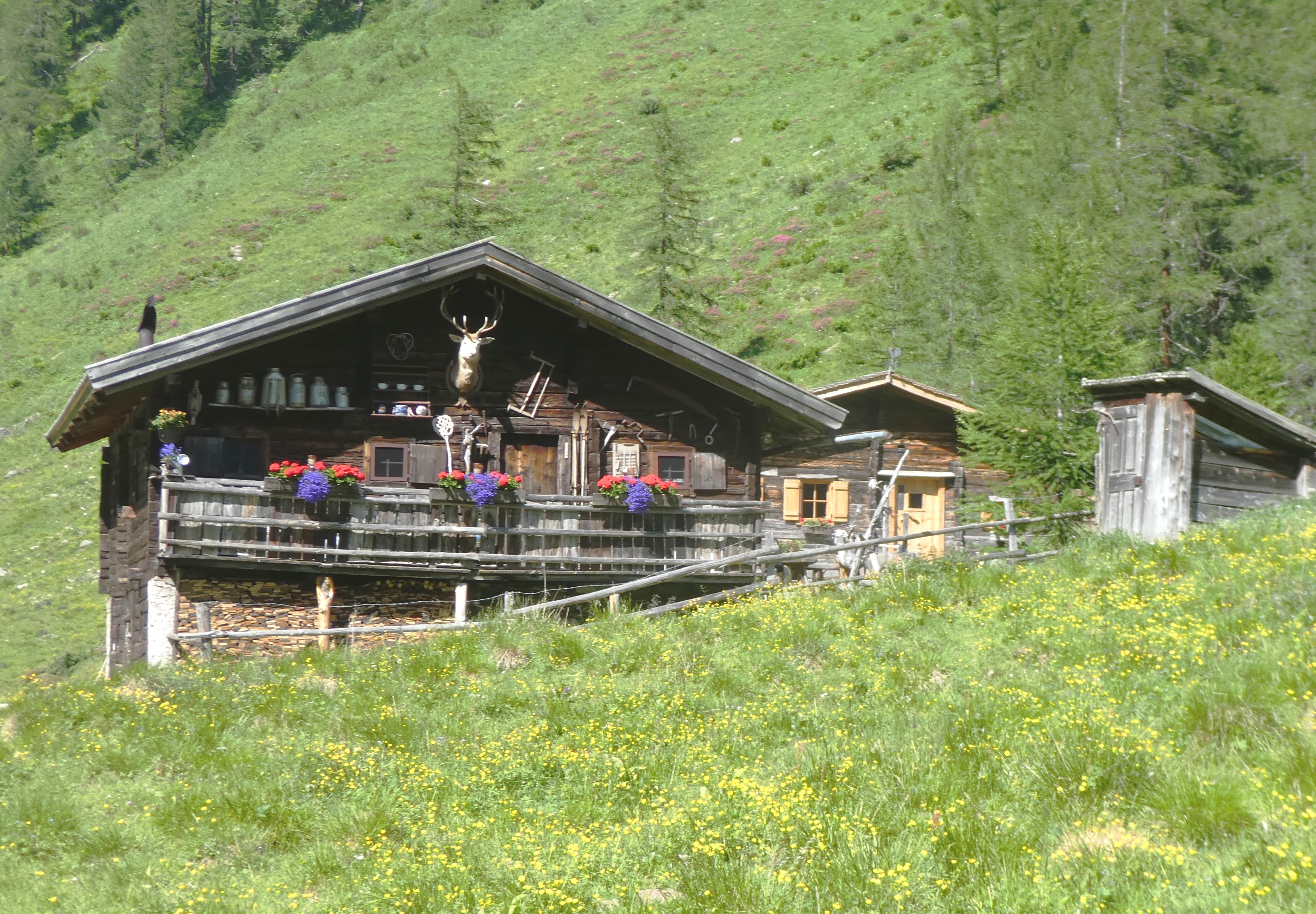
Back at the site we showered and pottered around until the sun went down and we retreated inside for a salad as it was too cold and windy to stay outside.
Monday 26th June – Kals in Osttirol
We awoke to blue sky with clouds. It had been a clear night sky with the plough at the forefront.
After a leisurely breakfast we set off to follow the circular walk around the circular walk-of the Kals valley.


From the camp site we walk up and join it as it contours around the eastern side of the valley to the Falsenkapelle a chapel built into the rock face.
It is lovely to start with, walking on the side of the valley through lovely woodland with so many different wild flowers.
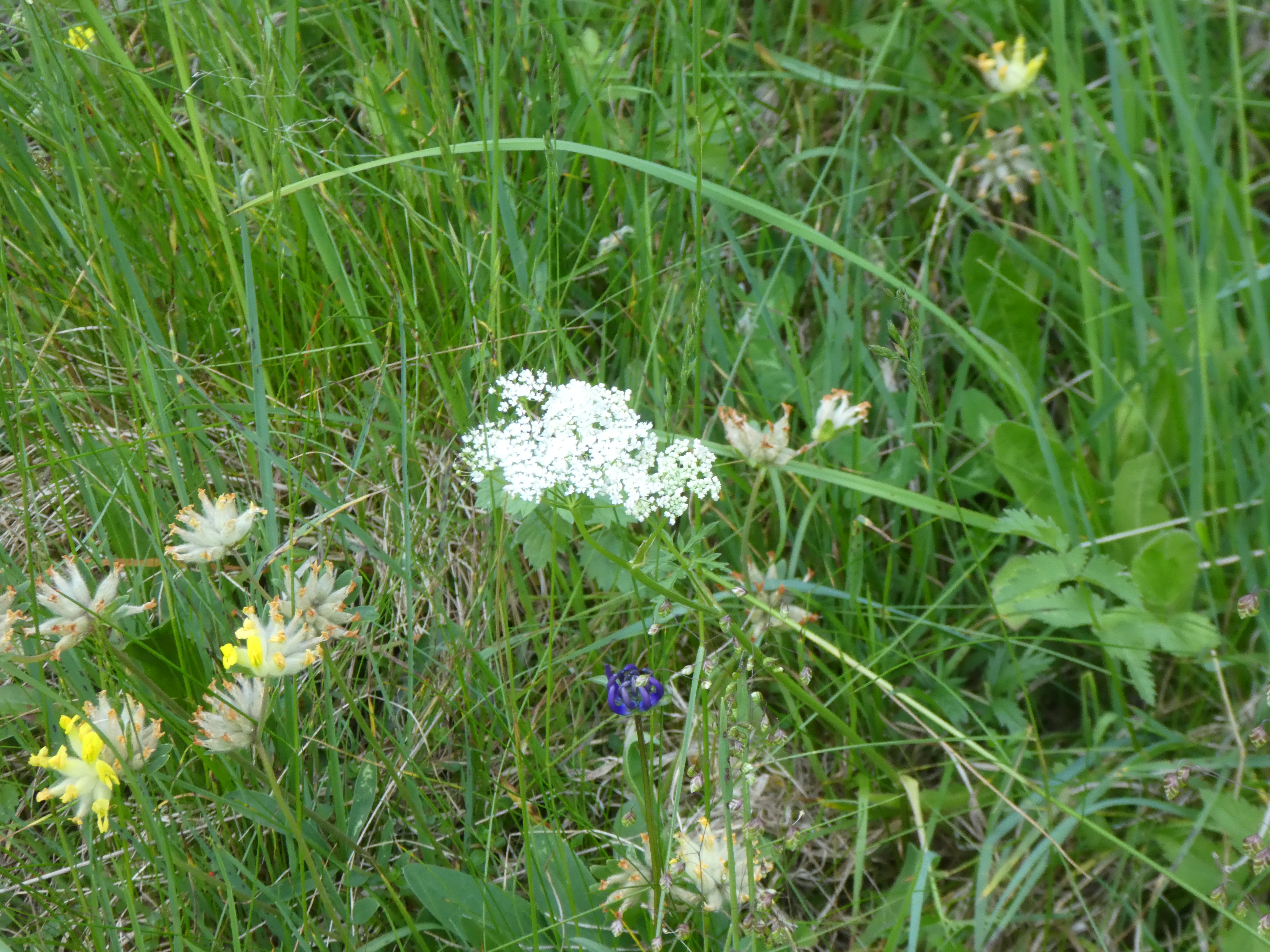

The path starts to rise slowly and as the side valleys get deeper we have to do some climbing. One valley is so deep that a wire suspension bridge is slung across the valley.
After crossing this the path carries on contouring through the forest as the main valley falls away below us. Several of the forest tracks are closed with diversions which on the whole we tend to ignore.

We haven’t bought any food with us and it is not easy to see how we can get down into the valley below us to find somewhere to eat. We eventually come out onto a road at Oberlesach which we follow down to a restaurant in the village of Lesach below us. Here we have trout and spinach dumplings nothing sensational but very welcome.
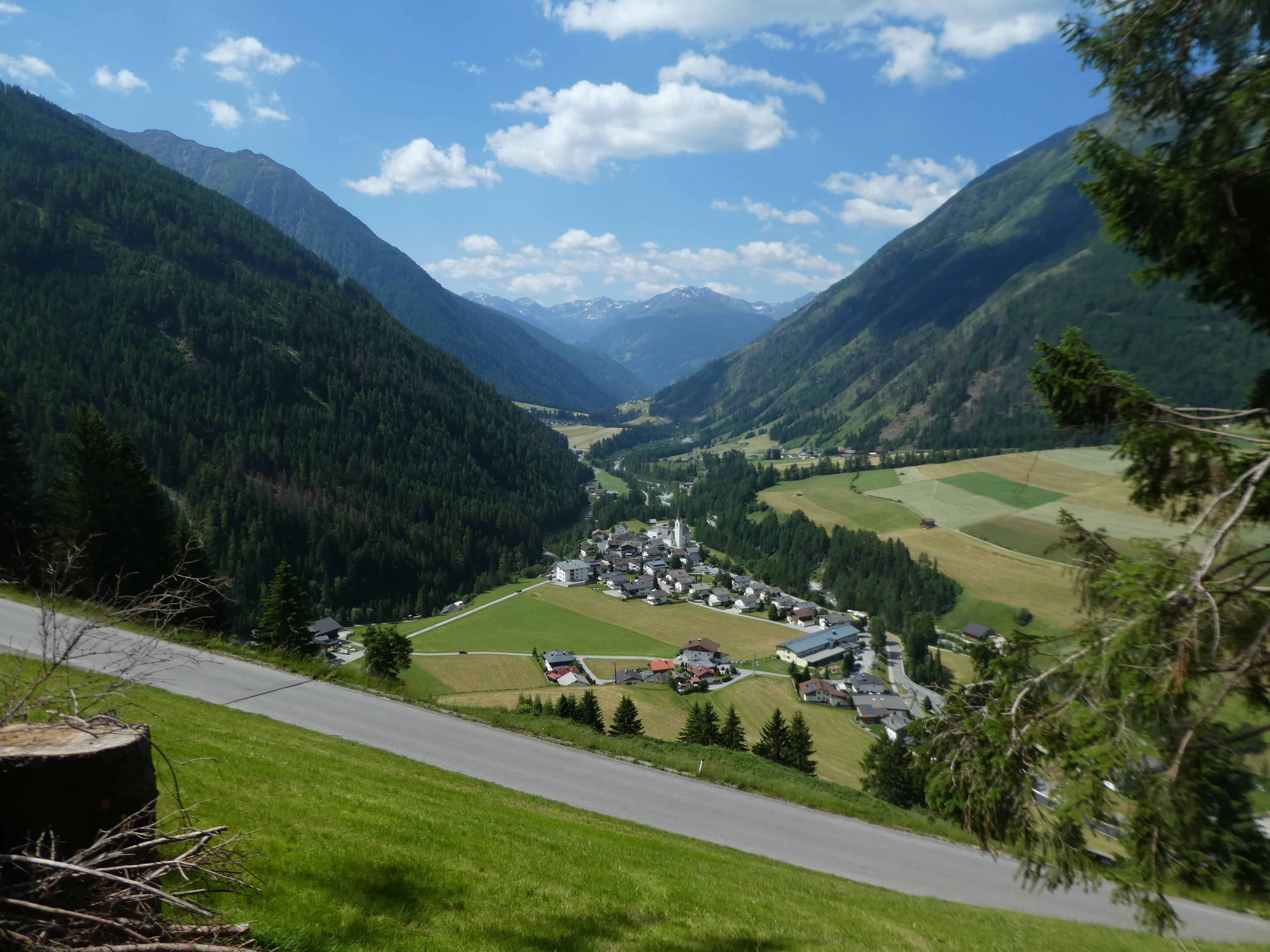
After lunch we carry on down to cross the river before making our way back up the valley side above Lana, Kals and Grossglockner. 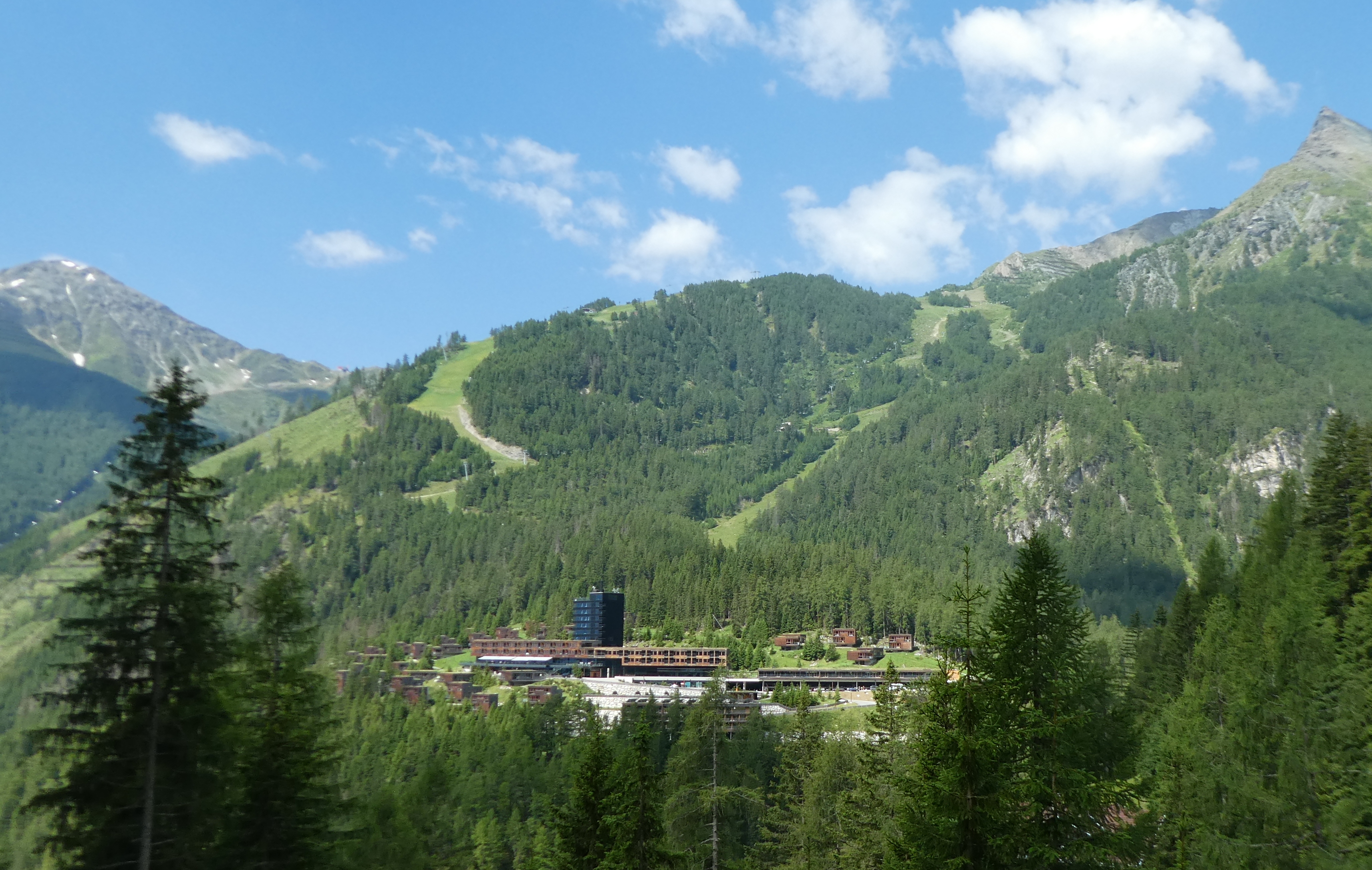
It was hot as we made our way back on the other side stopping at seats where they are provided beside the path providing wide views of the valley. We approach the Gradonna Mountain resort that looms over the woodland, the large hotel and chalets not well hidden amongst the trees.
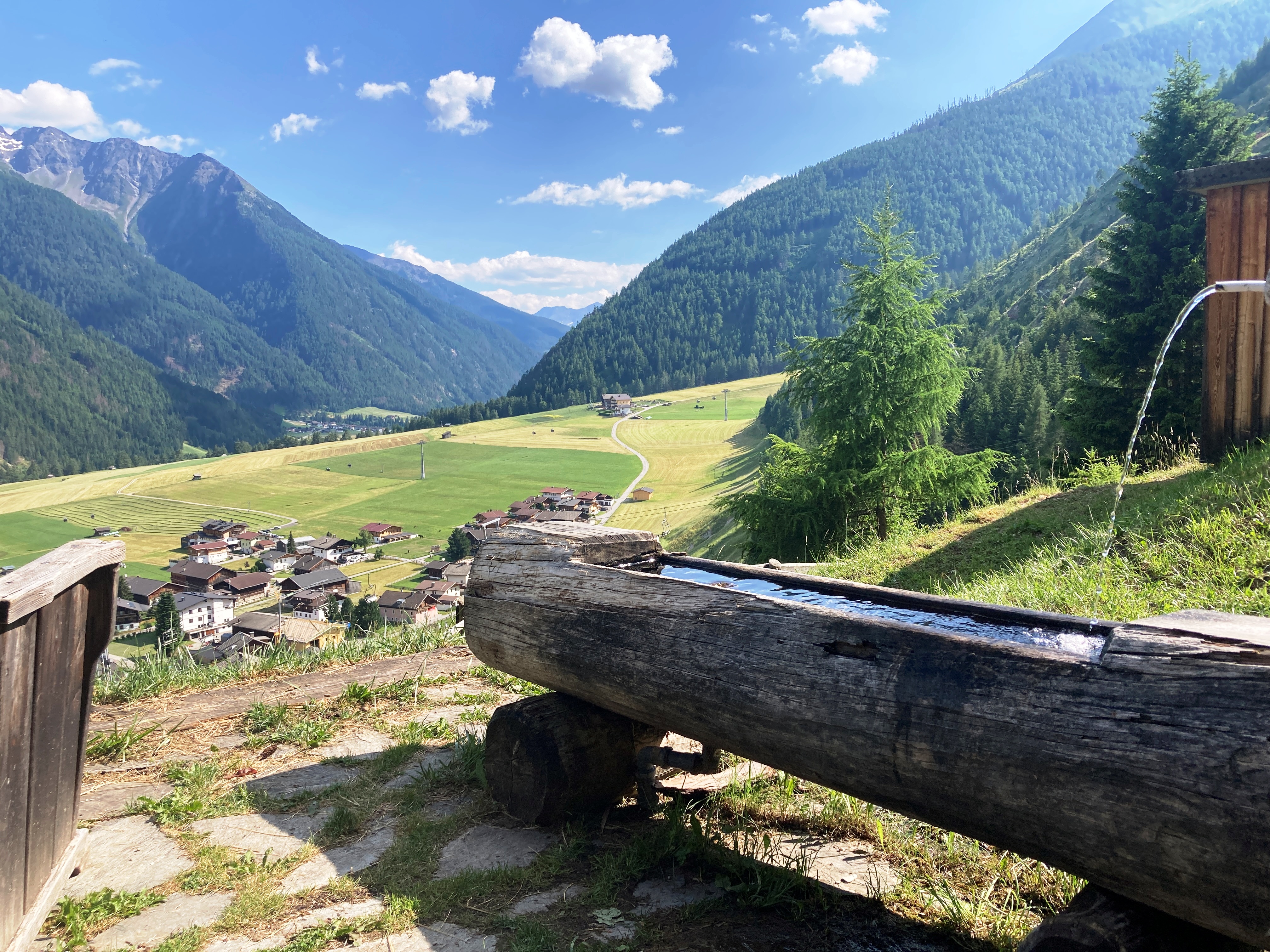
We stop at a seat with a water trough and a library box with interesting books about the area its history and culture showing the hard life the inhabitants had to endure when pastural agriculture was the only living to be had.
The view is lovely and it is cool. We are only a few hundred metres from the campsite, so it makes a nice end point for our walk.
Tuesday 27th June – Kals in Osttirol
Awoke to high clouds pottered Around and then caught the bus from Taurer to Lucknerhaus at 1. Here with a hotel etc there were a lots of cars and people milling around. We immediately found our path which went very steeply out of the valley.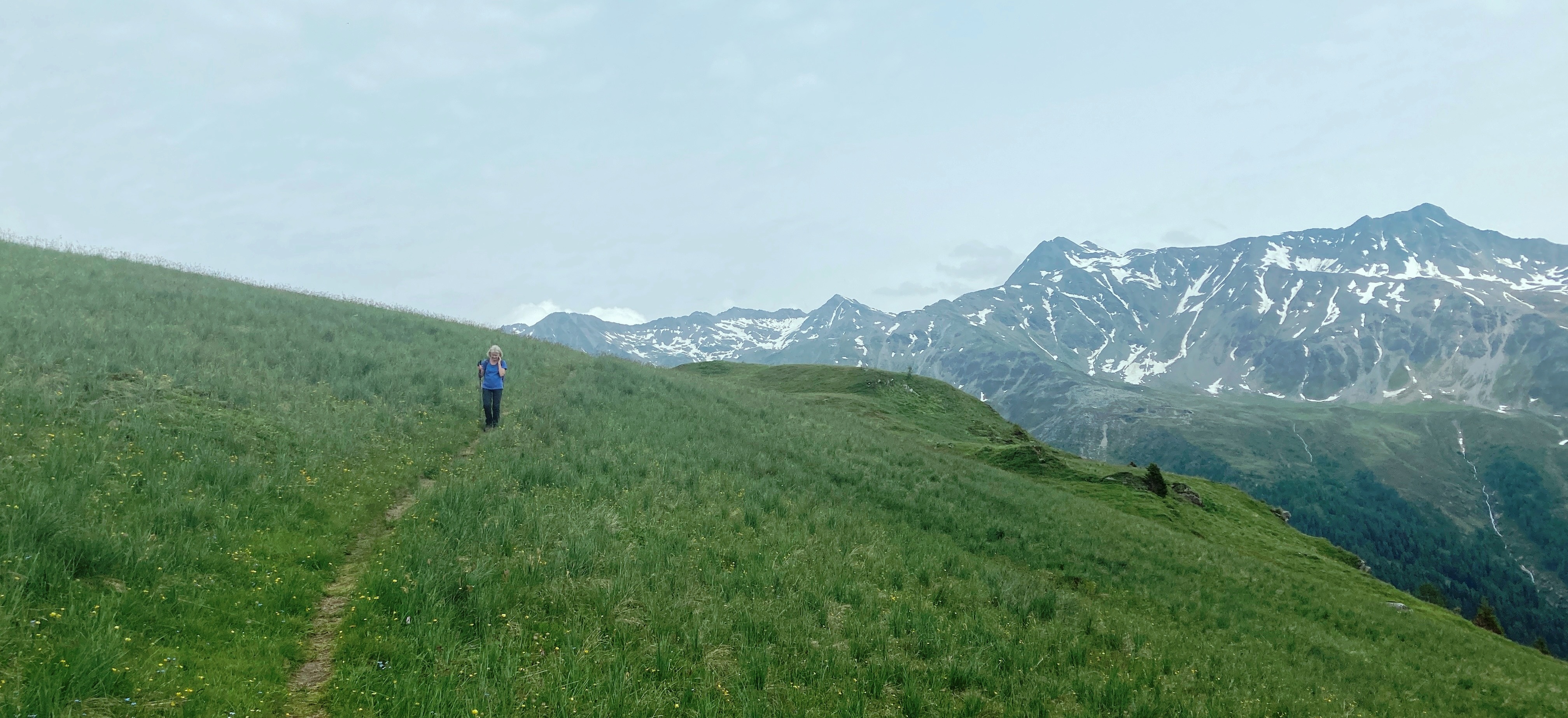
 There was a seat over the brow where we ate lunch and gave us time to recover from the climb.
We then continued through lovely meadows to a small grassy peak of Greibuhel 2,225 m high where we got a stamp!
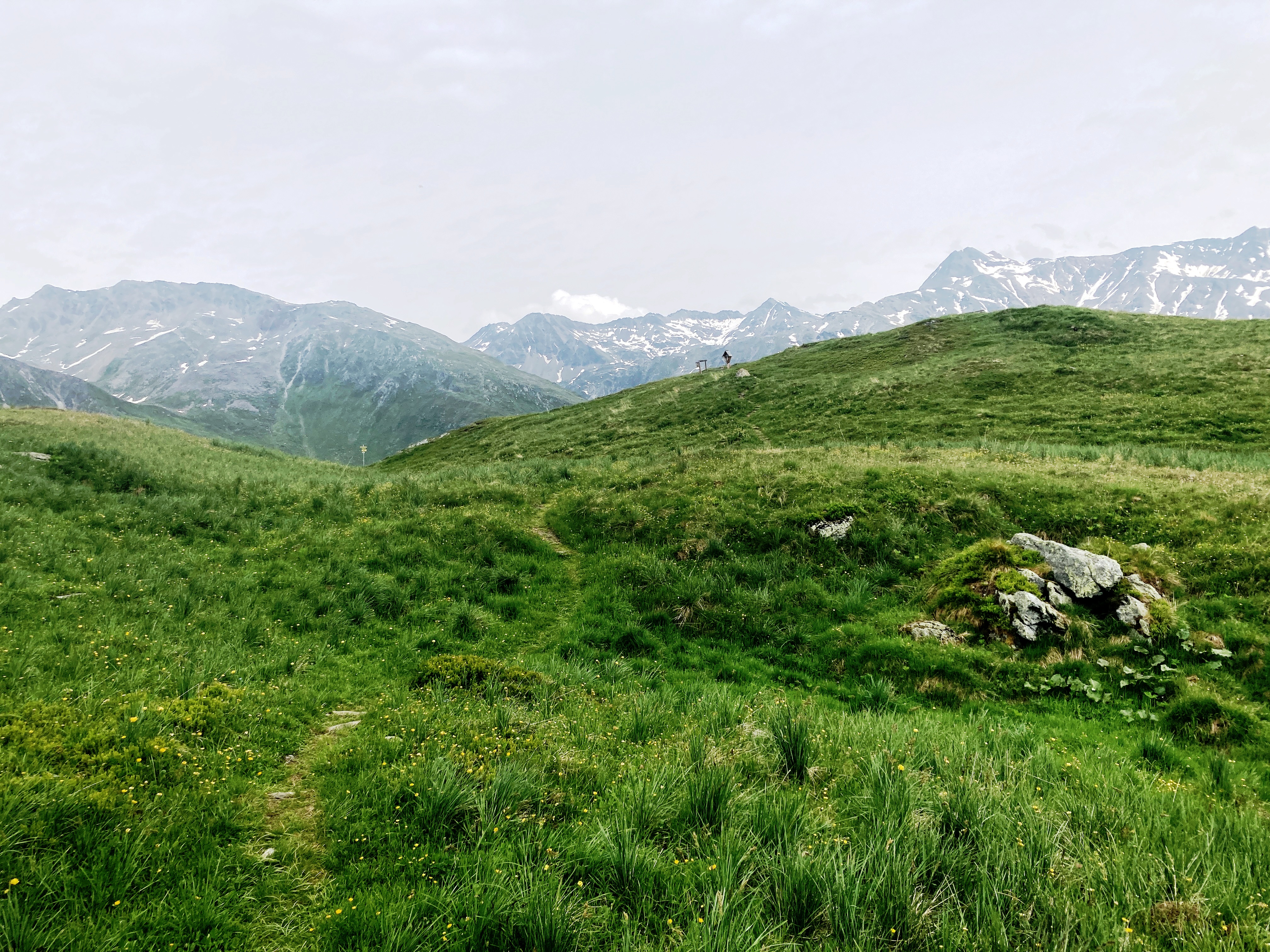
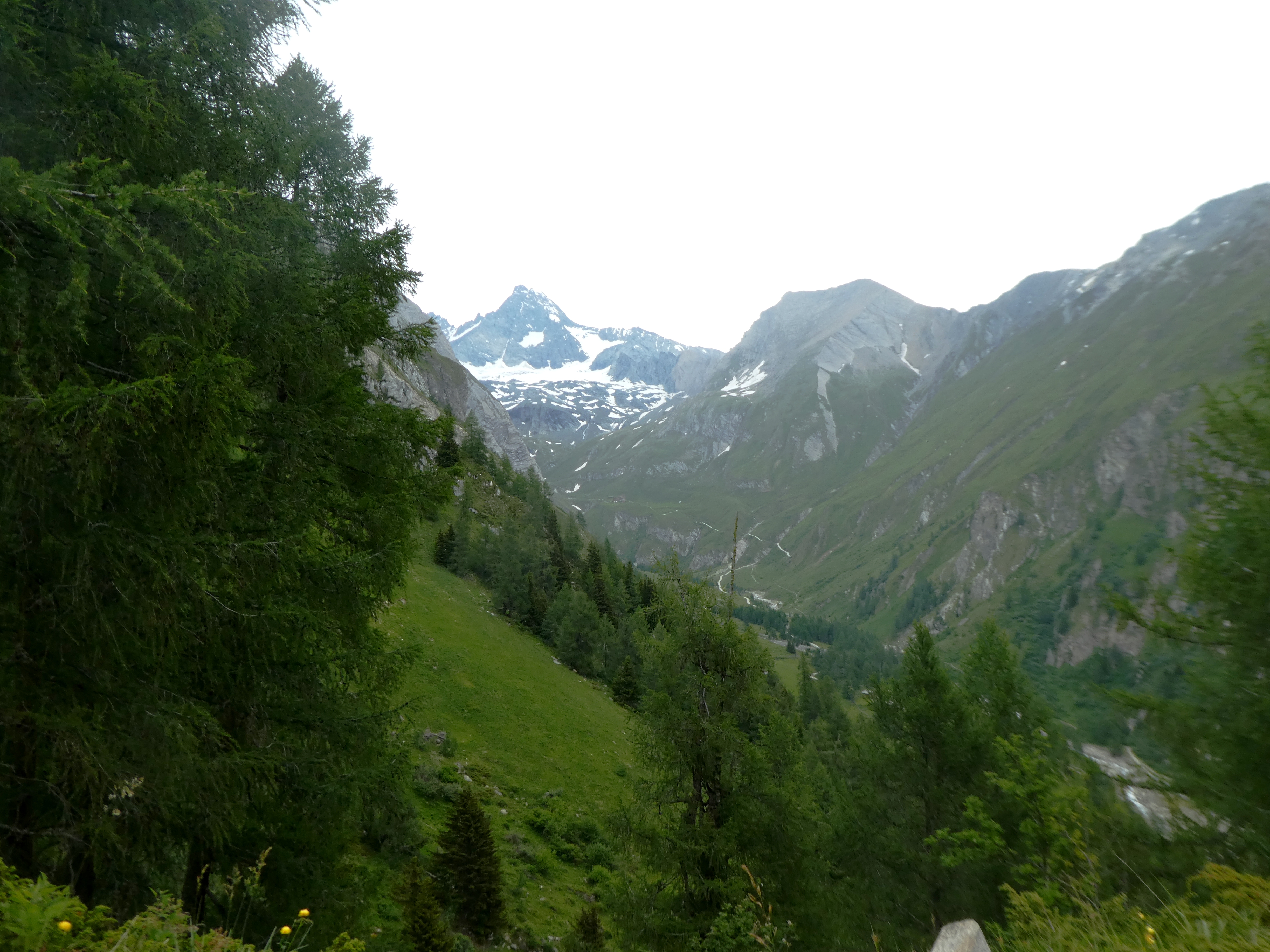
We then continued across meadows to the tree line on a narrow path through flower rich meadows.
Edelweiss, mountain arnica, Pasque flower, bellflower, golden hawkbeard, gentians, broad leaved marsh orchid, adenostyles (large green leaves with a spiky red flower just emerging), yellow monkshood, eye bright, cranesbill, bladder campion, clover and vetch.
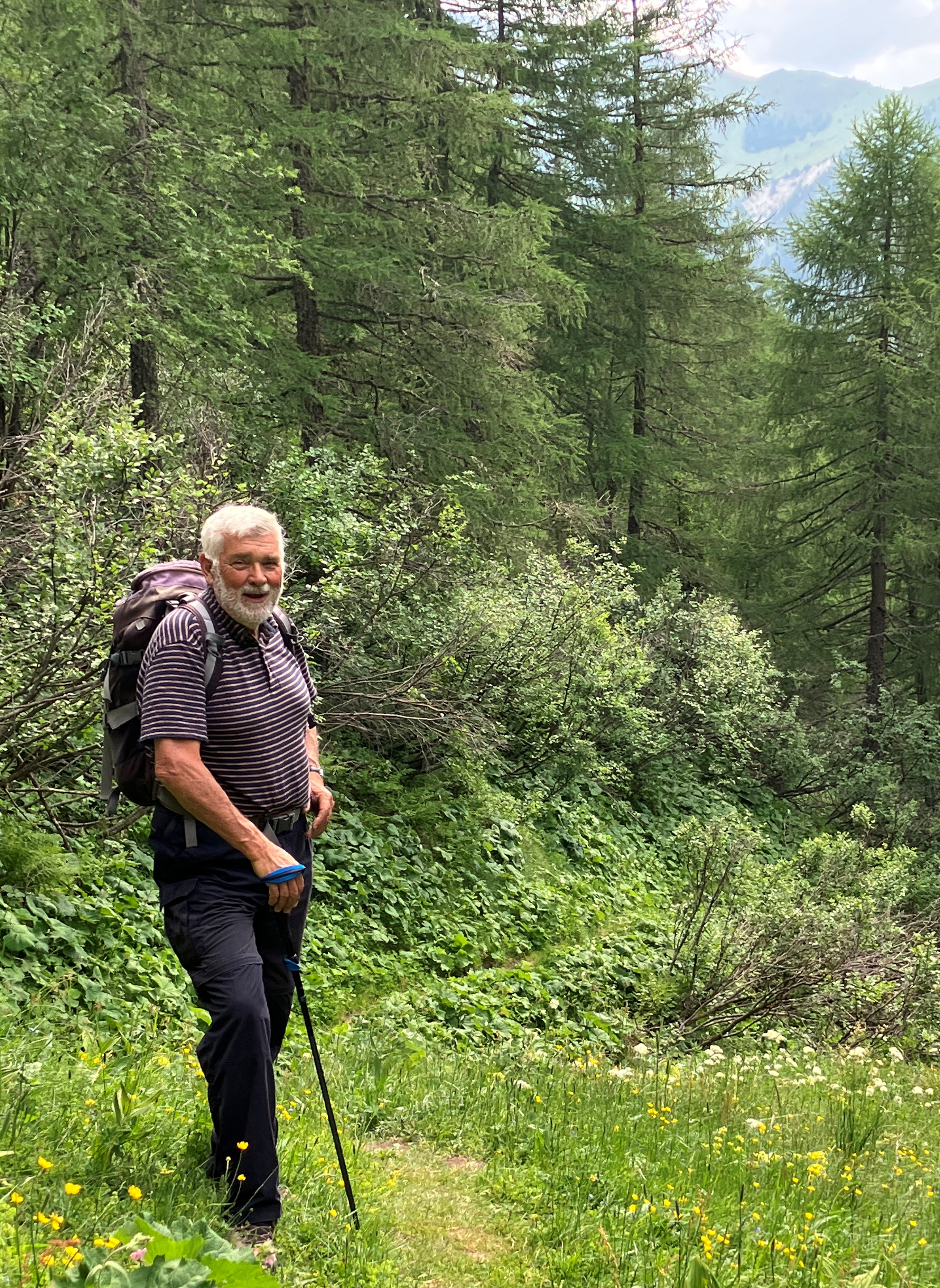
When we reach the tree line we descend steeply down a good zig zag path that passed forest tracks and huts.

We reach the bottom close to the Falsenkapelle we had seen yesterday and soon make our way back to the campsite. We rested with a beer before showering, eating and packing the van for an early departure in the morning.
Wednesday 28th June – Tyrol to Samobor
We had breakfast and left the site around 8.30.
We made our way down the valley to Huben where we joined the main road following the River Drava south to Lienz and on to Spittal then south on the autoroute to Villach.

We had previously booked a ticket through the long Karawanken Tunnel which took us through the mountains into Slovenia taking three hours off our journey.
We stop for coffee and a roll whilst travelling through Slovenia before crossing into Croatia at Bregana and travelling a few miles not to reach Camp Vugec on the outskirts of Samobor.
The camp site is in a garden-like space with a small swimming pool in the suburbs of Samobor at Hrastina Samoborska. The facilities were in an open single modern block which made changing to take a shower challenging.
No-one else was there and having spoken on the phone to the owner’s son we found a site for the van and enjoyed cooling off in the swimming pool. We rested with a few beers and a meal before cycling into Samobor.
A search on Google had found that Samobor was an old town with a significant history of its own despite its proximity to Zagreb. It had been declared a free royal town in 1242. It was a popular weekend resort for the citizens of Zagred who used the town as a gateway for cycling in the surrounding hills having been a tourist resort for hunters, anglers and hikers since 1810.

The road into the old town was flat but easy to navigate following a map from the camp site which showed us the route into the old town, about two kilometres away. It also indicated the route we would have to take tomorrow to cycle into Zagreb.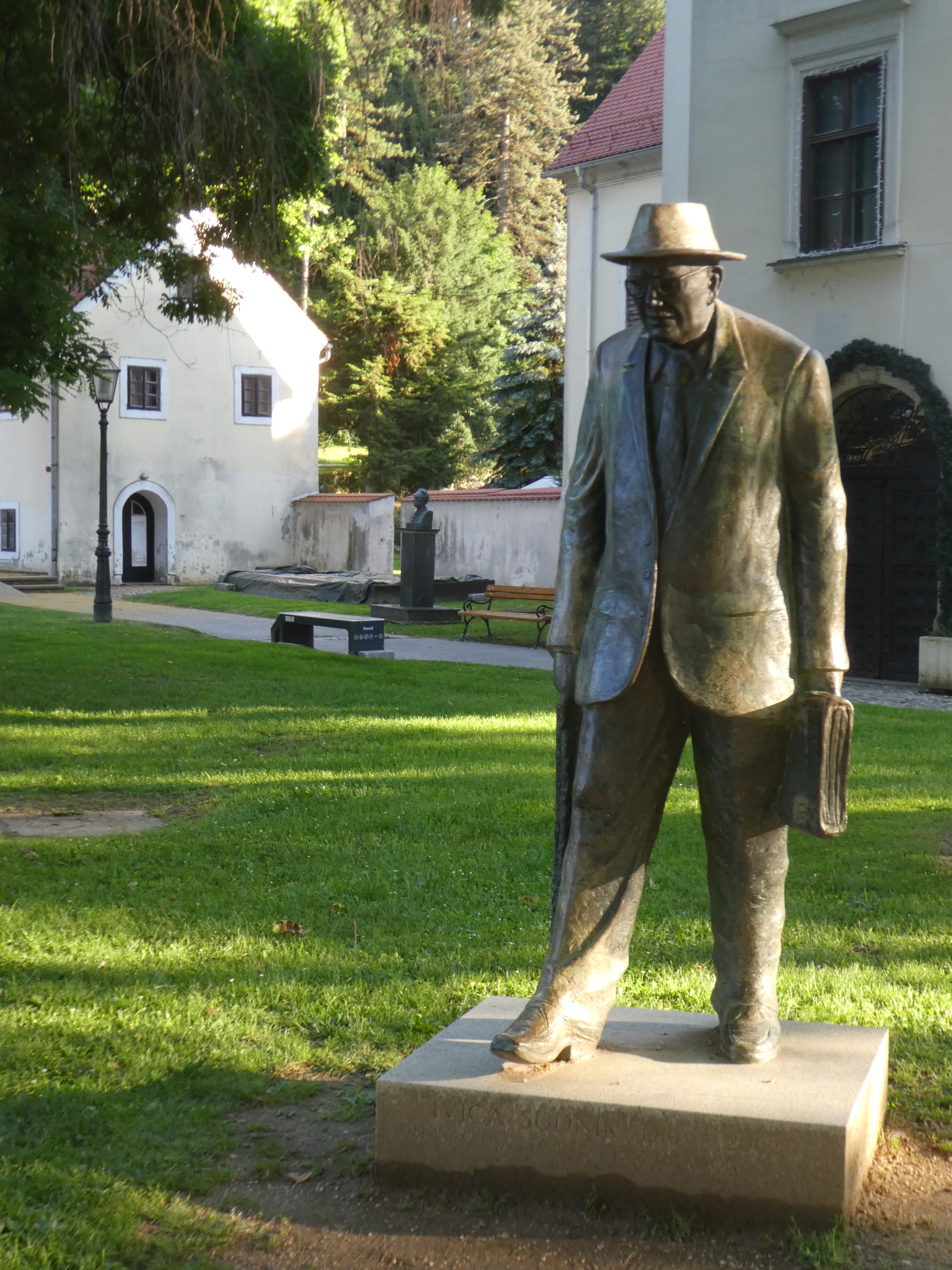
There was a real buzz in the centre whereas there were lots of people walking around the gardens around the canal and in the main square with its different old buildings lots of people sitting out eating and drinking.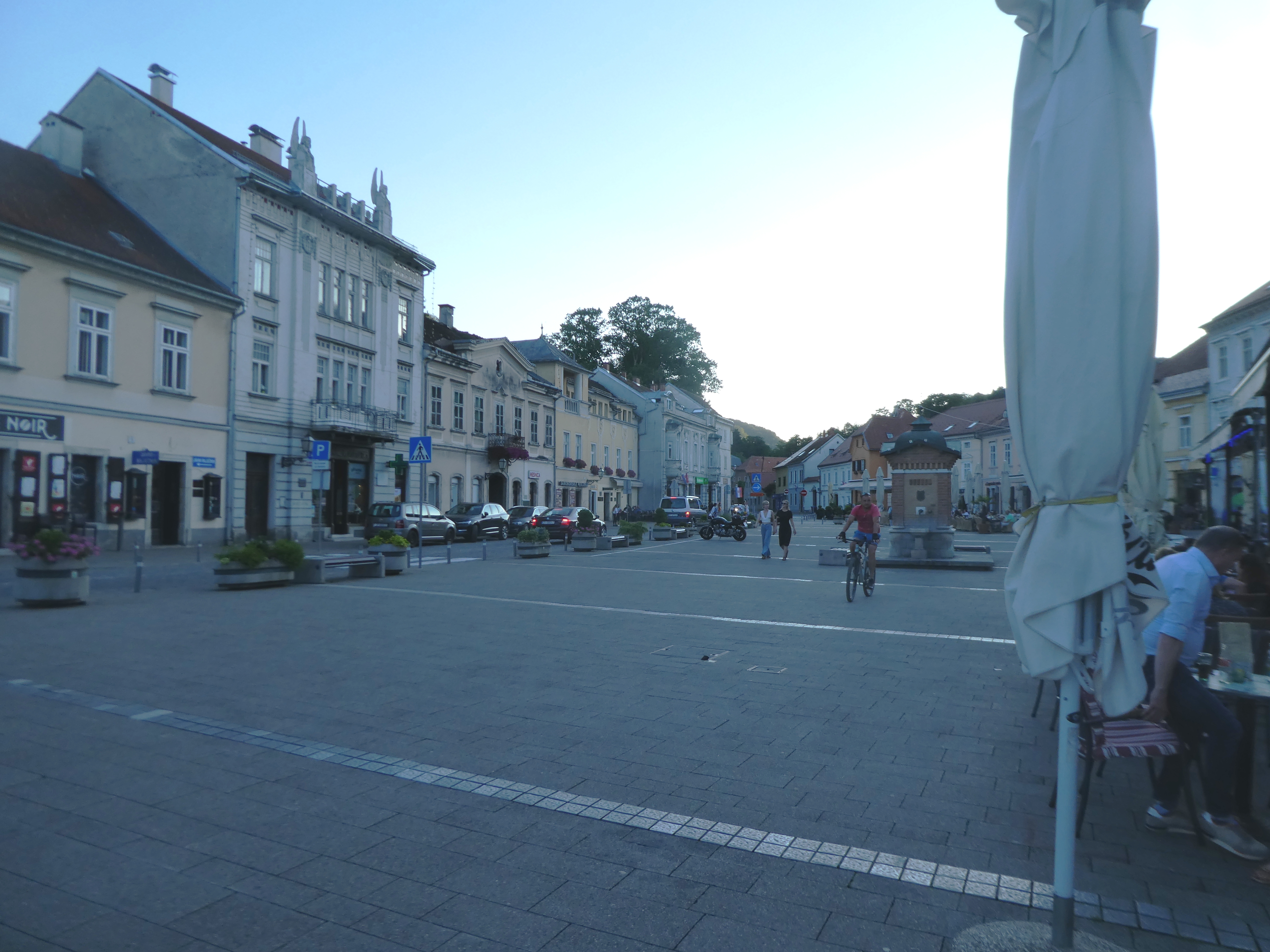
We enjoyed an ice cream whilst watching the life on the square. It was a really nice atmosphere and totally unexpected.
We made our way back to the camp site as it was growing dark as we thought it was just a suburb of Zagreb.
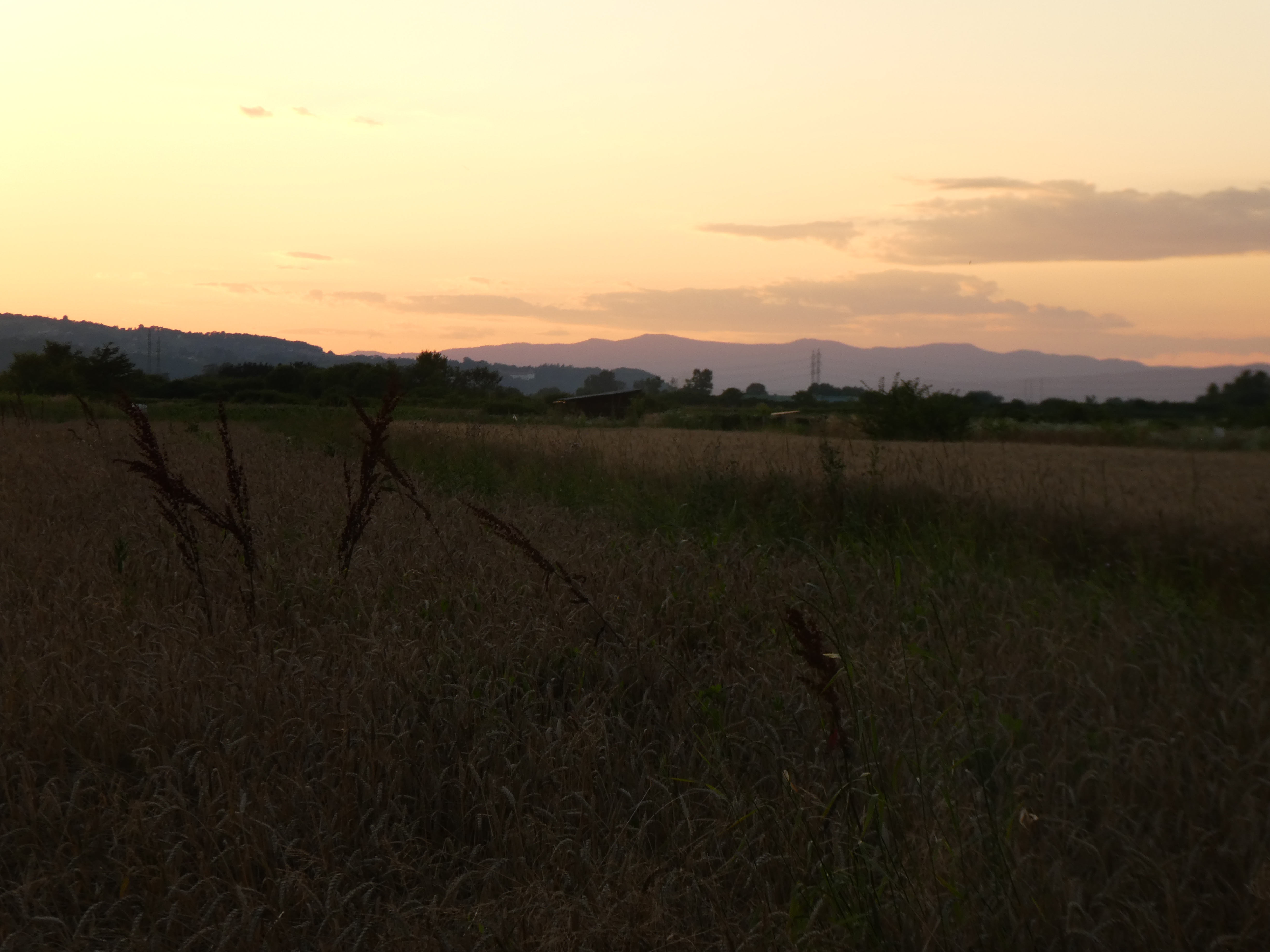

The sun sets across the flat landscape west towards Slovenia keeping the evening light with us until 10pm
Thursday 29th June – Zagreb
We had a good nights sleep and coped with the rather open showers.

As we ate breakfast we were fascinated by a tree nearby that had a young family of Merlin in it. The five chicks standing high on the branches calling out to their parents who came back occasionally with food. Not having seen any raptors the whole time we had been in the Alps we were quite excited.
We had arranged a free tour in Zagreb at 11am and reckoned it could take us up to two hours to cycle the twenty kilometres into Zagreb. We left in good time and followed a route used by cyclists from Zagreb to get to the Samobor Hills. It was part on road, then as we entered Zagreb along a cycle track. In the city centre we were left to our own devices, dodging people on pavements and keeping out of tram tracks, as we made our way to the main square where our tour was starting from.
We locked the bikes up on the square and found ourselves a coffee before we joining Vanya, our enthusiastic tour guide, and about 30 other English speakers. She was great manoeuvring us through the busy streets and telling us where to stand etc. to avoid the sun which was getting stronger and hotter as we went along.
The first new fact we learnt was the origin of the necktie called a cravat.

Apparently when the French were fighting the Austro Hungarian empire back in the day they had Croatian soldiers fighting with them.
The Croatian soldiers wore jackets with no buttons but wore a red bandana which was worn around the neck and threaded through holes in the jackets to keep them pulled tight around them.
The French found these neckties attractive and named them after the soldier , the Croats, from which the name Cravat was originally derived.
Although met with a degree of scepticism, the same truth was repeated later in our holiday by our guide in Dubrovnik, So….
The city of Zagreb was built on two hills.
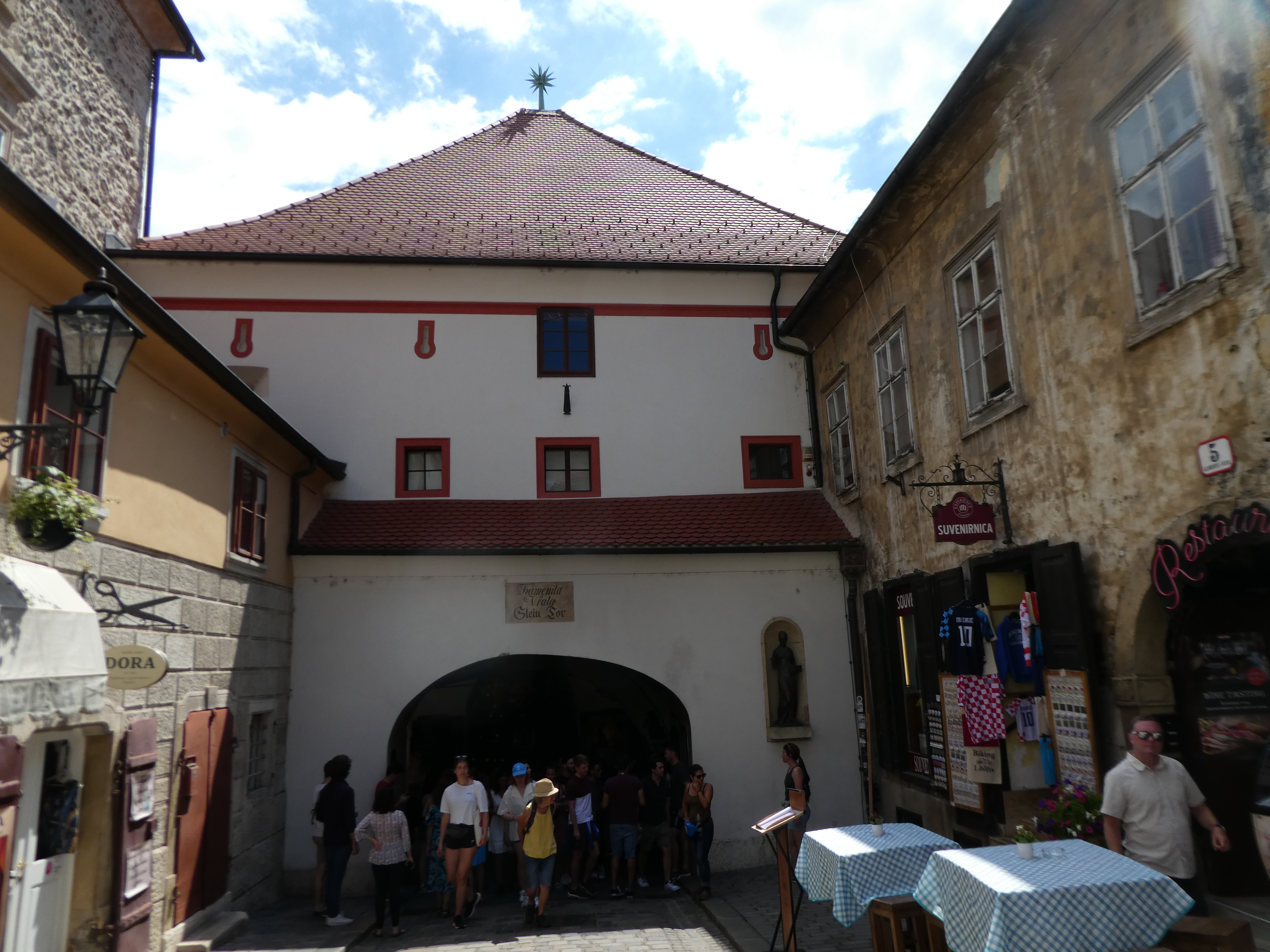
The first hill we visited the walled, fortified Grad bit of the city, on west side of the valley in between. ,Here we walked through an old stone gateway and saw the spiked ball on the roof of the gatehouse that kept away the witches and the oldest pharmacy in Croatia.

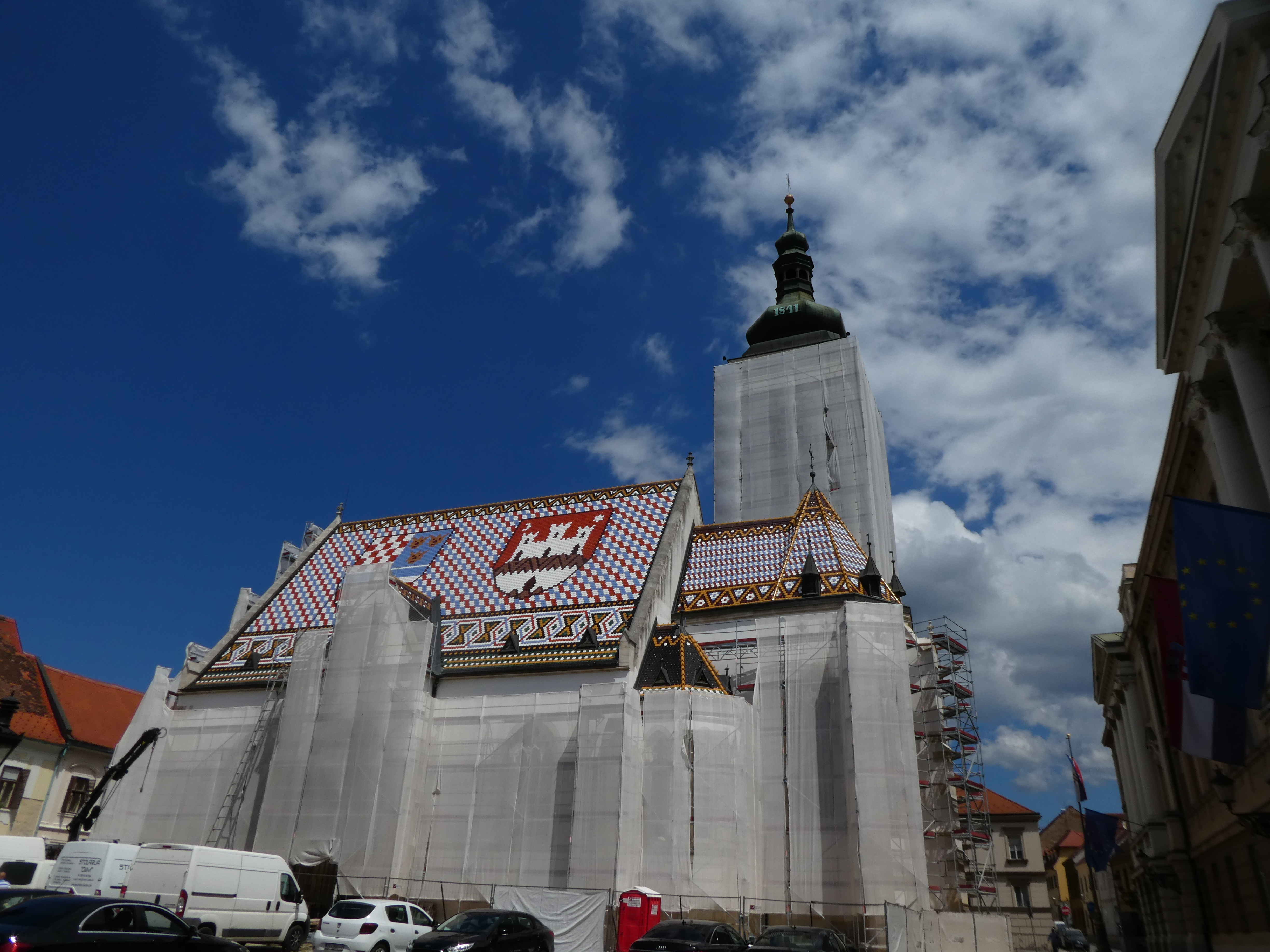
We then viewed the square with the tiled church roof with the coat of arms of the country and the presidents residence and the parliament building.
 We learned that because of recent earthquakes a lot of the buildings were being repaired. We then went to a view overlooking the city and at noon saw the daily canon being fired which was quite spectacular in loudness and smoke. The cannoneer then appears at a window on the tower to the applause of the gathered crowds.
Descending to the Blood Bridge in the valley between the two hills there was no longer a bridge but a touristy area of bars and restaurants that used to be the red light district.
We then climbed up to the other hill, to the market, which was bright with colour, and then to the Cathedral that was sheathed in scaffolding standing in a large square.

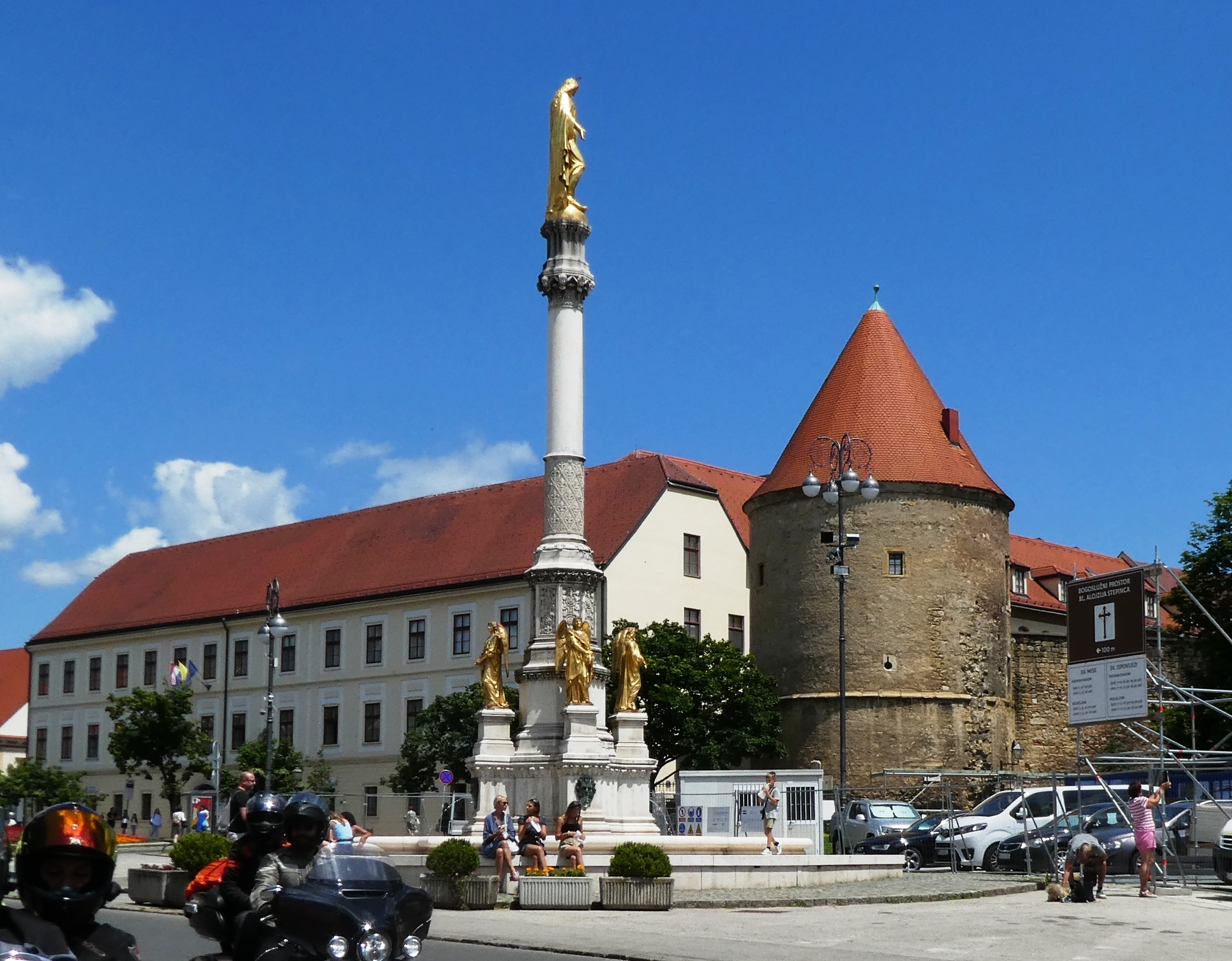

Vanya took us back down to the main square where there was a brass model of the City and showed us the route we had been on, before heading back via the small Zagreb fountain to the beginning. It was excellent!
We then found somewhere on the steps leading up to the market to eat, cool though slow, before doing the 20k return ride.

Splashing in the pool on our return was a real bonus and the addition of a family with small children staying on the site the evening was pleasantly entertaining.
Friday 30th June – Samobor to Brestovaca Voda in the Bosnian Forest
After a good nights sleep we awoke to the sound of the Golden Oriole’s, very distinctive call.
We had breakfast and left the site stopping at Lidl in Samobor before making our way on to the main road heading south around Zagreb and on towards Banja Luka in Bosnia.
We were a bit stunned by the bomb damaged buildings on the border and the number of unfinished, damaged and large empty houses.
We travelled through Banya Luka and followed the river until we eventually found a small residential road by the river where we stopped and ate the traditional Croatian bureks, fatty filo pastry filled with dry cheese and spinach, that our guide had recommended to us yesterday.
We then travelled on turning off the M4 onto a small road the R440 that should have led us through the Bosnian forest to Vitez where we hoped to camp for the night.
This lovely winding road led us through villages but gradually it got smaller and less and less made up until it was just a steep forest track. We continued thinking that it would get better at the top but it just got less and less negotiable. When it turned into a stream we were defeated and turned around only to find we had a puncture!
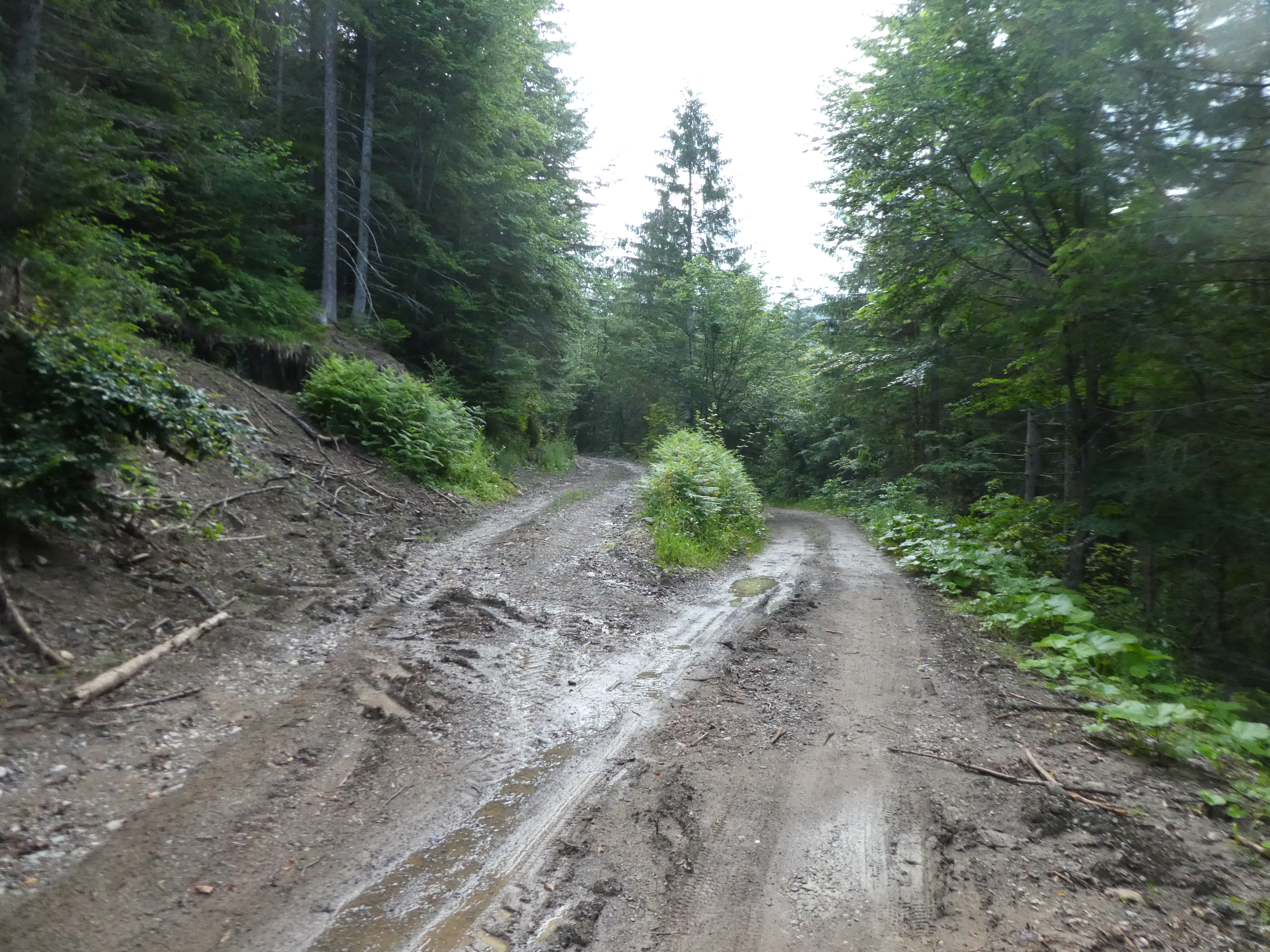
The ground was muddy, hard, uneven and stony. We got the spare wheel off and started to jack up the van when the jack gave way and buckled dropping the van back on to its punctured wheel!
We then decided that one of us would go for help (Janet) whilst the other (Graham)would carry on trying to jack up the van.
It was a bit of a shock walking down to see how difficult the track was and how far we had gone. After a half hours walk Janet reached a forest, electricity maintenance place and couldn’t believe her luck in finding a dog and two workers there. Neither could speak a word of English but with lots of gestures they understood the problem.
One of the workers loaded up a little red rickety tractor with tools and a bottle jack. With Janet sitting precariously on the rear mudguard the tractor made its way slowly back up the mountain. It was embarrassing that we go so far up the track and the tractor driver could not believe we had driven so far.

The van had been rising slowly with the repaired jack and some logs but it was never going to work so it was a great relief that the tractor appeared up at the van.
Our volunteer was a great help and set to with difficulty digging a pit to stand the bottle jack in whilst the spare wheel was brought round to be fitted. Finally the van was jacked up and the wheel came off and the spare went on.
It was not easy and at one point the van had to be manually lifted to release the bottle jack ! We couldn’t thank him enough and we set off down the forest track ahead of him before deciding as it was getting late that we would some where to park up by the track to stay the night. We knew nobody was around and our minds would be clearer in the morning.
We gave him €50 and some beers so grateful were we that he was around and knew what to do. When he came down passed us later puzzled by us staying there for the night but he had a smile on his face and was drinking from the bottle of beer in his hand.
We tidied up the van and ourselves up as best we could and settled down for the night.
Saturday 1st July – Bosnian Forest to Visegrad
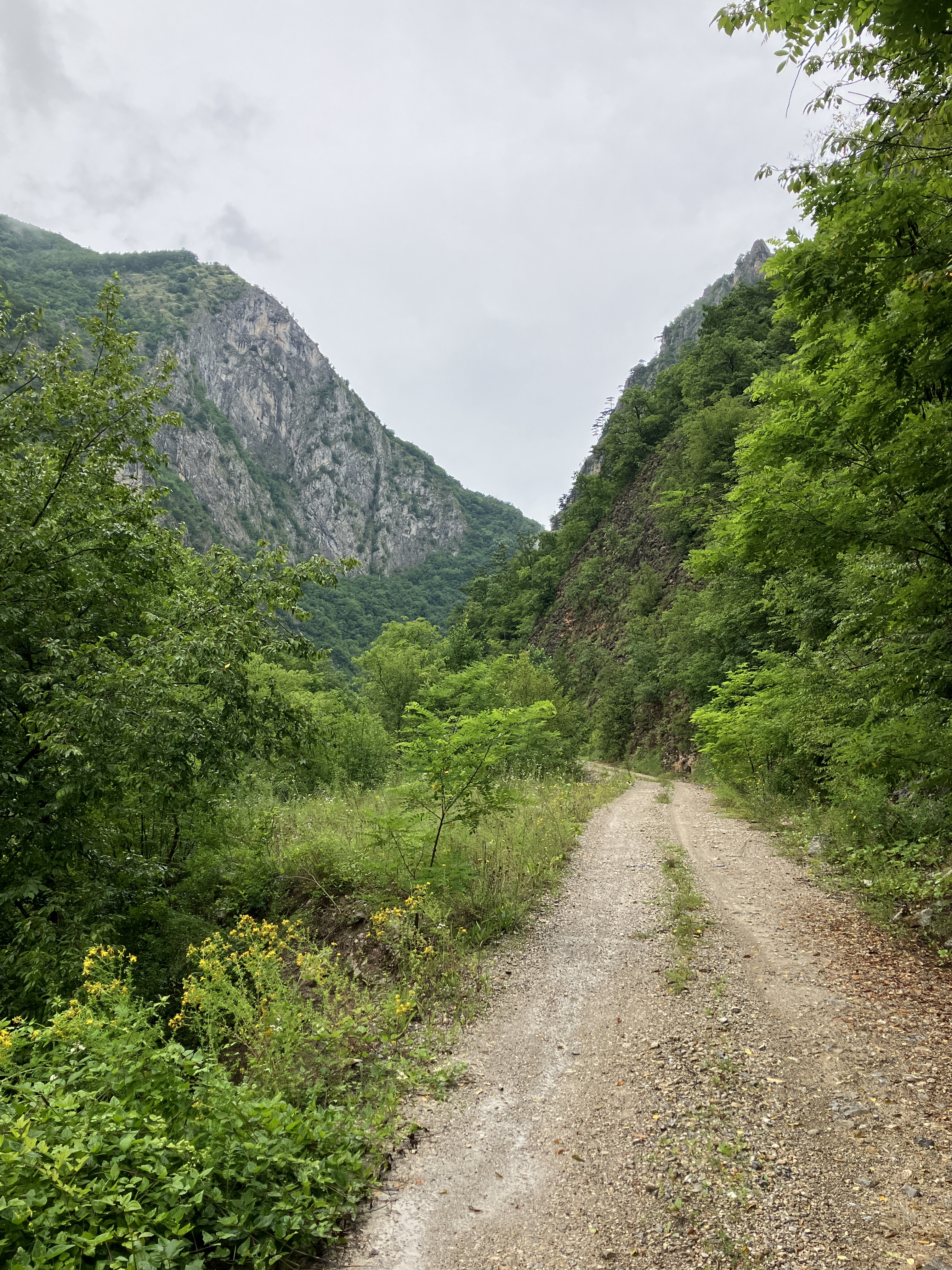
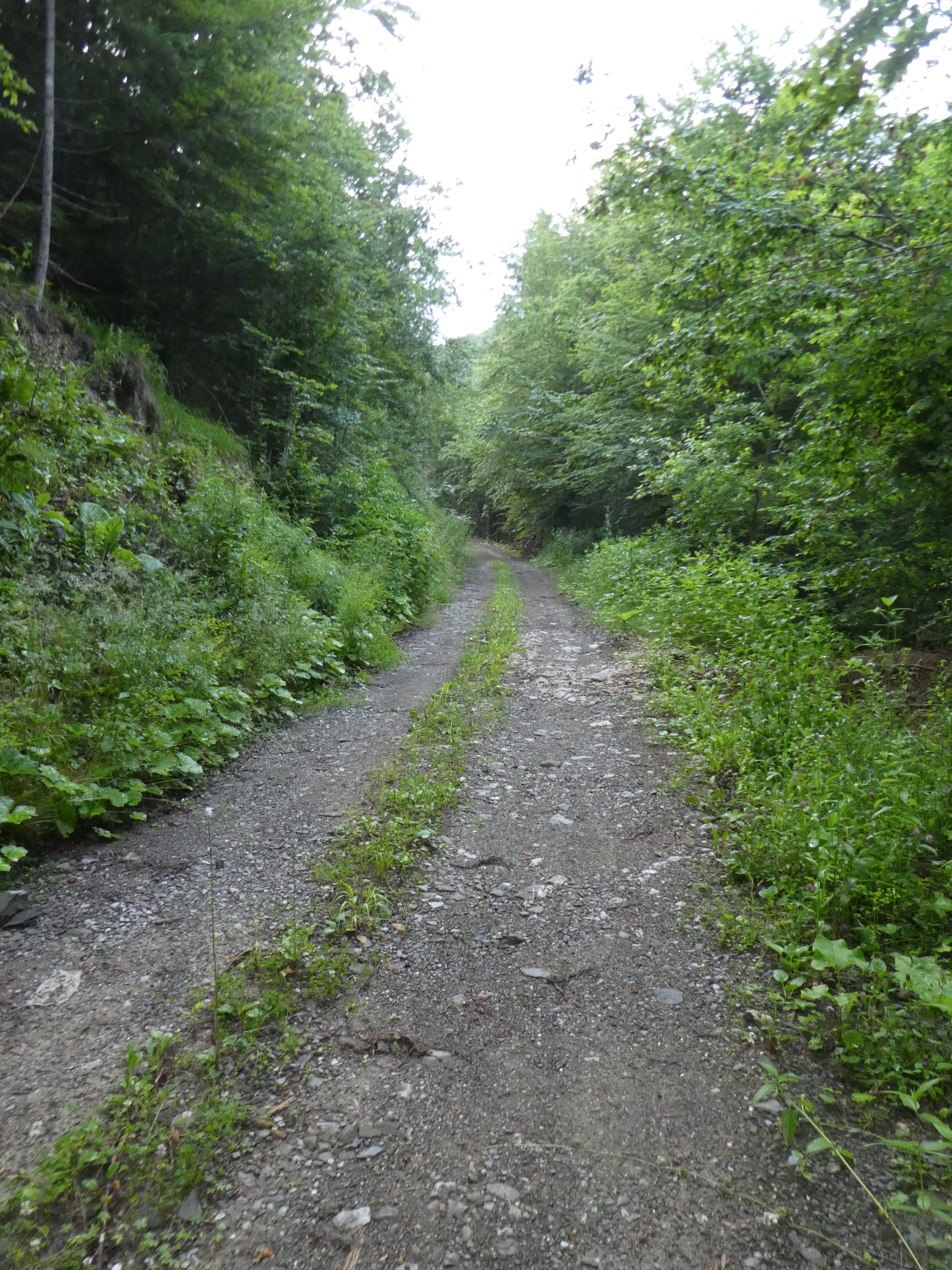
We were up early and spent a while enjoying the Ancient and Primeval Carpathian Forests we had come so far to experience !
After coffee and something to eat we set off slowly down the hill back to the M5 which took us 45 minutes.
We passed very few people in the houses nearest to where we were and we realised how fortunate we had been to find the workers.
Once we were back on the main road we made steady progress towards the auto route leading into Sarajevo. At one point we had to stop to tighten the wheel nuts on the changed wheel. Whilst we were doing this a man came out from a workman’s that near some road works and offered us help and some apples. We declined both the wheel having already been tightened and the apples looked decidedly crabby but it was a lovely gesture and we thanked him.
It had the feeling of driving through Morocco going through the hamlets and small towns along the main road. Lots of people, lots of litter and a slow queue travelling through each of these places all of which which seemed to merge into another.
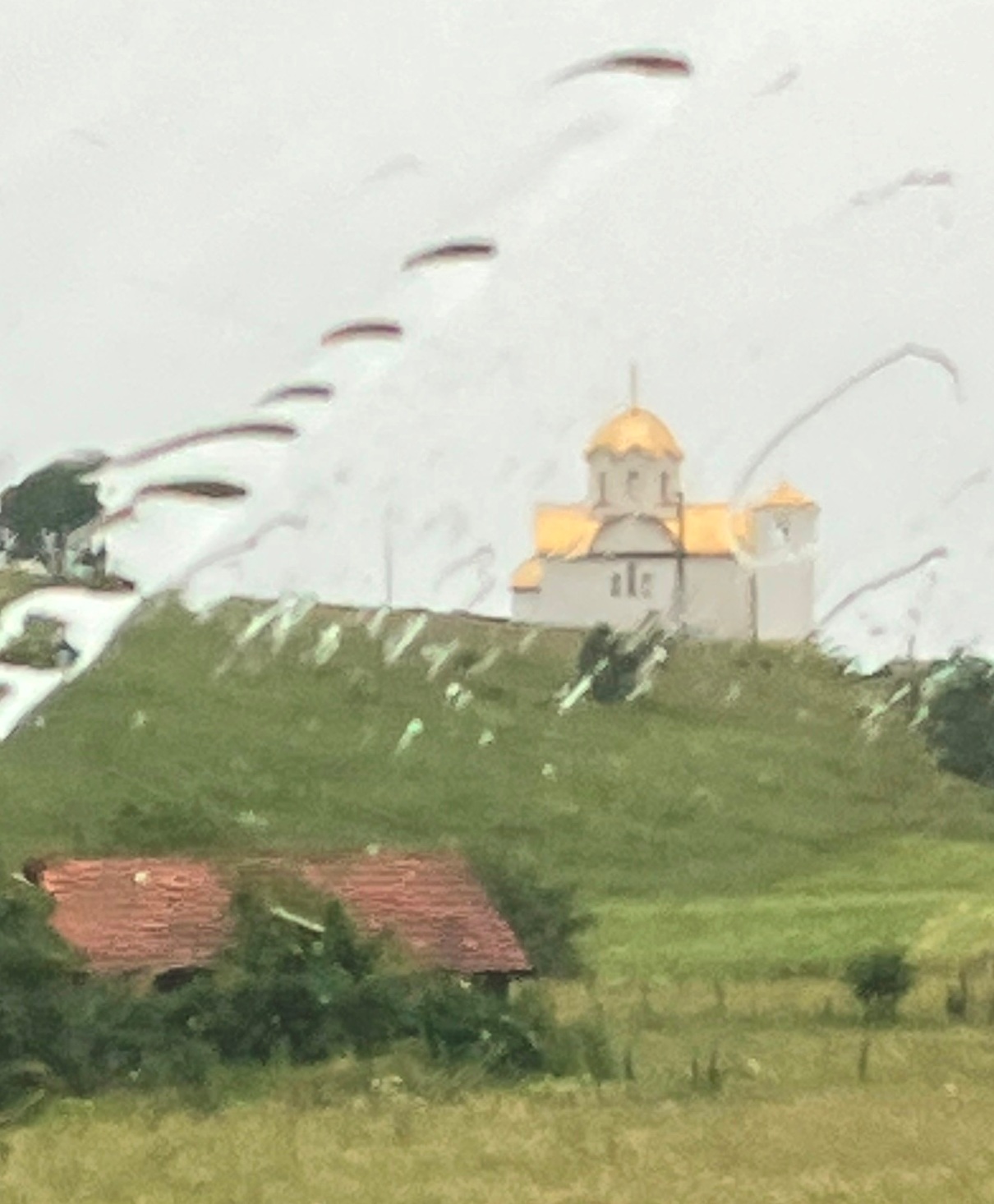
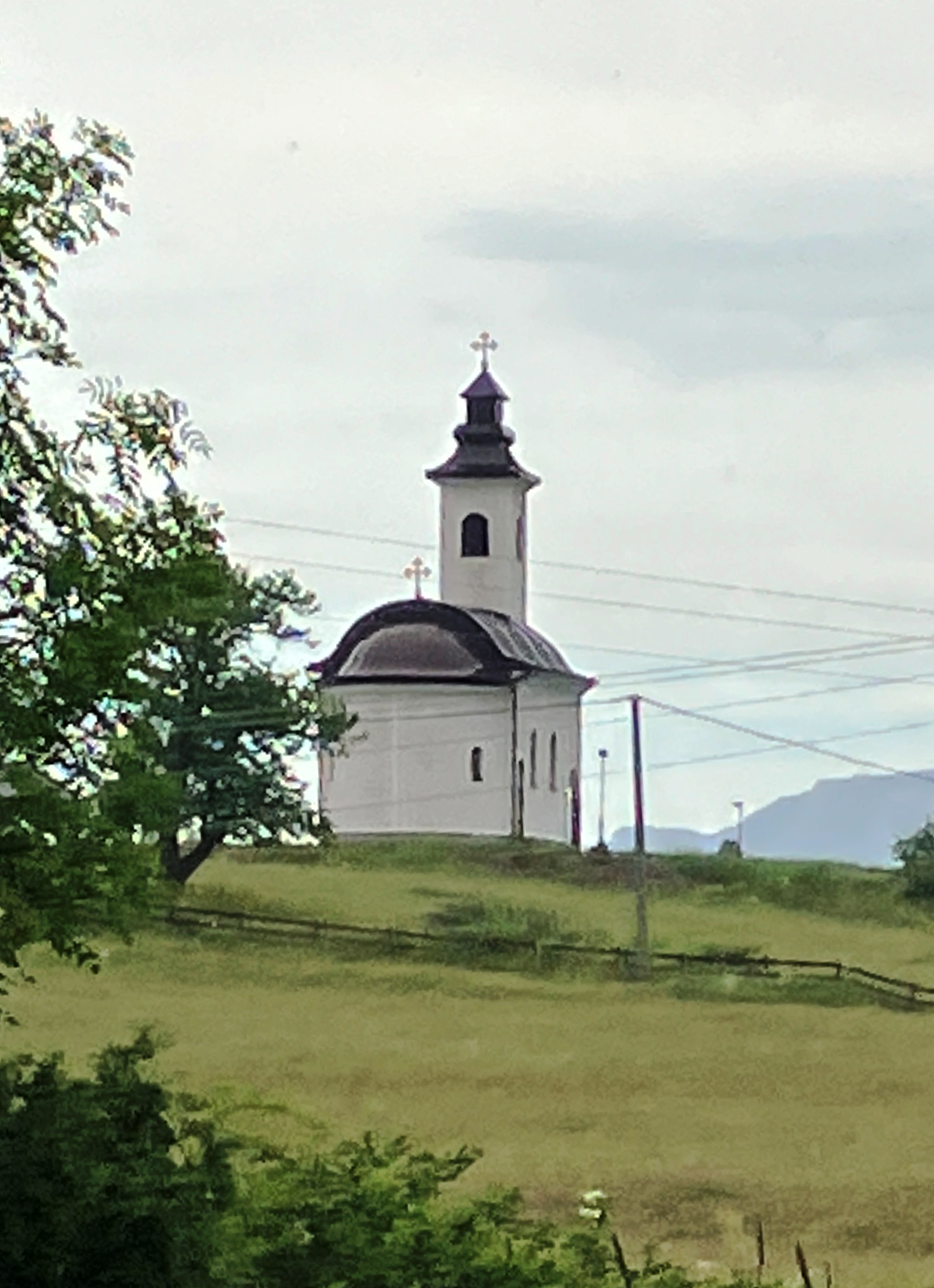
 War damaged houses just sat amongst Christian and Muslim places of worship a stark reminder to recent history.
We descended from the hills to the plain where we joined the modern road network around Sarajevo.
As we reached Sarajevo the rain was pouring down. So there seemed no point in stopping Janet just took photos through a rain smeared windscreen!
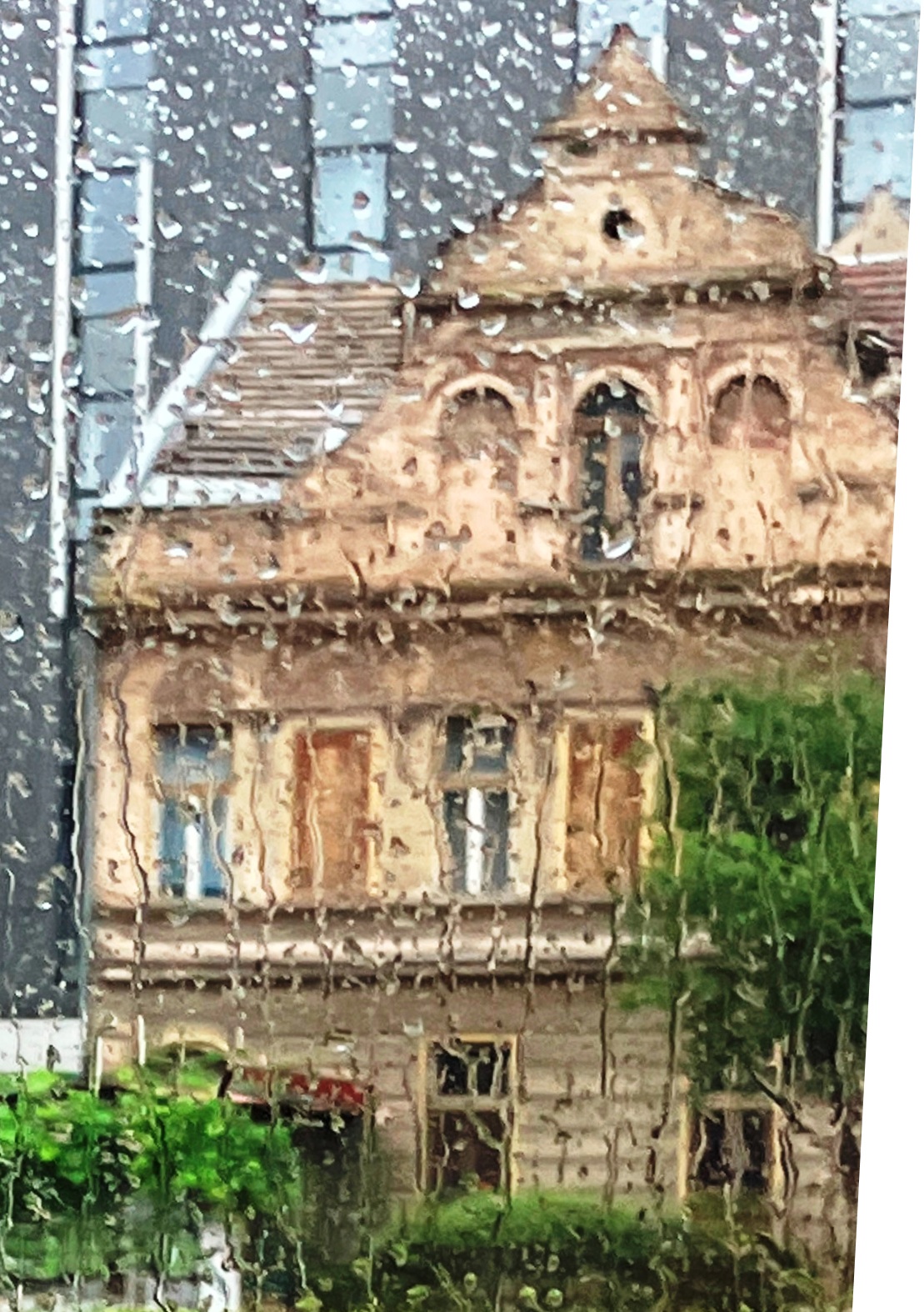
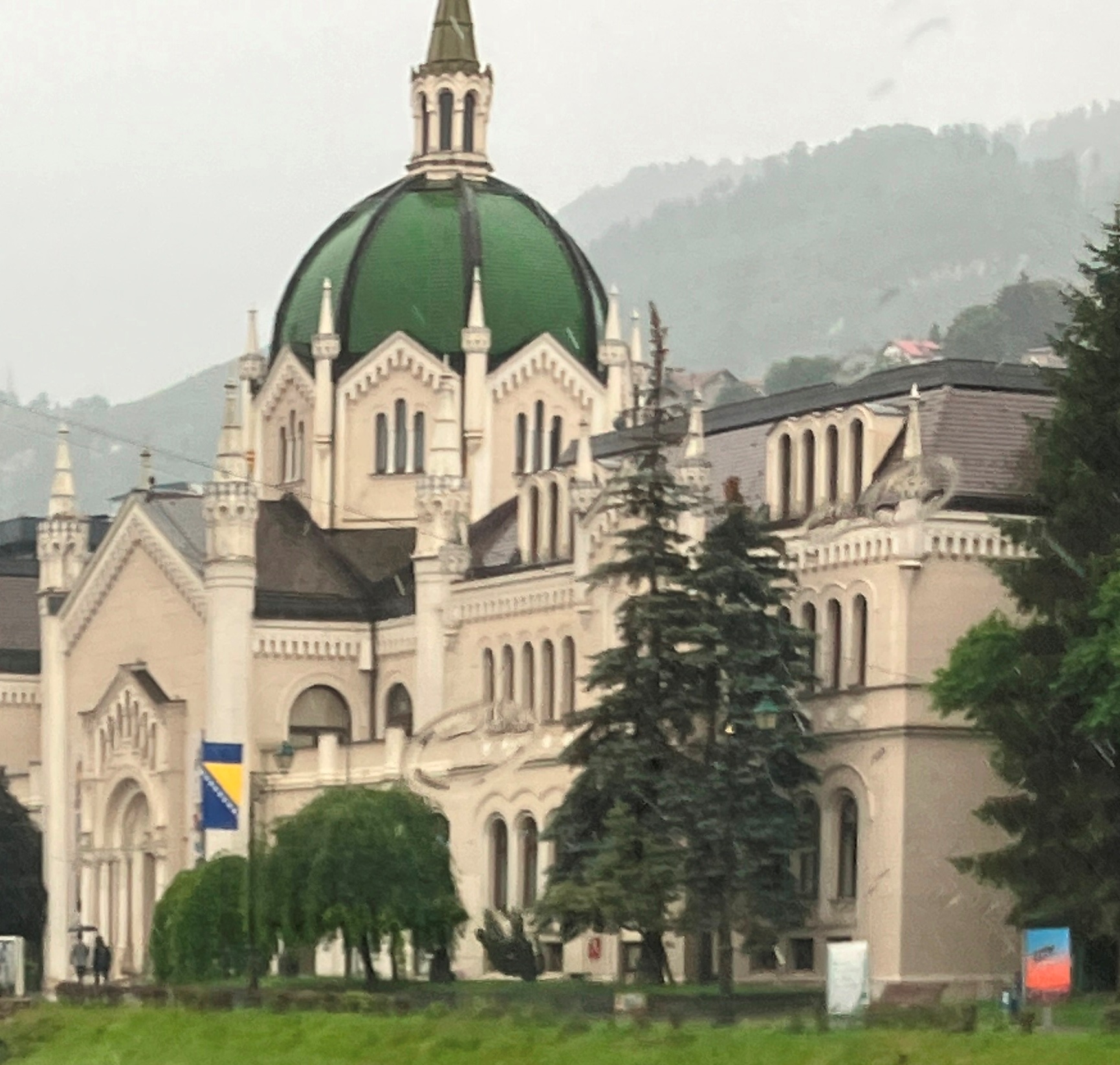

The city is built at the end of a narrowing valley so once through the old part we climbed up through a narrow sandstone gorges to the hills high above.
It was here that many of the snipers and guns were situated to fire down onto the people in Sarajevo below.

We wound through these narrow valleys passing through unlit tunnel after unit tunnel out onto a high plateau and through more gorges to Visegrad.
Here we stopped and walked over the Mehmed Pasa Sokolovic Bridge built by the Ottoman architect of that name between 1571 and 1577.
It had allowed all the trade routes from the east to enter Europe and was the scene of many power struggles over the centuries.
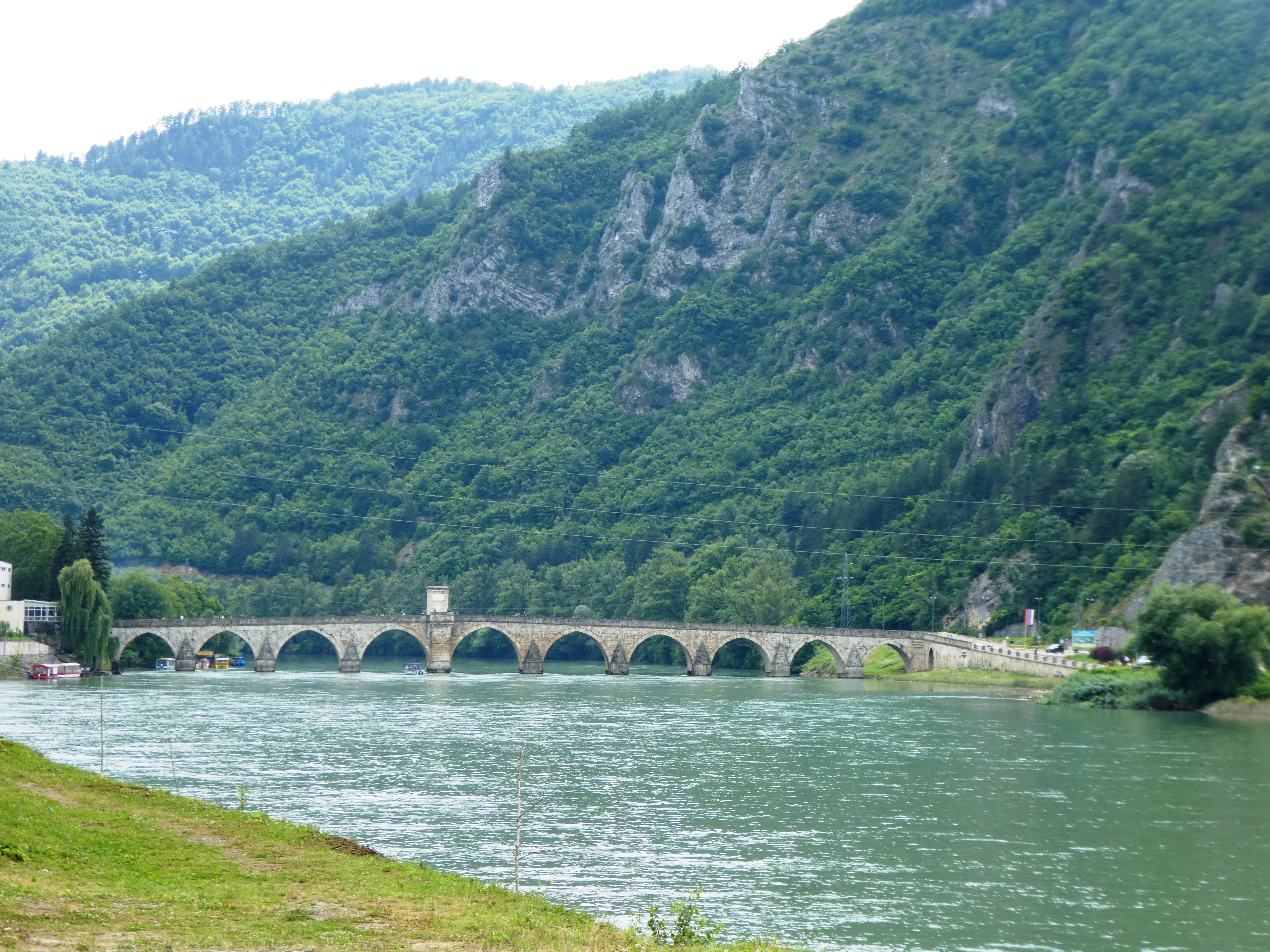
Apart from the bridge there is little else to show the significance of this town at the time we were looking for information about the significance of the town on the Silk Route and the wars between the Ottoman Empire and the Serbs with the town finally falling to the Austro Hungarian empire in the 18th century.
We were unaware until after we left that it had been the scene of some horrendous acts of genocide carried out by the Serbs against the Bosniaks. For centuries Visegrad had remained a town two thirds Bosnian Muslim (Bosniaks) and one third Bosnian Serb. The communities entwined few caring who was what.
In 1992 a hurricane of violence was unleashed by Bosnian Serbs against their Muslim neighbours. Thousands of Bosnian Muslims, men women and children, were murdered in a series of documented massacres their bodies dumped into the River Drina.
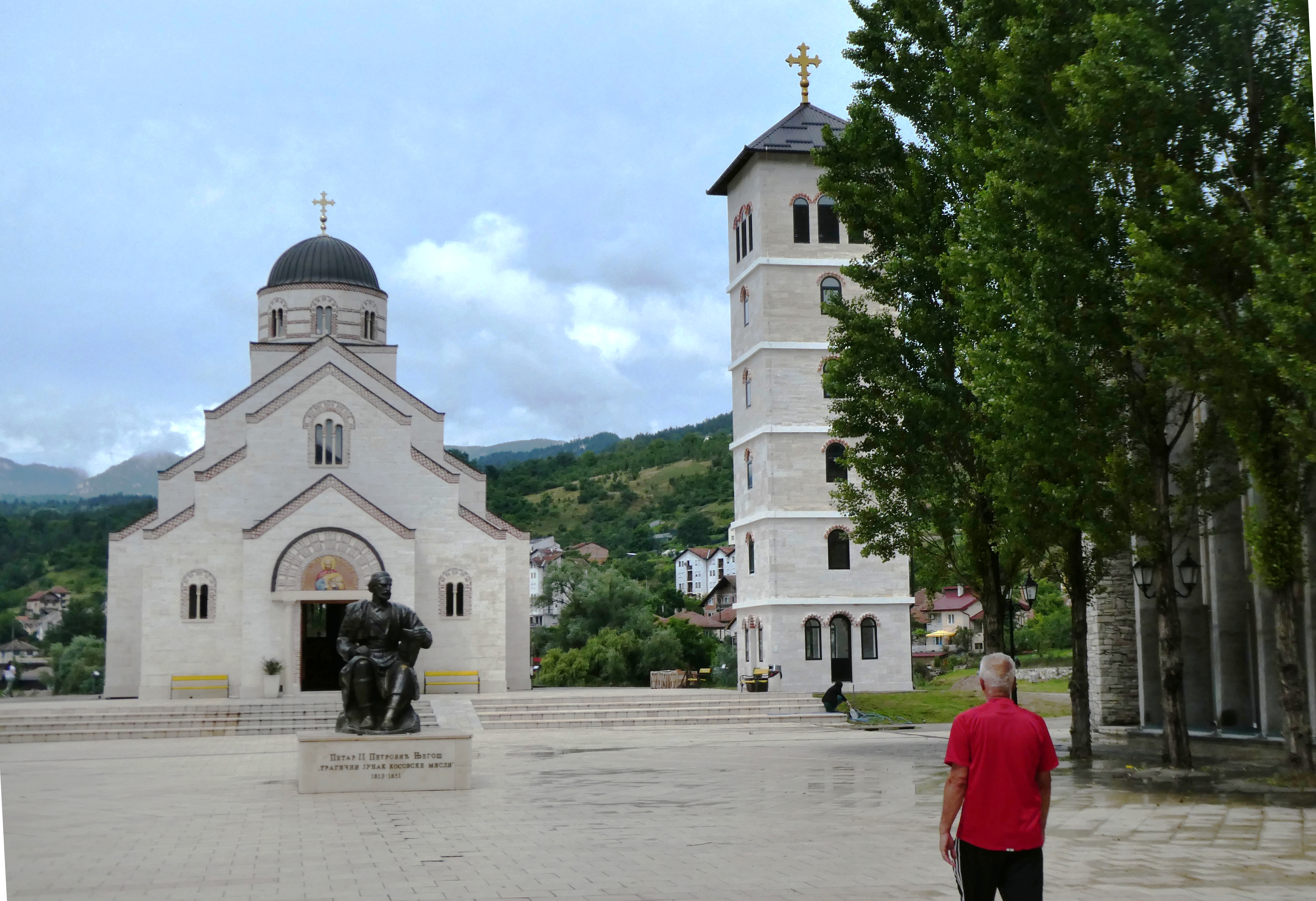
Various monuments, especially one on the confluence of the River Drina with the River Rzav , suddenly made a lot more sense.


We headed east out of Visegrad towards the Serbian border where we found River Camping.
A delightful site with a small river on one side and large grassy area, lovely view of the mountains, a fire cooking area and nobody else there and hot sun.
Using their internet connection we were able to get tickets on the Italian ferry from Split to Ancona in a weeks time.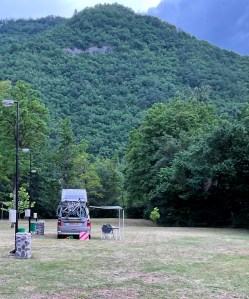

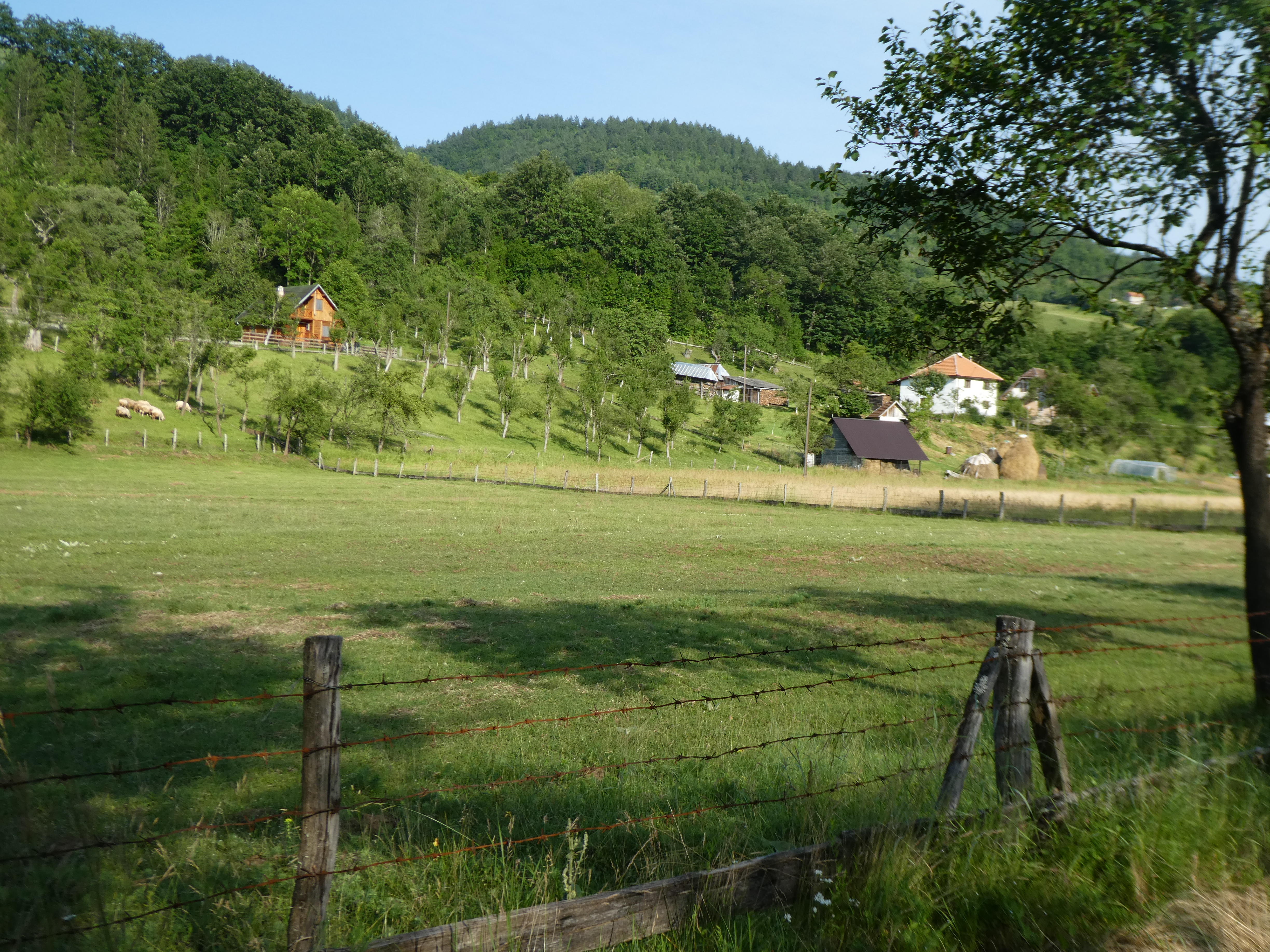
Having settled in we walked up the valley running to the south through small hamlets, a centre with rolls of barbed wire where apparently refugees are held if they are caught escaping over the mountains.
 There were families by the bridge fishing and one lad came running past us with three fish making his way to one of the local houses.

 We cooked on the fire and ate on the table by the fire which made a nice change.
As we finished the thunder started rumbling and lightening flashing and the rain came which brought back memories of holidays in the Pyrenees when the kids were young.
Sunday 2nd July – Donje Vardiste to Zabljak Montenegro
We spent time sorting the van and manage to get the lock fitted on the spare tyre and talked to the young guy in charge of the camp site who was concerned because numbers staying were down from last year. 
Whilst having breakfast we thought long and hard about which way to go after our previous experience following a rural road into the forest. We couldn’t go over the border to Serbia as the van was not insured.
So we went back through Visegard and through all the tunnels beside the river lake viewing again the disgusting amount of plastic waste in huge rafts held back by booms to the side of the river.
We then turned off to the west to Gorazde, and then turned right onto a rural road! We wound our way up through villages to the border with Montenegro.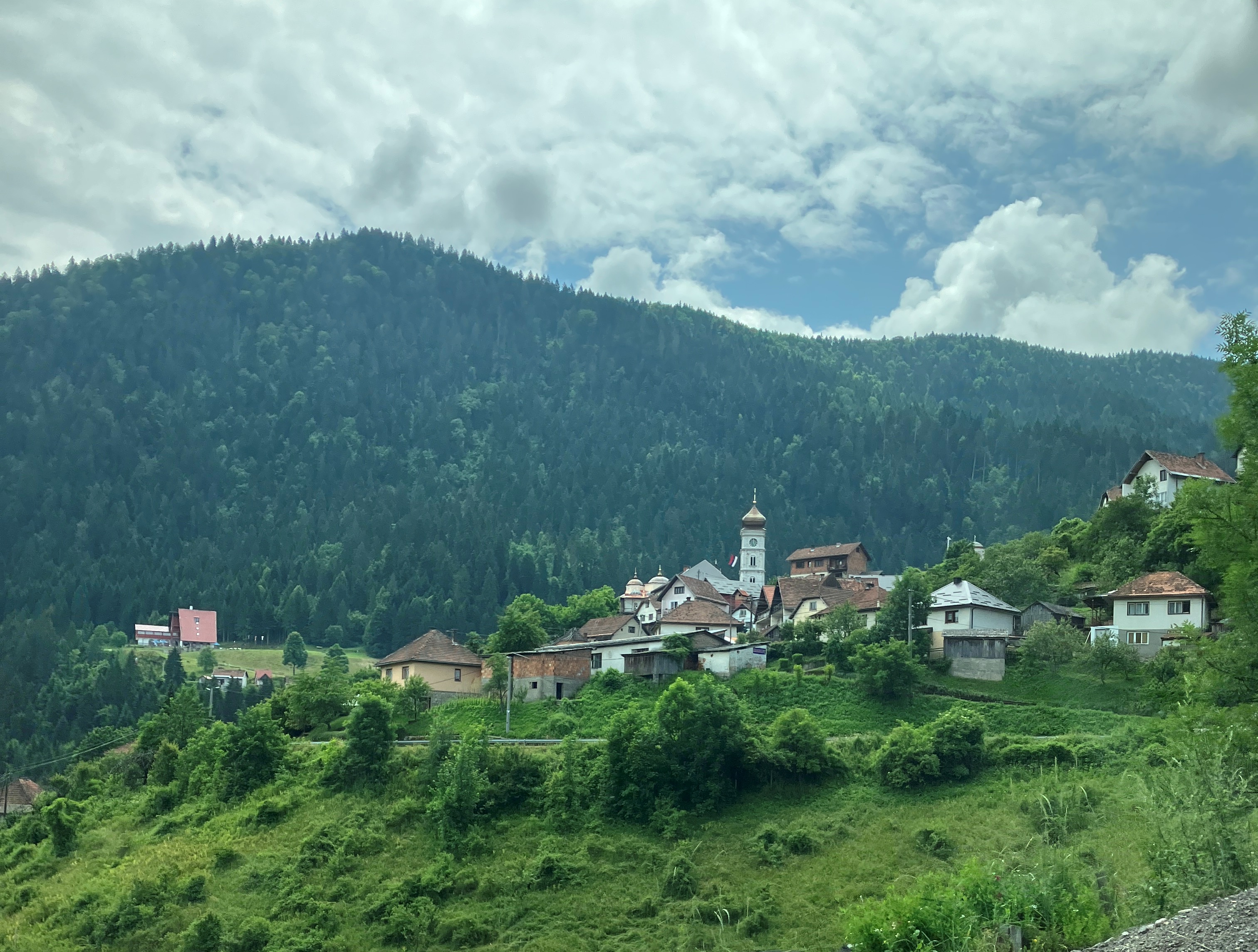
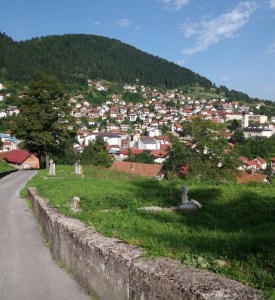
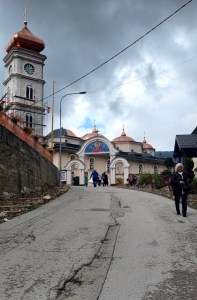
In one of the villages Cajnice, there were lots of men standing around in the street and in the bars chatting, just like Morocco, not a women in sight!
From here the road deteriorated much to our alarm but a bit further on two policemen stopped us in a friendly way to find out where we were going which reassured us that the road went somewhere.
The Bosnian border control a bit further on was minimal with two guards in a hut with a simple barrier. The road, worn out with use and no repair, went up and over the mountain before we arrived at the bit more sophisticated Montenegrin border with one guard in a larger set of building with several strong barriers.
We were amazed that as we made our way up articulated lorries were using the road in the opposite direction luckily we only met them on the wider bits.
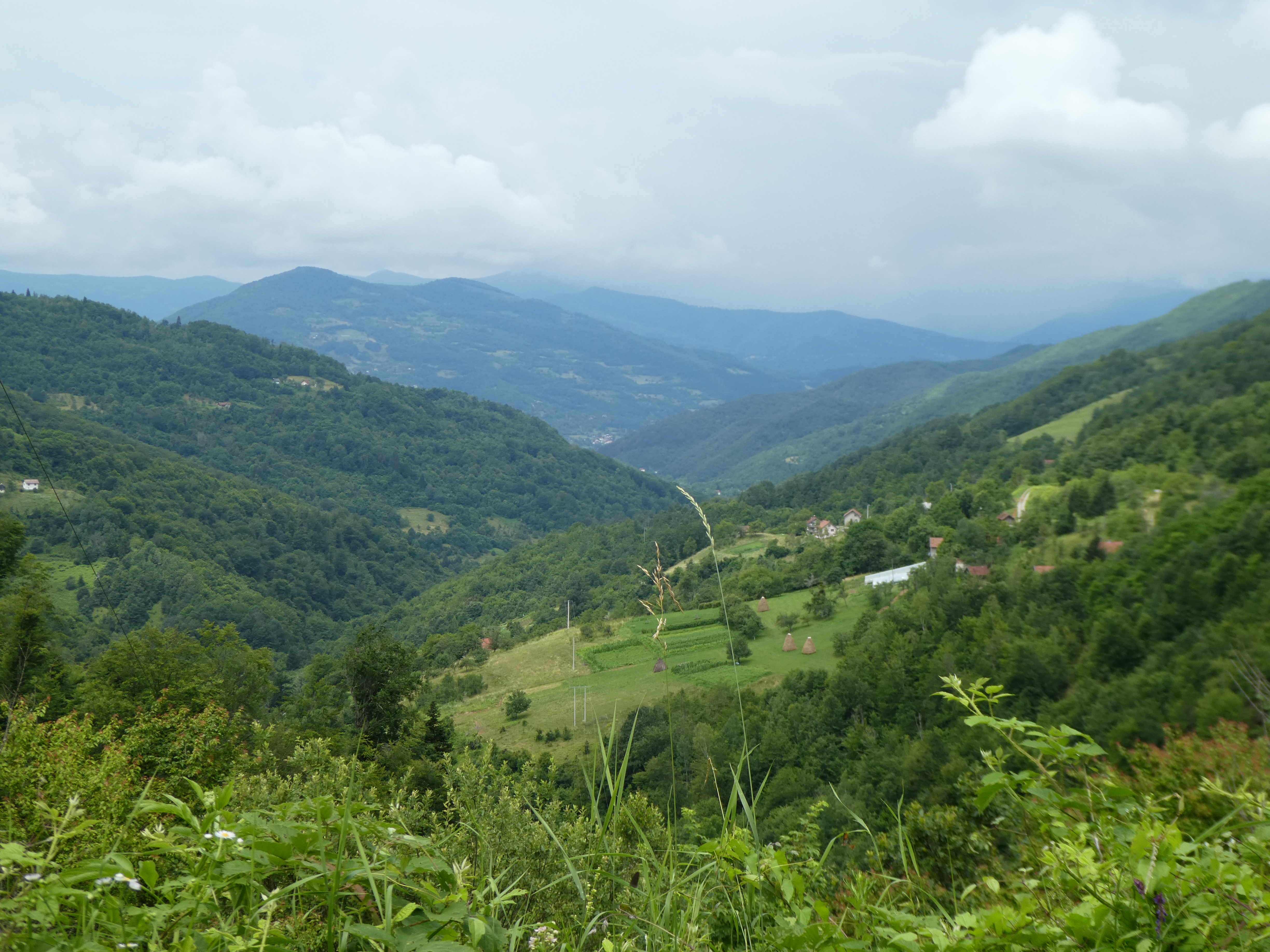
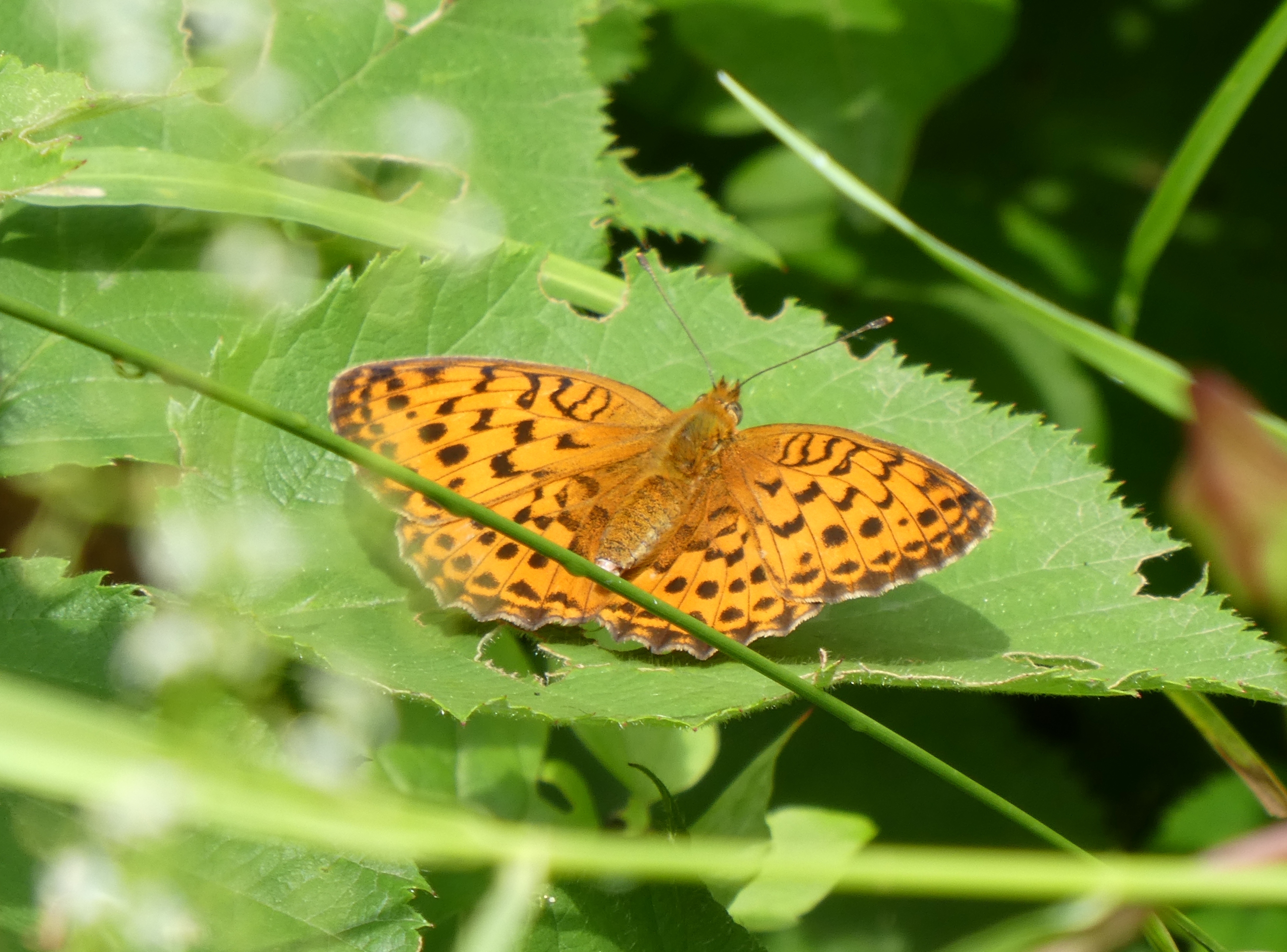

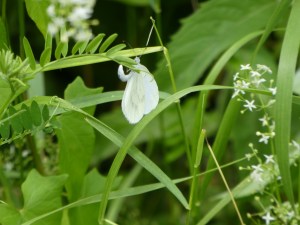
The road soon became better and passed through lovely undulating meadows until we joined the road coming in from the east from Serbia and reached Pljevlja. We stopped at one point on a pass where there were numerous butterflies including High Brown Fritillary.

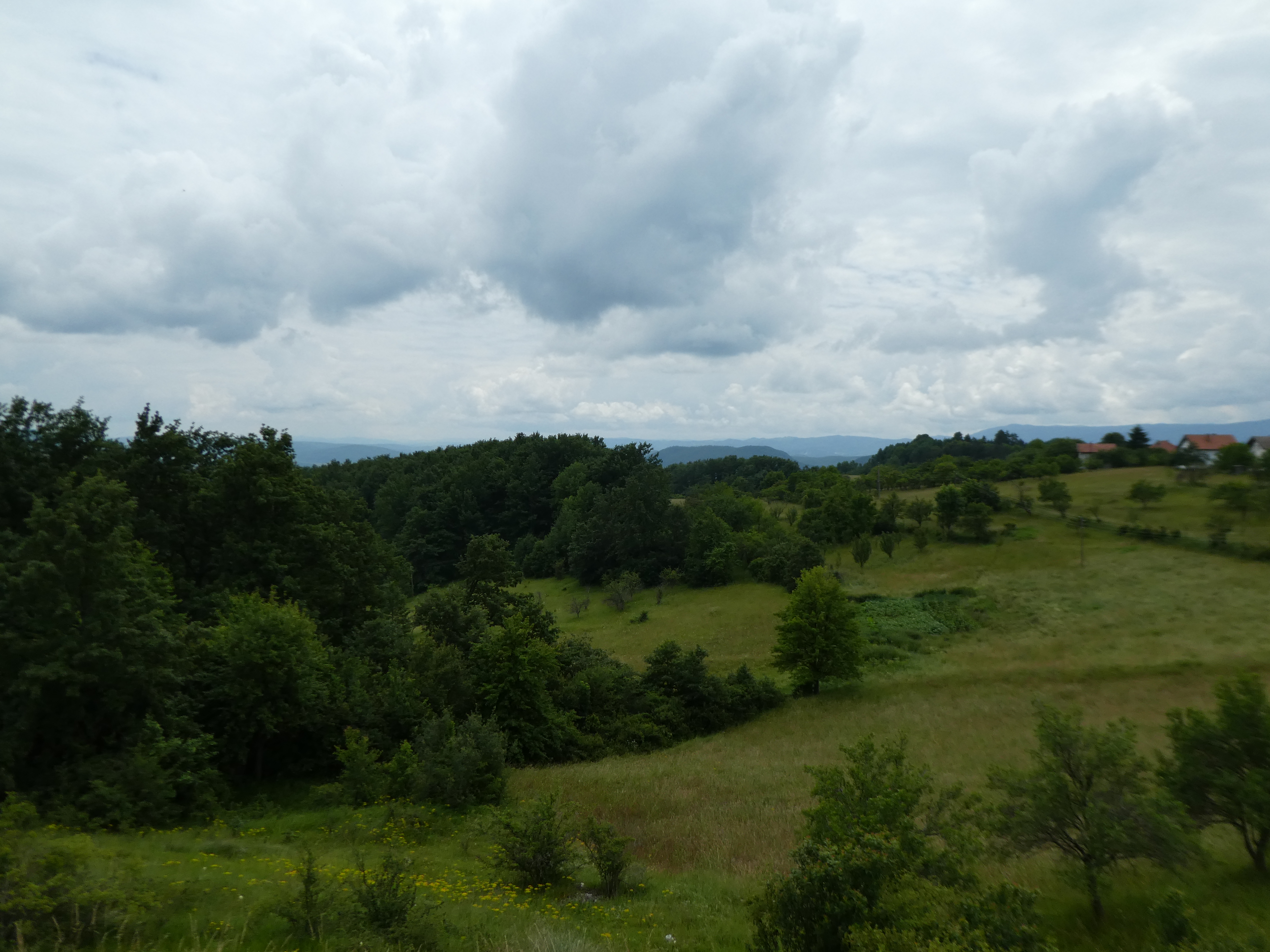
We followed the road down to the very deep Tara Gorge. Descending into it through several hairpin bends it was spectacular.
There were coach loads of people here viewing and taking photos from the middle of the bridge making it impossible to stop.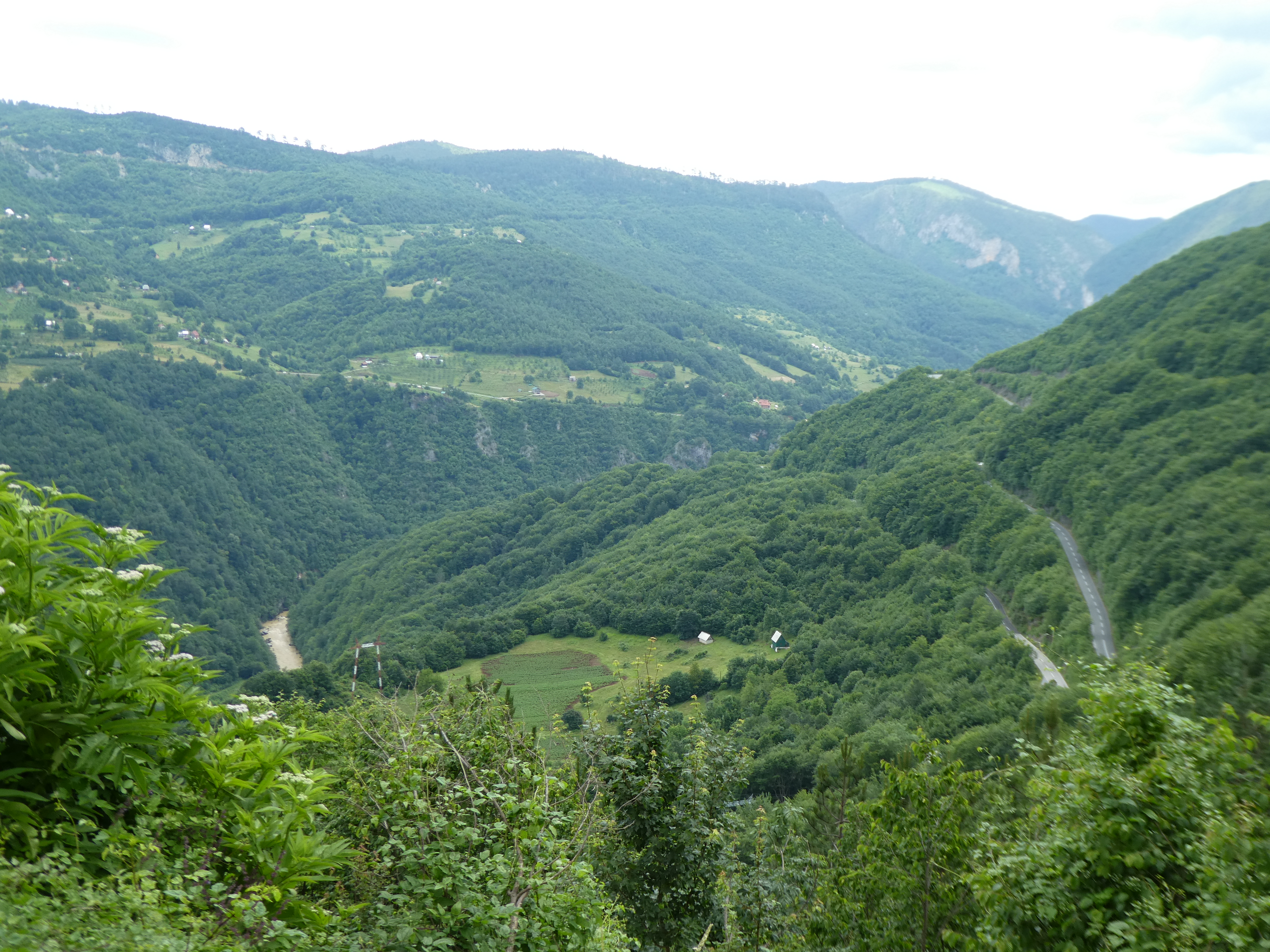
At this point it started to rain and we continued up a steep twisty but properly surfaced road to the top of the gorge where the landscape changed to an alpine plateau with many triangular shaped holiday houses and chalets dotted around.
Zabljak is a modern mountain tourist resort with shop lined street and traffic lights !! We made our way through its crowded streets and out towards its main attraction the black lakes where our camp site was.
It was Sunday and because of the cars, coaches and people at the entrance to the parking area we missed the sign to Autocamp Minski Potok. We carried on into the ramshackle development that had sprung up around the entrance to the lakes called Ivan Do and found a rather shabby uninteresting camp site.
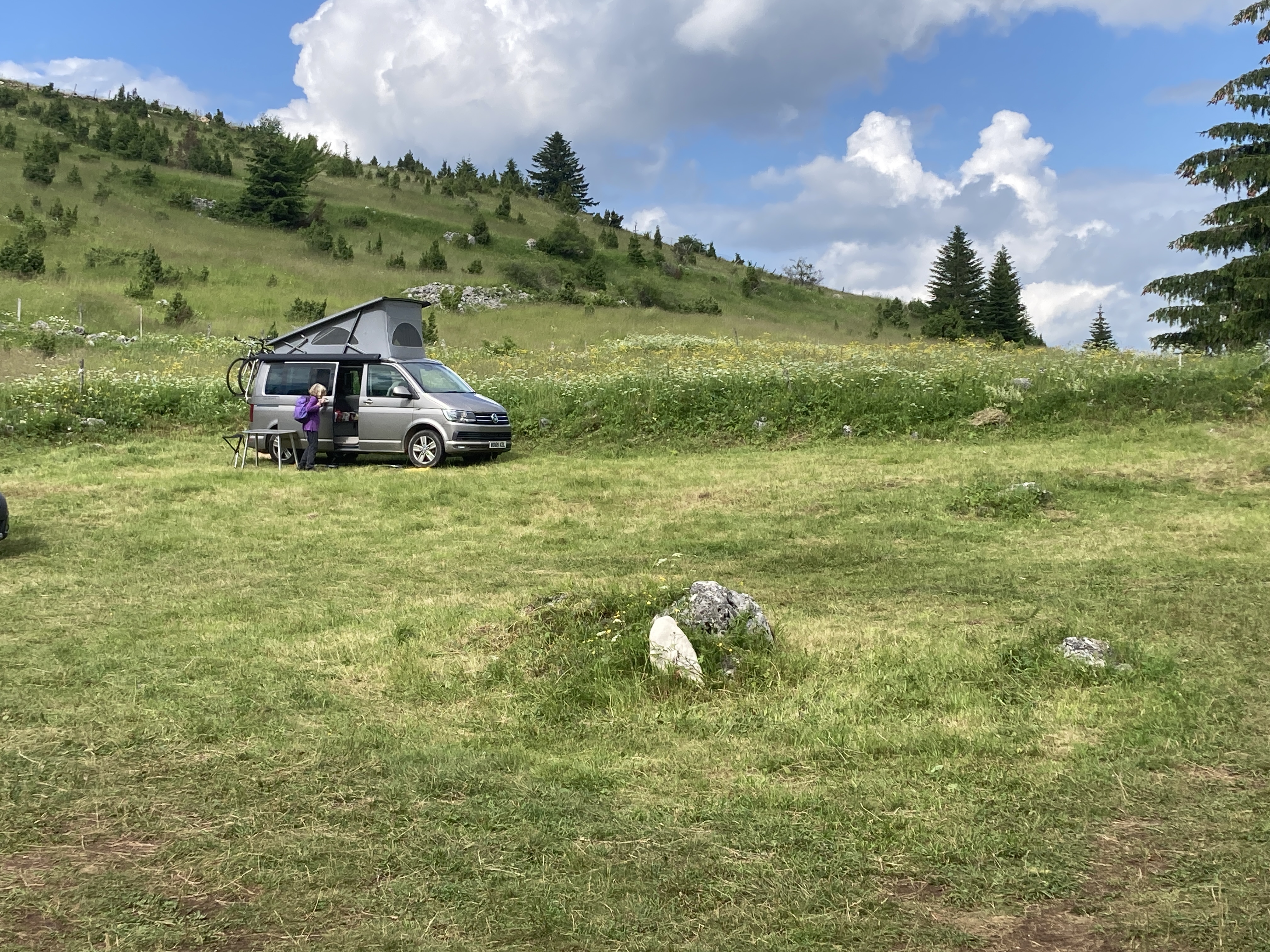
After several wrong turns we found it and managed to get a place at the far side with a magnificent view of the mountains in the heart of the Durmitor National Park.
We had a bite to eat and then walked back into the town for some food shopping but as it was Sunday nothing was open. 
We returned to the site and chatted to the owner who with other new arrivals were sharing a small welcoming glass of schnapps.
It was so different from all the sites we had been on so far it was a bit of a shock to the system to find concrete block sheds old showers and dark toilets with no hot washing up water.
But it was fine everything clean and working and at €17 a night good value. We realised how spoilt we had been up to now.
Monday 3rd July – Durmitor National Park
We awoke early and wandered up into town for bread and pastries for our breakfast. On the way back we stopped at the Information Centre where we were unable to get any information or maps but did photograph a map of the area they had which showed walking routes.
After breakfast we packed a picnic and made the decision to walk past the lakes and up to an ice cave and panoramic viewpoint high on a mountain pass above us.
We could walk straight out of the camp site on to a track that took us through Ivan Do where we had been yesterday and out into the forest surrounding the lakes.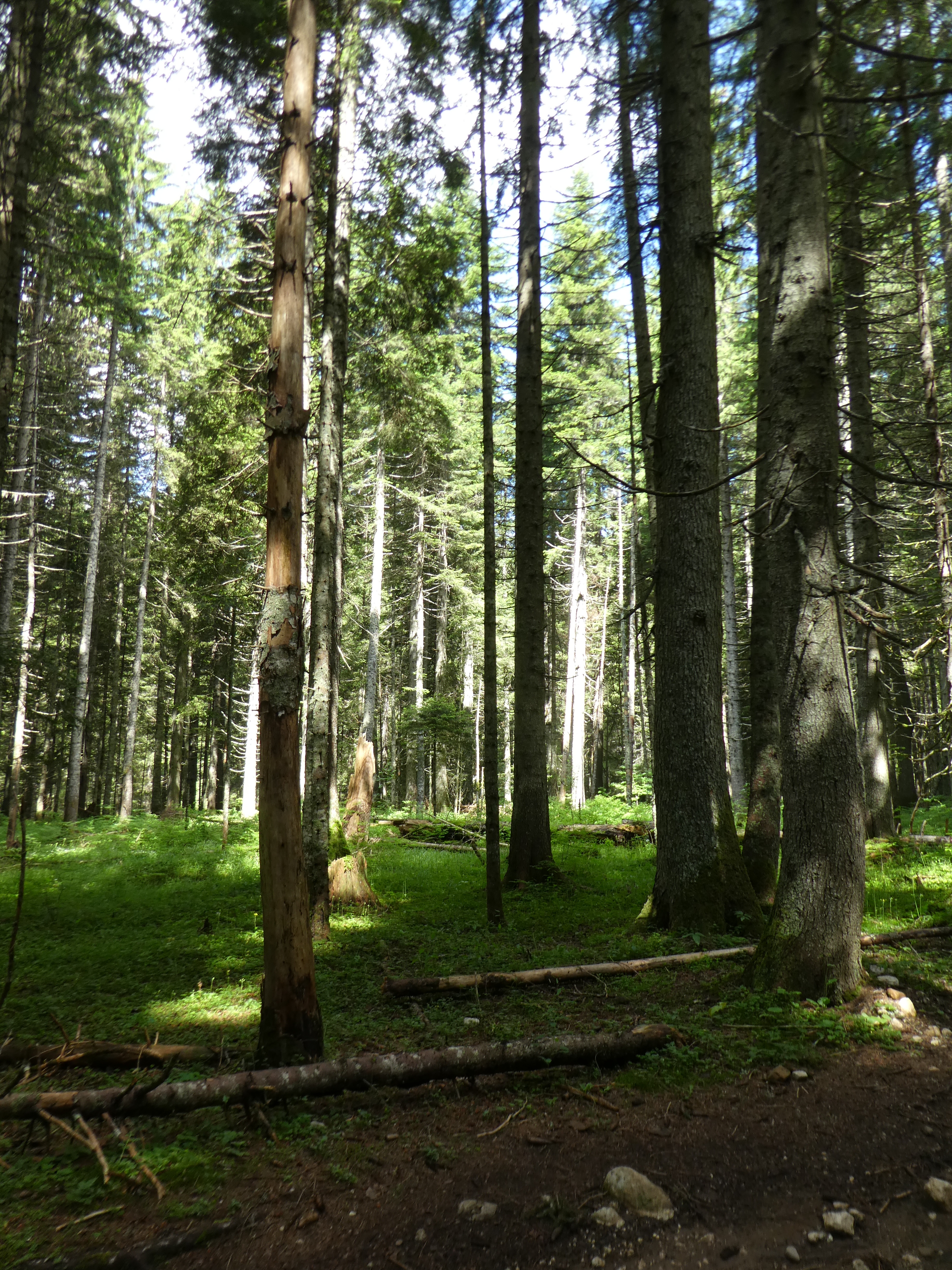
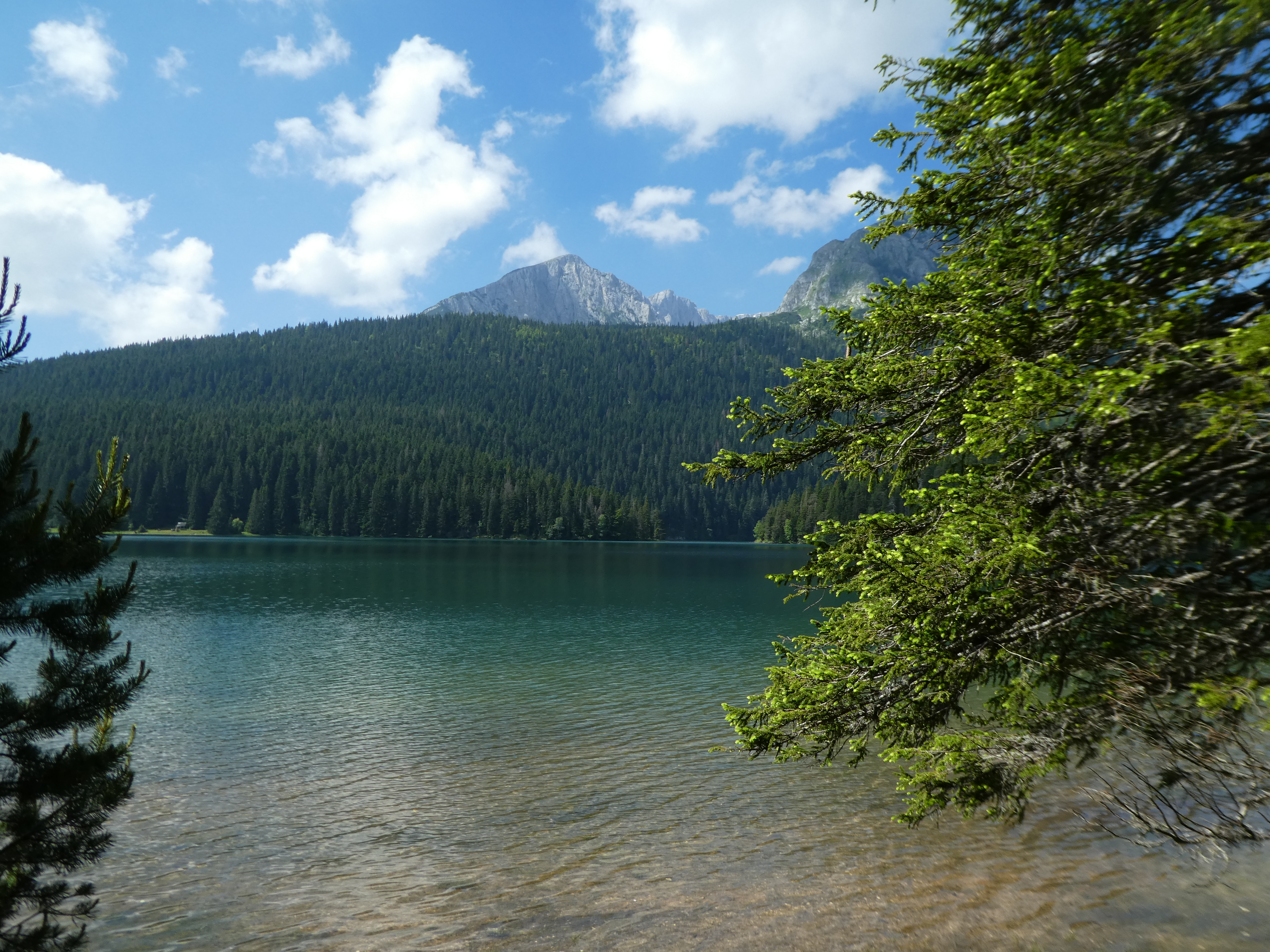
As we descended to the lakes we were stopped by a park ranger who sold us two tickets for entry into the park.
All a bit random but he seemed official although the tickets dated yesterday had had their dates changes to show today! After walking around the edge of the lake we turned up into the forest and headed up towards the ice cave, Ledina pecina. The first steep bit was through old woodland a mix of pine lower down and a mix of older trees higher up.
Once clear of the trees and the path running through limestone was overgrown in places by shrubs which we struggled through.
The path opened up occasionally as we crested limestone spur after limestone spur. At one point we found ourselves in a small valley with a shepherd huts, Stari Katun Lokvice, (one with a vocal but incomprehensible shepherd, sheep and beautiful meadows) .
.
There were other people walking as well, which was encouraging, as the path was clear but not well marked and we had no reliable map. 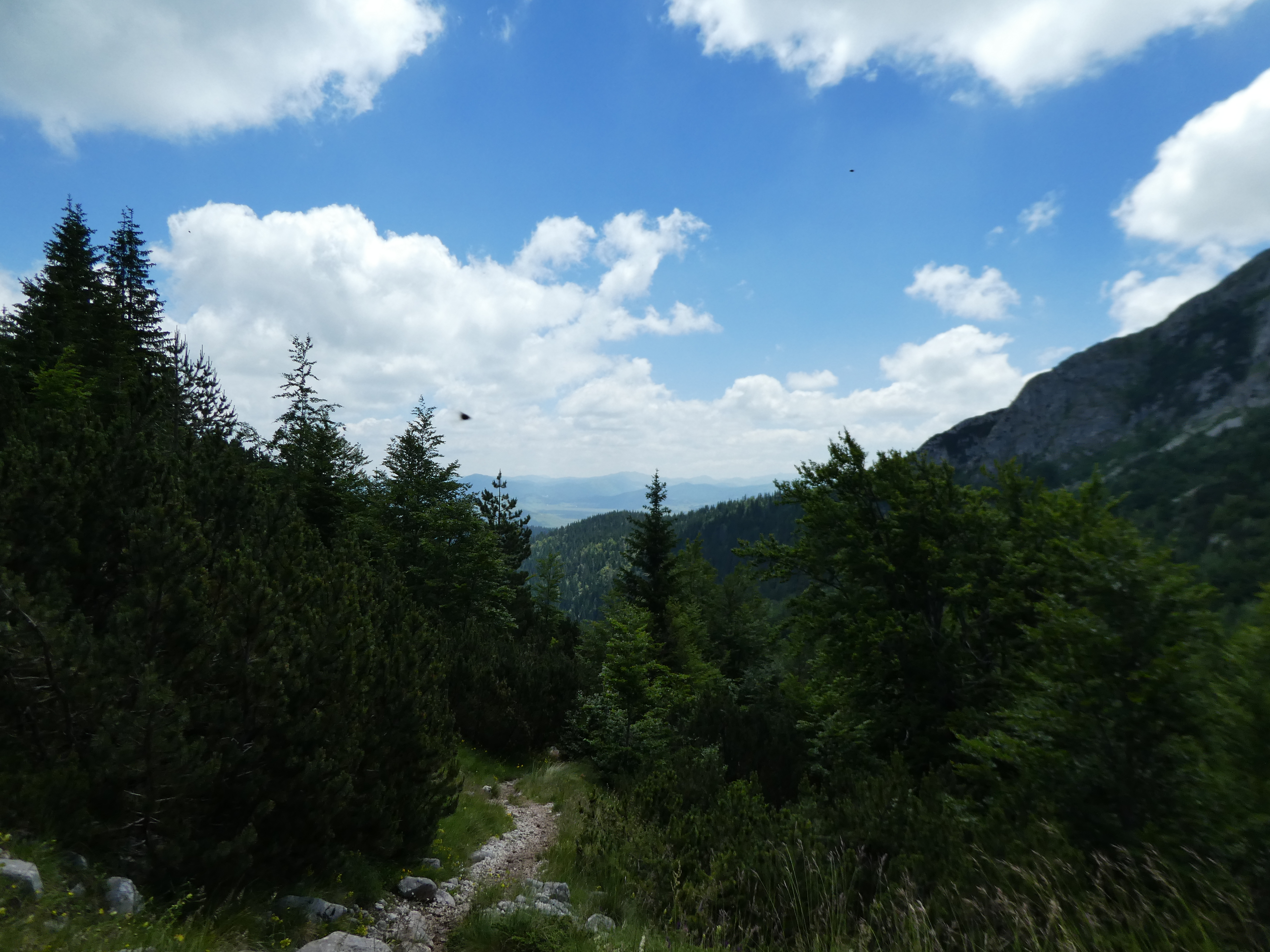

We went up and down over sharp rocky ridges through limestone karst craters, hard going and we kept thinking we had reached the cave.
By watching fellow hikers we at last identified where we were going high up towards the peak of Bobotov Kuk.
At this point called Karrla on the map at around 2000m we decided not to climb any further in the absence of a map and an idea of what we were looking for.
We descended the way we had come, amazed how we had managed to make our way through the scrub but enjoying the flowers and views.


Against our better judgement when we got back down to the lake we decided we ought to walk around the famous Blue Lakes, more up and down but thankfully a bar and a very welcome beer. 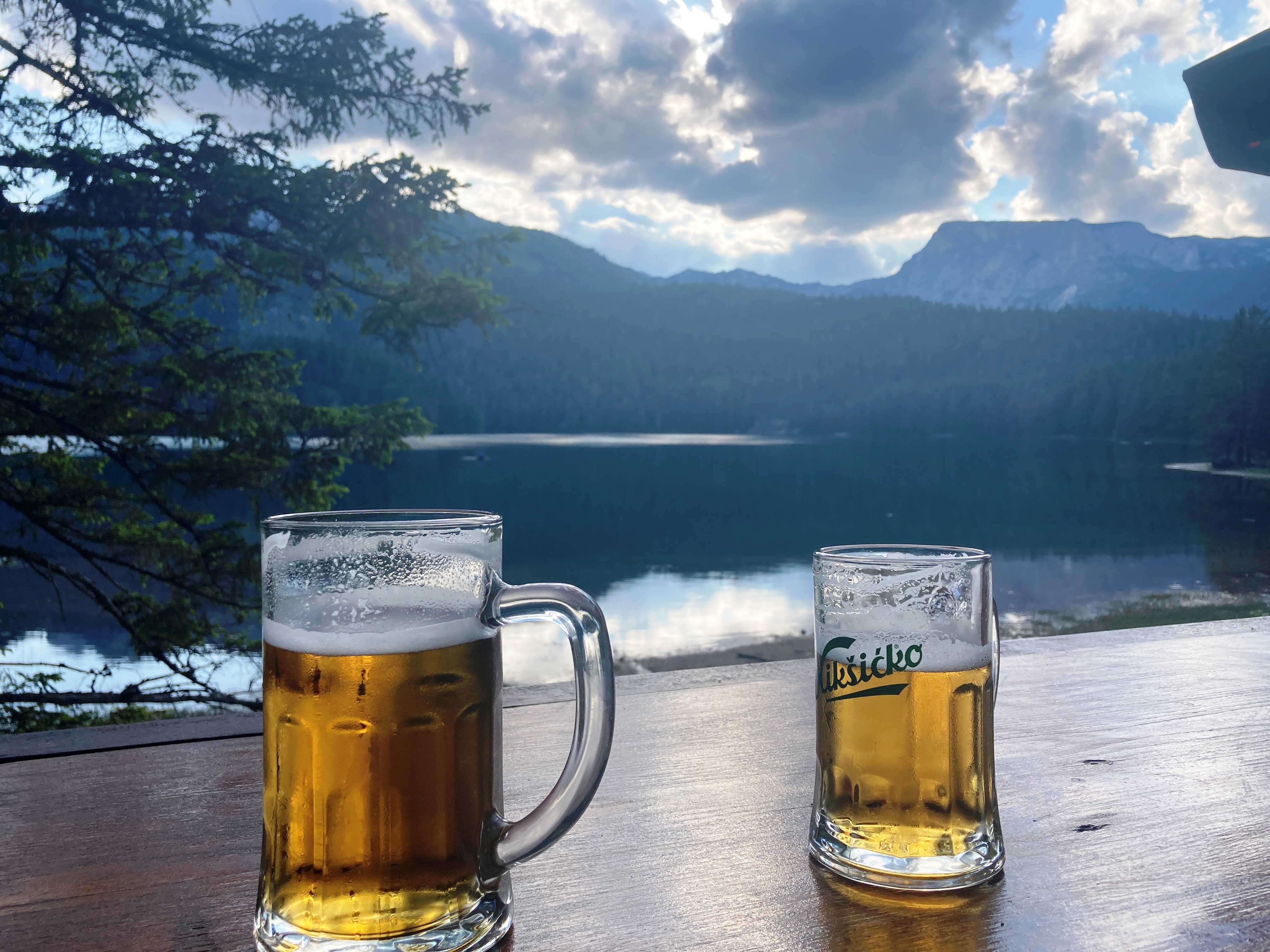
The lakes were interesting as during the winter and spring they joined up as a single although they flowed into rivers going into different catchments one flowing in to the River Piva and the other into the River Tara joining together on the Montenegrin Bosnian border south east of Foca to become the River Drina.
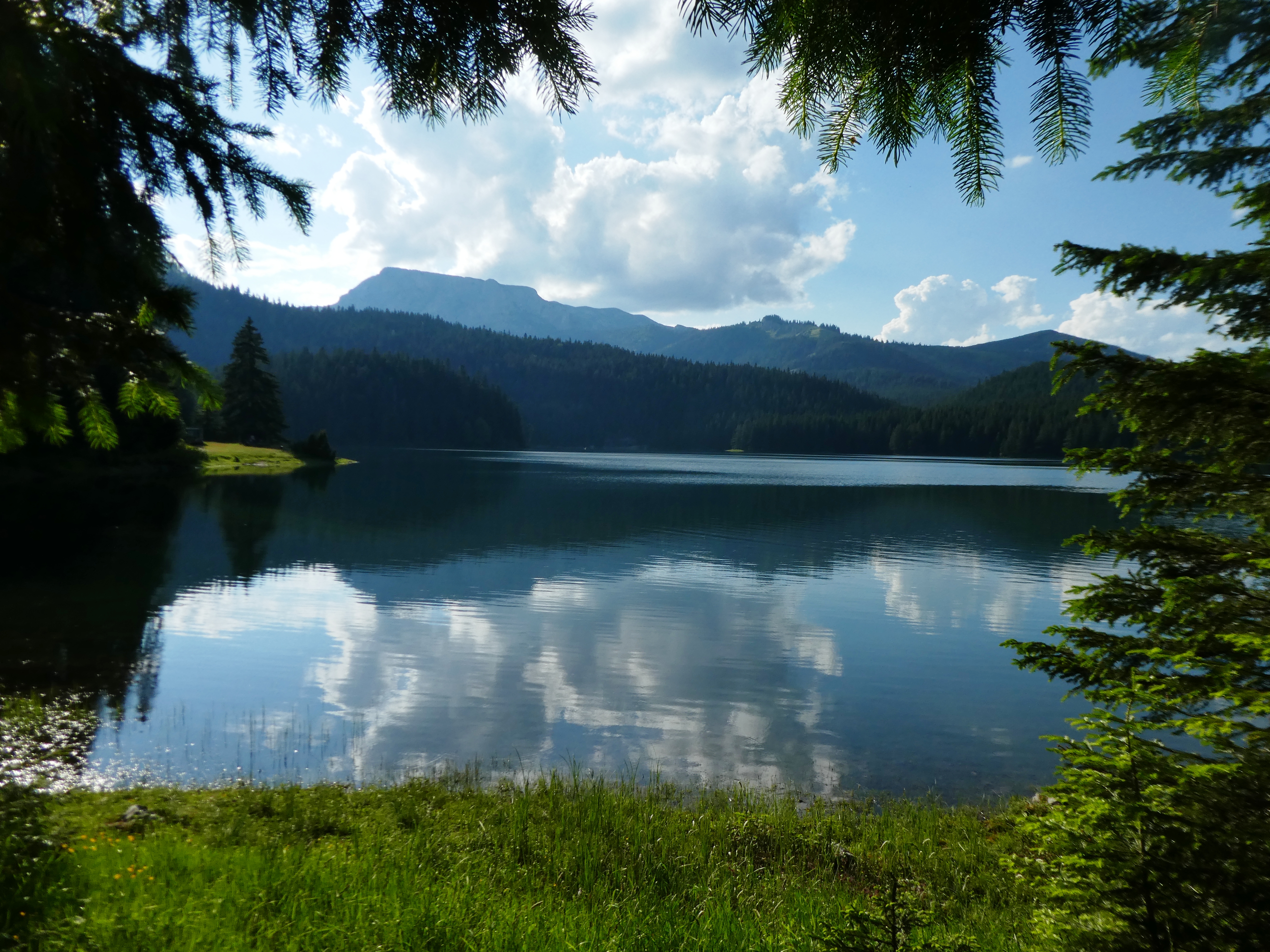
We learnt all this from an Irish man whose family were not so impressed with the walking as he was. 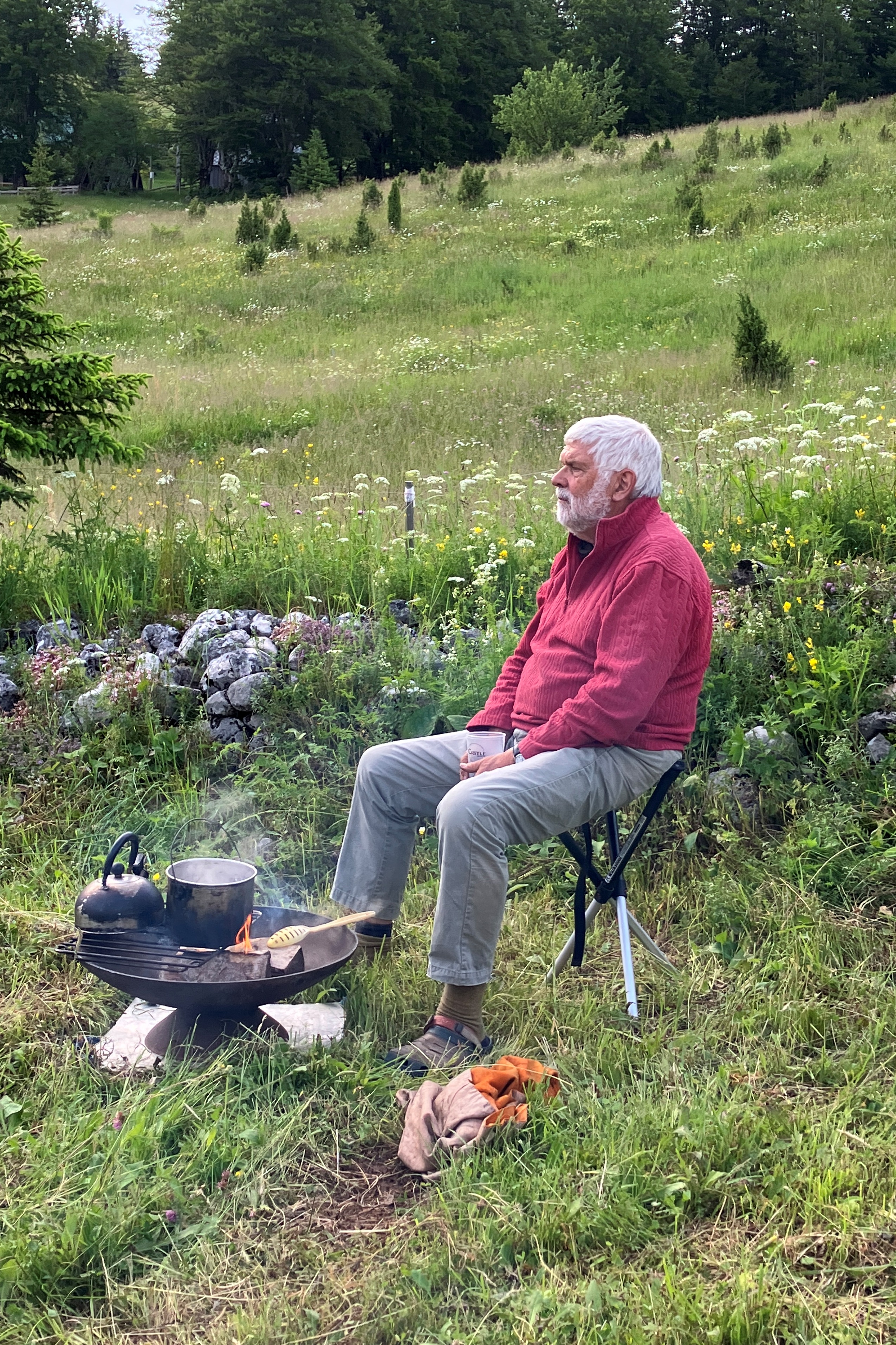
As the lakes were joined up still and we could not cross on the land between them we had to follow a rocky path before reaching the bar.
On returning to the site we found several more happy Czech families camping near to us and it was lovely to eat while children were playing around us.
Tuesday 4th July – Durmitor National Park to Virpazar
There was not a cloud in the sky above the mountains as we breakfasted, it was lovely.
We packed and filled up with water (hosepipe from kitchen area) we then headed a few kilometres south of Zabijak to beautiful high mountain plains where we found the mediaeval cemetery containing numerous Stecci ancient ornately carved headstones set amongst sweeping flower rich grasslands. The sun was shining the air clear and with mountains in the background it was beautiful.


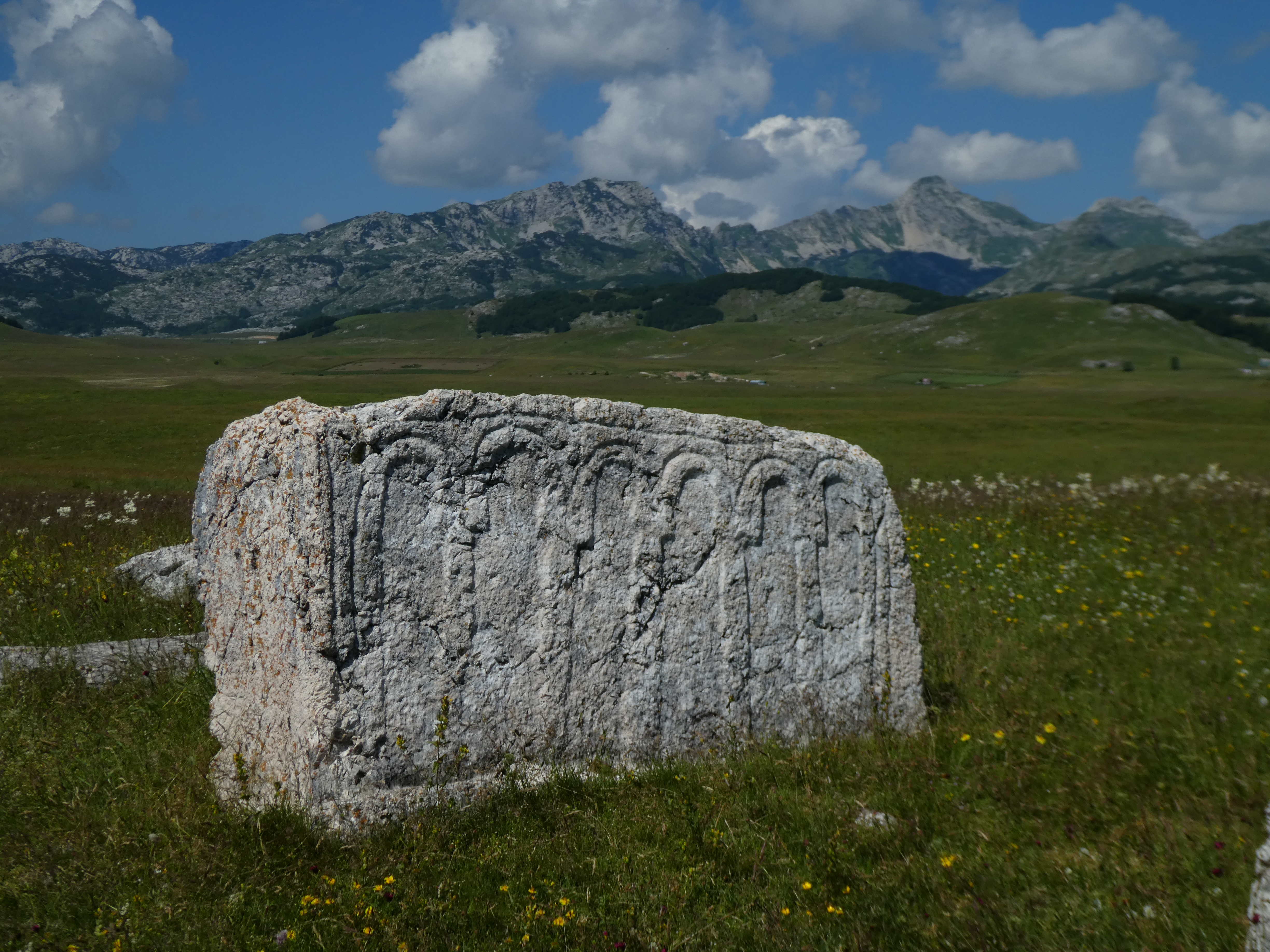

The stones many of them with simple carvings on them, really fascinating, all amongst slightly undulating meadows filled with 100s of flowers and the occasional blue/ green lake framed by the magnificent mountains that we had spent 2 days in.
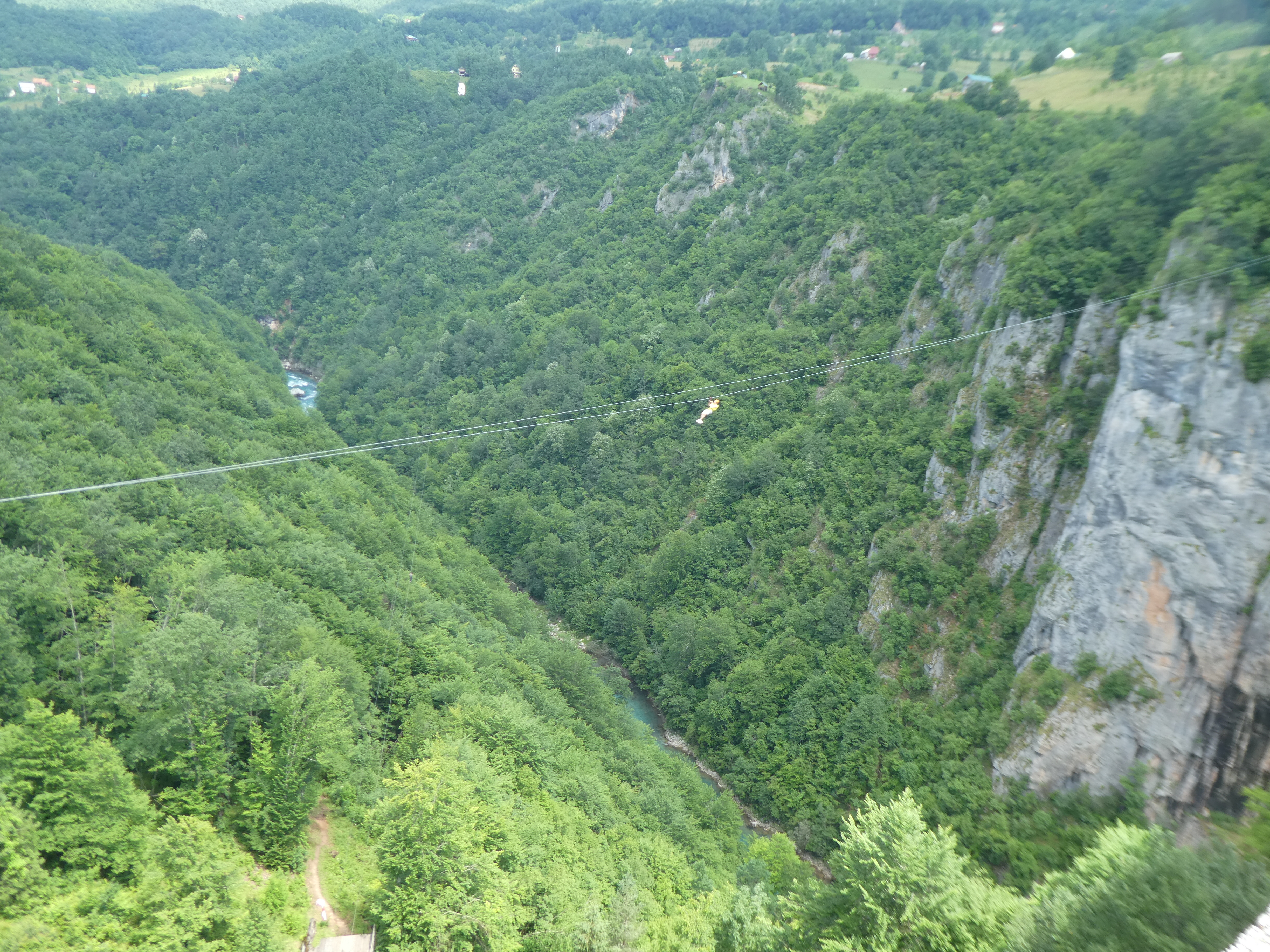
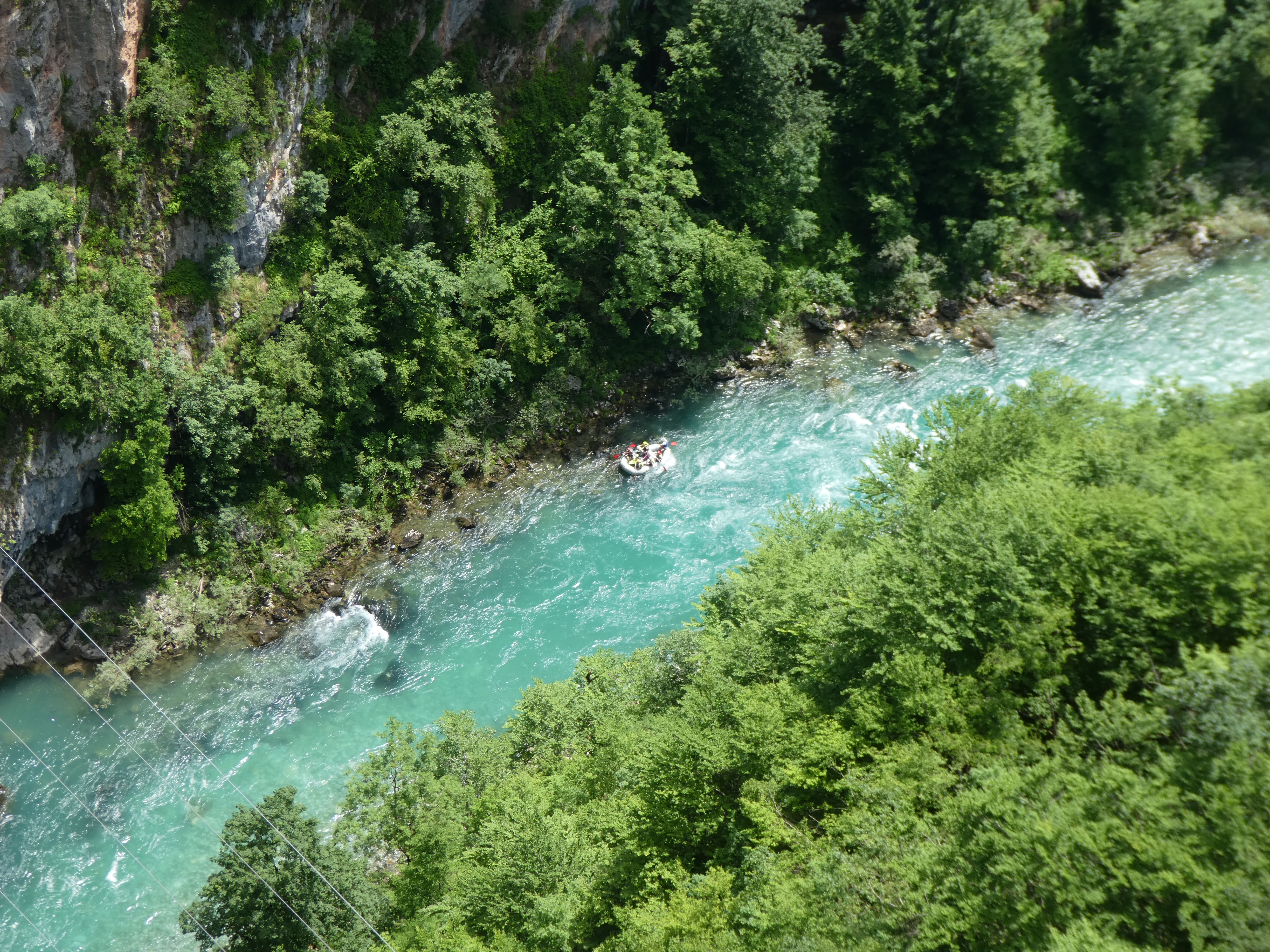

We then went down to the Tara Bridge, which had less people on it than on Sunday. We walked across and looked down people on the zip wires and riding the rapids below on inflatable boats.
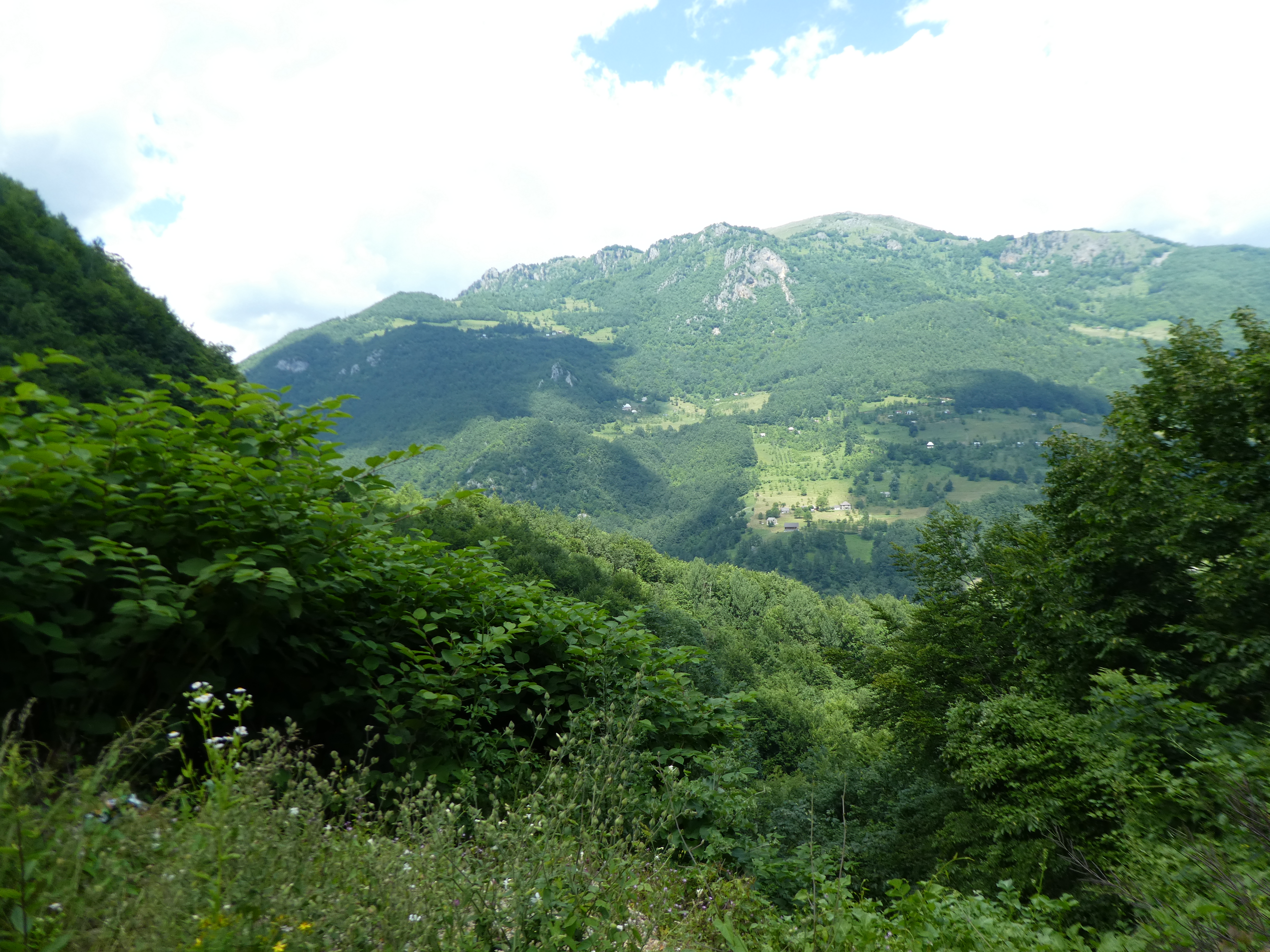
We then drove up the gorge for miles and miles witnessing spectacular scenery, we couldn’t believe how long it was.
We were also disorientated by the way it the River Tara flowed north rather than the south towards the Adriatic. In fact it flows north to join to become the River Drina that flows along the border of Serbia and Bosnia until it flows into the River Sava which itself flows into the River Danube at Belgrade.
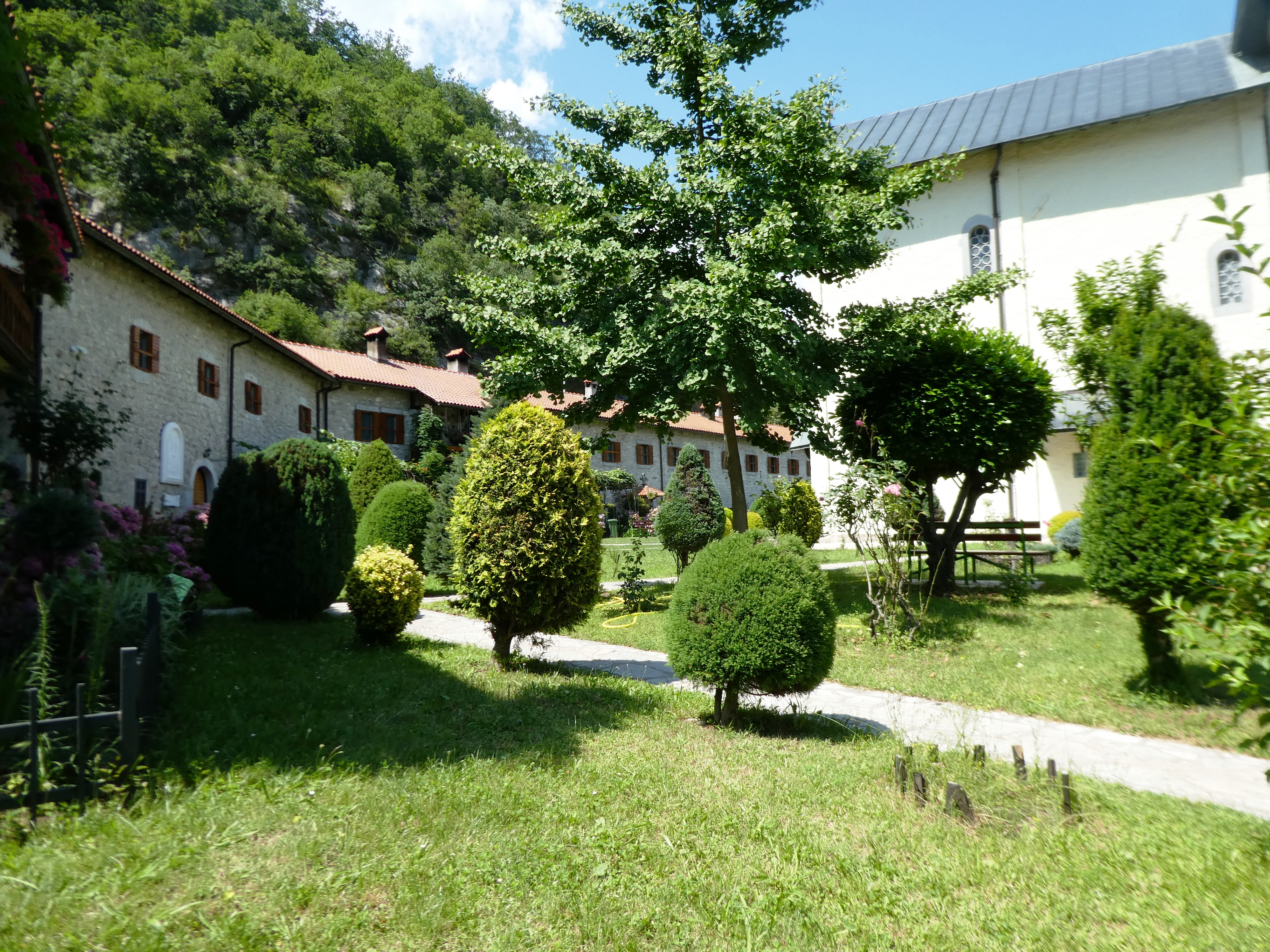
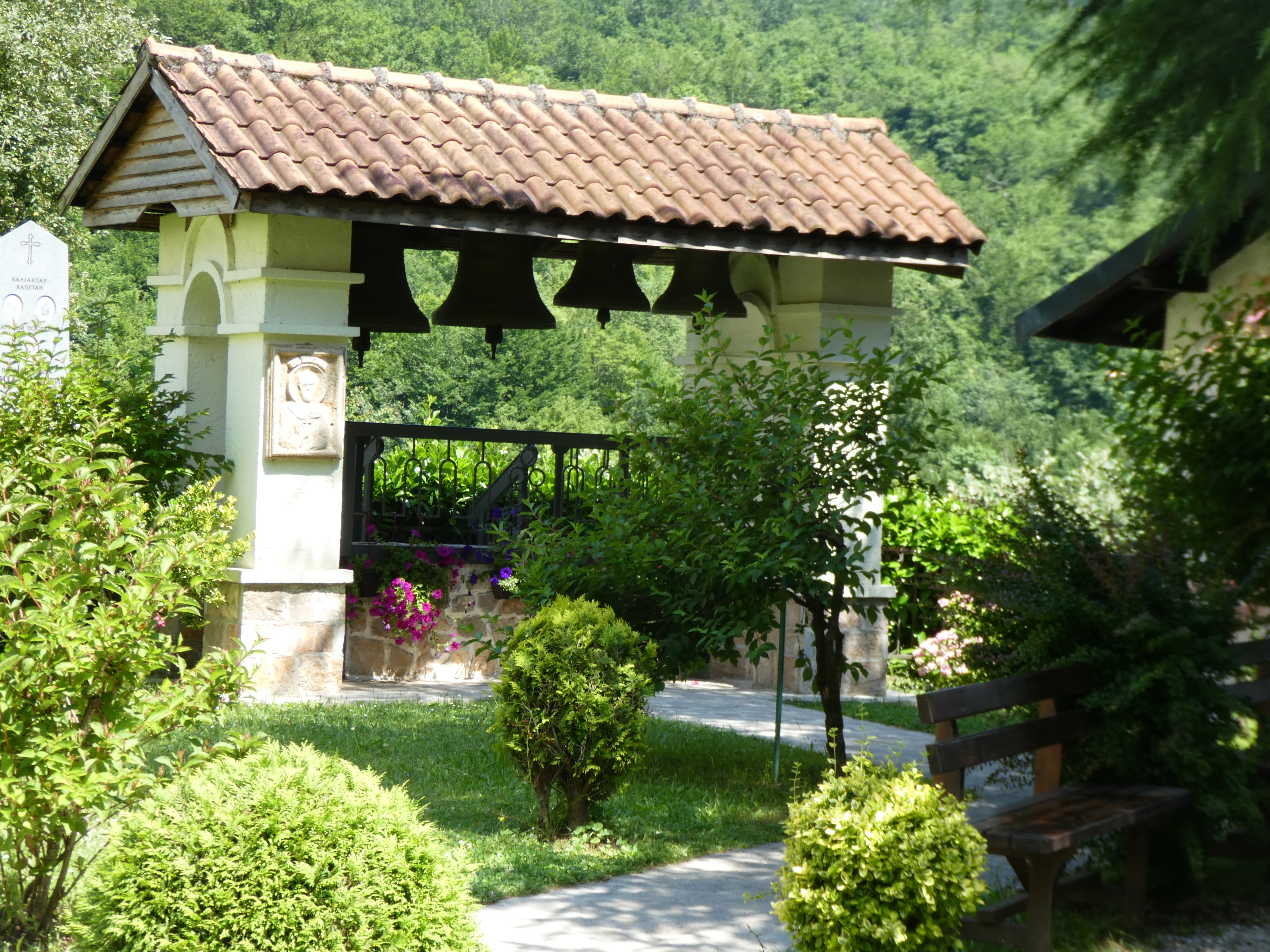
When eventually we came up onto a high plateau ridge that forms the watershed where we join the River Moraca we then went down and stopping at the Moraca Monastery. The Serbian Orthodox monastery built in 1252 is one of the best known mediaeval monuments in Montenegro. 
It comprises of two main churches one to the Assumption of Mary and the smaller one to St Nicholas and our trip is enhanced by the presence of a guide taking a couple of people around explaining the history and architecture in English.


Every part of the walls were covered in 13th century frescos, some of which were damaged in the 16th century during the rule of the Ottoman empire.
In St Mary’s Church many of the frescoes have been renovated but several are still original.
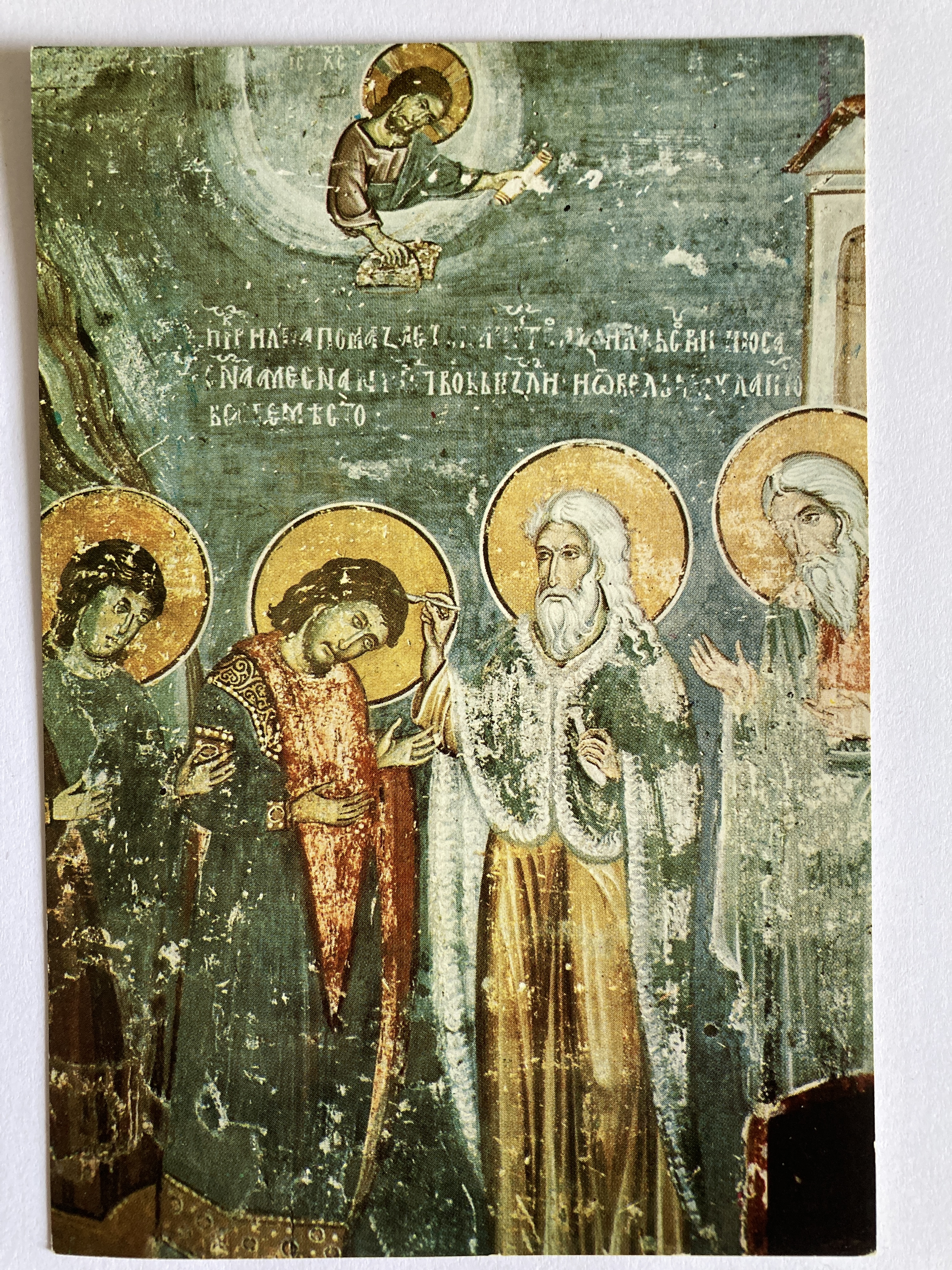


The frescoes in St Nicholas’ Church are even more impressive.
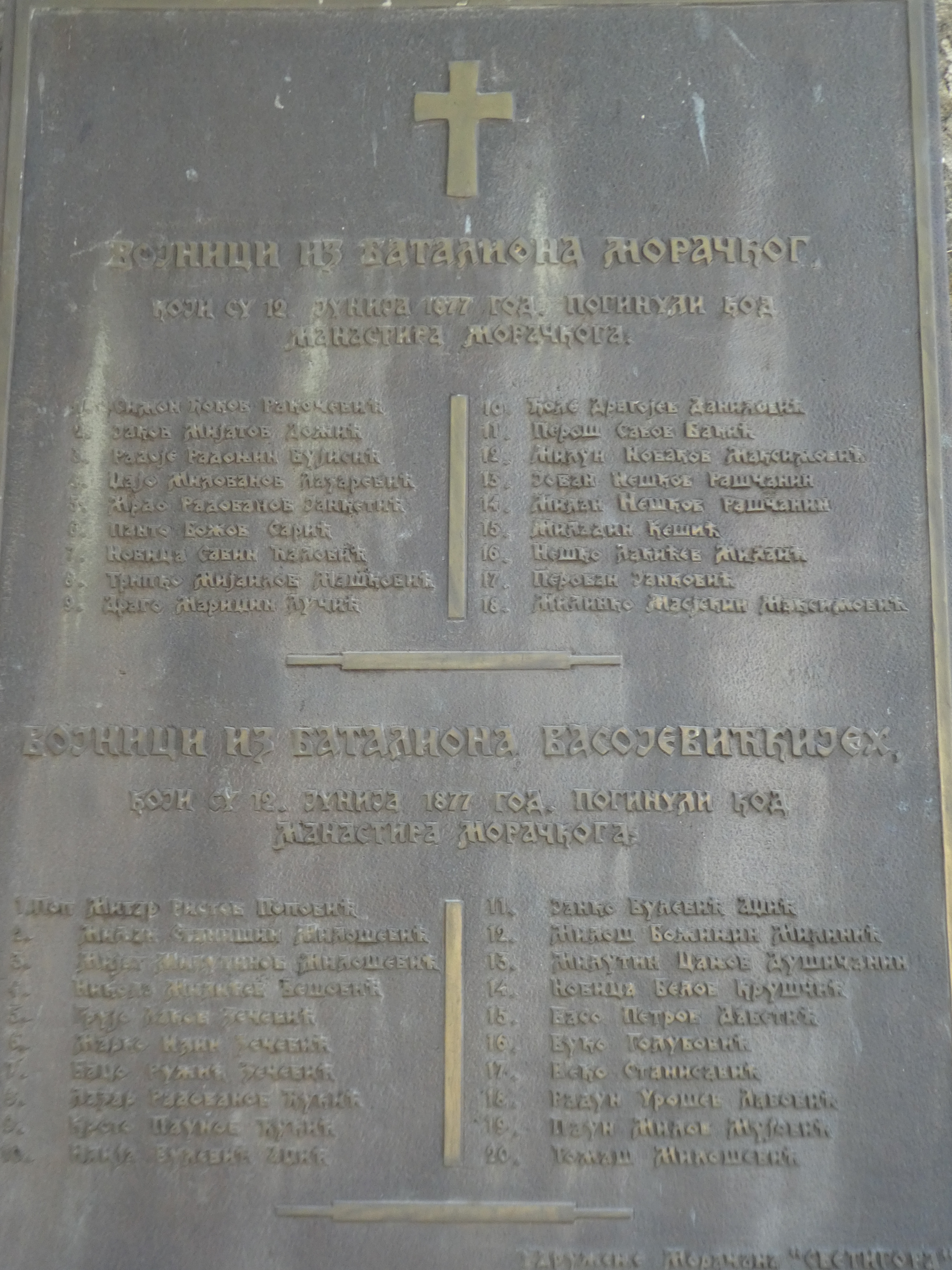
The only disturbing detail is the monuments and memorials written in Russian. Why this more so that other monuments in Latin elsewhere in Europe I don’t know.
With temperatures soaring into the mid thirties we continue on after a much needed beer in the shade at a café by the monastery. We follow the River Moraca through more gorges to Podgorica and onto Virpazar on the amazing Skadar Lake.

Looking for a camp site to the south along the lake we travel along a narrow twisty road, over the mountains above the lake for eighteen kilometres.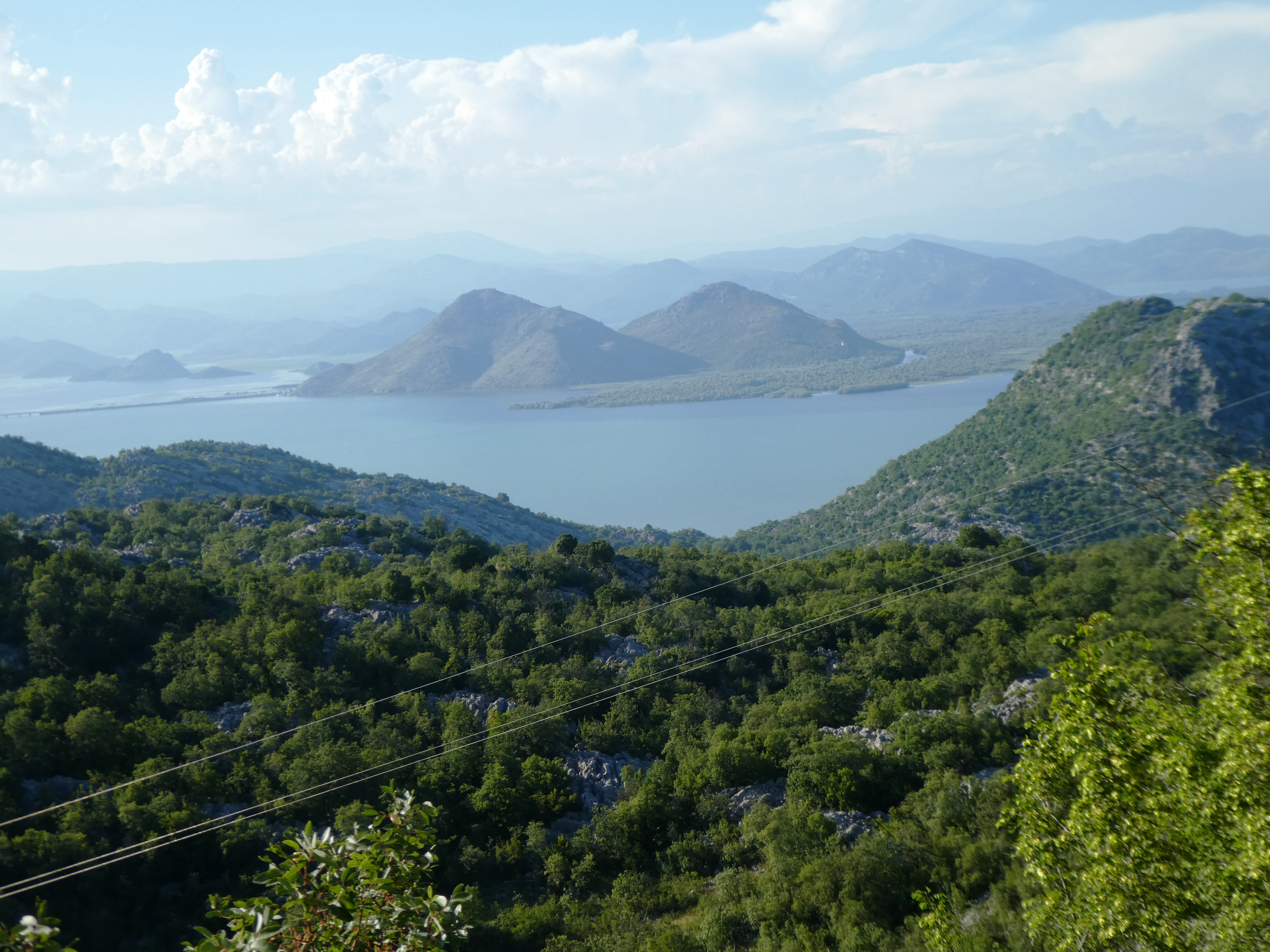
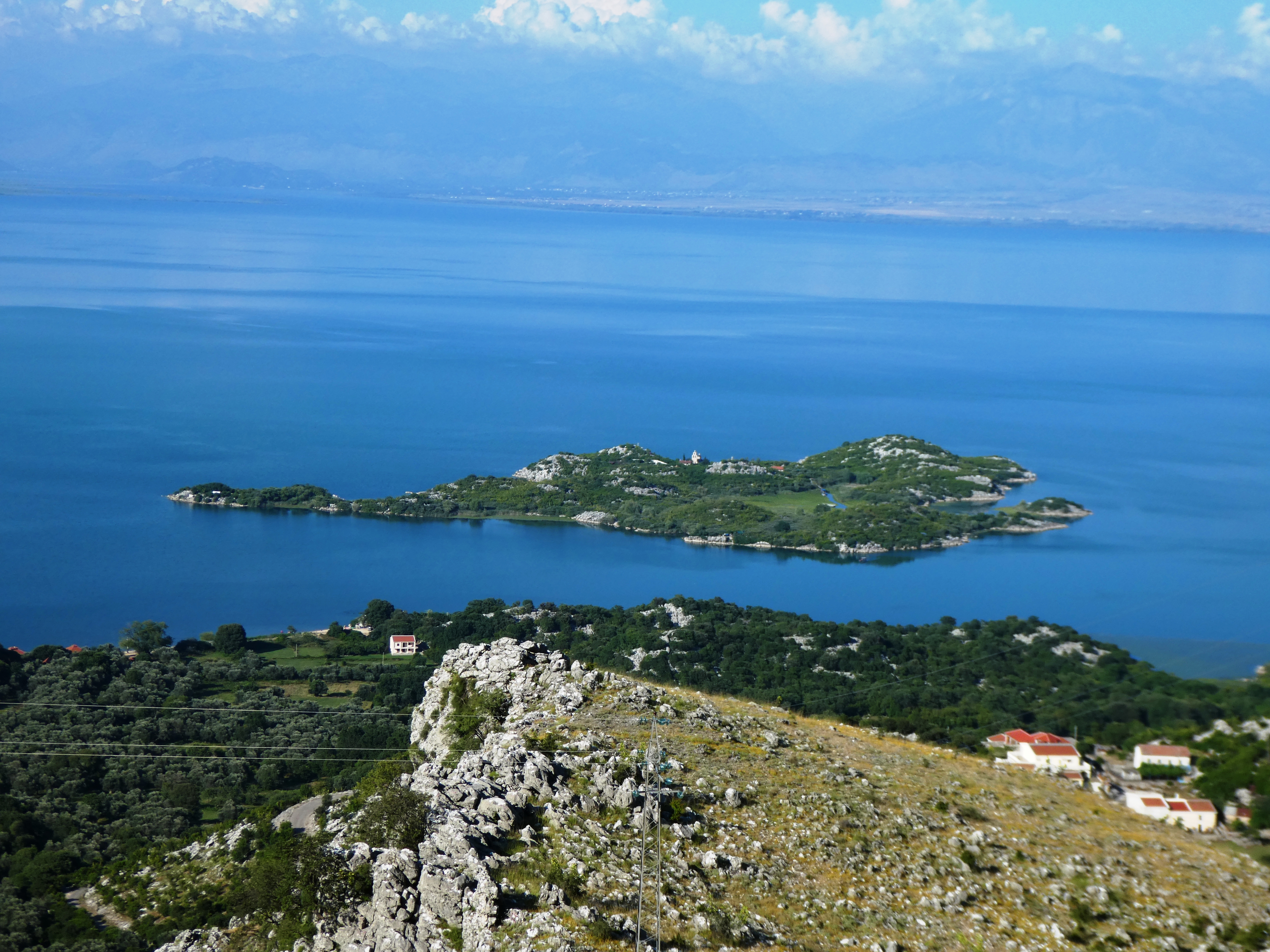
At one point Janet rescues a slow road crossing tortoise and puts it safely into the bushes.
The camp site we are looking for does not materialise realise so we turn around at Besa and head back to Virpazar and Camping Lad.
On reaching the site it seemed scruffy and three lots of dogs poo had to be cleared before we could set up. The toilets and showers were in open blocks and there initially appeared to be no wash basins.

Feeling tired we walked into the town had meal at the Restaurant Pelikan watching the antics of traffic manoeuvring outside a supermarket and negotiating with trains to get over the level crossing. Janet received a complimentary box of Sage tea from the manager of the restaurant as did all ladies.
Thinking about tomorrow we take a leaflet from a lady selling boat trips on the lake before returning and finding wash basins and a quiet site.
Wednesday 5th July – Virpazar to Kotor
Having decided that the site was passable we were awoken at 5am by a group of eight young Czechs who turned up in their van and proceeded to out up their tents!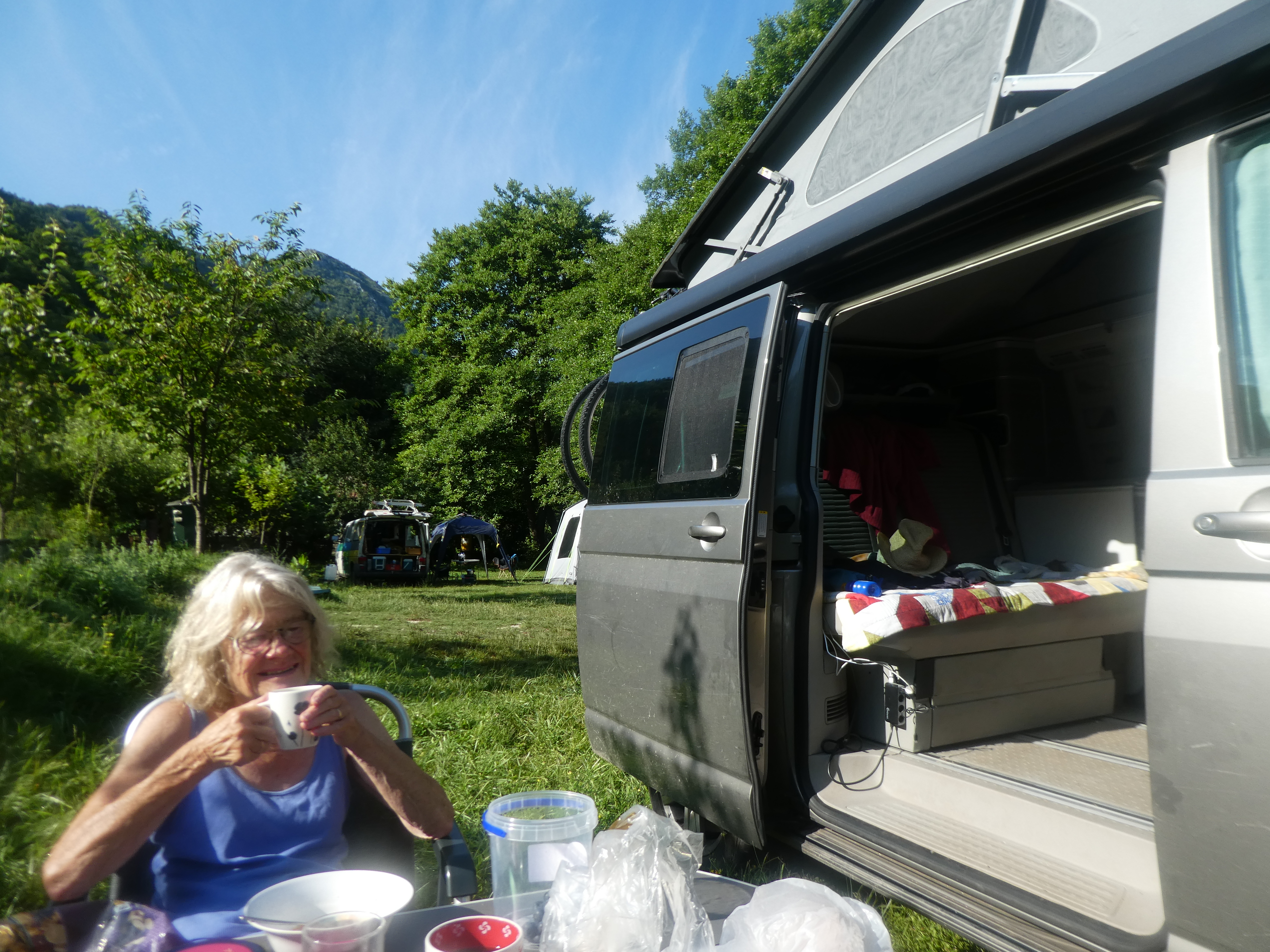
We decided to move on so after a pleasant breakfast in the sun which was promising to turn into a scorcher of a day.
We pack up and park in the town before getting ourselves a ticket for the 11am boat for a two hour trip around the lake.
 We had time to kill so we wandered around Virpazar in the heat looking at the old stone causeway that made the town historically important.
Vir (whirlpool) Pazar (Market) is first recorded in the 13th century and became an important crossroad for trade between the north south and east trade routes especially in the 19th century.
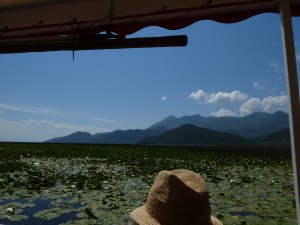
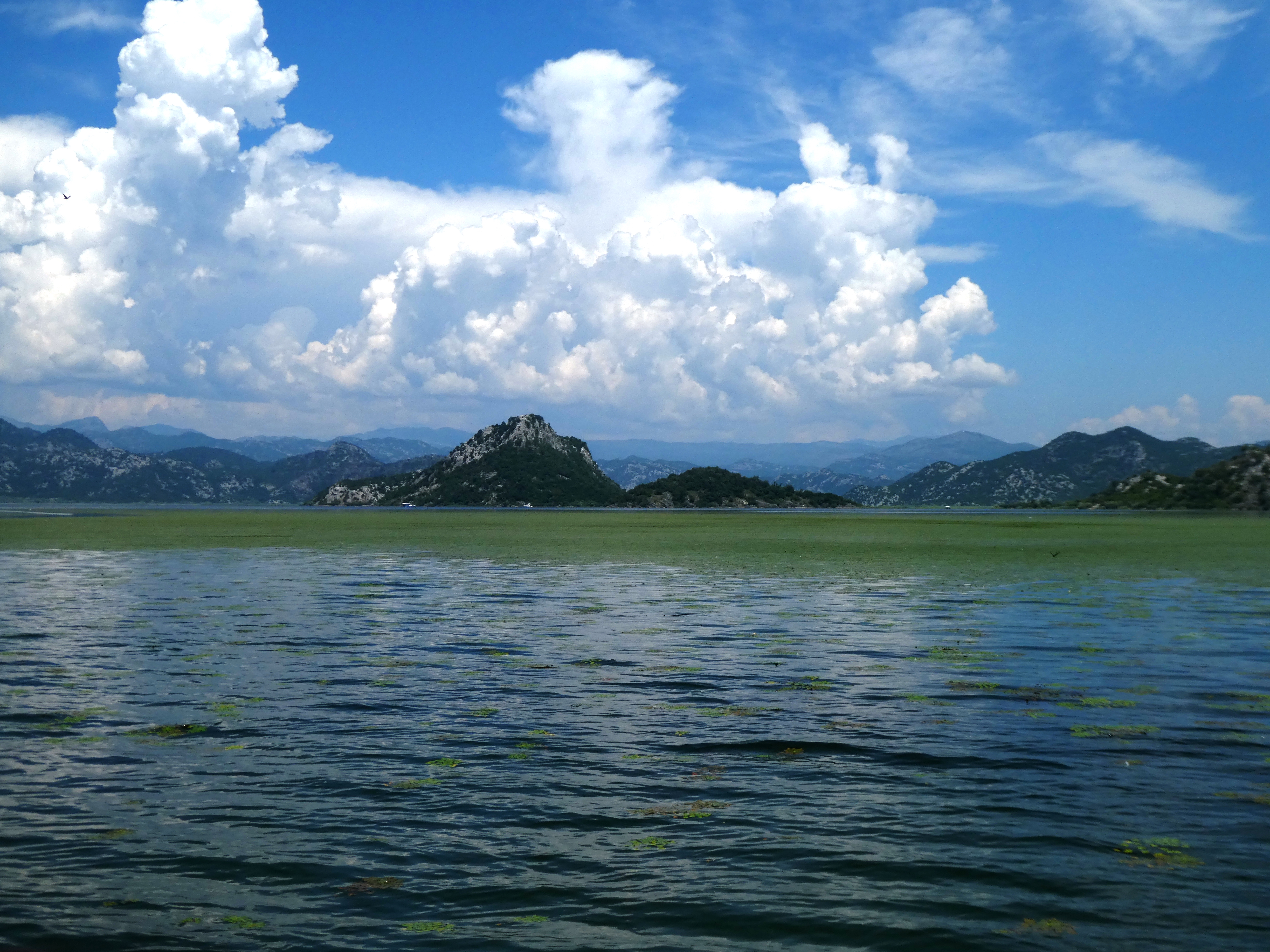
There were eighteen of us on the boat and we were taken out through the reed beds to the open lake.

We passed under the road and rail bridge crossing from Valpazar to Podrica. It was fun to see the trains that had chugged slowly through the level crossing in the town last night trundling over the bridge.
On the lake there were lots of terns, great crested grebes, cormorants, a few egrets, heron and a crane not amazing but July is not the best month for bird watching.
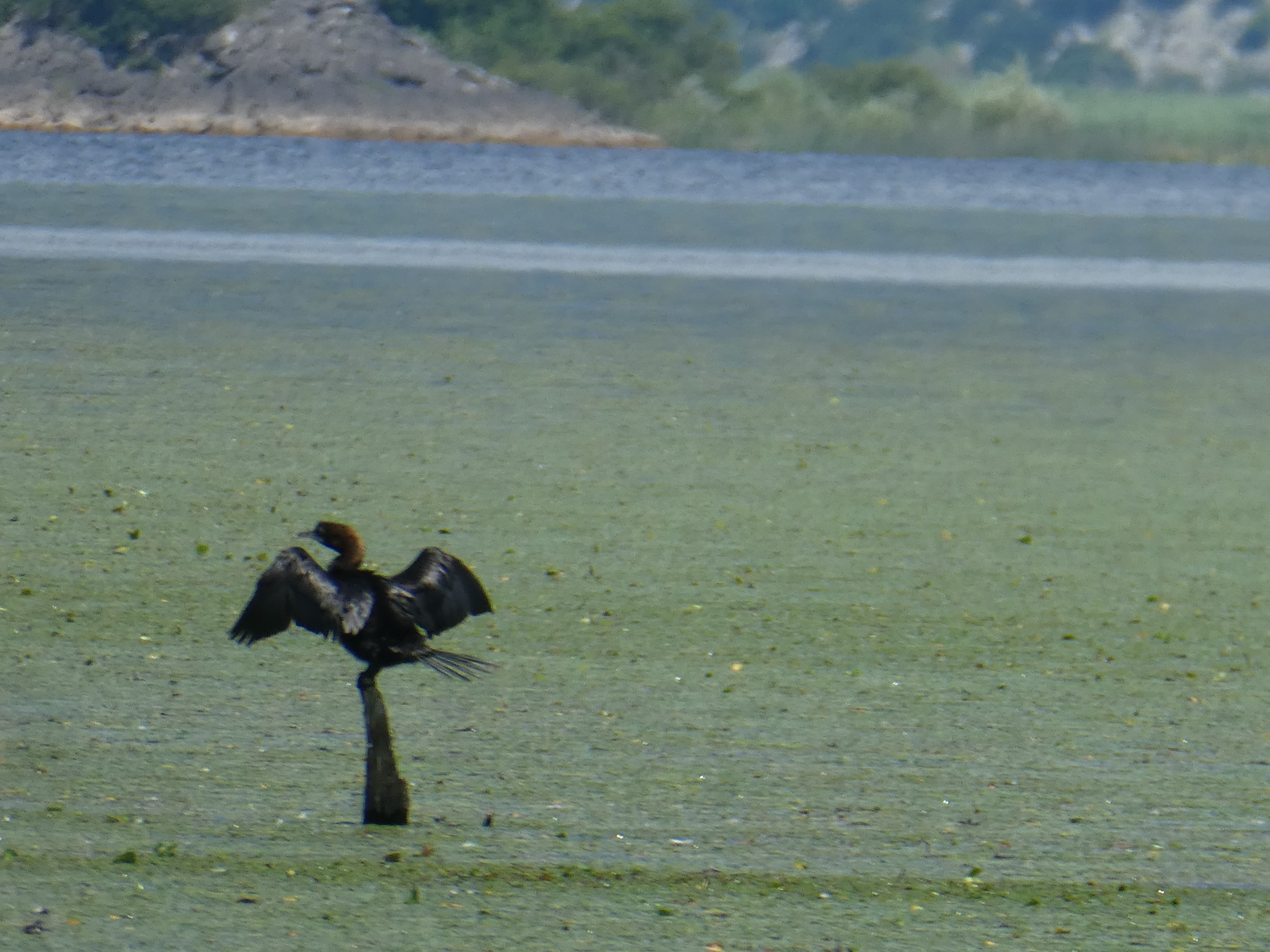


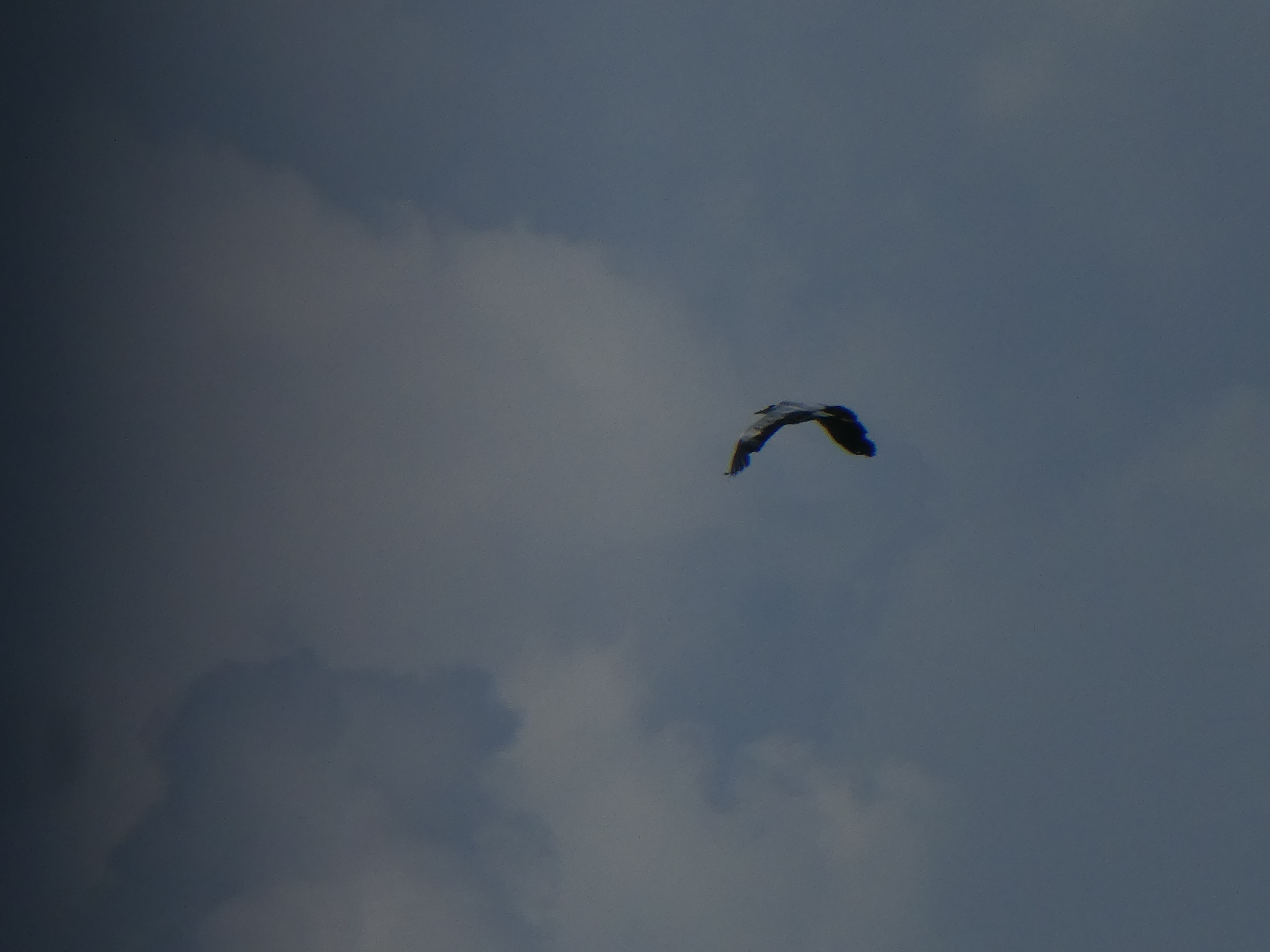 We went north through the lake and then on the way back stopped by a beach where there was an opportunity for a swim and refreshment.
Towards the end we spent 20 minutes on a beach where you could swim and buy a drink.
It was nice to experience the lake from the water and we thoroughly enjoyed it the views of the surrounding mountains especially.
We had lunch at a restaurant in the town before driving through the tunnel to the coast where we swam at Petrovec Beach. It was of course crowded but lovely to swim in the Adriatic Sea.
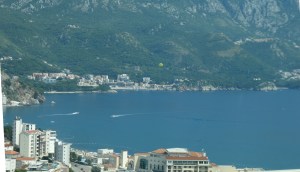
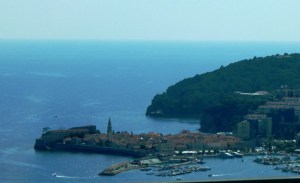
We then travelled north up the coast to Budvar with spectacular views across the Adriatic until we turned inland and climbed up over another mountain range to the plateau of the kingdom of and the old colonial city of Cetinje.
This had previously been the capital with an old monastery built in the 15th century. Here we wandered around admiring the diversity of old buildings.
In the 19th Century it was the capital of Montenegro and King Nikola had invited the ambassadors of all the major to visit to build there. When they were there he tried to marry off his daughters to create ties to other nations.

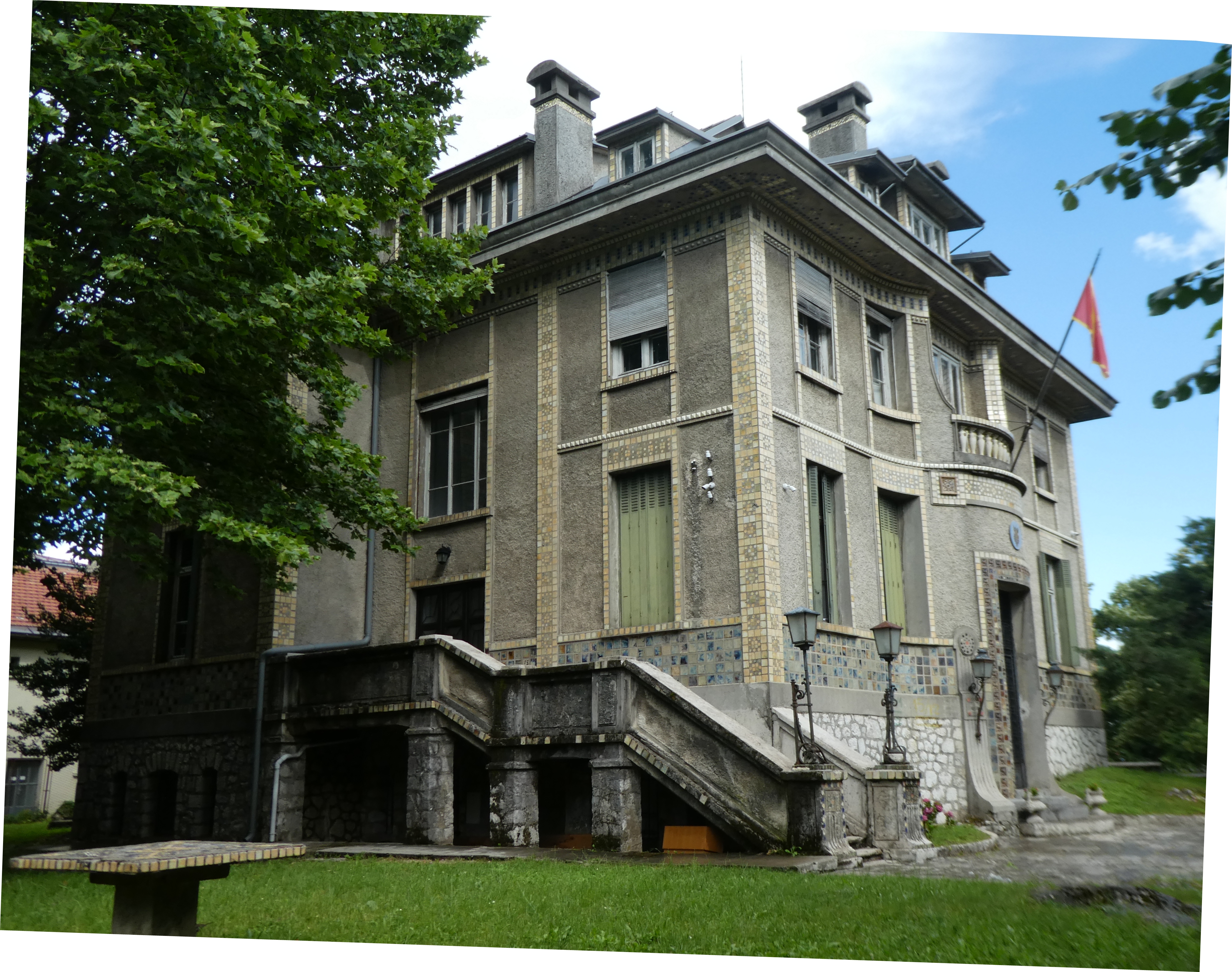
We had a beer and travelled on across the mountains to Kotor. It was a lovely new road going up but coming down the road twisted and turned and was very narrow for over five kilometres.
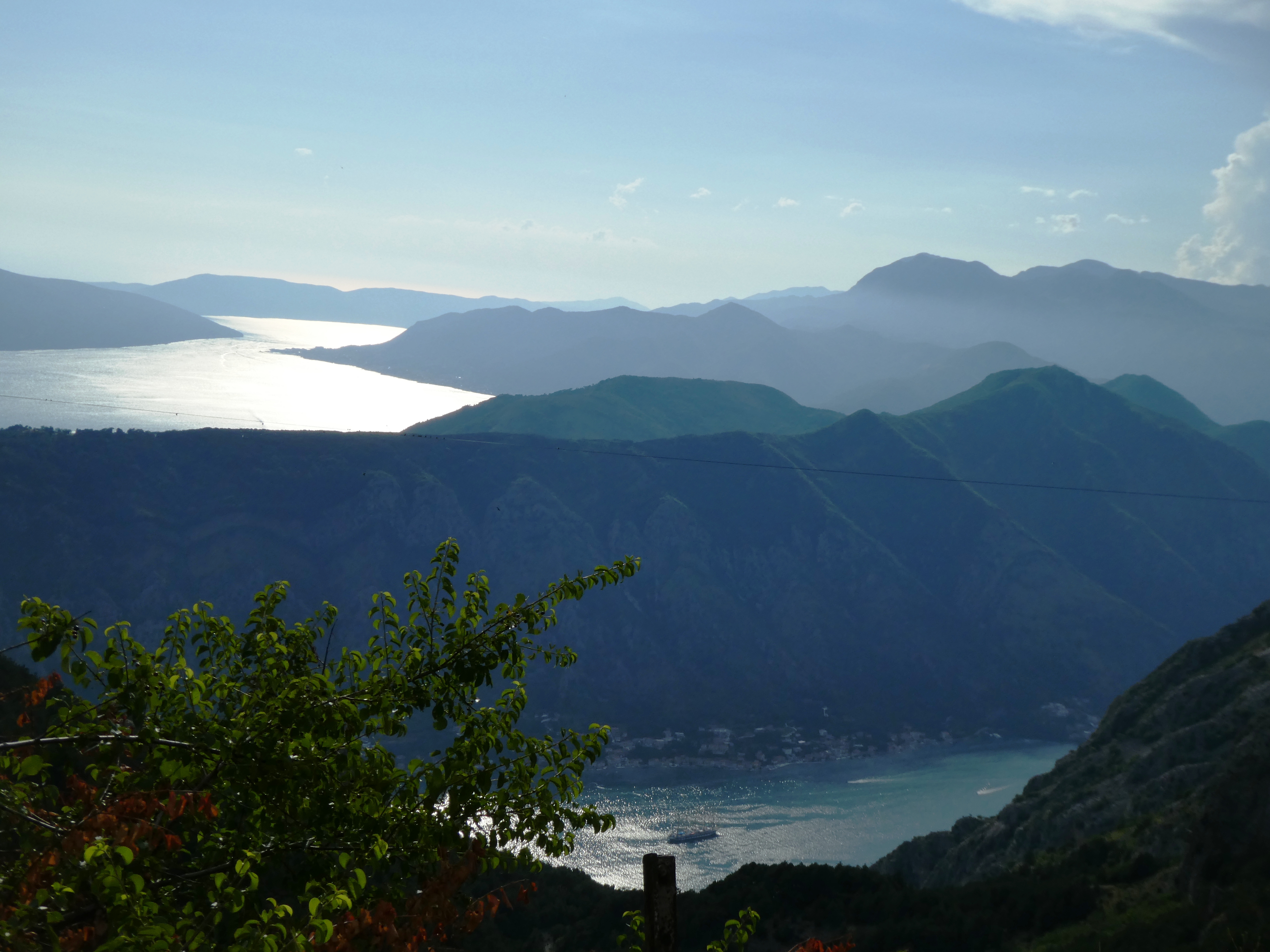

We stopped because the views were amazing.
It was around 6.30 when we drove through Kotor and along the road north of the town alongside the water.
This again was busy with people and traffic but lovely so many people using the waterfront across the road from their houses, eventually we reached Camping Mimoza and drove in the narrow gateway.
 It seemed very full but the owner found a space on the far side which would just let us put the roof up under an old caravan awning frame. It felt good with showers, toilets and basins but clean and conveniently very close by.
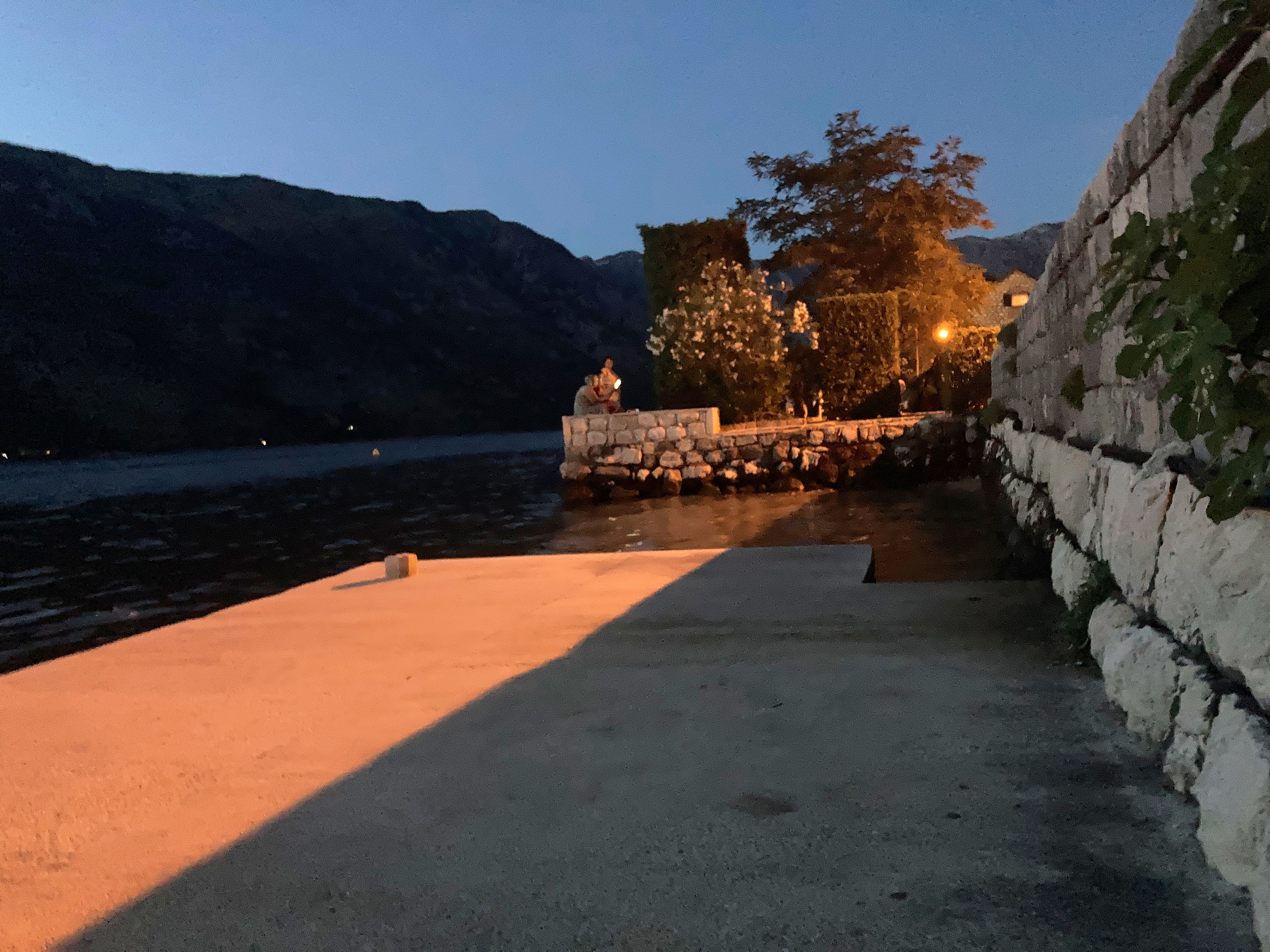
After tea we sat on the side of the water watching the lights as it grew dark.
Thursday 6th July – Camping Mimosa, Tivat
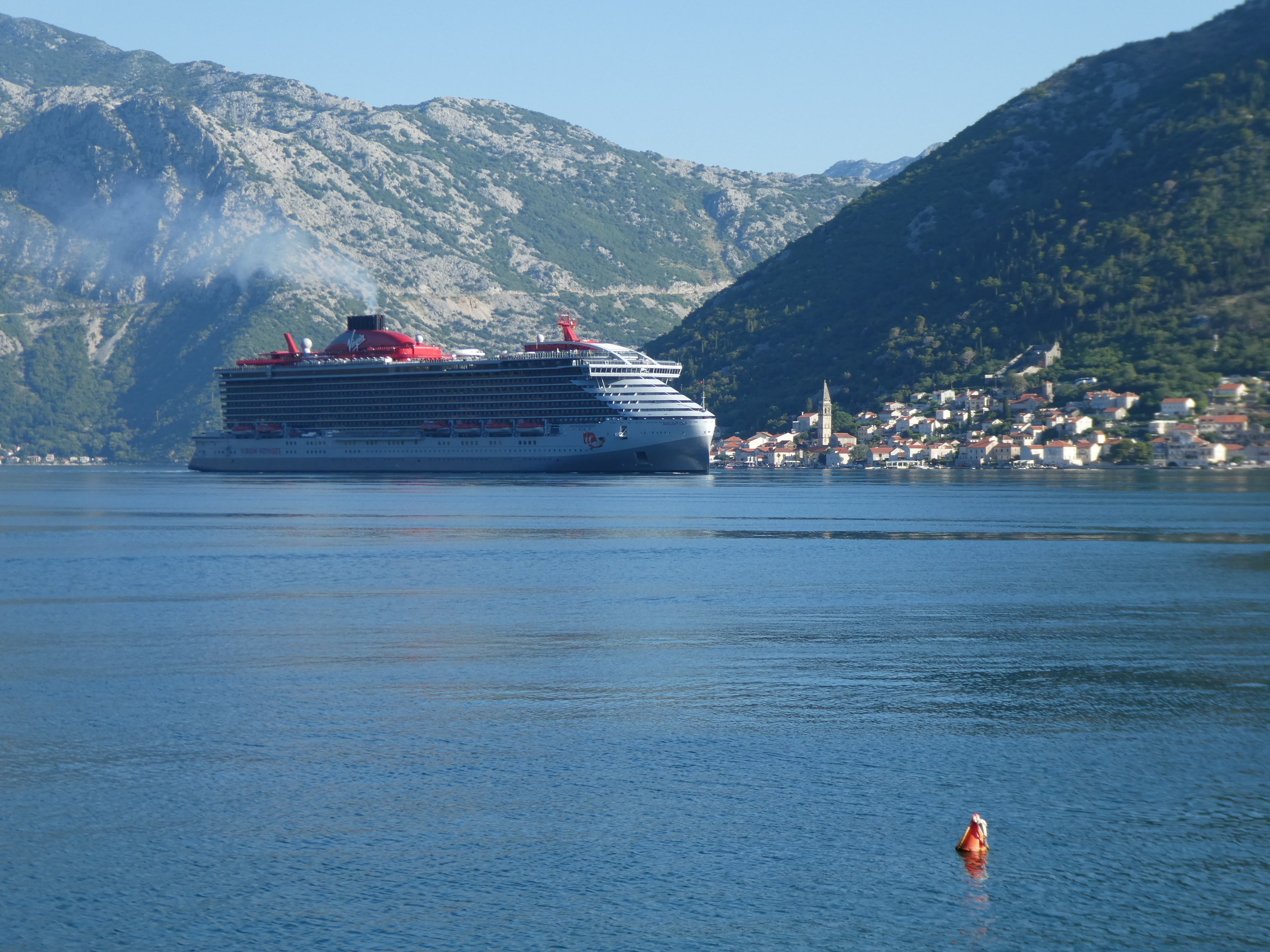
We were awoken bythe horn of a cruise ship monstrously entering the inlet that led to Kotor harbour.
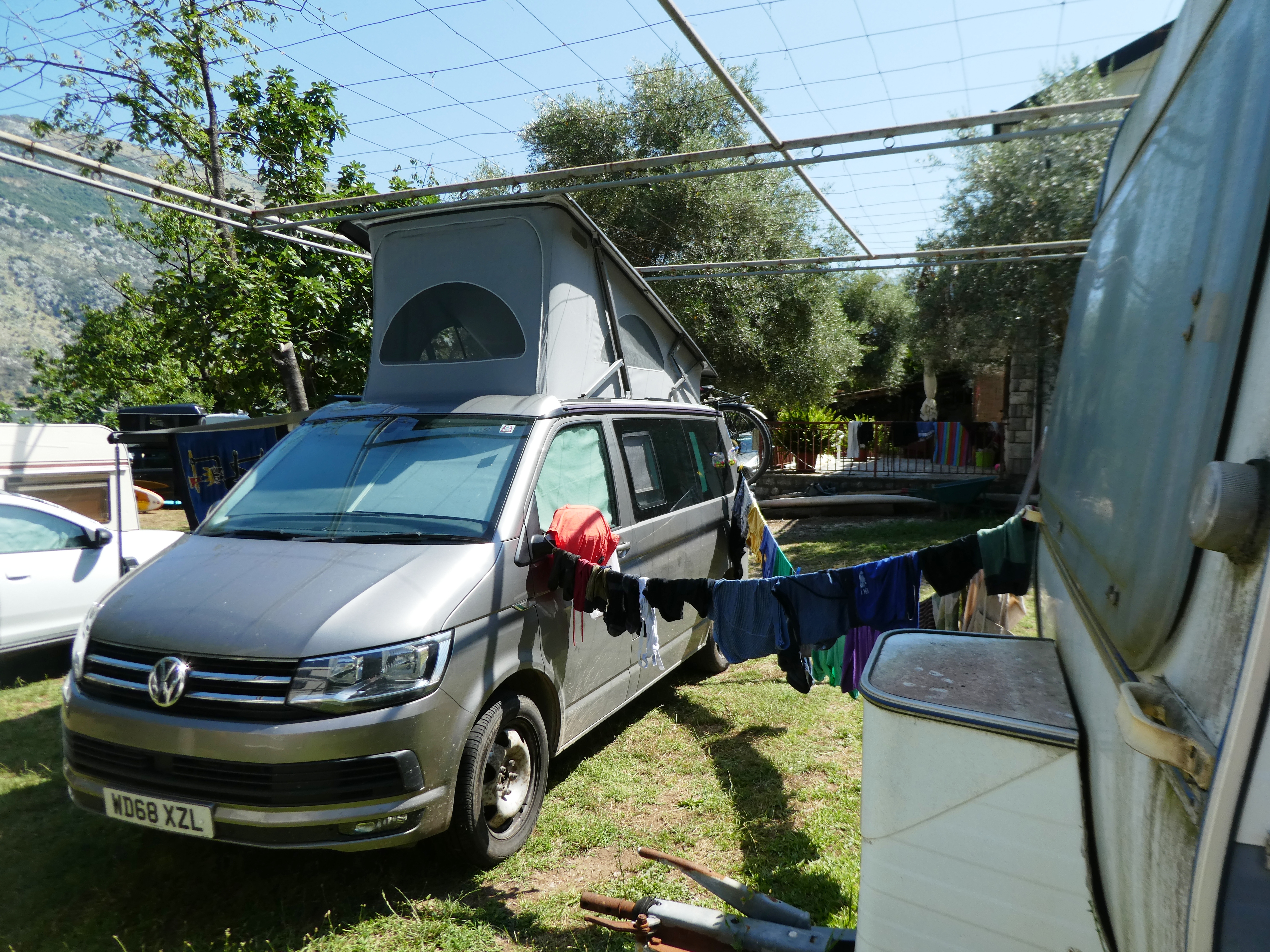
After a leisurely breakfast and apart from doing loads of washing first thing we had a really lazy day.
We swam from the jetty infron of the camp site before showering and walking along the shoreline towards where tomorrow’s ferry would leave.

There was a small church on the point where you could see around the corner to the ferry at Lepetani.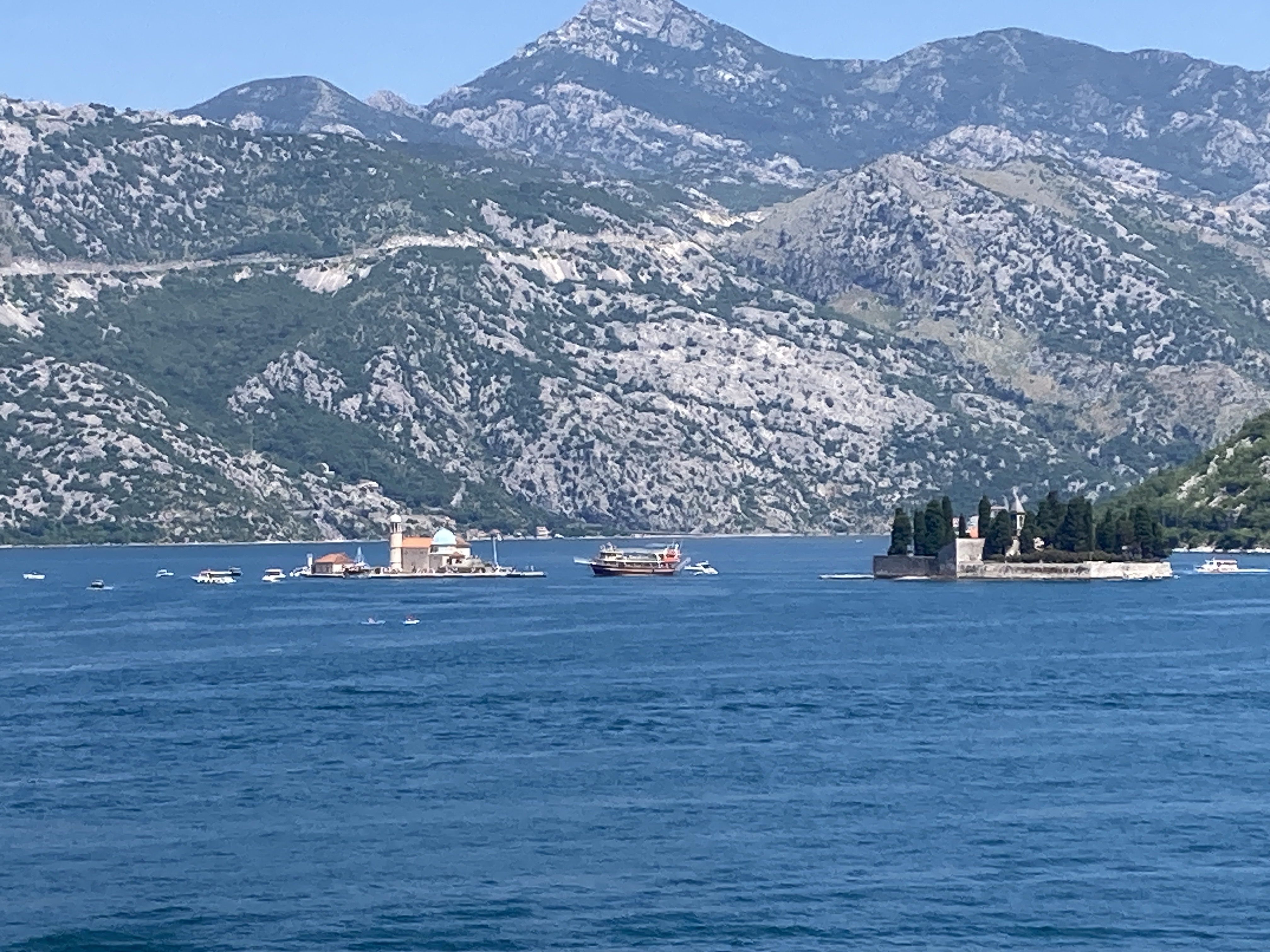

We wandered back to the campsite for lunch before swimming off the jetty and reading all afternoon.

We walked te other way in the afternoon along the busy waterfront to get a view back towards Kotor.
The camp site filled up and as with us vans were jammed in everywhere the only little downside being that we lost our view of the water.
We managed to get a good view out over the water later though when we had supper in the campsite restaurant.
Friday 7th July – Camping Mimosa to Dubrovnik
Up early, swam and packed the van and so that we were away by eight.
When we arrived at the ferry there were loads of vehicles queuing but it was well managed.


Ferries seemed to materialise out of nowhere and we were soon across and in a very slow queue of traffic heading to Heceg Nova and the border back into Croatia.
Once there the traffic thinned and we made good progress to Dubrovnik.
 We checked out a supermarket car park as we were told the van would not get into the hotel car park so need somewhere to leave the van overnight, but it was a nightmare.
So we went to Hotel Lero where we had booked a room and as we drove in the barrier was open to the outside car park so we drove in and parked and checked with reception it was ok.
We were of course delighted to get in but we were rightly cheesed off that the hotel said we couldn’t park there but also that we couldn’t use the underground car park as it was 2.2m would would not have been a problem.
We were too early to book so we explored the area and soon found ourselves down on the beach which proved to be private so we blagged our way up through the Hotel Vapour to get back to the road.
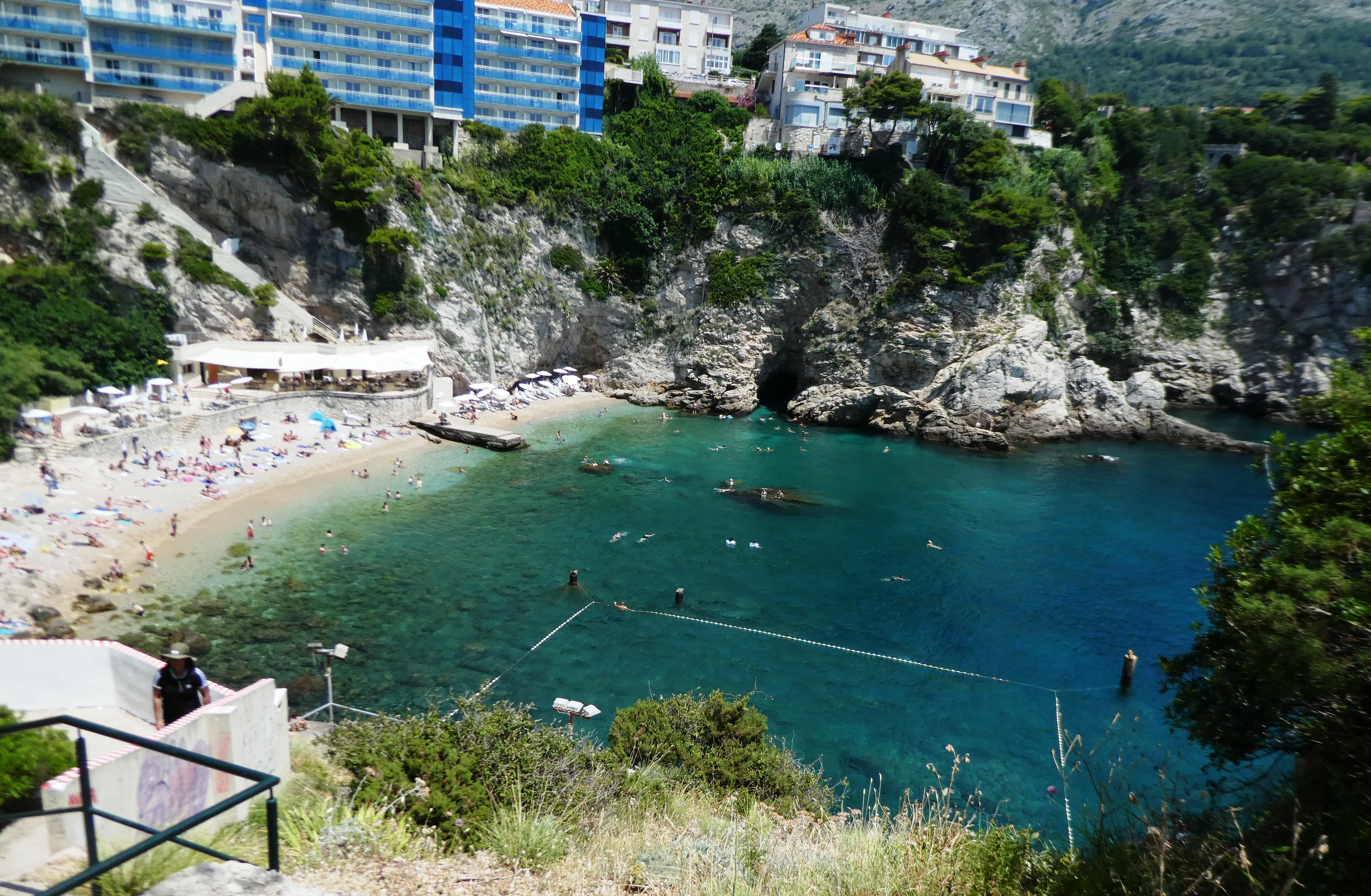
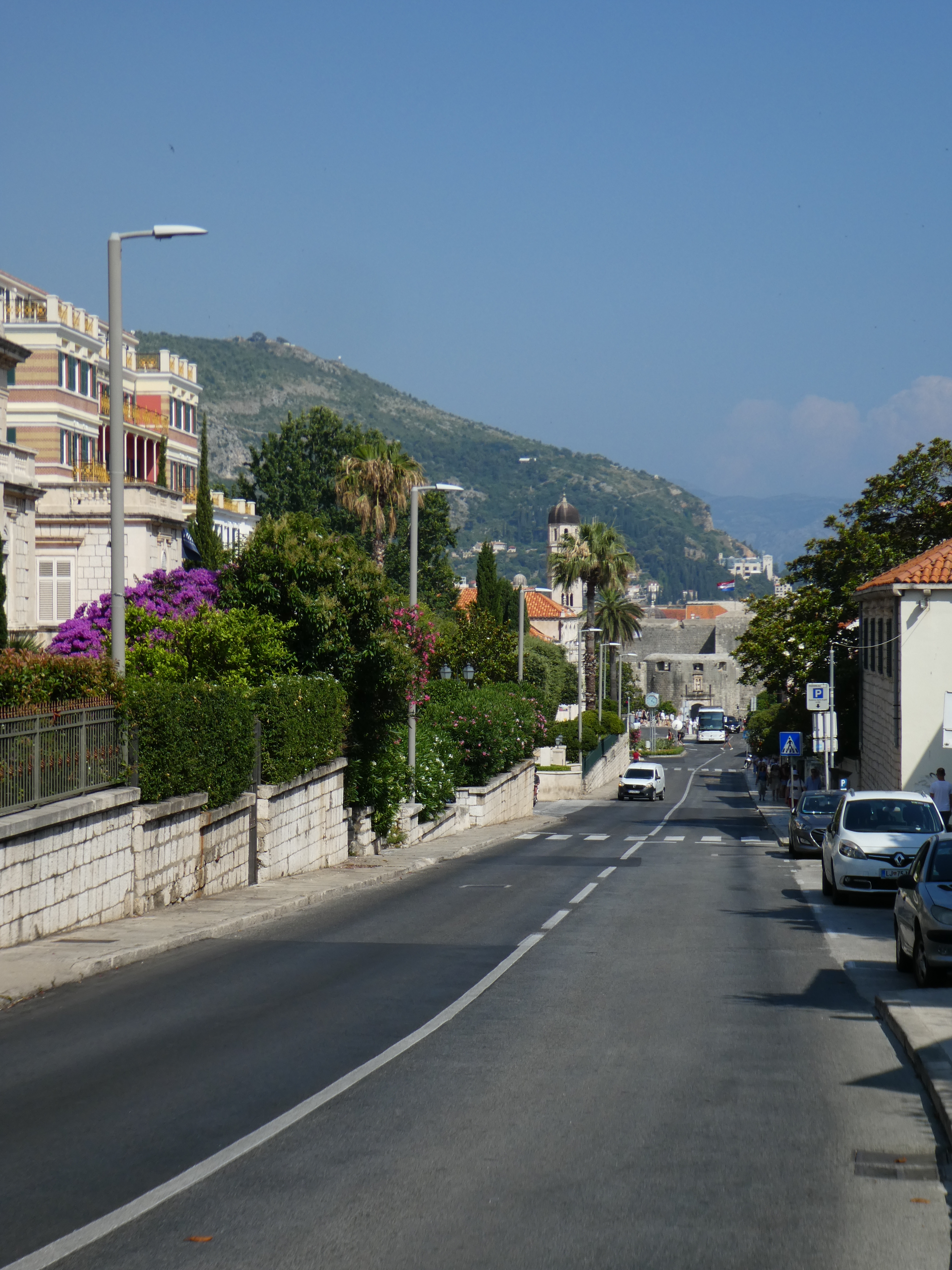
We had a bite to eat at a small restaurant before going back to the hotel to book in.

It was a great room with a balcony overlooking the coast on the 4th floor and cool after walking around in over 33 degrees.
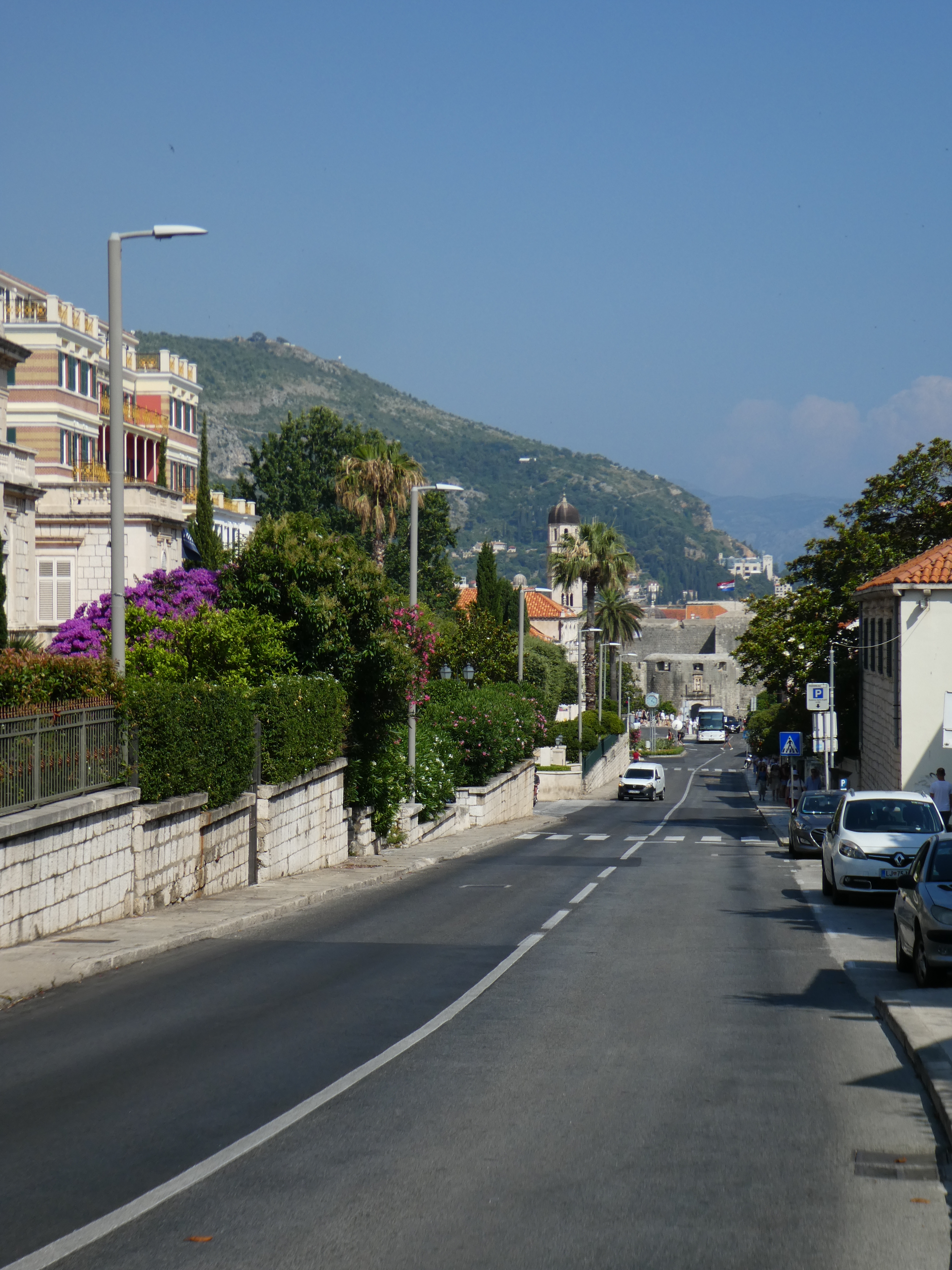 We showered and relaxed then around four o’clock we descended to the compact old City. To get a real feel for the city we bought an expensive ticket to be able to walk around the two kilometres of walls.


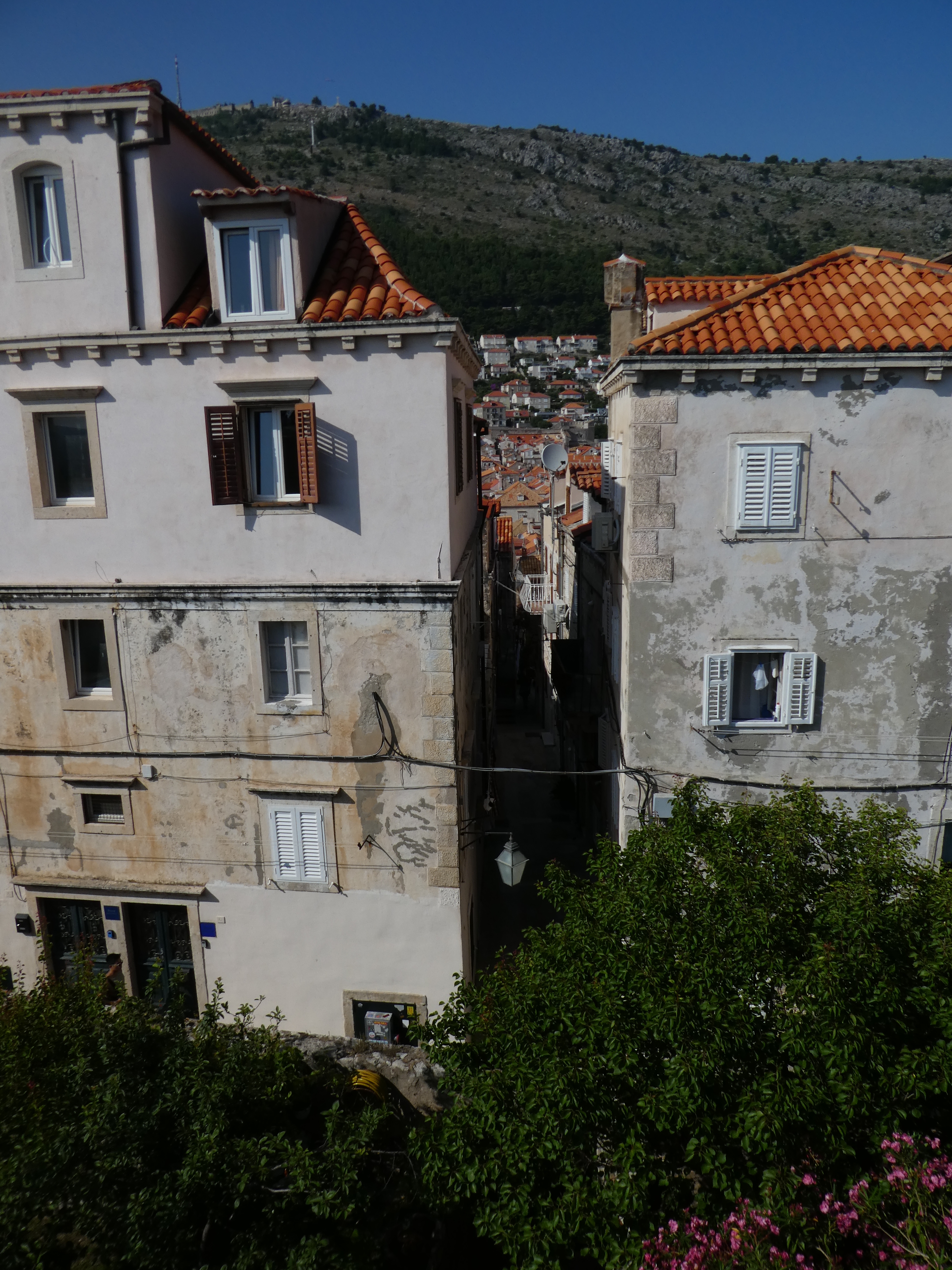
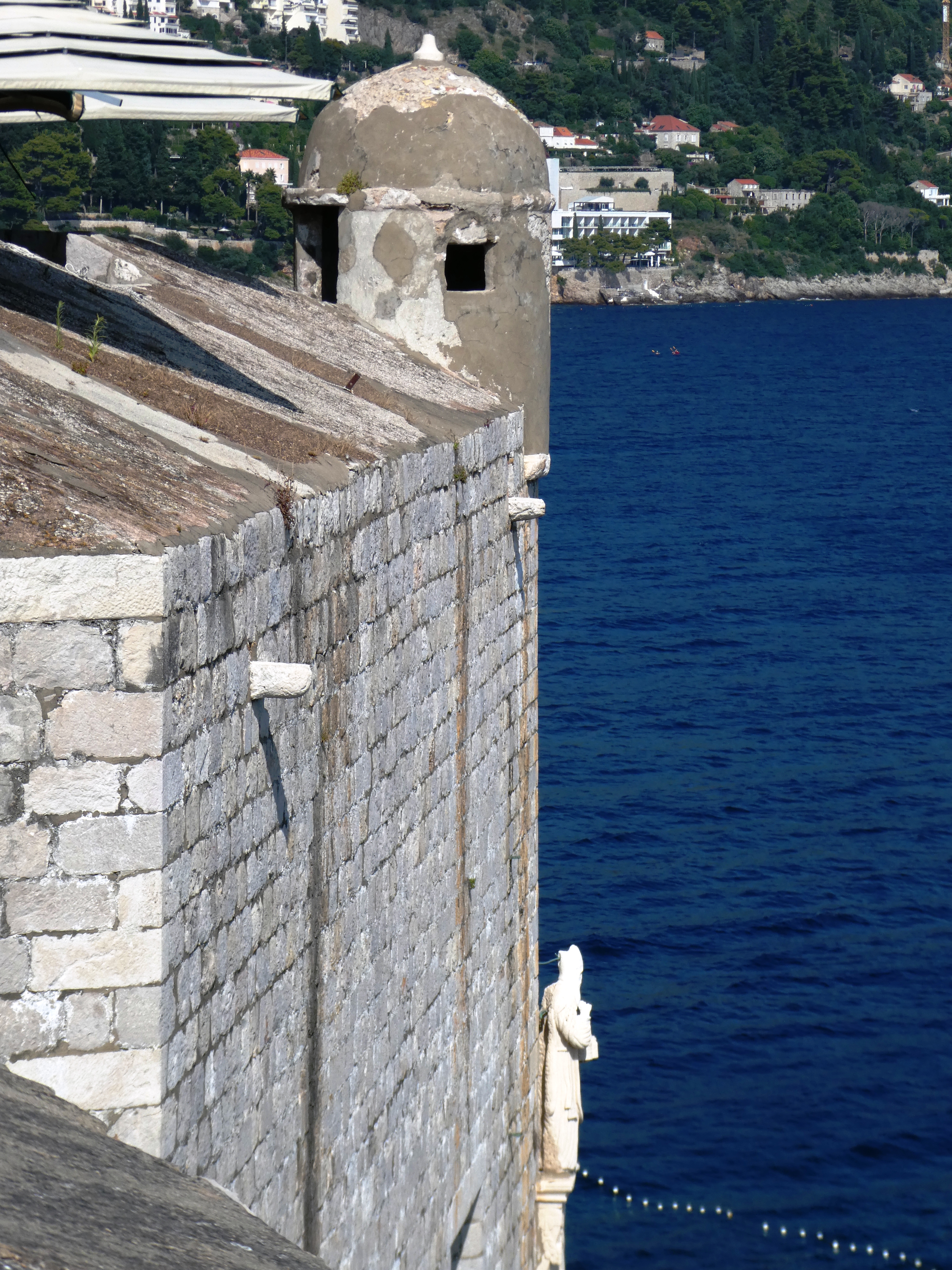
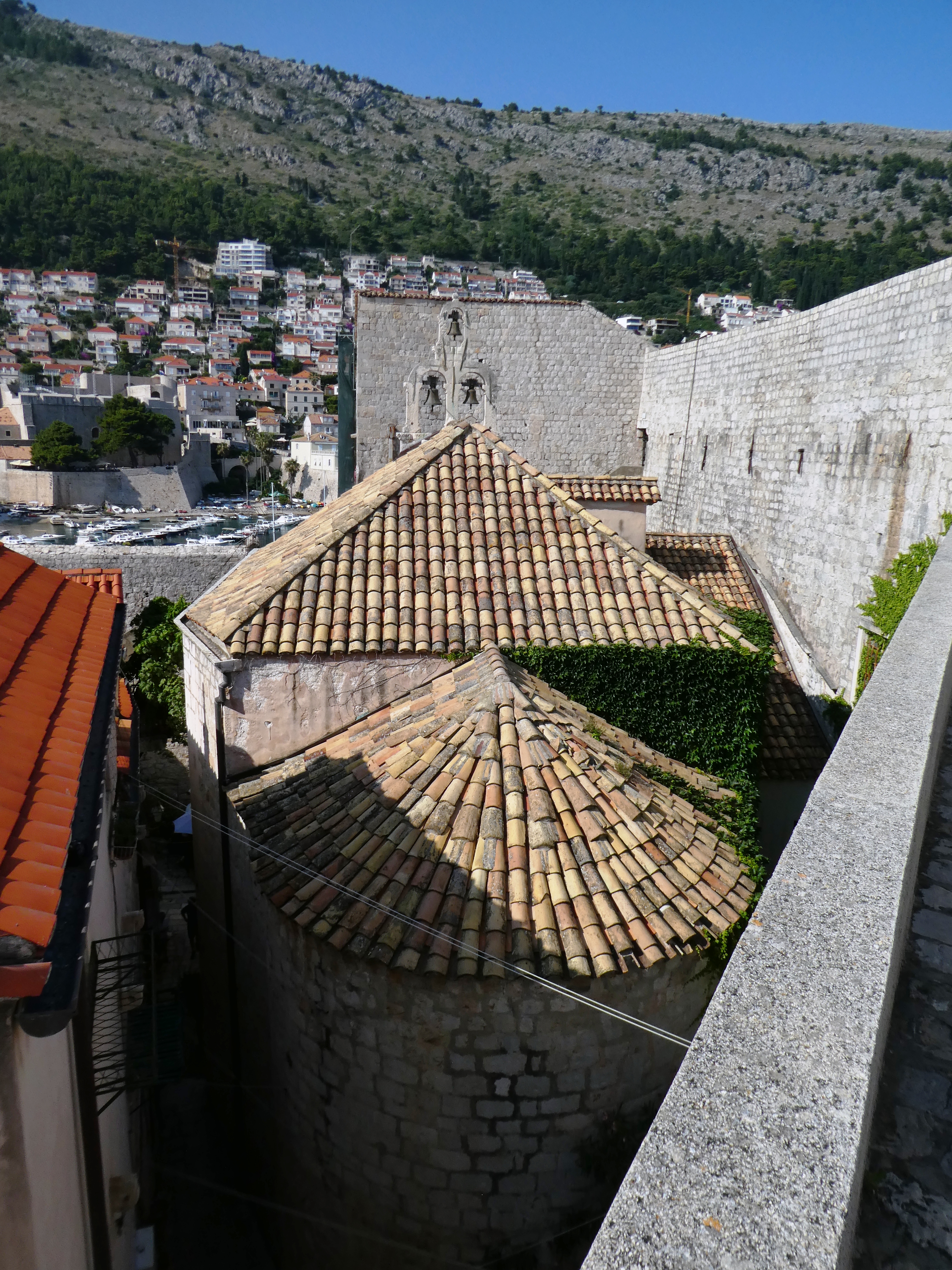
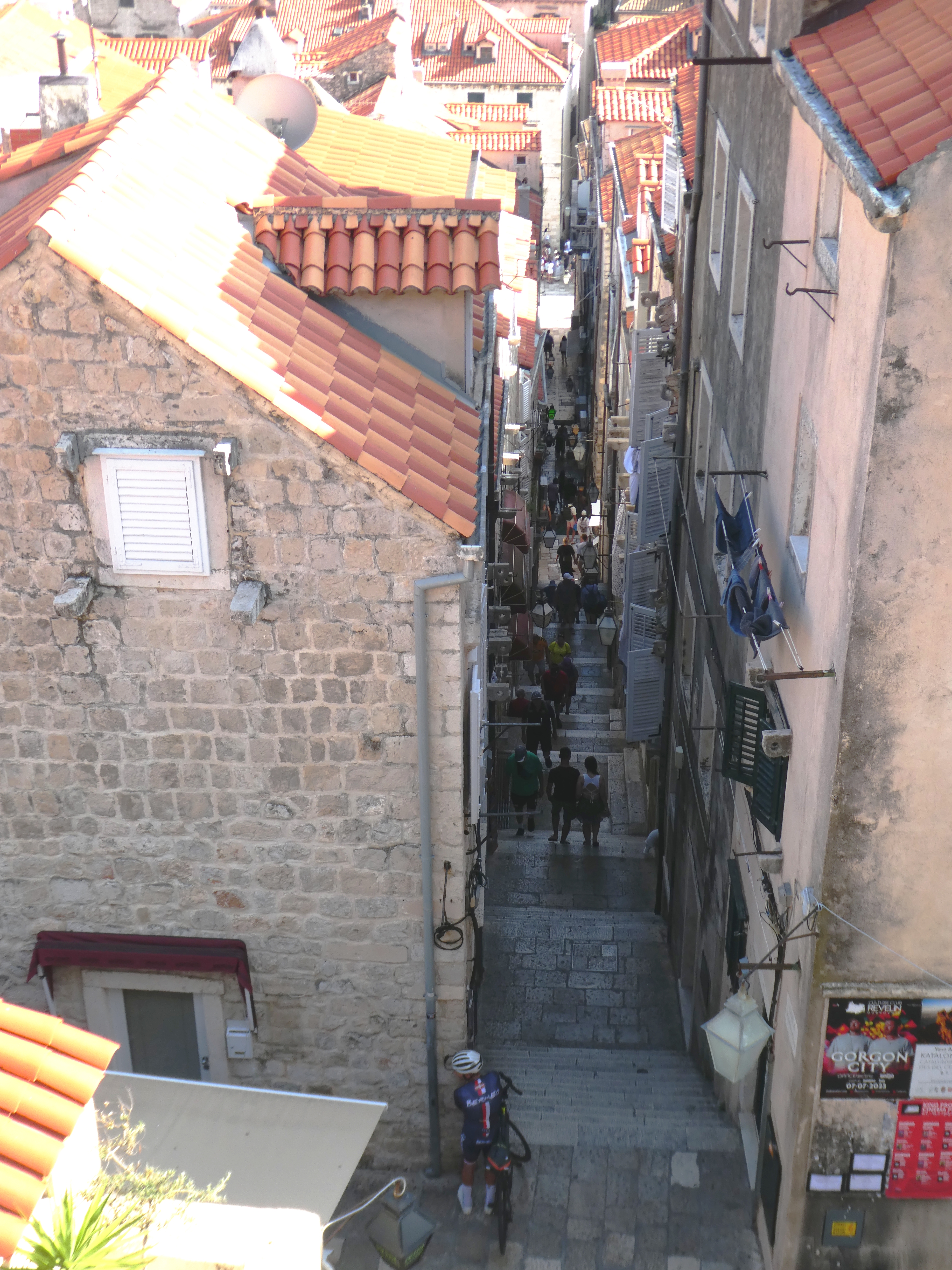
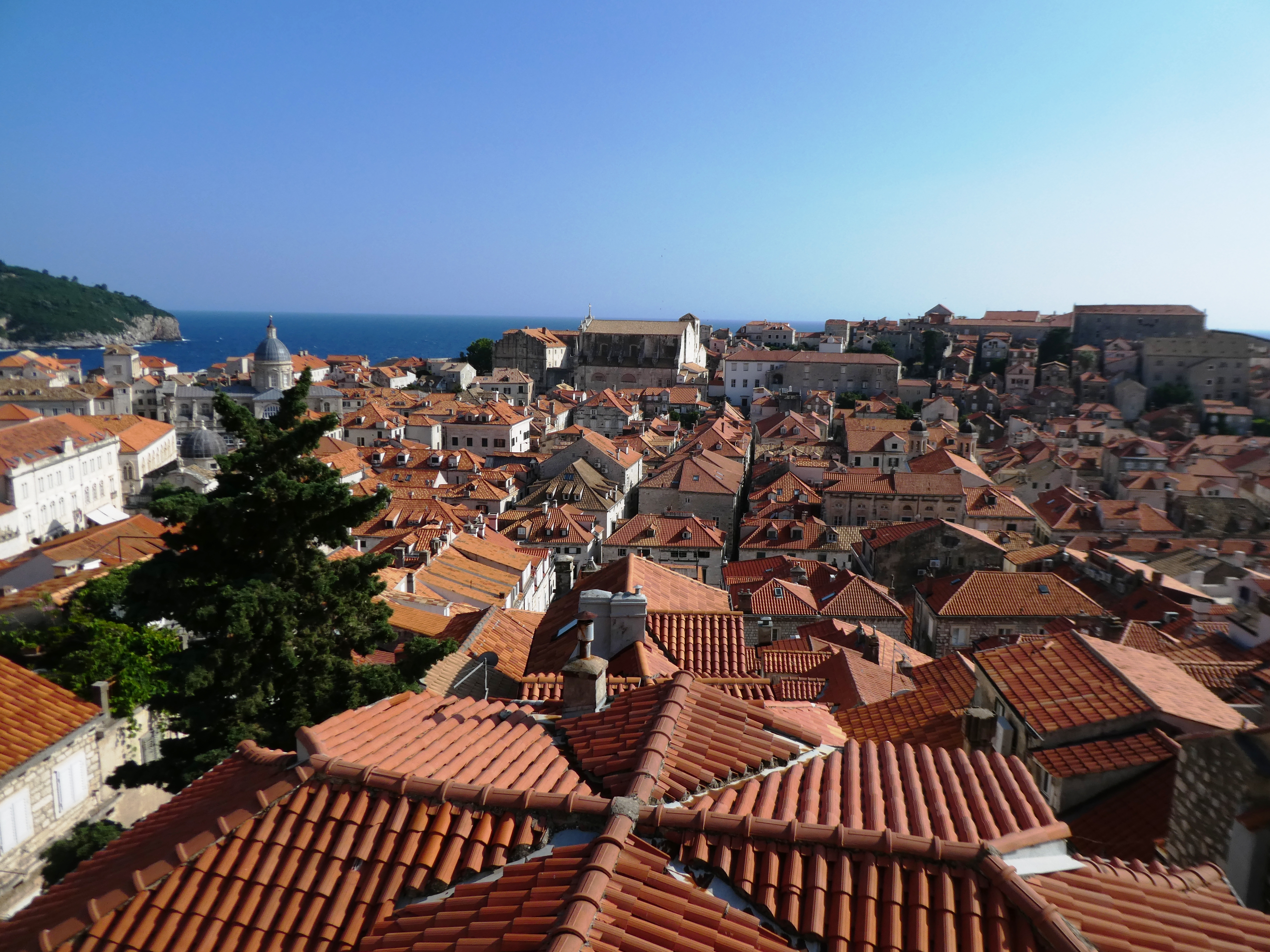
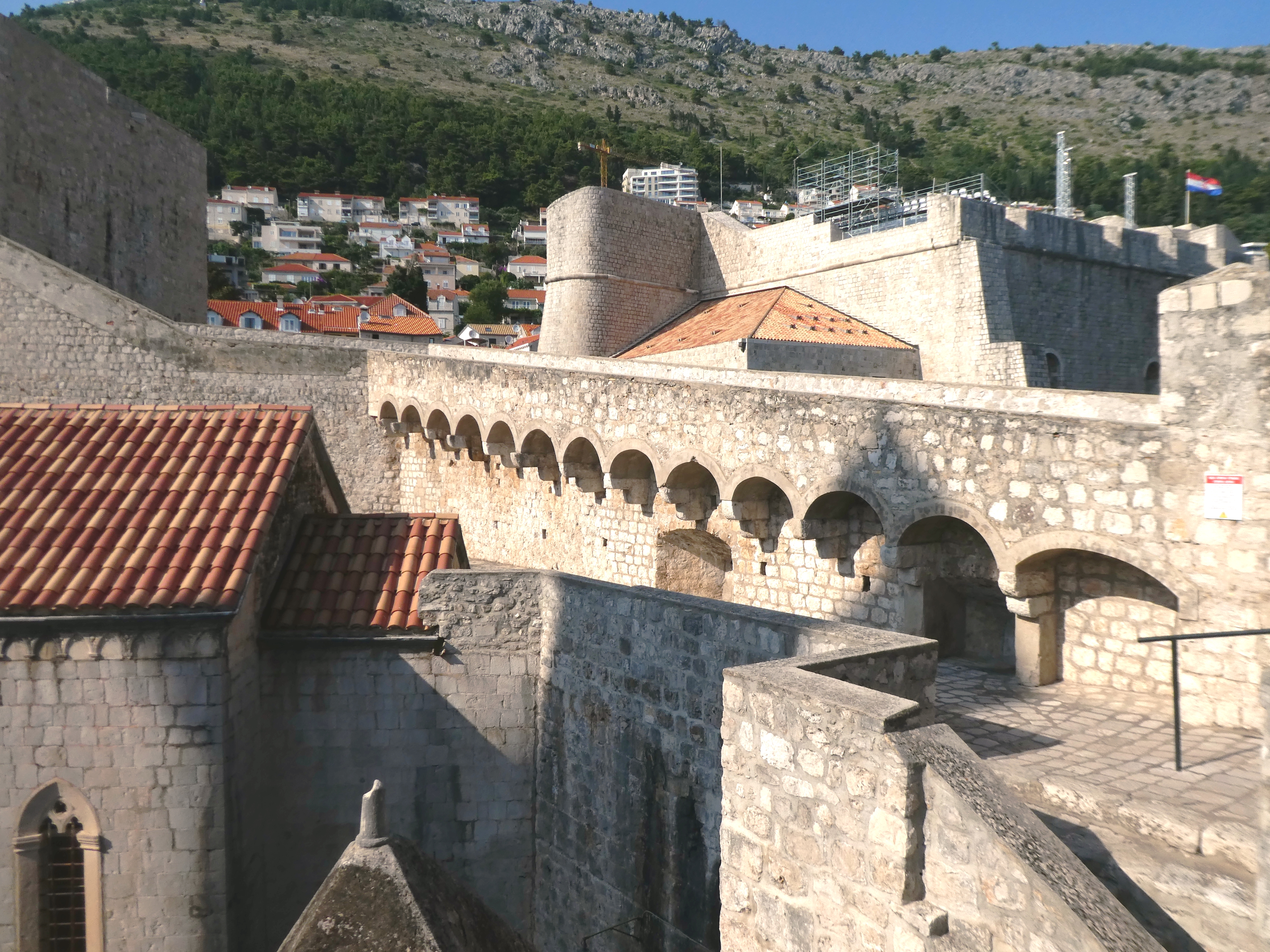
 They were amazing with views both looking out to sea and into the narrow streets and over the roofscapes.
Before six o’clock we went out of the walls to Pile Gate and met up with our free tour guide Marco. There were loads of people on the tour so we were divided into two groups, we were with Marco a native of Dubrovnik, a historian studying both here and in America.
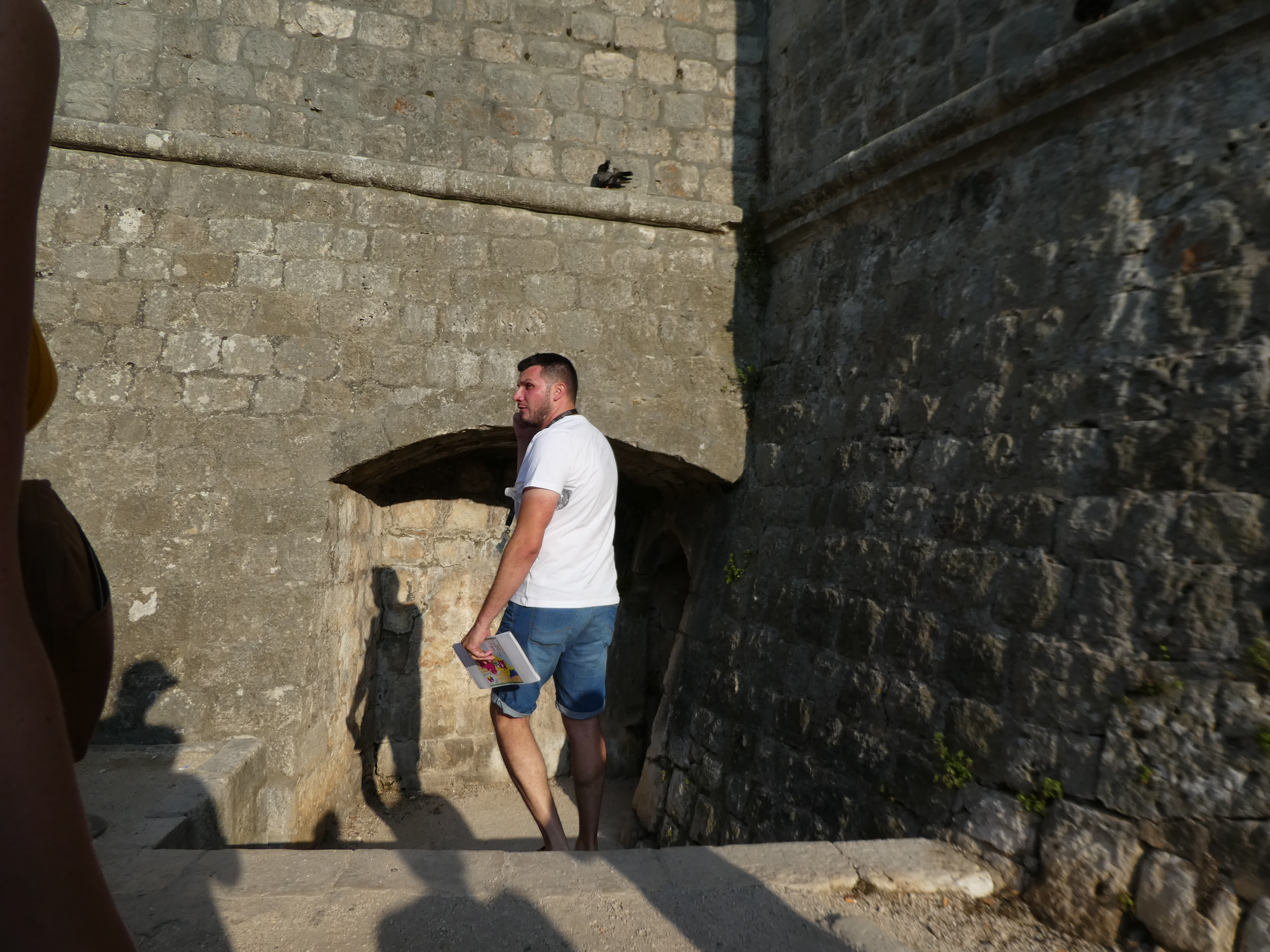 His main points were that historically the town was an important port along with Venice. Salt was the main local commodity but that it was part of the Silk Road trade route making the merchants very pragmatic in their political dealings with whichever country tried to hold Dubrovnik as its own.
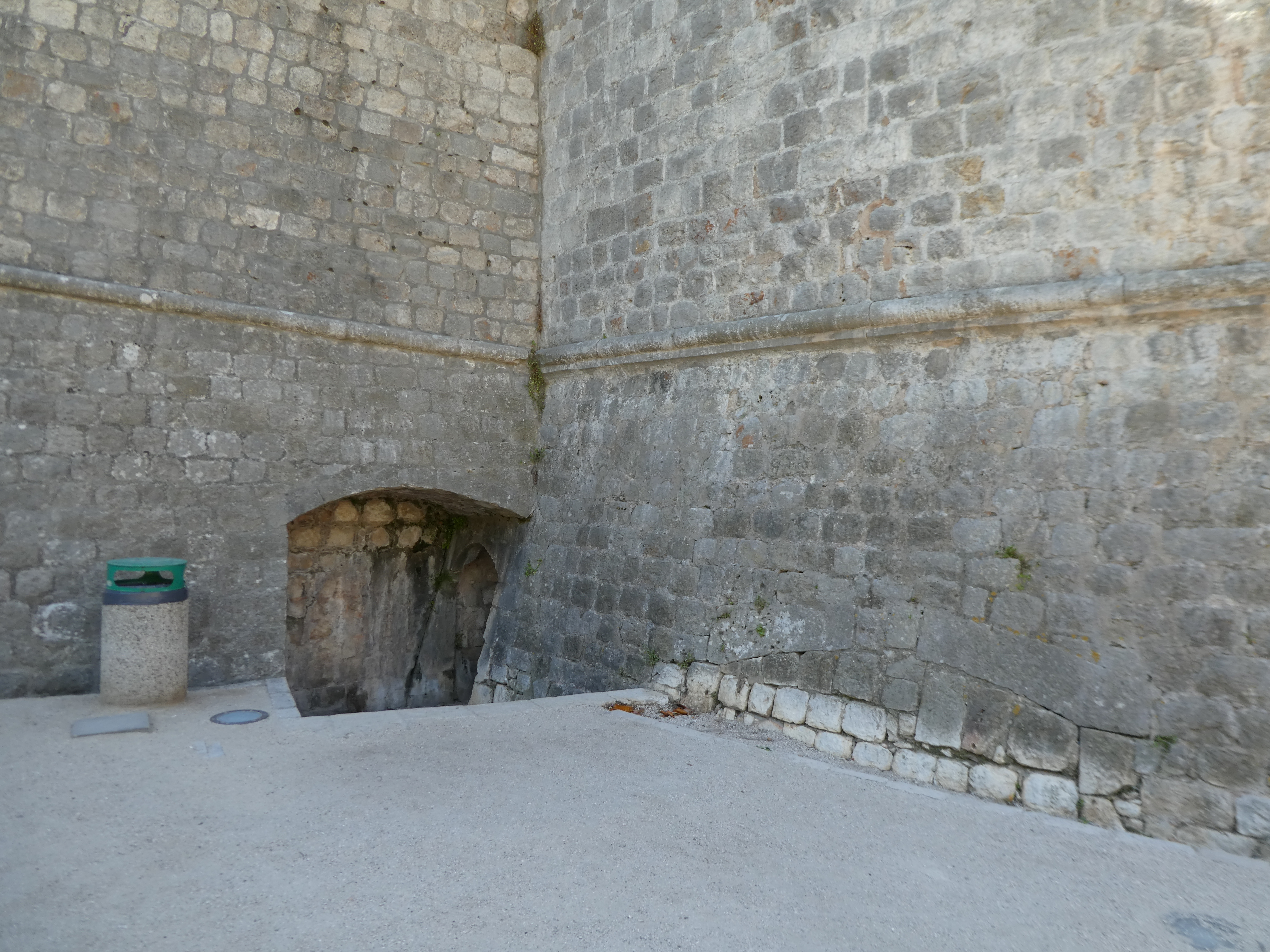 He showed where the original stones for the moat at Pile Gate were.
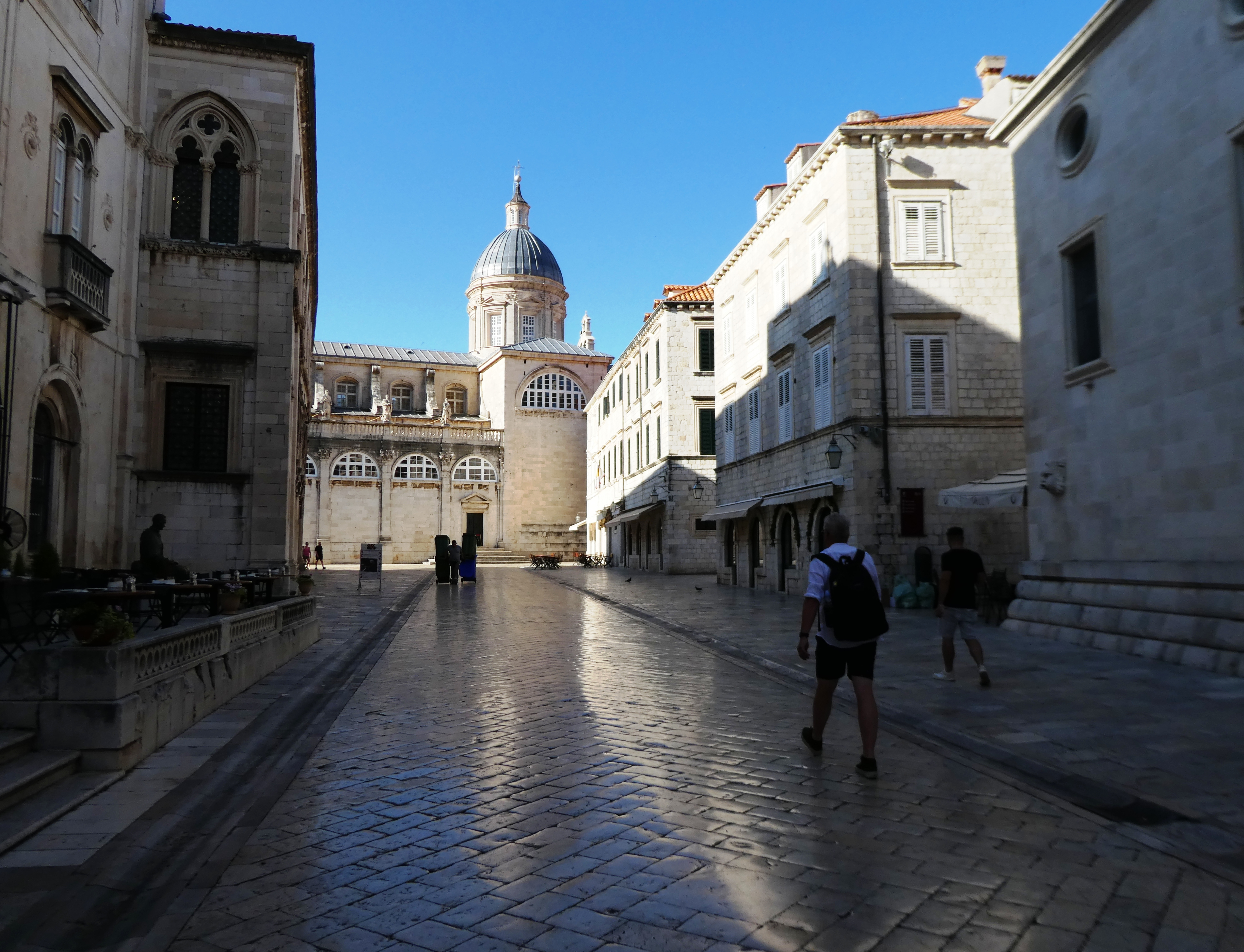
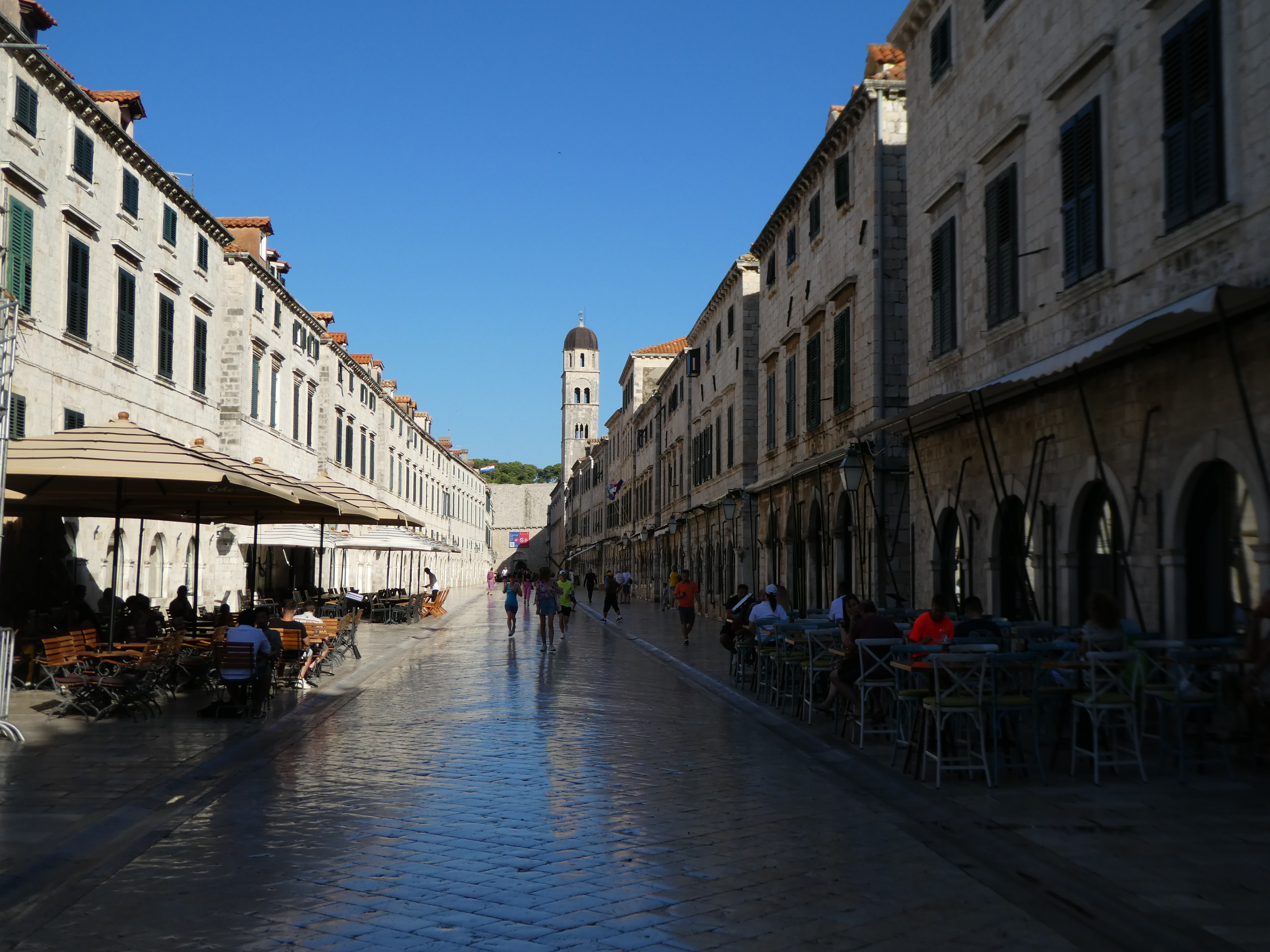 He explained about the false perspective on the road leading from the port to the Pile Gate created by making the road narrower as it got nearer Pile Gate.


He showed us Roman graffiti on the walls and the old doorway to a mediaeval school that showed just how much the street level had been raised.
He passionately informed us about the Balkan war and the affect on the country and the city. The mix of Catholics, orthodox Christian’s and Muslims now seemed to be living in a pragmatic peace but the civil war and the bombing of Dubrovnik had had its toll on the community and the fabric of the old City.
 Information boards at Pile Gate and on buildings through the old City spoke of the deaths and damage caused during the war.
Apparently since joining the EU and the rise in tourism, the City and the country were doing very well economically but the population of the old city had dwindled with many properties sold to people outside of Croatia.
The tour finished in the south of the City now a marina but in what had once been ship building sheds.

Pleased with our enlarged knowledge but rather foot sore we sort food and were rather overwhelmed for choice finally settling for the Restaurant Renaissance where we happily enjoyed pleasant unexceptional food washed down with a very expensive bottle of Rose.
We returned up the hill to the hotel wearily with lots of others and had another shower and a coffee sitting on the balcony watching the city before a very good nights sleep, in an enormous bed.
Saturday 8th July – Dubrovnik to Stolac
Armed with the knowledge from yesterday we got up early and made our way back down to the Old City where we explored in the cool some of the sights of interest we had seen on the free tour.
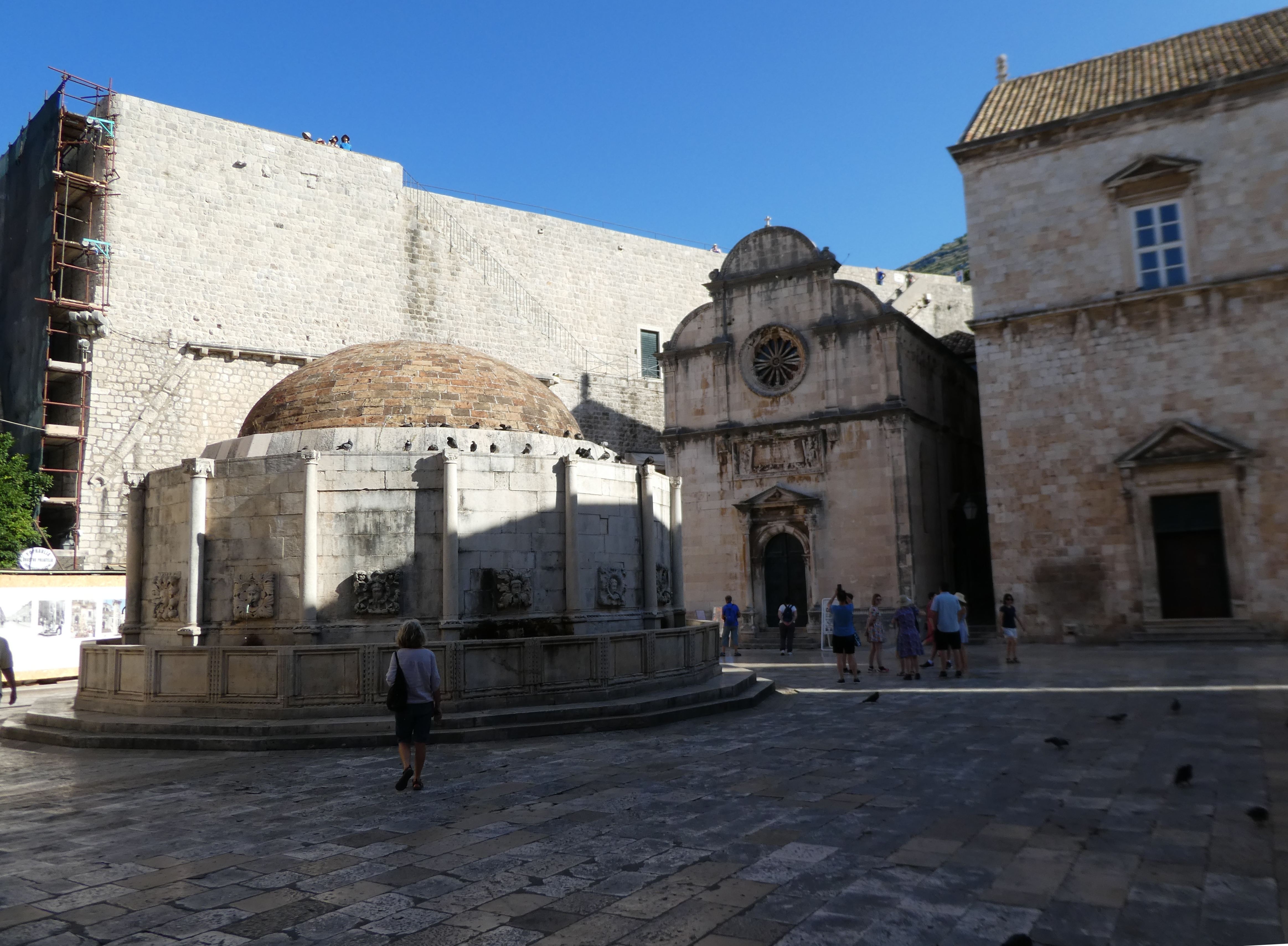
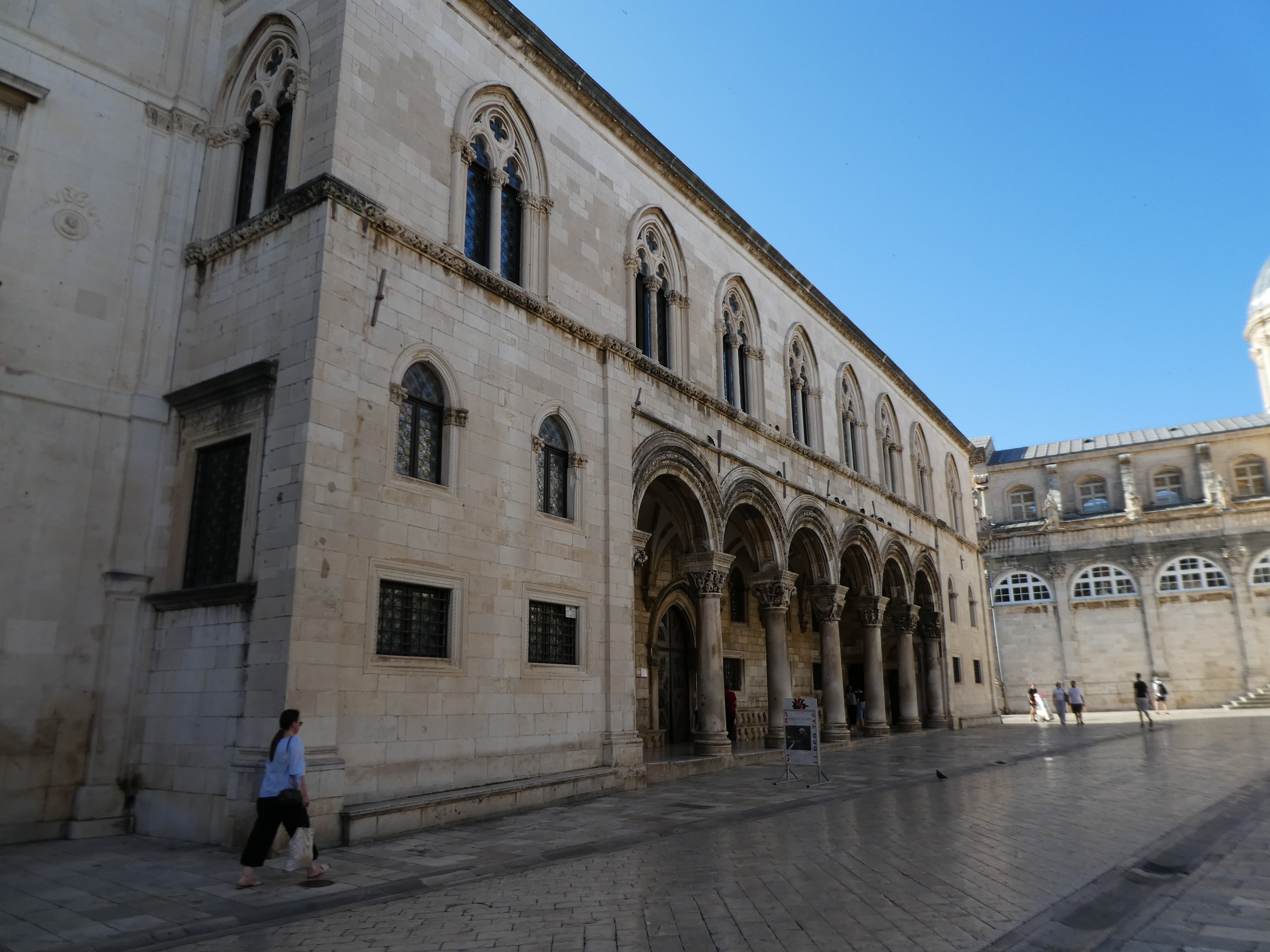
We walked down into the city again and wandered around visiting a few churches that were open and recalling different aspects from the night before
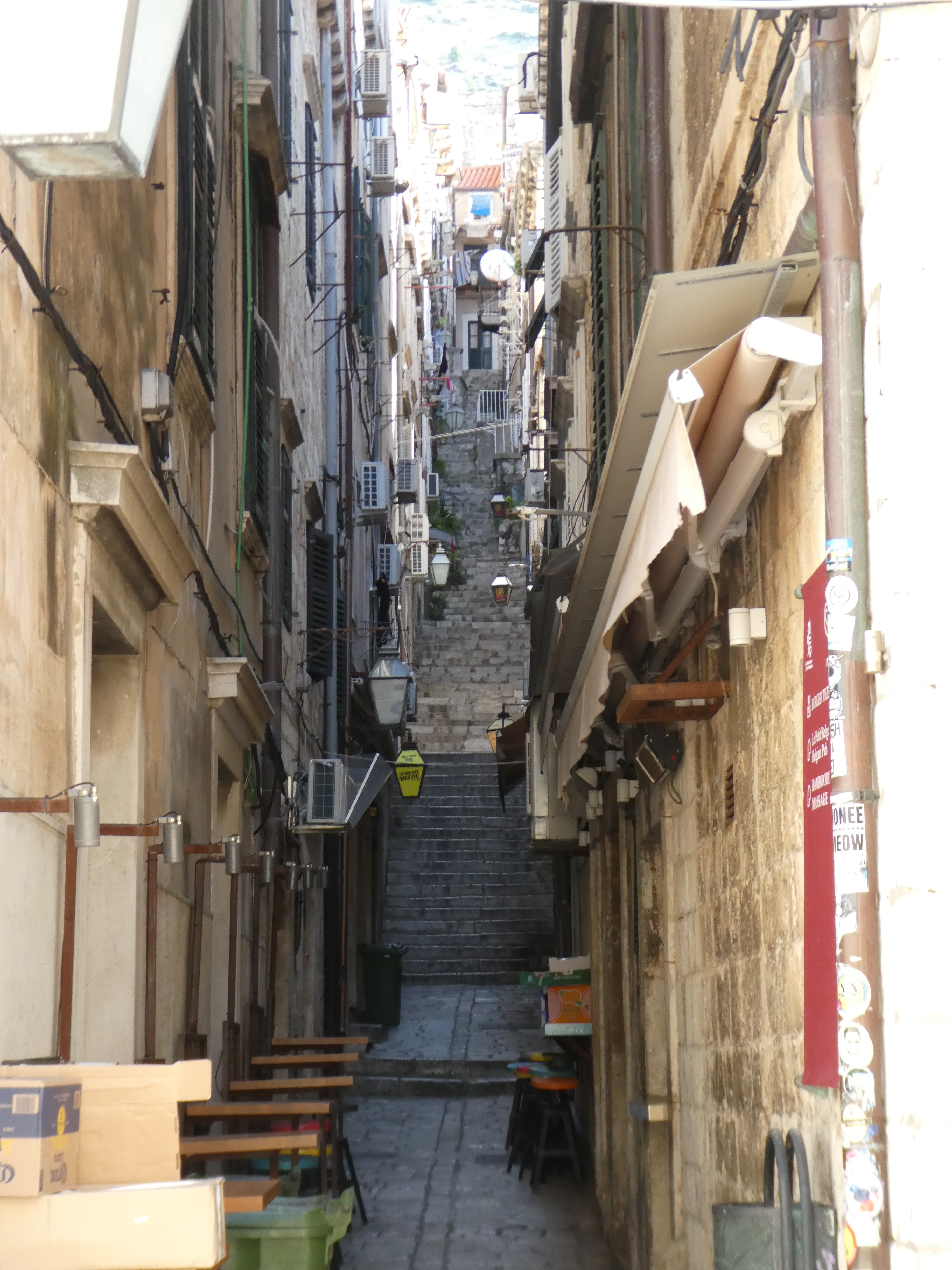
We returned for a good long breakfast before taking another shower and we booking out at 11am .
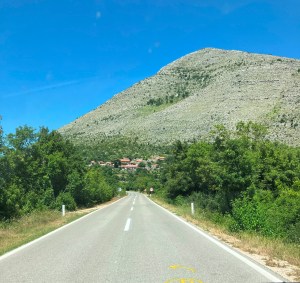
We drove out of the busy city the way we had come in before turning east up the steep hairpins through the border control and, avoiding wild pigs, taking us over the mountains to the road that led north towards Stolac where there were some more cemeteries with Stecci in.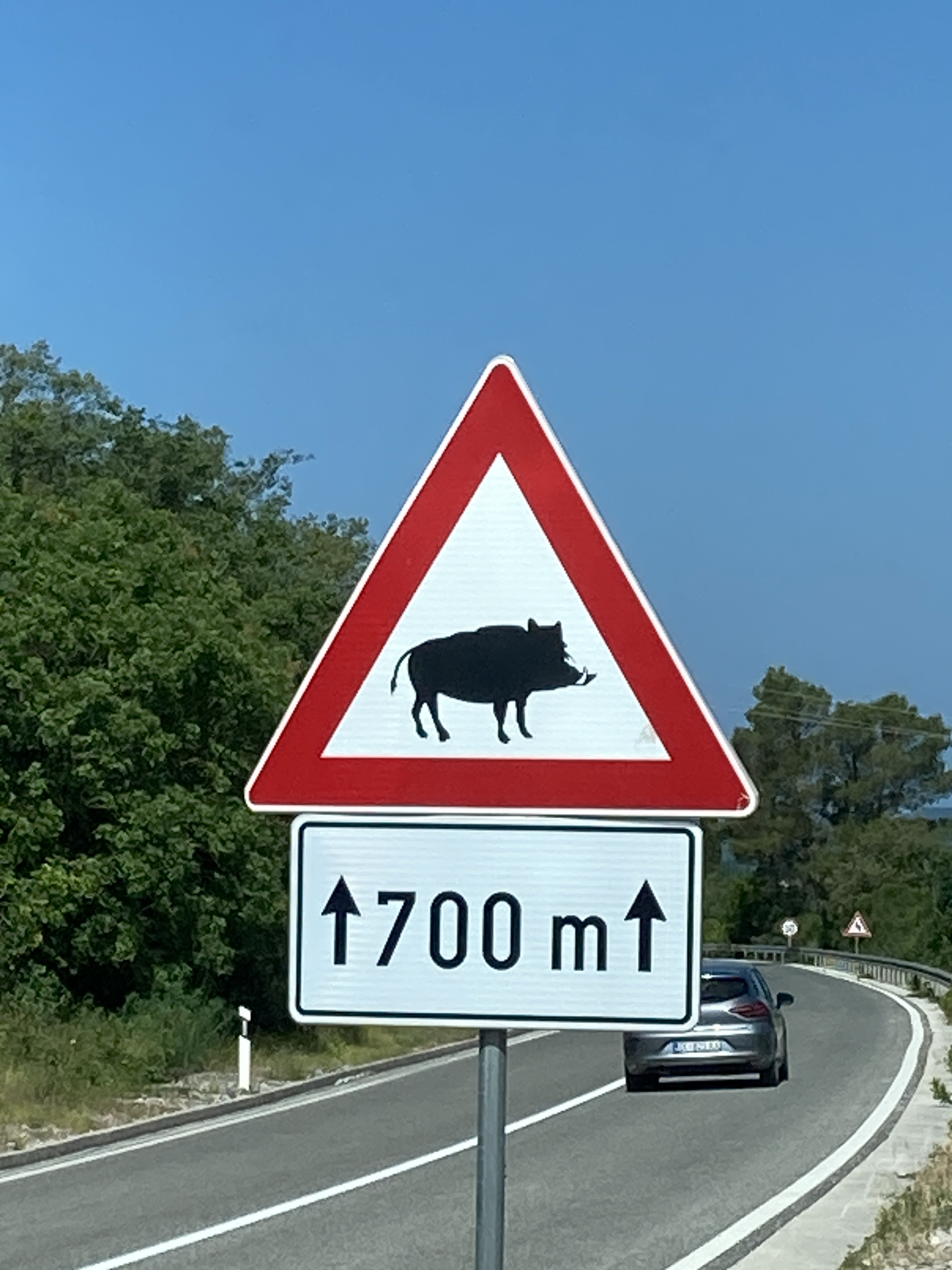
Back again in the limestone hills we descend onto a high plain where winding waterways have been canalised and equipped with waterwheel to irrigate the land either side. 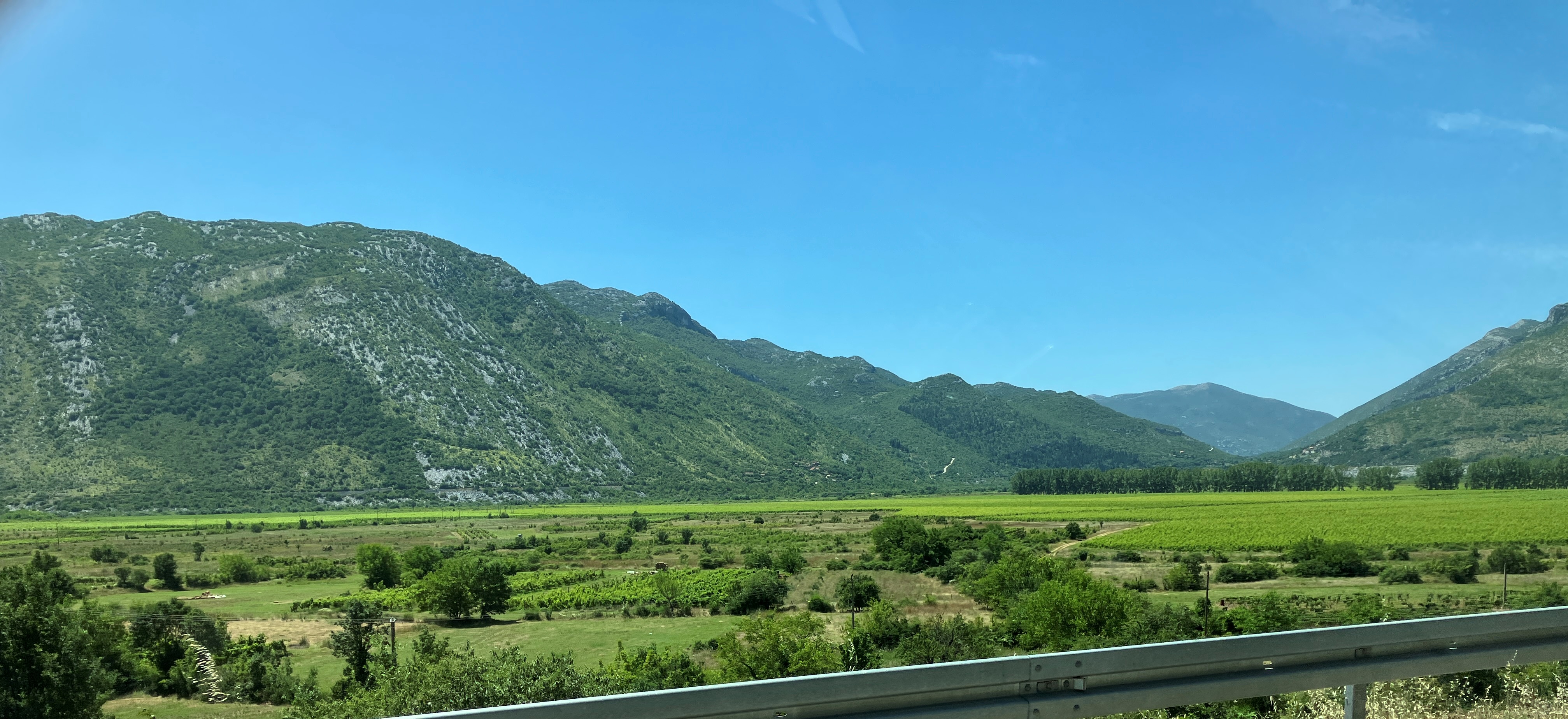
We reached Stolac and found the campsite that felt right, some shade, a small river for swimming and a friendly owner.


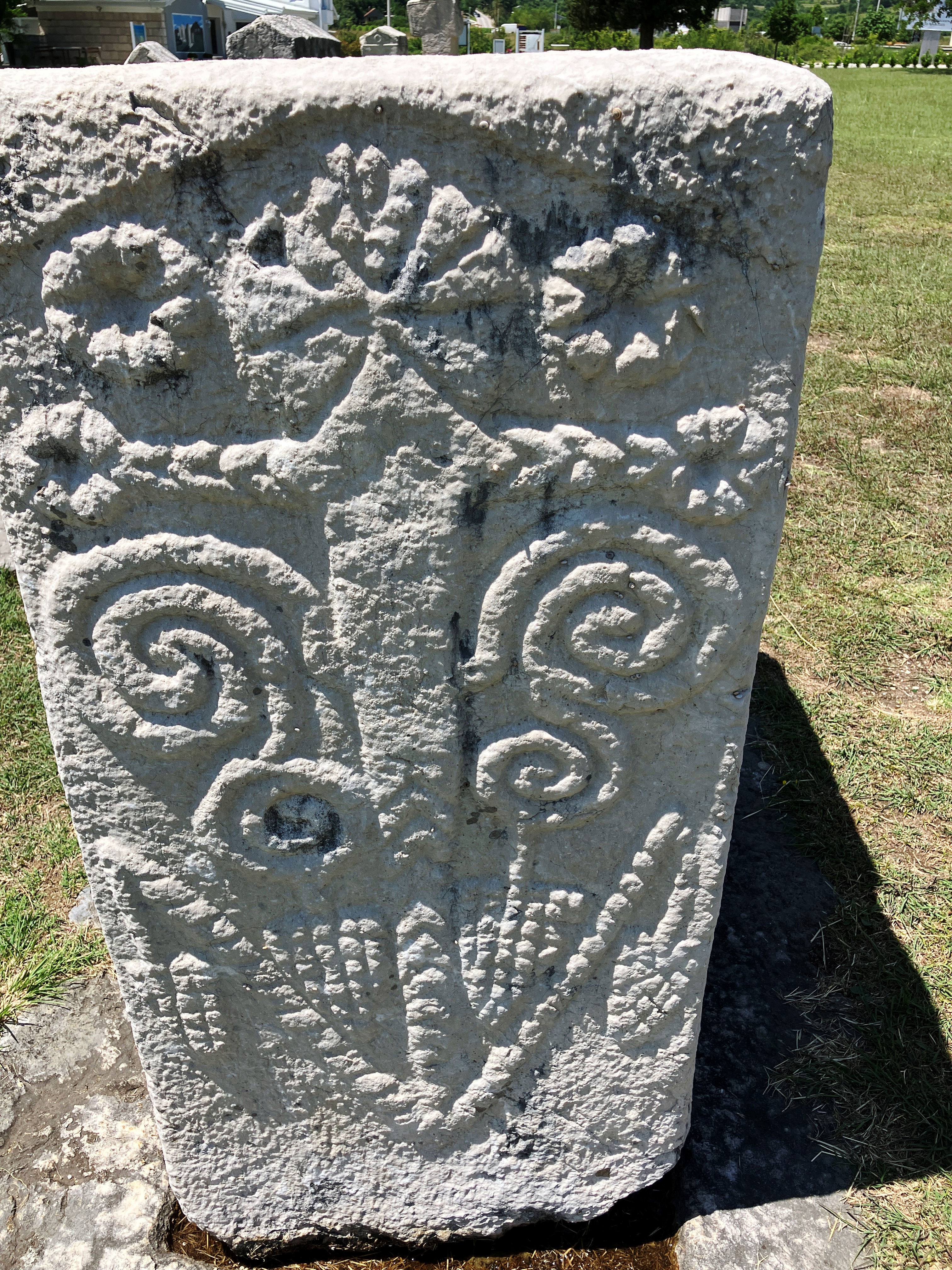
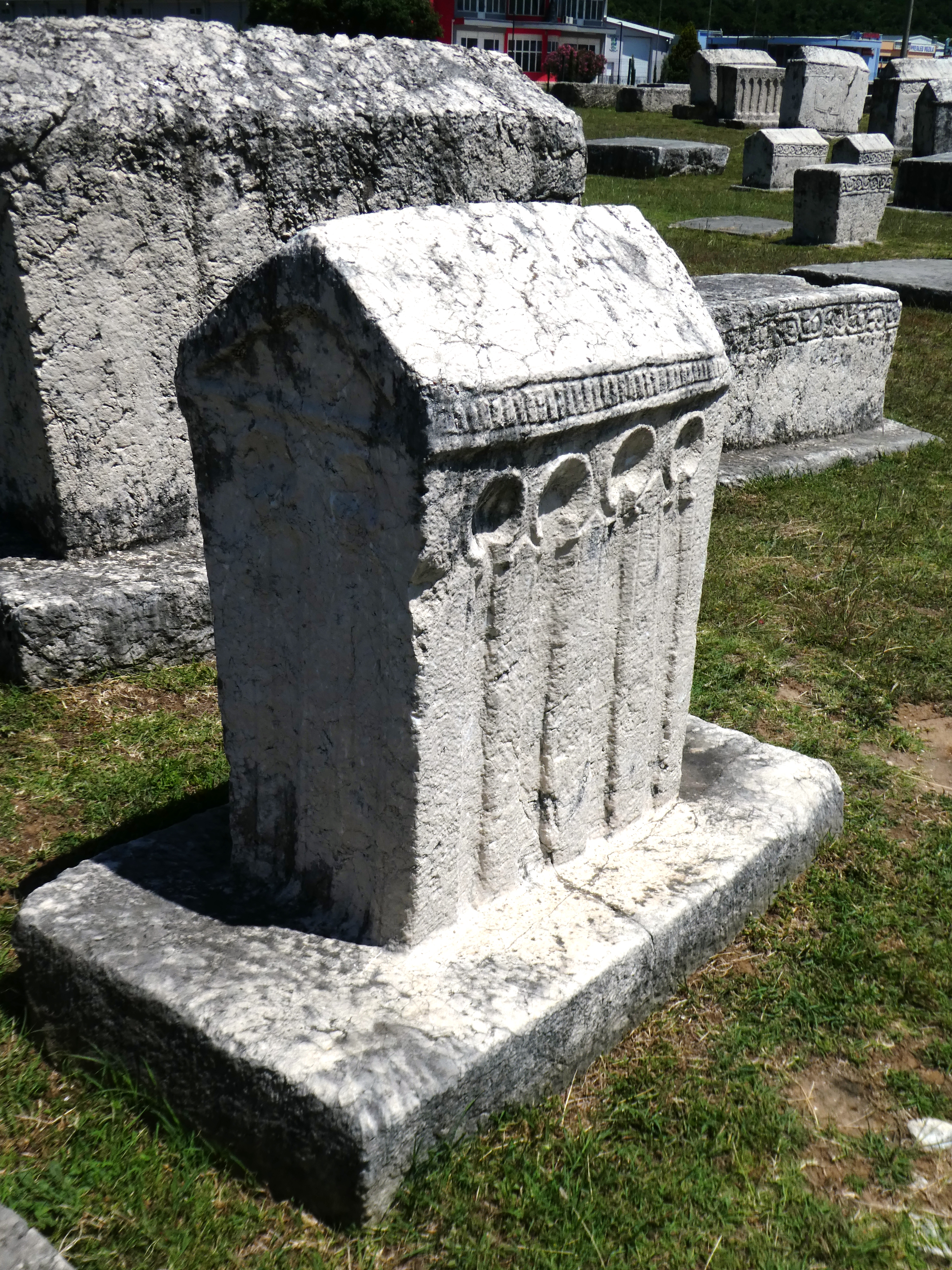
We left there and visited Radimlja another ancient grave yard with 135 tombstones with some of the same motifs of those we saw before at Zabljak. A figure with a raised hand and outstretched palm, hunting scenes, knights tournaments, figures dancing, vines and grapes, anchored, weapons, trefoil and the sun.
We retuned to the site and found a nice plot, swam in the cold river and relaxed.
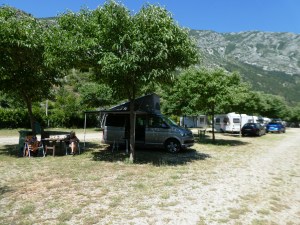
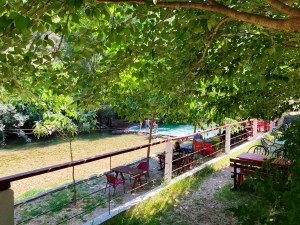
When it felt slightly cooler we took our bikes and rode down the valley to Stolic.
 The river played an important and there were several old mills from medieval times.
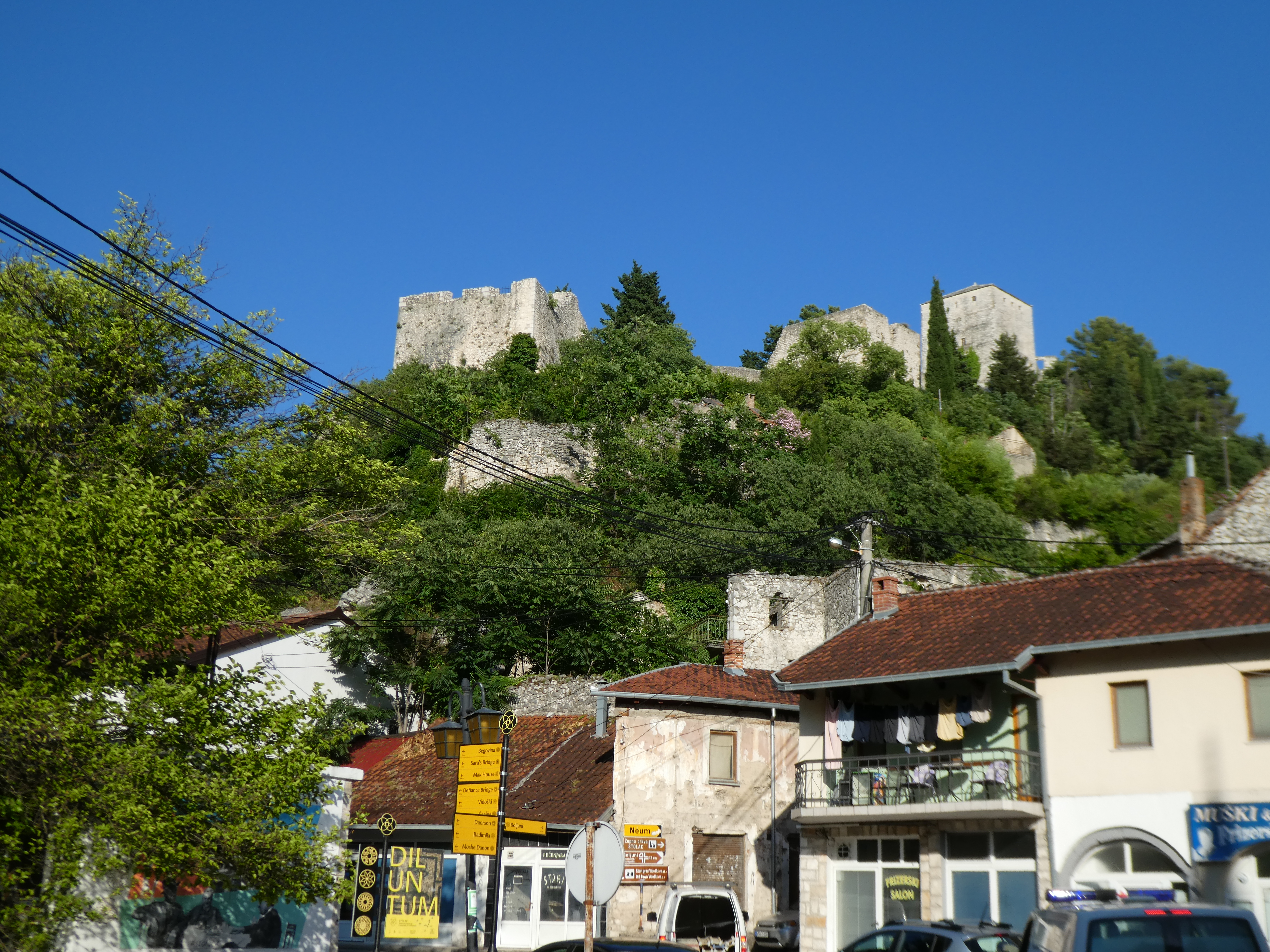
The ruin of a stone castle stood guard over the town and had played its part in the 1990’s war when it was used by snipers to shoot down into the town on to Muslims.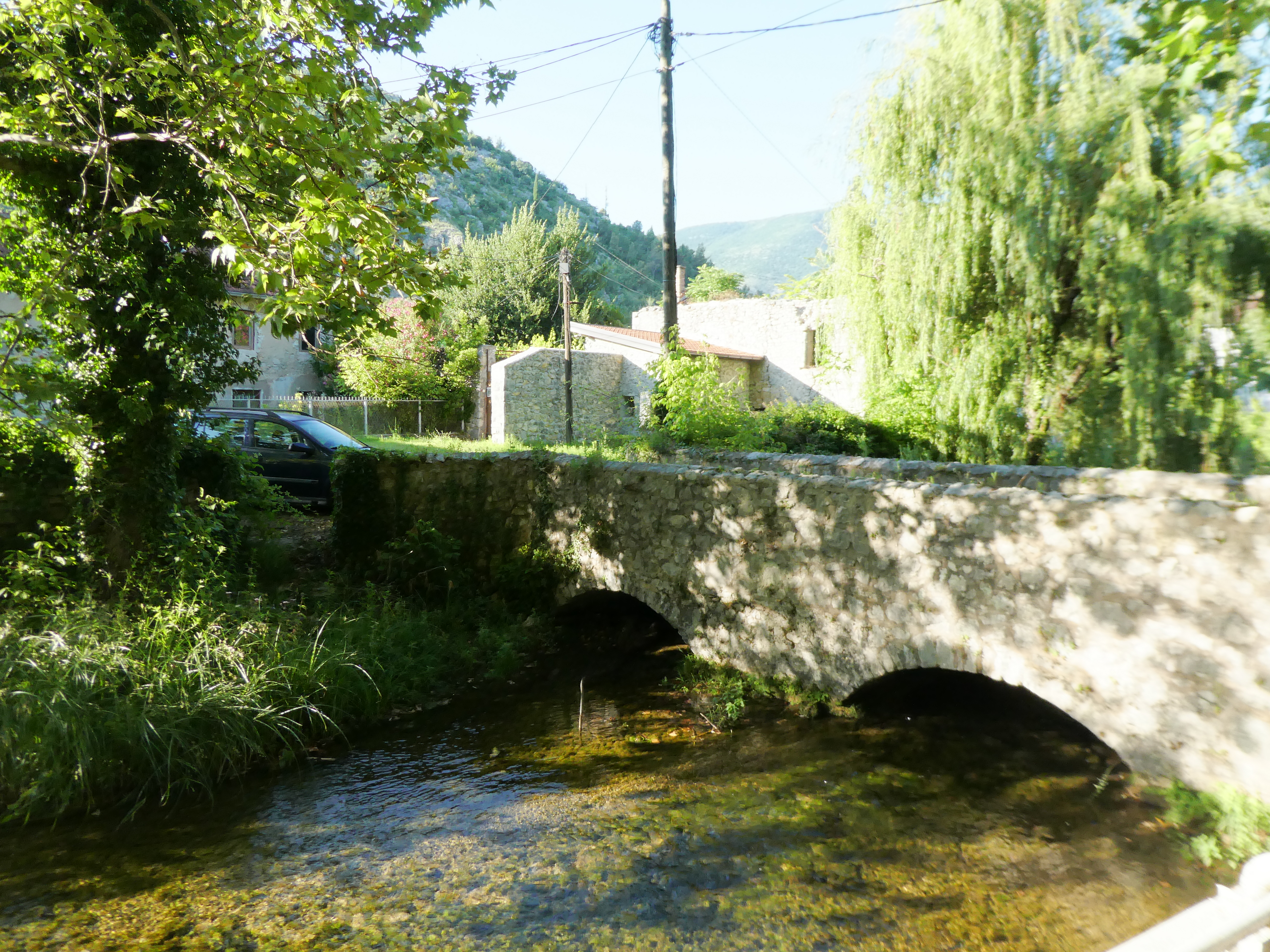
Certain parts of the fire an shell damaged town where whole communities had lived were abandoned.
There was still significance evidence of the war, with many houses still having bullet holes and signs of rebuilding of the square, a new clock tower and one of the mosques that had been rebuilt since the war when it was partly destroyed.
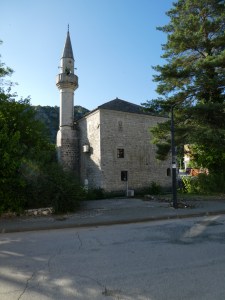
 We cycled around the town before going back up the main road where we had a good view of the waterfalls where during the day lots of people played in them.
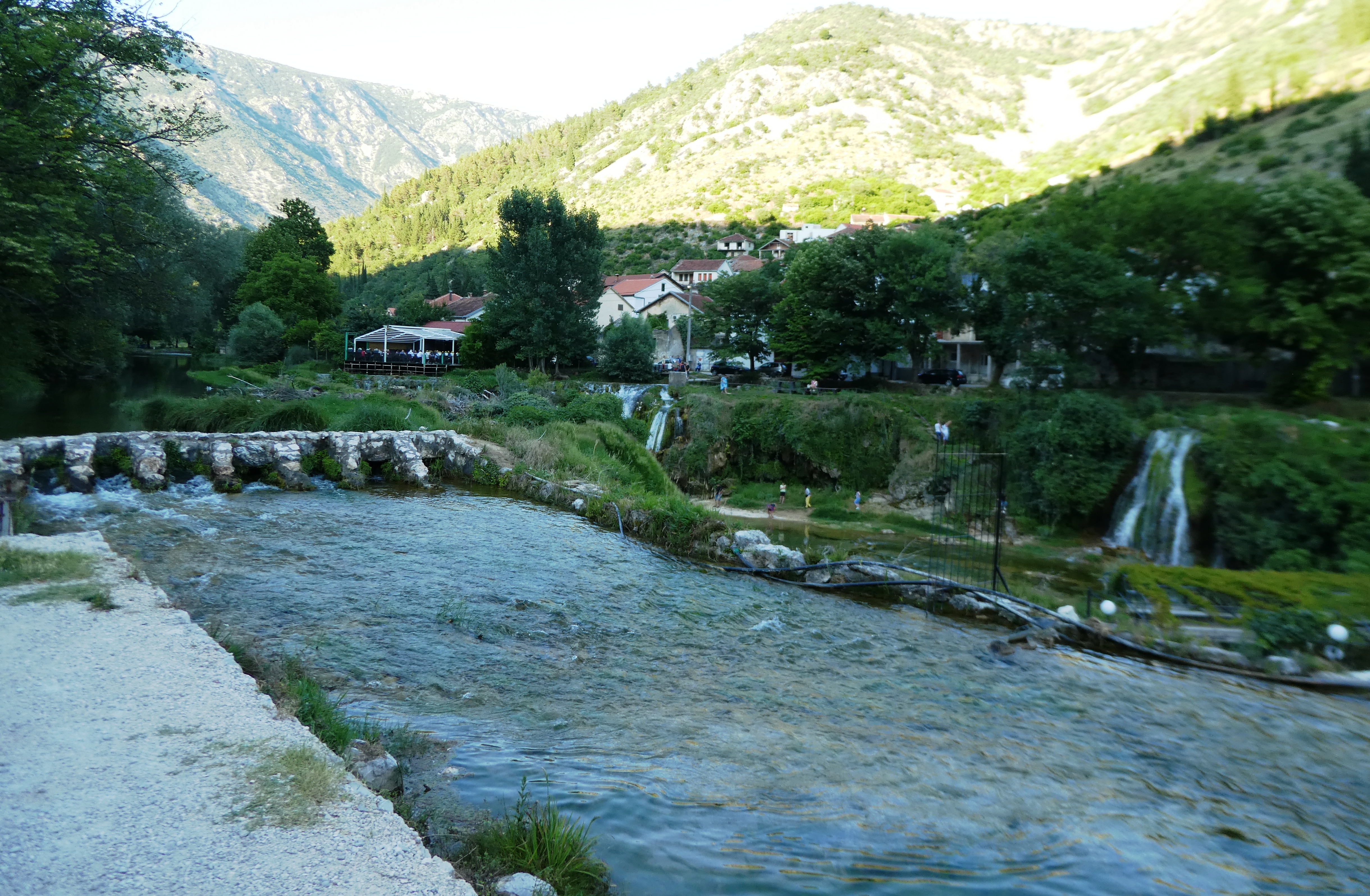
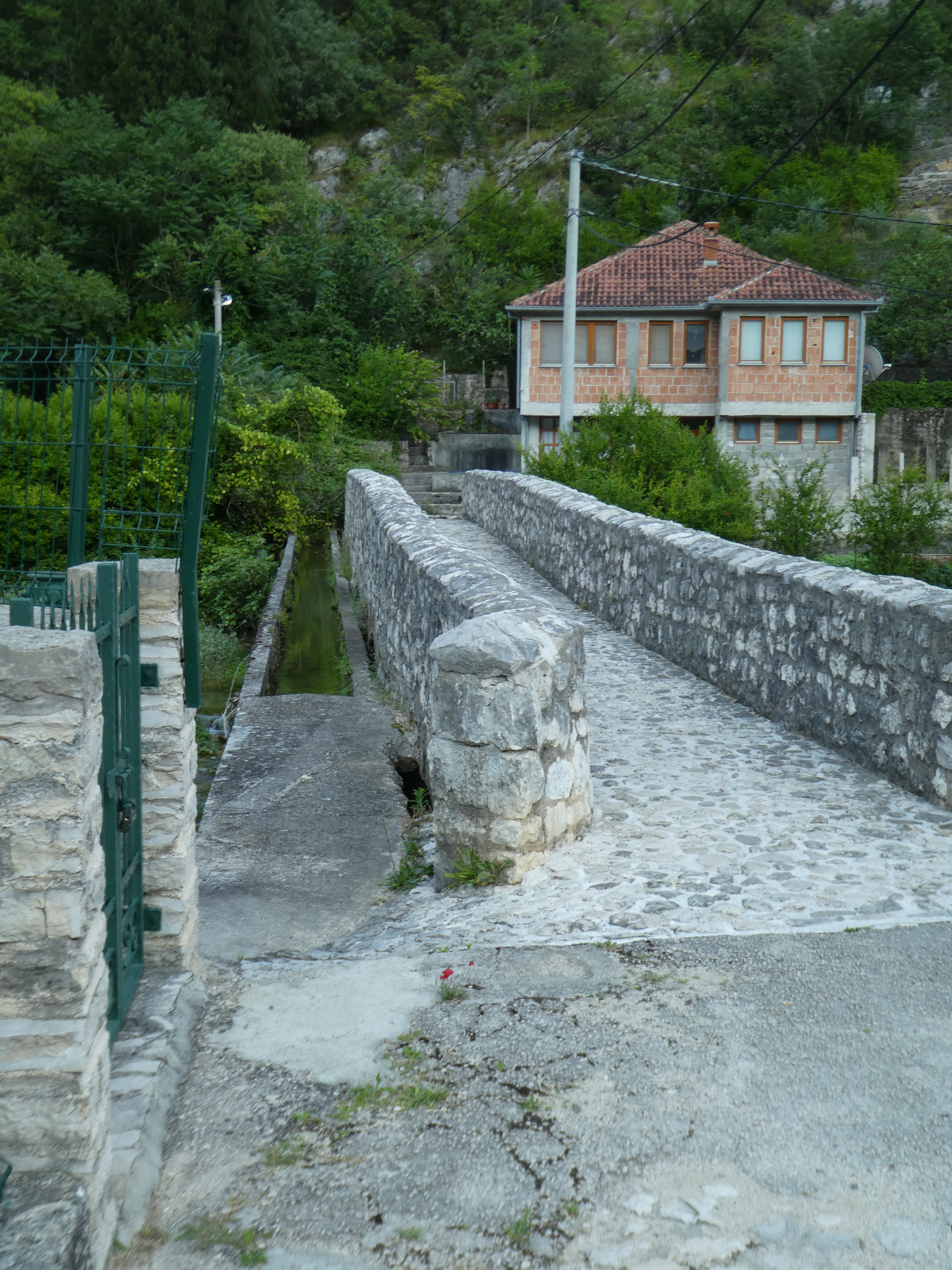
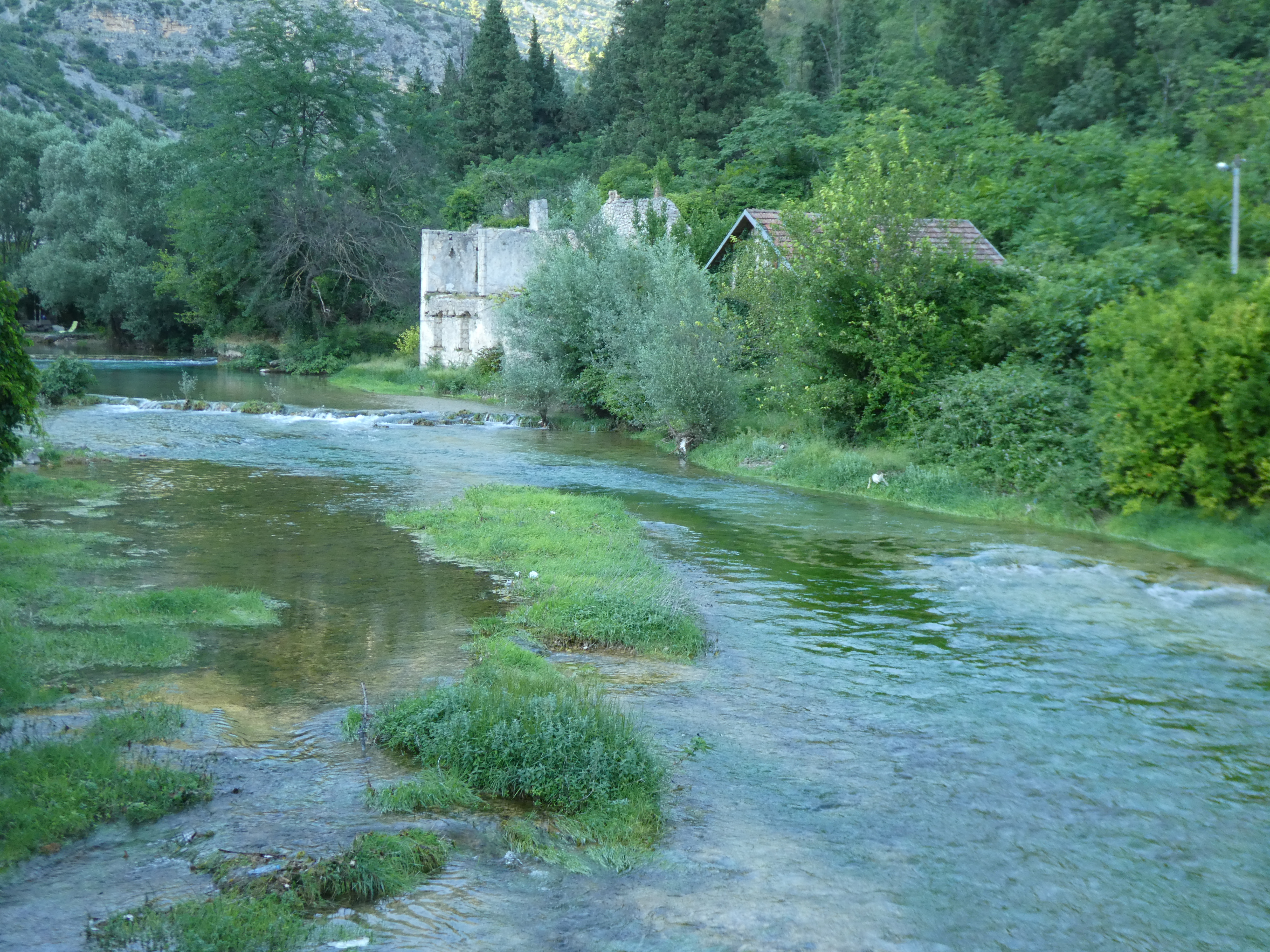 There were lots more people on the sight when we returned some motor cyclists, two Czech families and some walkers from Bosnia.
Sunday 9th July – Stolac to Loviste
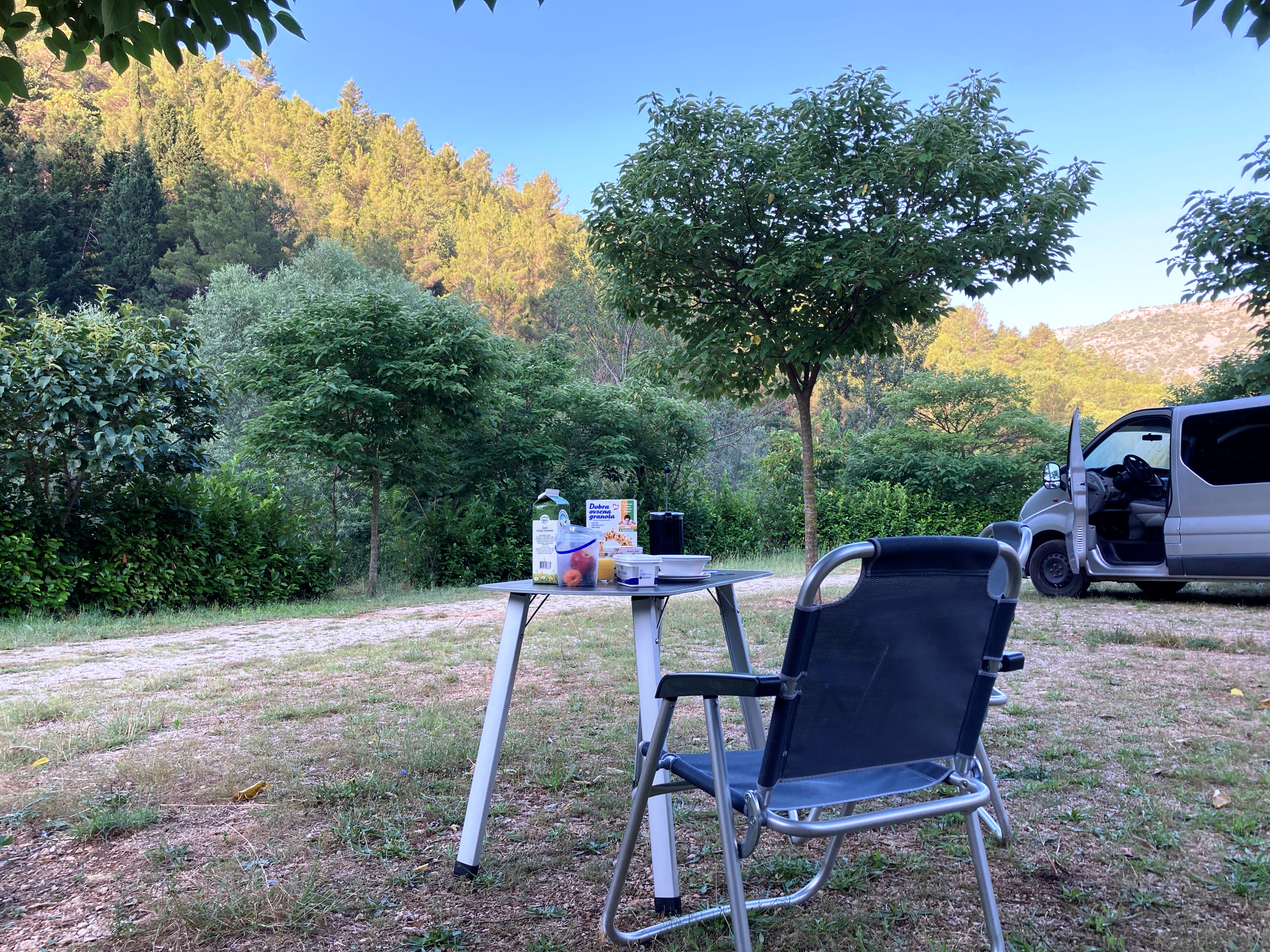 We were up early and had breakfast before we drove to Mostar.
We headed straight into the centre of the city and were fortunate to find a parking space in the heavily restricted parking area.
From here walking around the city was a contrast to walking around Stolac.

Everything in Mostar seemed to have been rebuilt and the interpretation and presentation of the history of the city was very clinical with little physical evidence of its recent conflicts.
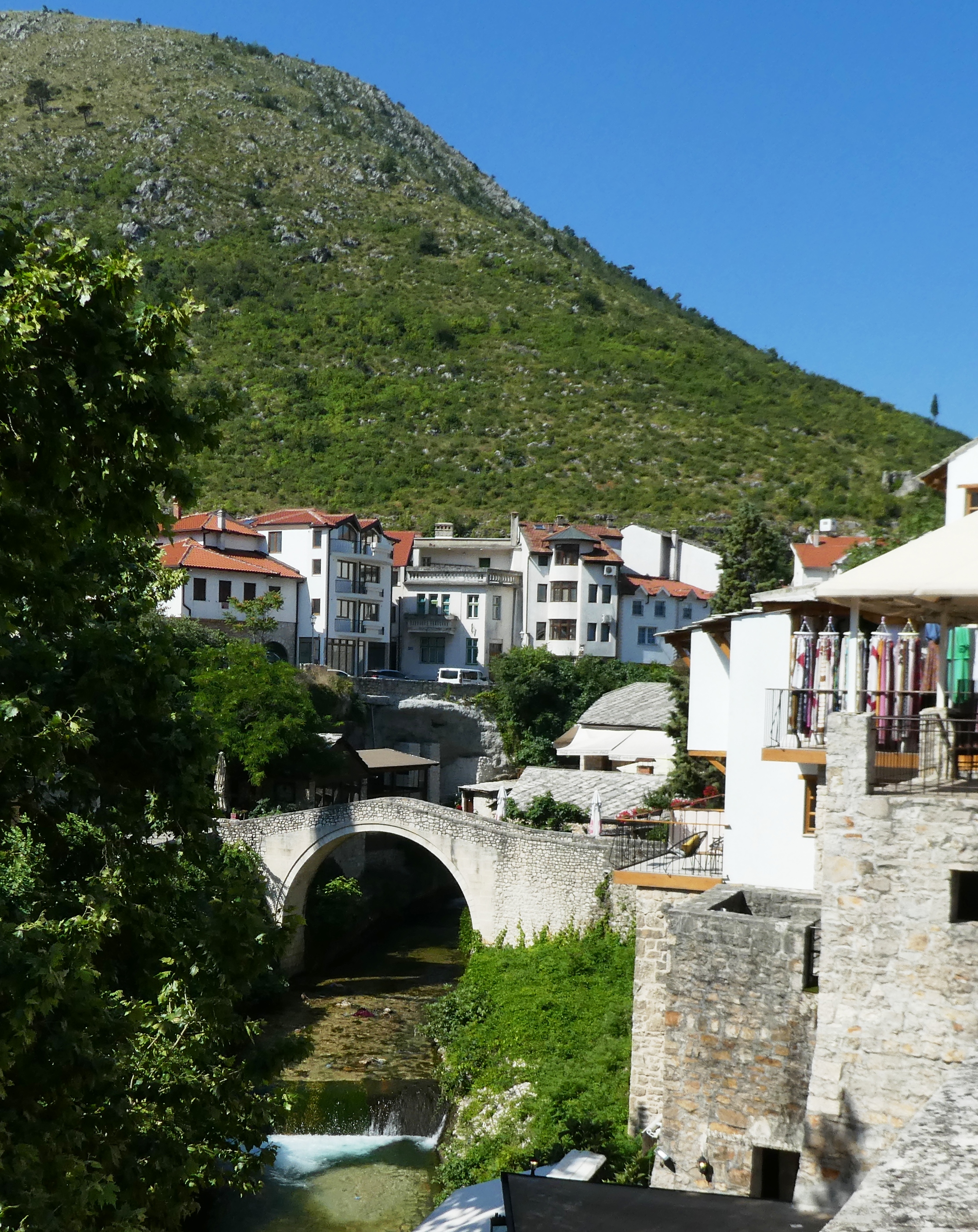
 We walked through the already crowded streets to ‘the old bridge’ that had been fully reconstructed after the war and crossed over it into the market area where the smaller ‘crooked bridge’ could be seen.
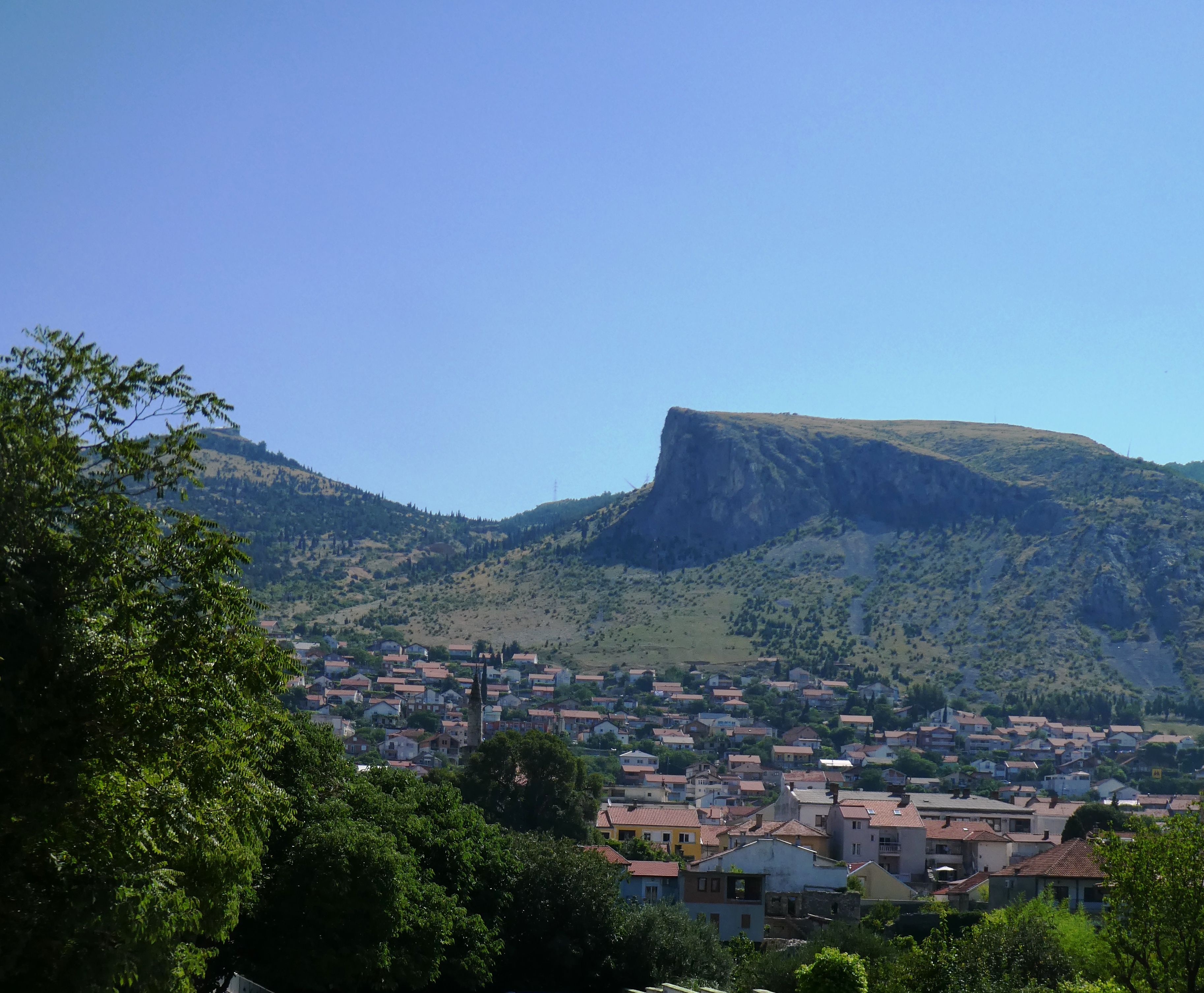
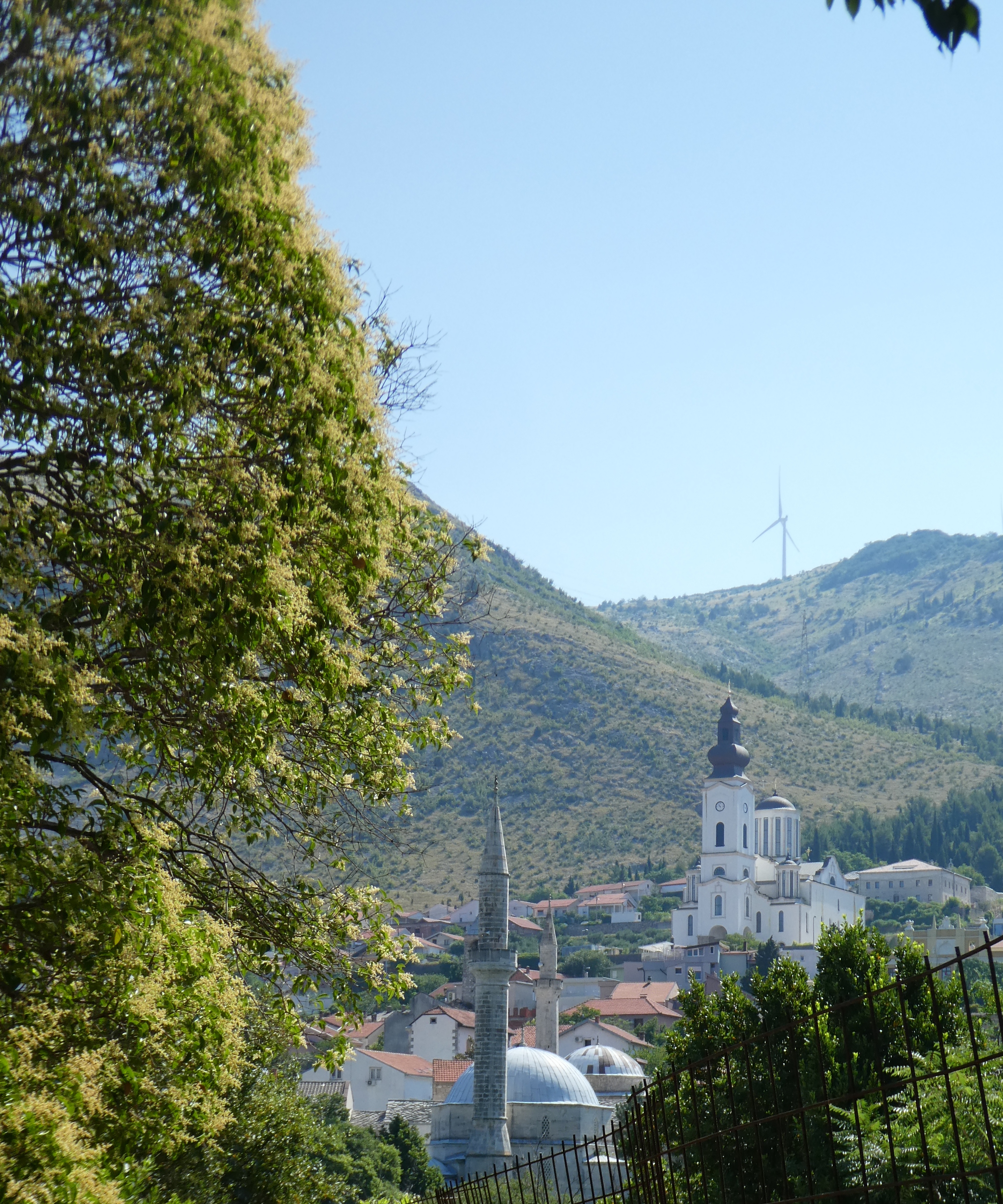

We wandered around taking note of the high hills surrounding the city from where snipers and guns could be fired into the centre of the town.
We made our way back to the van and headed south towards the Adriatic Coast.
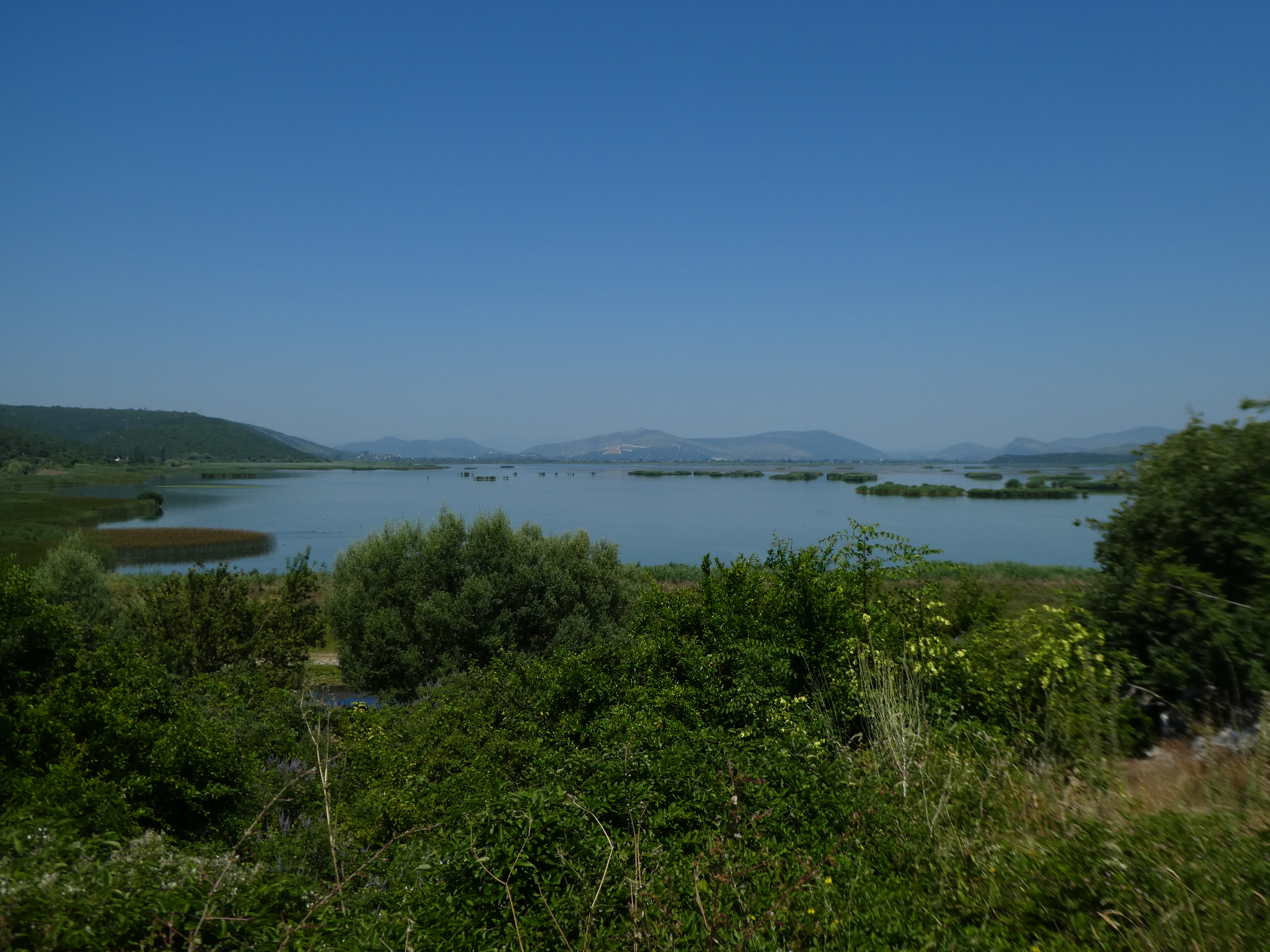 Looking for somewhere to stop for coffee, we turned off east on a minor road towards a large lake and had a break overlooking Svitavsko Lake.
We were sure that at times there must be an abundance of birds in the fresh waters of this shallow lake but in the heat, coots, crested grebes and some ducks were all there was to be seen.
We then went climbed up a wiggly rough rural road and over the mountain to join a new road that went west towards the coast and Bosnia’s only seaport at Neum.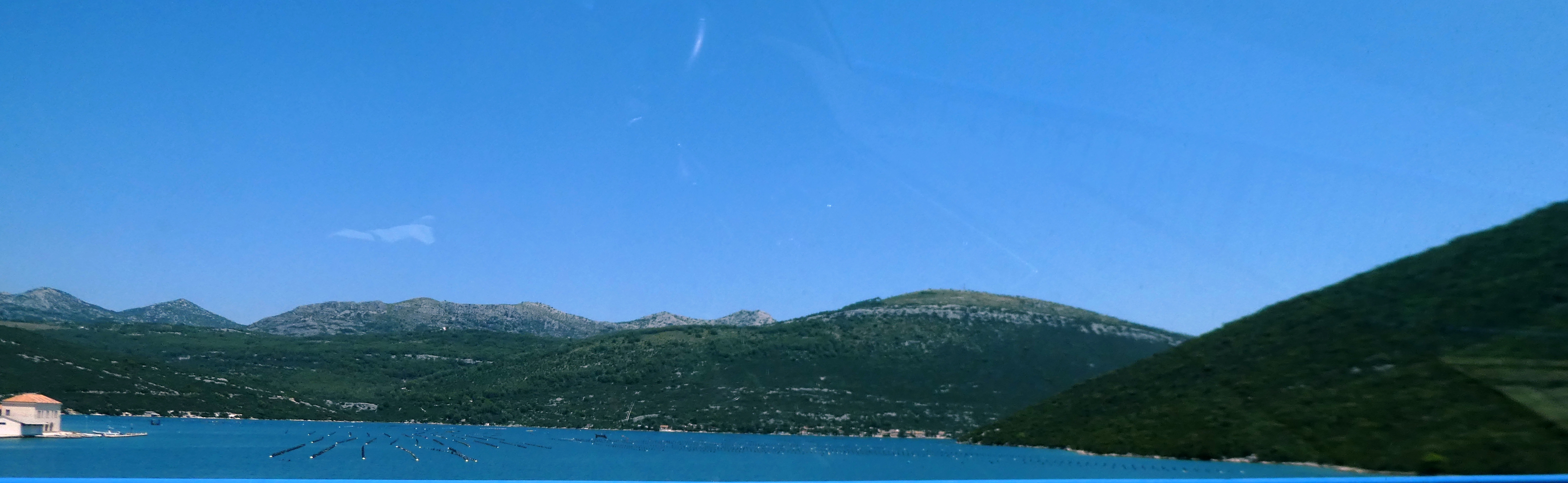
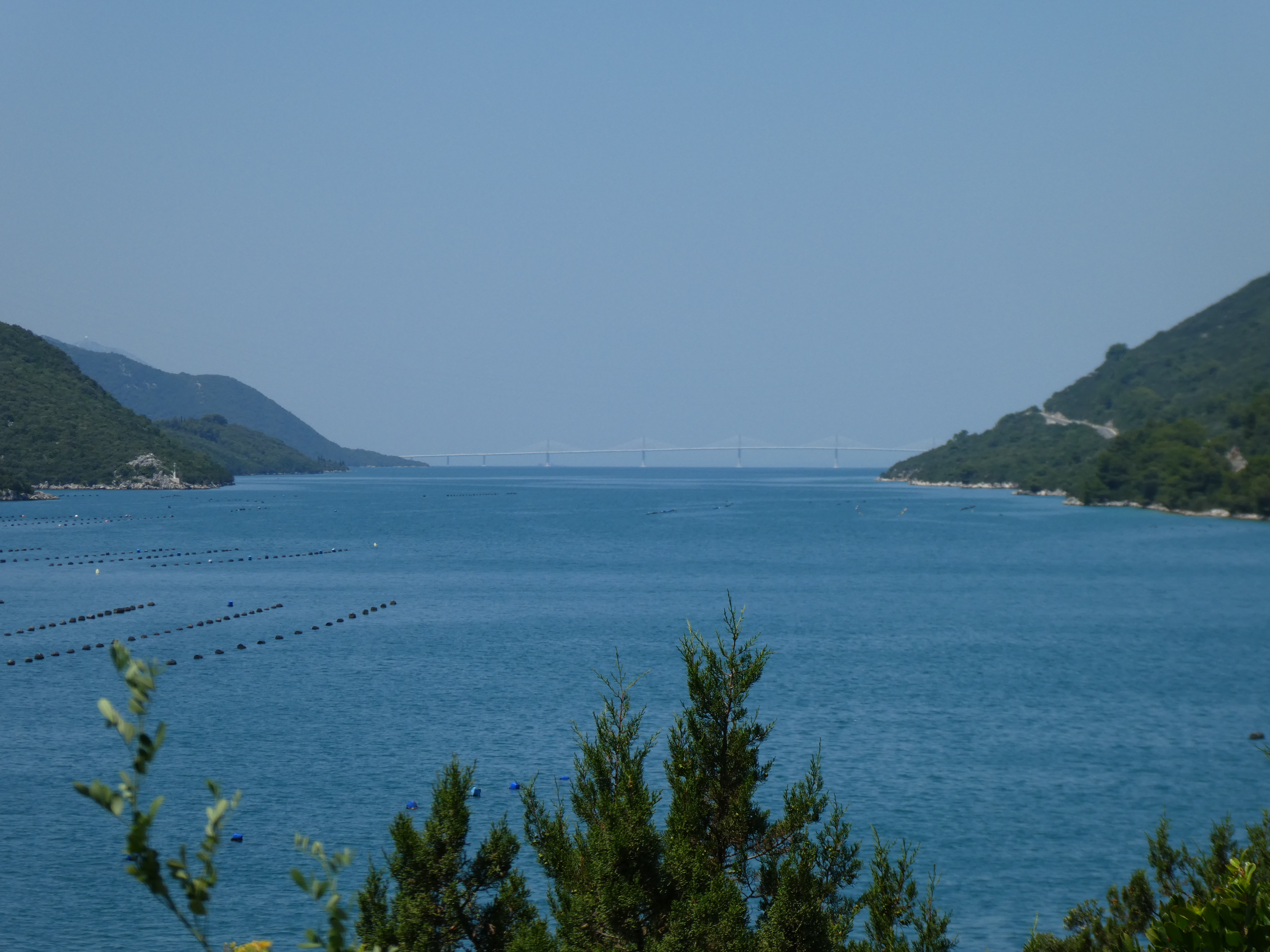
We travelled south from Neum to Ston passing back over the border to Croatia. Travelling down the coast from Split to Dubrovnik there was no continuous border but a new bridge spanning the sea linking the southern tip of Croatia on the Peljesac peninsular with its northern part.
In Ston a small village with a huge castle we found an open supermarket and bought enough food to keep us going.
 Ston Castle controlled all access on to the Peljesac peninsular at a very narrow strip of land that joined the peninsular to the mainland.
It formed part of a series of defensive stone walls built from 1358, originally more than 7 kilometres in length, to protect the City of Ston and its valuable salt pans that contributed to Dubrovnik’s wealth.
This is the second largest stone wall in the world after the Great Wall of China.
After leaving Ston we then travelled down the peninsular to Loviste at the northern end passing through a variety of seaside towns, all with large numbers of boats moored out to sea or in marinas, that faced west into the Adriatic backed by limestone mountains.
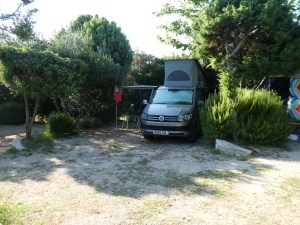
The village of Loviste stretched around a large bay with the more established residential areas and bars located at one end and the campsites and newer buildings at the other. Camp Lupus fronted onto the bay and stretched back up a hill into olive groves which provided shade for pitches and offered a view out over the bay.
We pitched in a cave of shade at one side of the site and after a much needed swim walked to the village and back again.
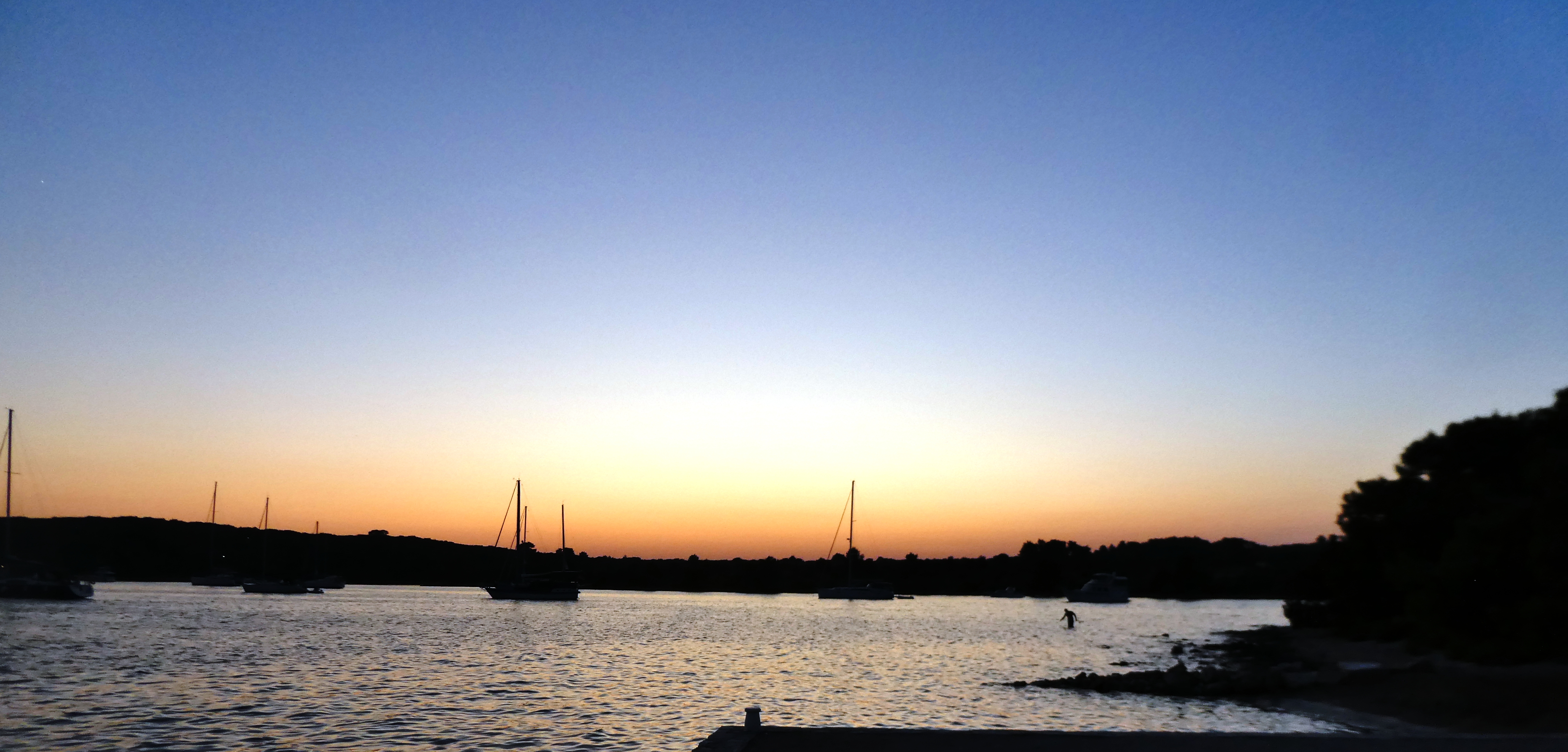
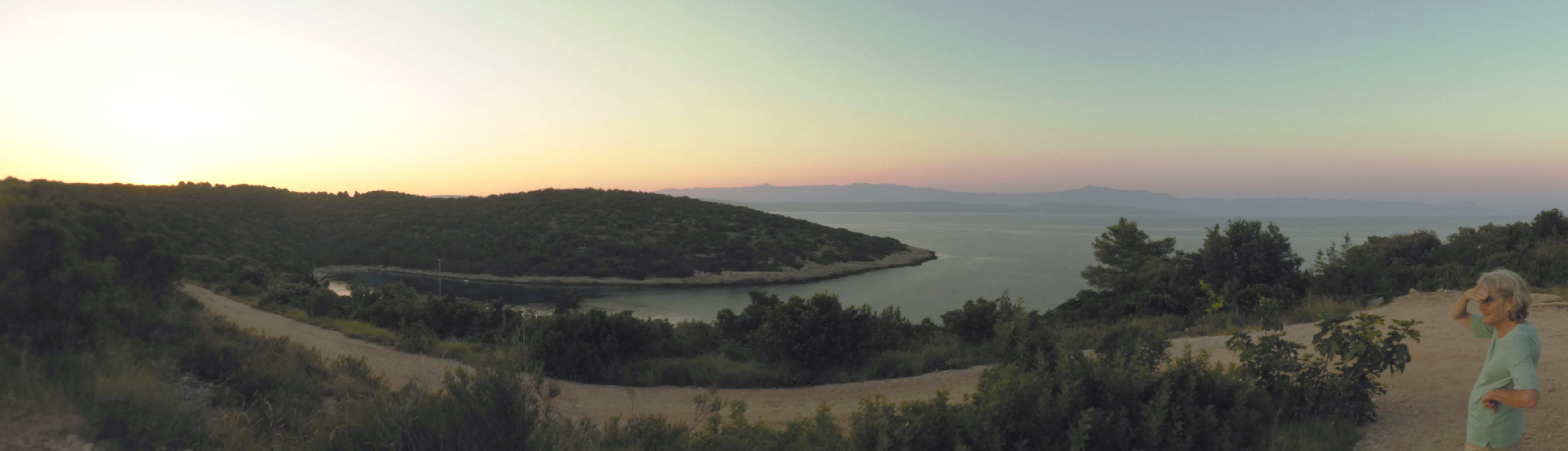
After a meal we went for a walk out of the back of the site and went over the hill to find Loviste beach on the other side of the peninsular, just as the sun as setting.
Monday 10th July – Loviste
A chilled start to a very hot day.

After breakfast we we decided to make our way to another little beach on the campsite map at U Lozova Bay across to the eastern side of the peninsula.
Unfortunately the map wasn’t very clear so we wandered up and down various scrubby paths through former olive groves, some new ones and a newly planted orchard.

The scrubby vegetation occasionally fell back where areas had been cleared for agriculture.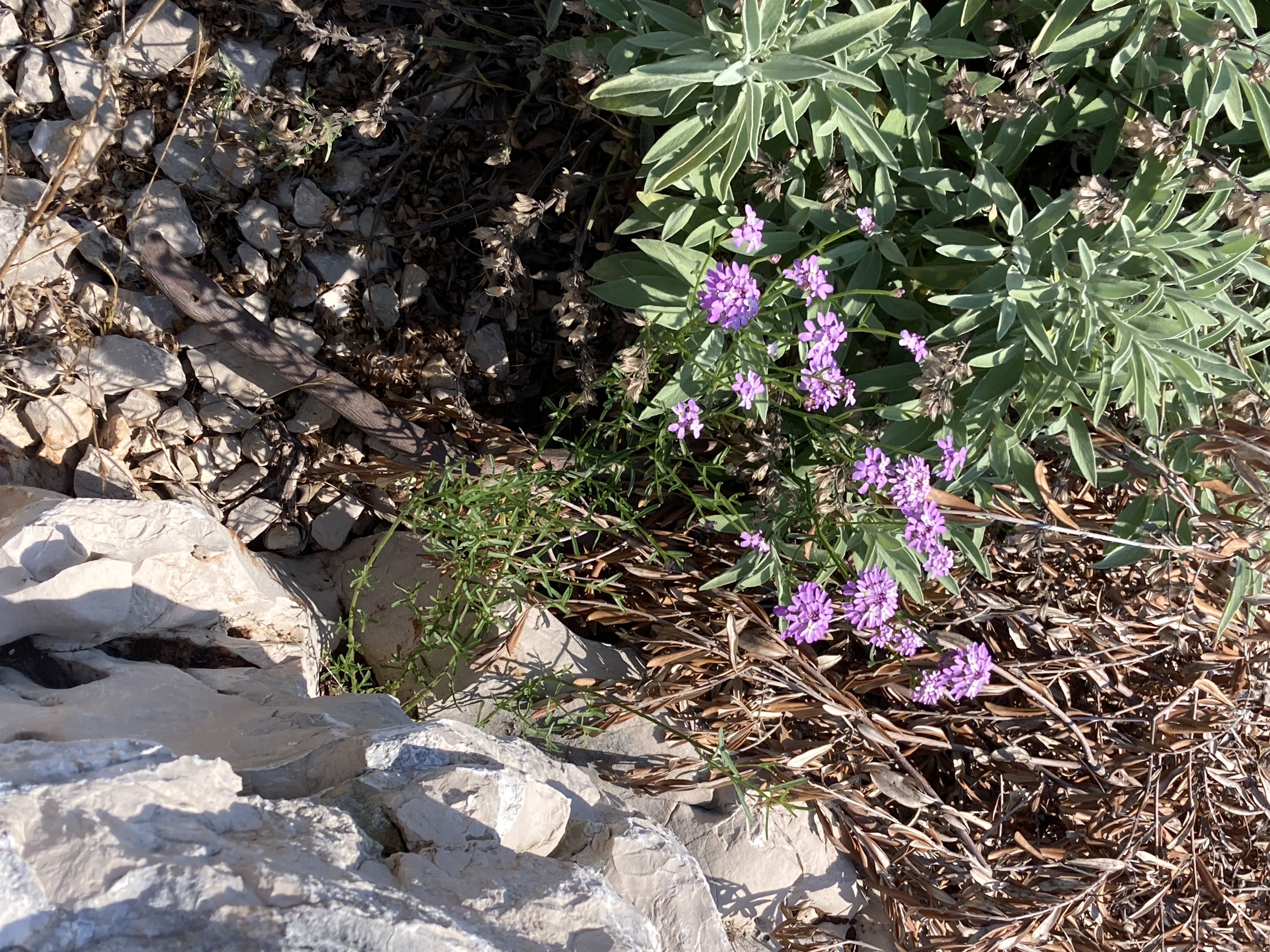

We enjoyed identifying flowers and discovered the lovely white admiral butterfly along the track.
Eventually we found a path which was only recognisable because of a rusty pipe and a series of man hole covers leading to the sea. These features had appeared on photograph on Google Maps and was the only means of knowing where we were.
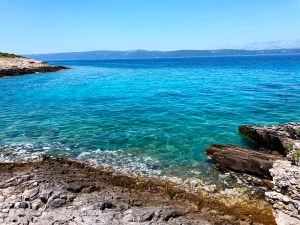
 It wasn’t easy forcing our way through thorny scrub following a notional rocky path but we eventually arrived in a small rocky inlet.
With some difficulty and great care we changed and swam sharp limestone rocks. It was a relief to be in the water as the day was hot and the track had been dusty.
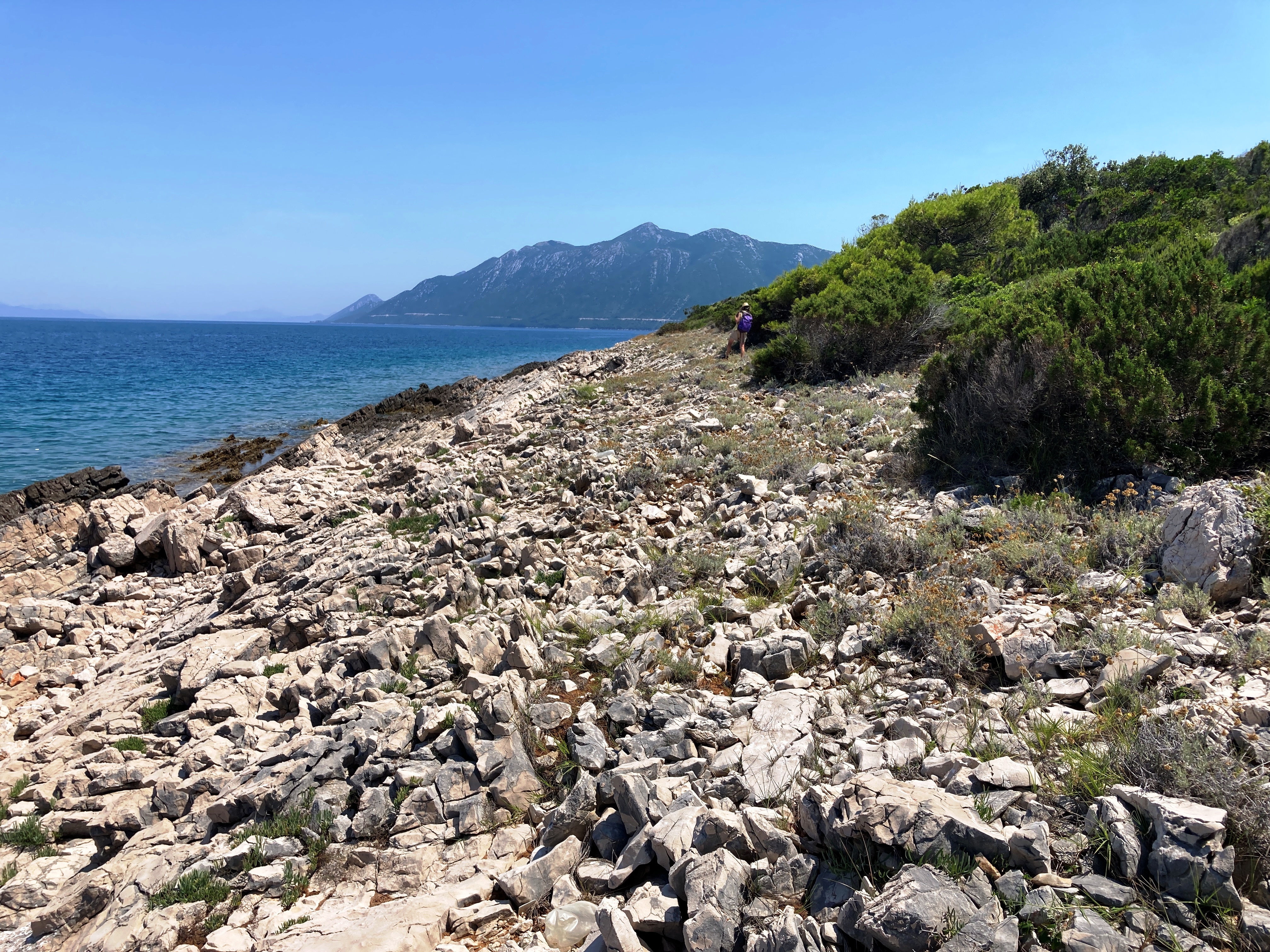 We swam along the shoreline towards the bay we had walked to last evening thinking it would be easier to walk along the shore rather than go back the way we had just come.
 So we followed the scrubby shoreline above the rocks to the Loviste beach where we had another swim before returning to the site rather later than we anticipated.
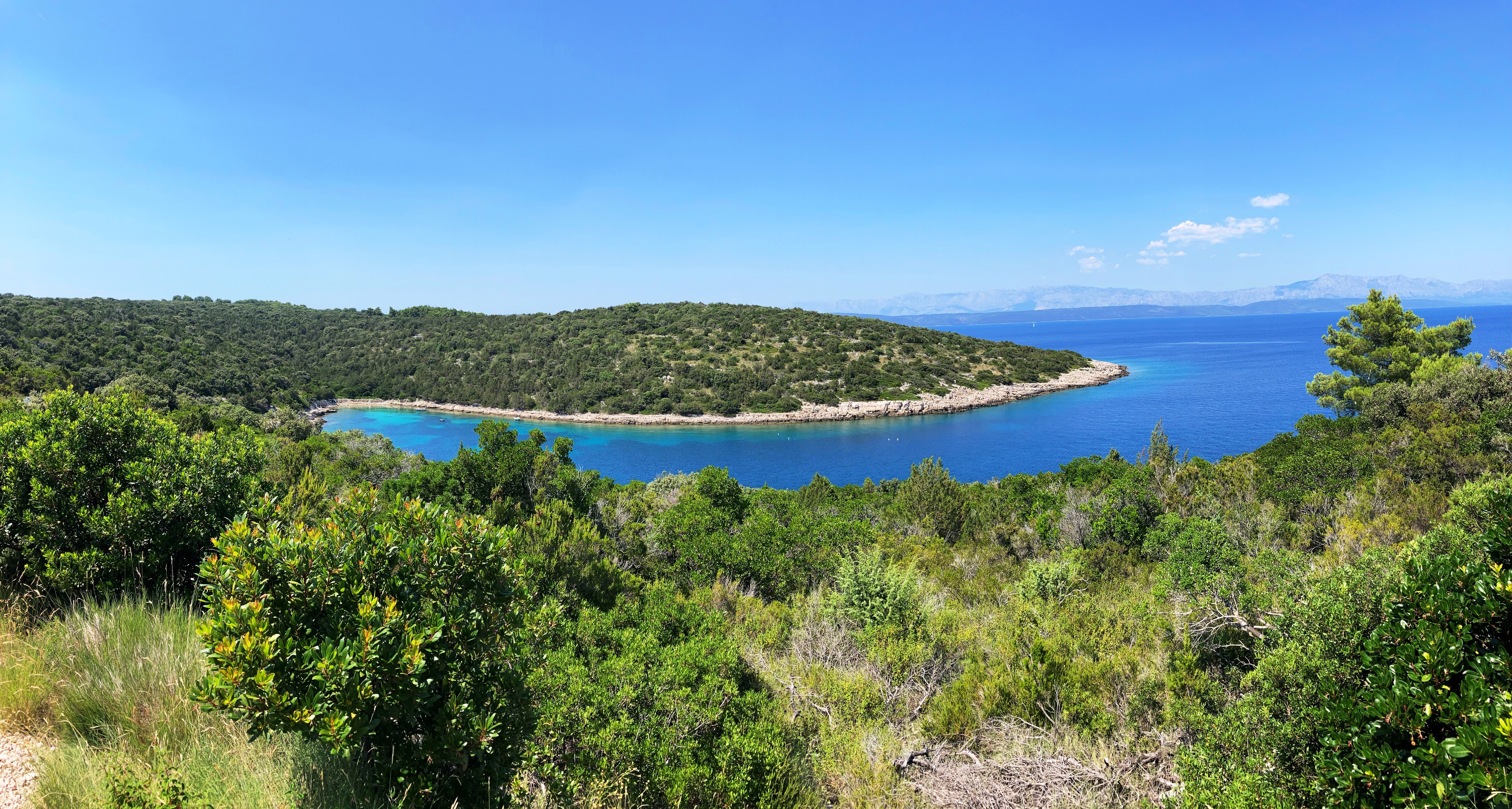 Although very hot we decided to cook as we had taken no food with us for our expedition.
So, after lunch, we spent the late afternoon swimming and resting on the site.
Tuesday 11th July – Loviste to Split
Walked around to the village and back and swam below the site.
Again very hot so we slowly packed up and drove to Brijesta just below the new bridge linking the peninsula to the mainland.
It was obviously a muscle farming fishing village with a small promontory with people in the water as it was so hot doing anything else.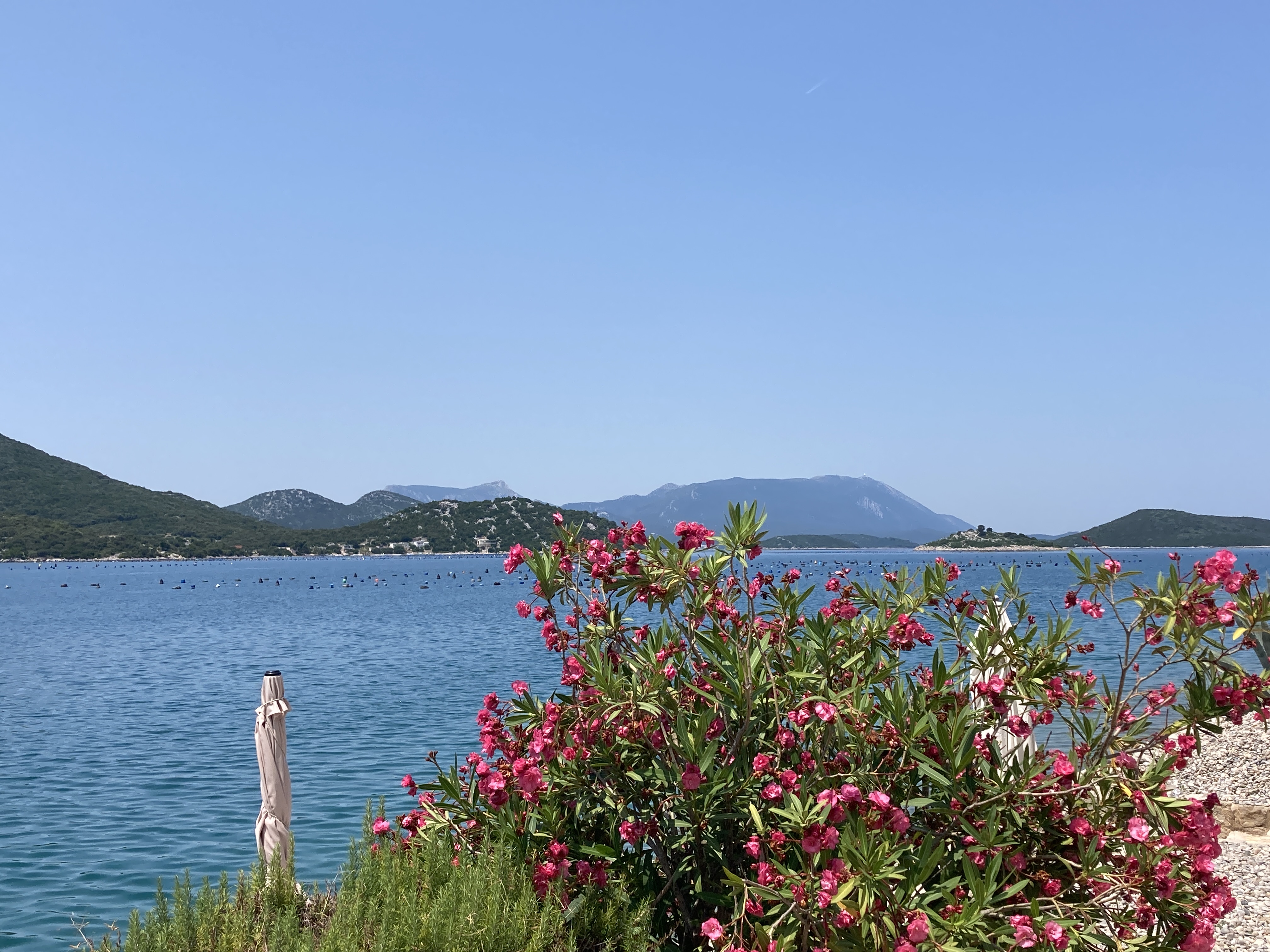
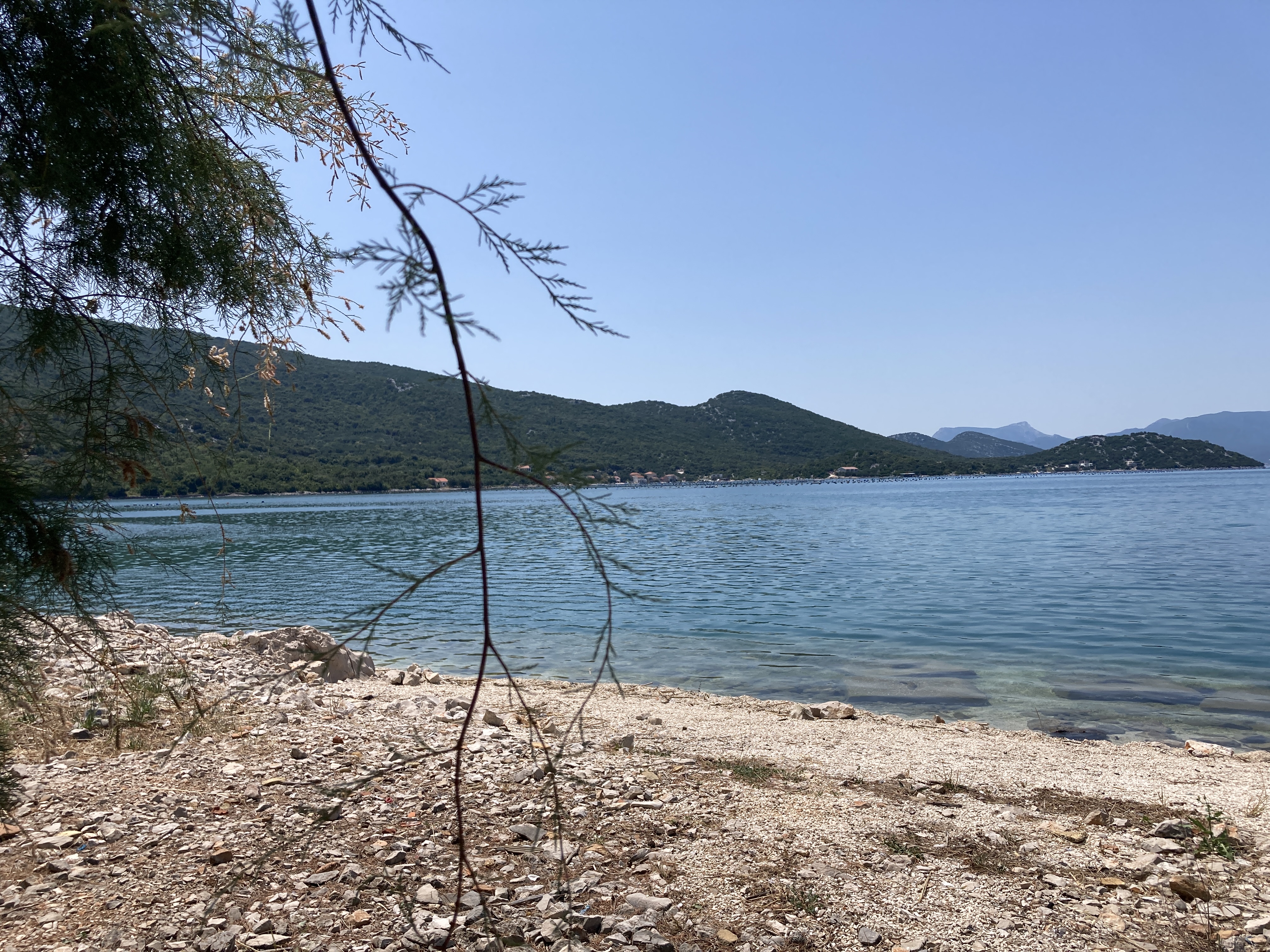

We walked a bit then ate in the van and tried to shelter under a tree but the heat was too much so we decided to head to Split along the coast.
Opting for the coastal road although slower offered a chance to take our time so we didn’t arrive in Split too early
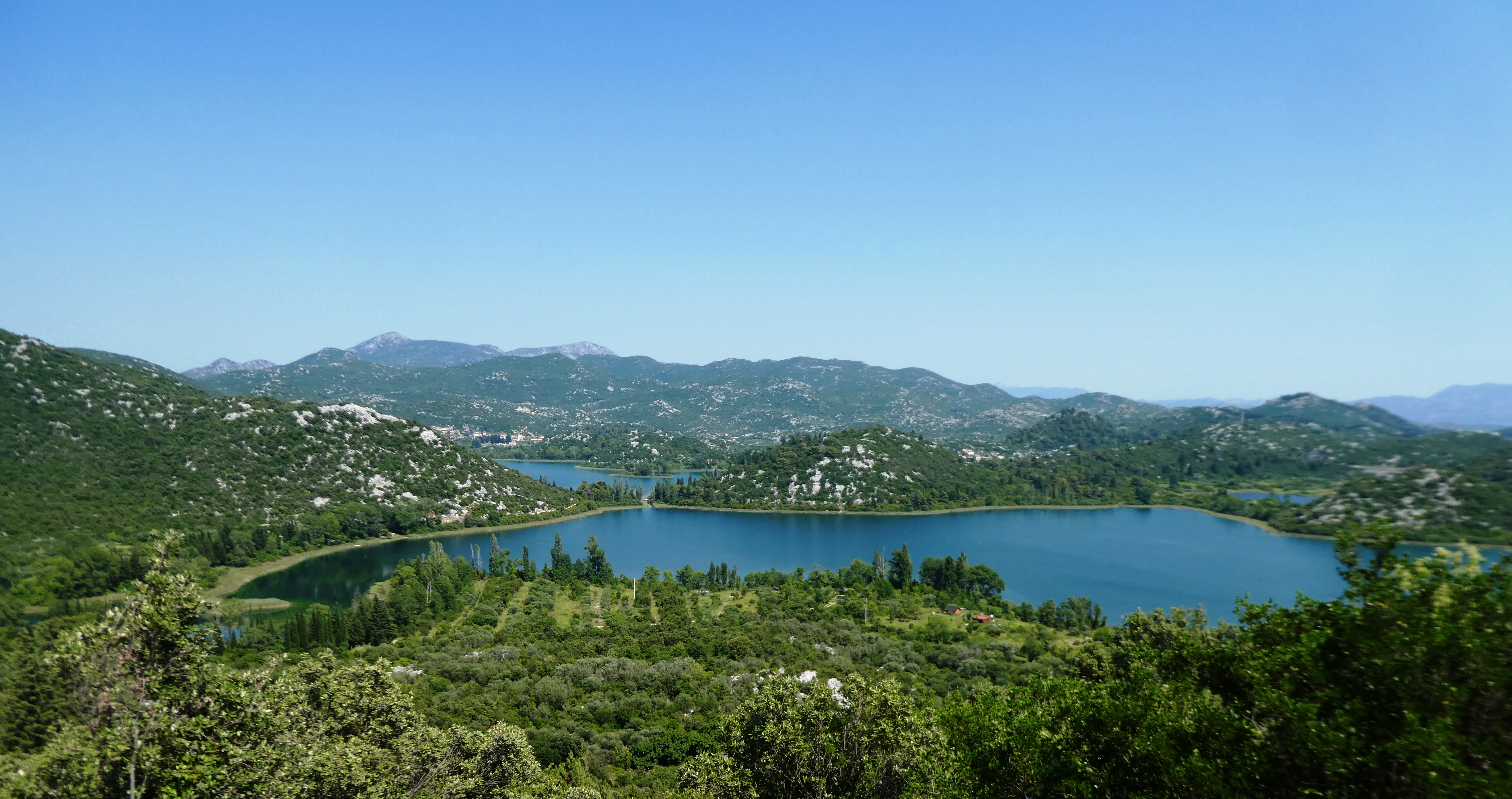 This worked well dropping inland before returning to the coast as we went north, having amazing changing views of the coastline.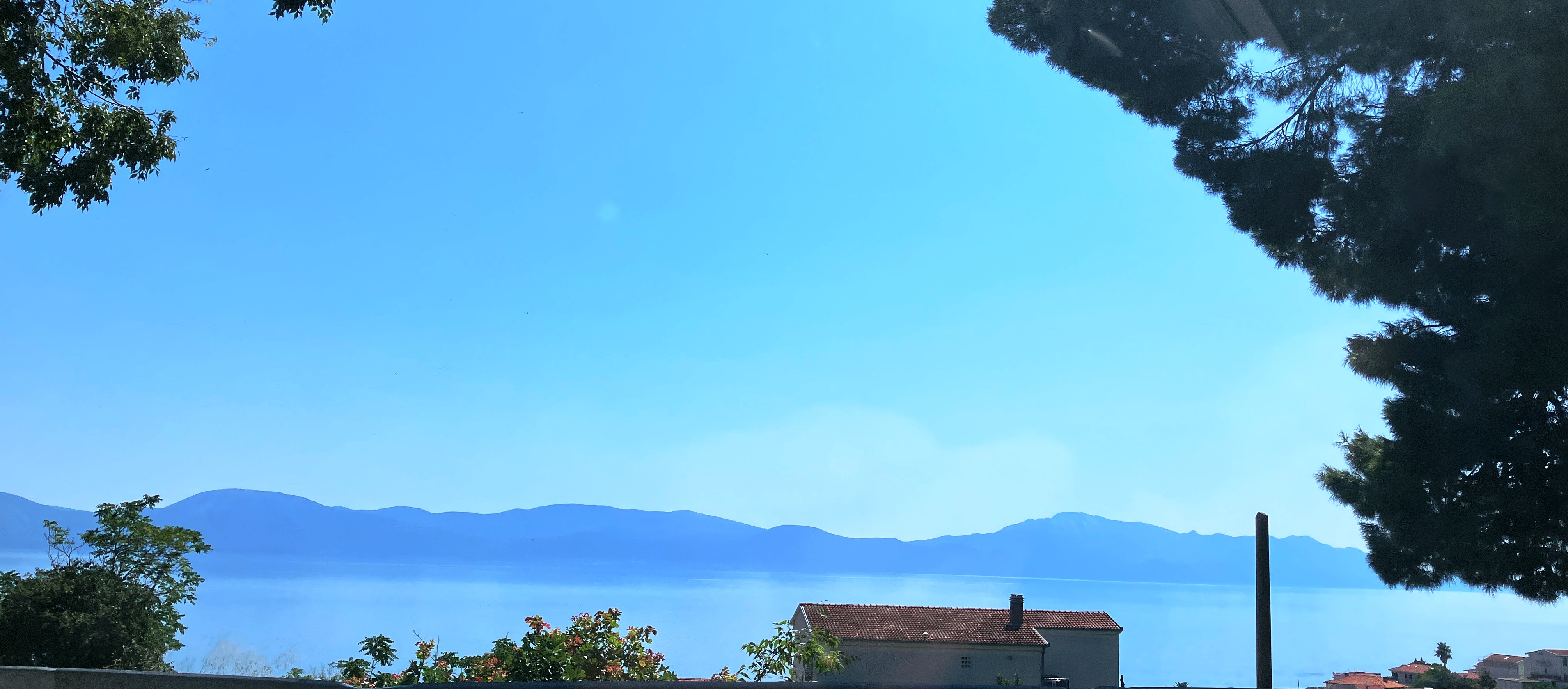
After spending a long time looking for somewhere to park we stopped briefly for a drink at a cafe on the sea front.

Having been here a few years before it felt very familiar as we made our way down to the port. Here all seemed chaotic with vehicles to parked up everywhere before boarding the ferry to stop the town from seizing up.
Janet found the ticket office where even though we had booked online we were given a formal ticket which we never had to show!
After much arm waving and Italian histrionics from the man in charge of getting the vehicles on board, we got on board and enjoyed looking back over the city.
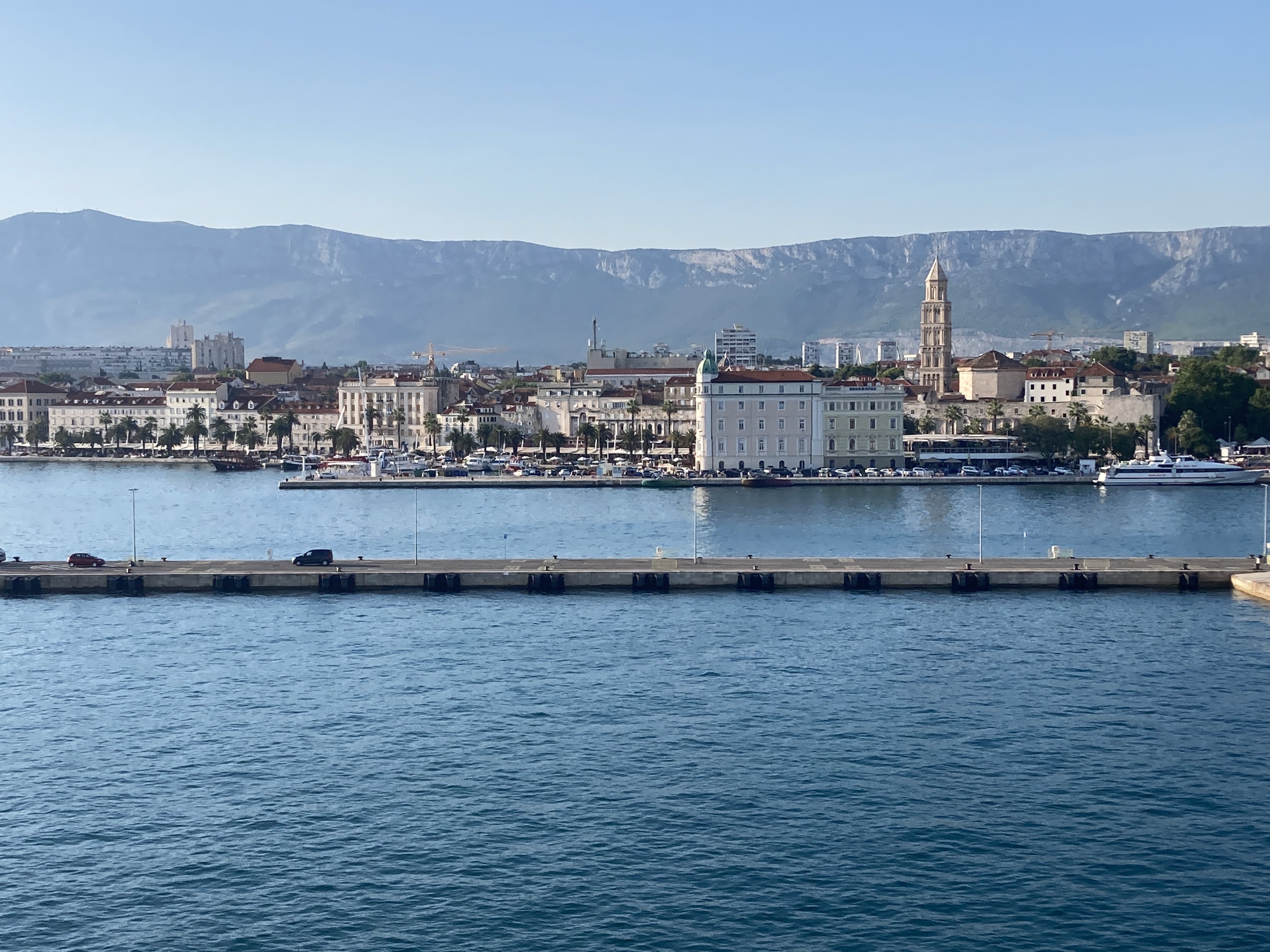
As we headed out onto the Adriatic we took a last glimpse of Croatia as the sun went down.
We watched darkness fall over the many Islands as we headed west to Ancona and Italy. 
Wednesday 12th July – Split to Mont Sole
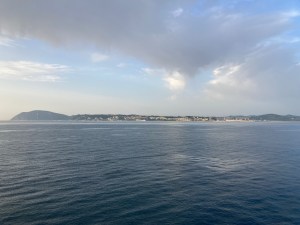
There was melodic music to wake us on the ferry but a fine shower and terrible coffee.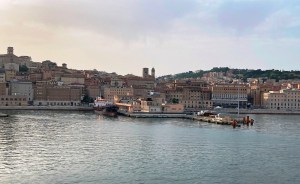
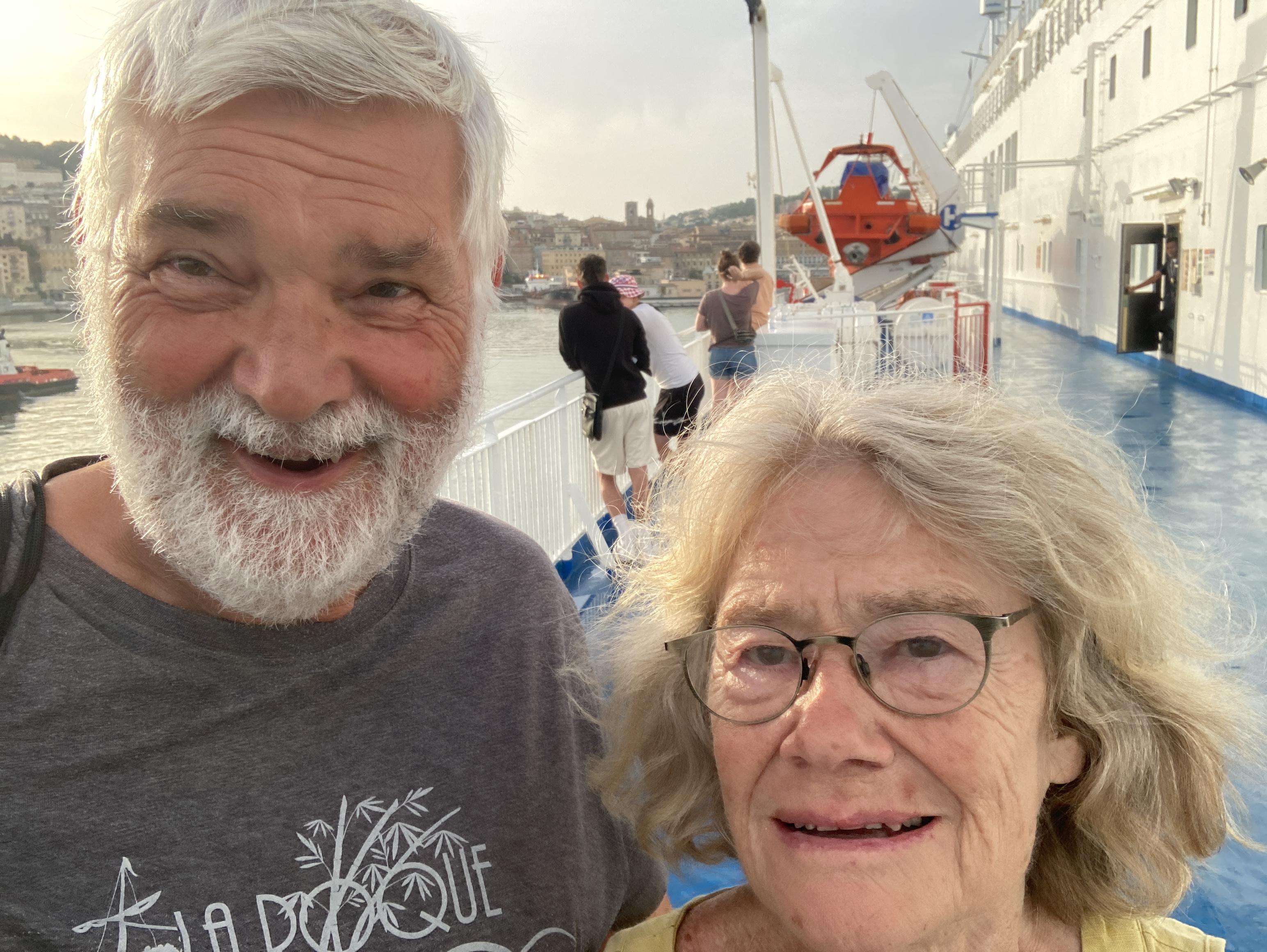
We were off the ferry and travelling to Urbina by 8.40. As we had no desire to travel on the autostradas we decided to take the main road along the coast.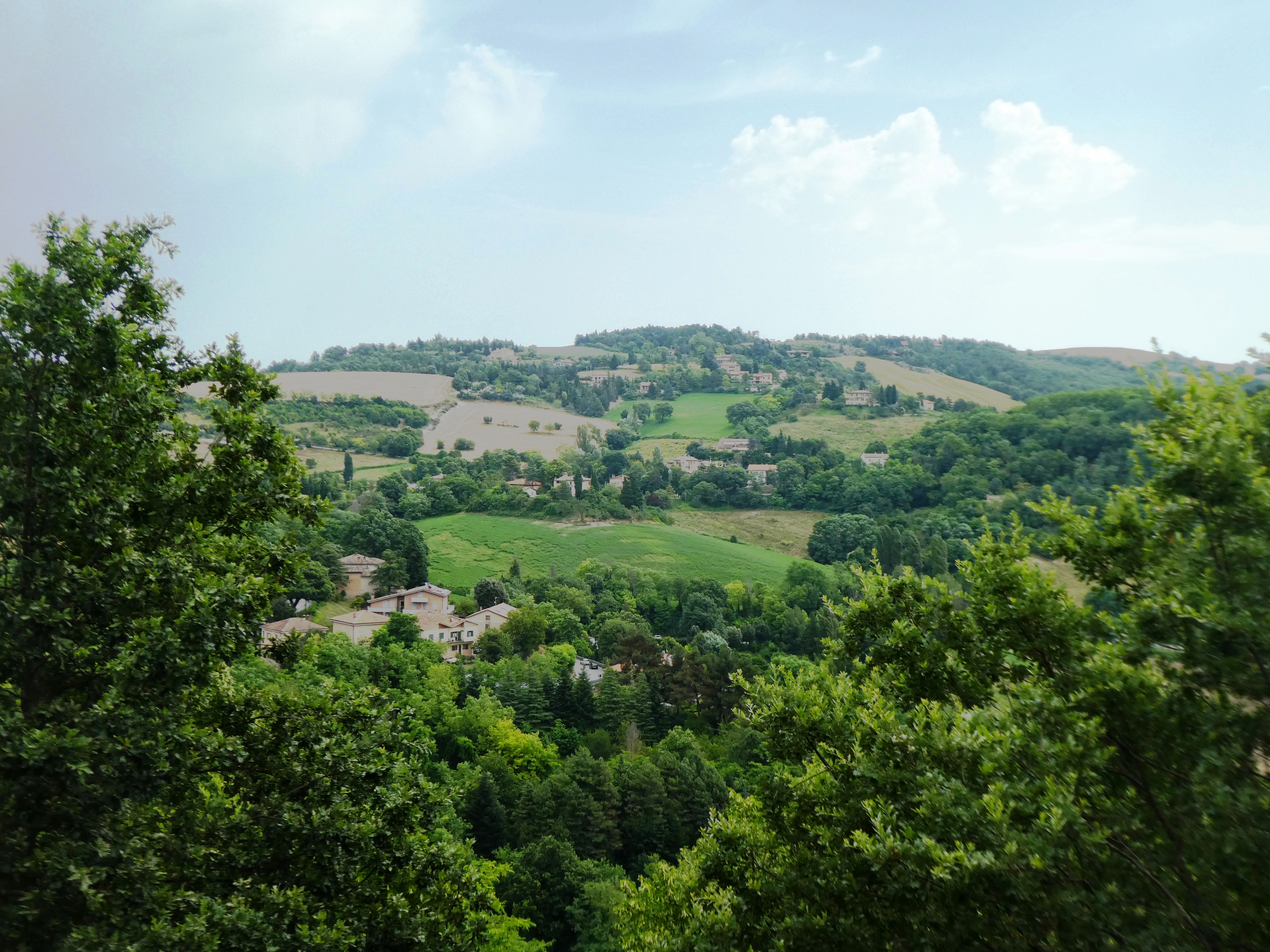
There was not much traffic and we soon made it to Urbina inland amongst the hills.
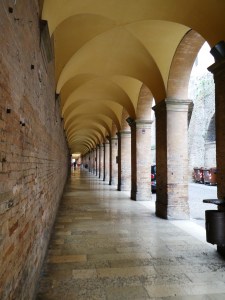
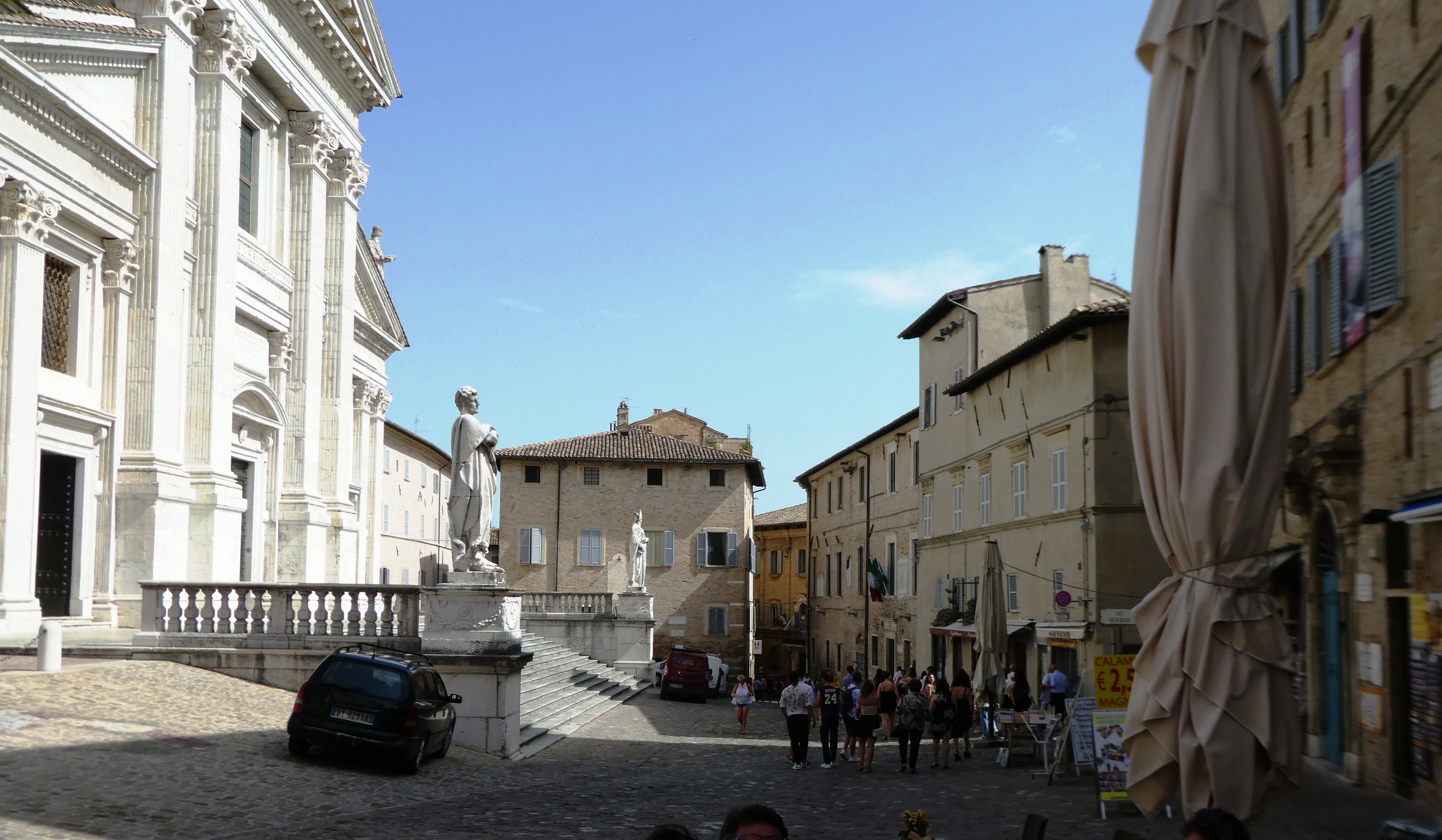
We parked outside the town and enjoyed an hour or so wandering around, taking coffee and pastries in the square, and admiring the buildings that gave the town its status as a World Heritage Site.


A small university city, it was vibrating with fun and laughter as graduating students, who wore olive leaf crowns, and their friends and family, sang songs as they wandered proudly around.

We were asked to judge the song/dance performed by one graduate and gave him the thumbs up.

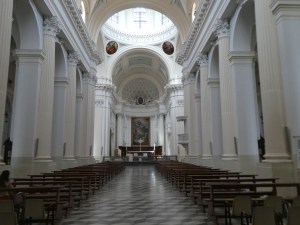
It was good to be back amongst classical buildings and the fairly simple light renaissance churches.
We shopped and then headed south along the Autostrada to Bologna.
Unfortunately on joining the autostrada we missed the ticket lane so came off at the next junction that was jammed and tail-gated a car through the barrier and went back onto the road buying a ticket correctly!
The road was very busy especially around Bologna and not in very good condition so it was a relief to wind our way up through a complicated network of one way road works up into the hills.
We were heading for Camping Naturista Ca’le Scope and after lots of small twisty roads we reached a high ridge with spectacular views and followed a track into the woods where we found the site. There were large electronic gates which were shut and we could get no sense out of the intercom at the gate. So we followed a car which appeared along the track and opened the gate. The driver seemed to think we had spoken to someone on the phone and drove on in.
The gates stayed open so we went in only to find it was a nudist camp. Not a suitable location for a short one night stay! We immediately decided that this wasn’t for us but then we couldn’t get out as the electronic gate had shut behind us. On the gate it stated clearly that people who were leaving the site without any clothes on would be heavily fined.
Unable to get any sense out of the intercom at the gate we were lucky that there was a couple just leaving (fully clothed) who let us out. We went back along the track.
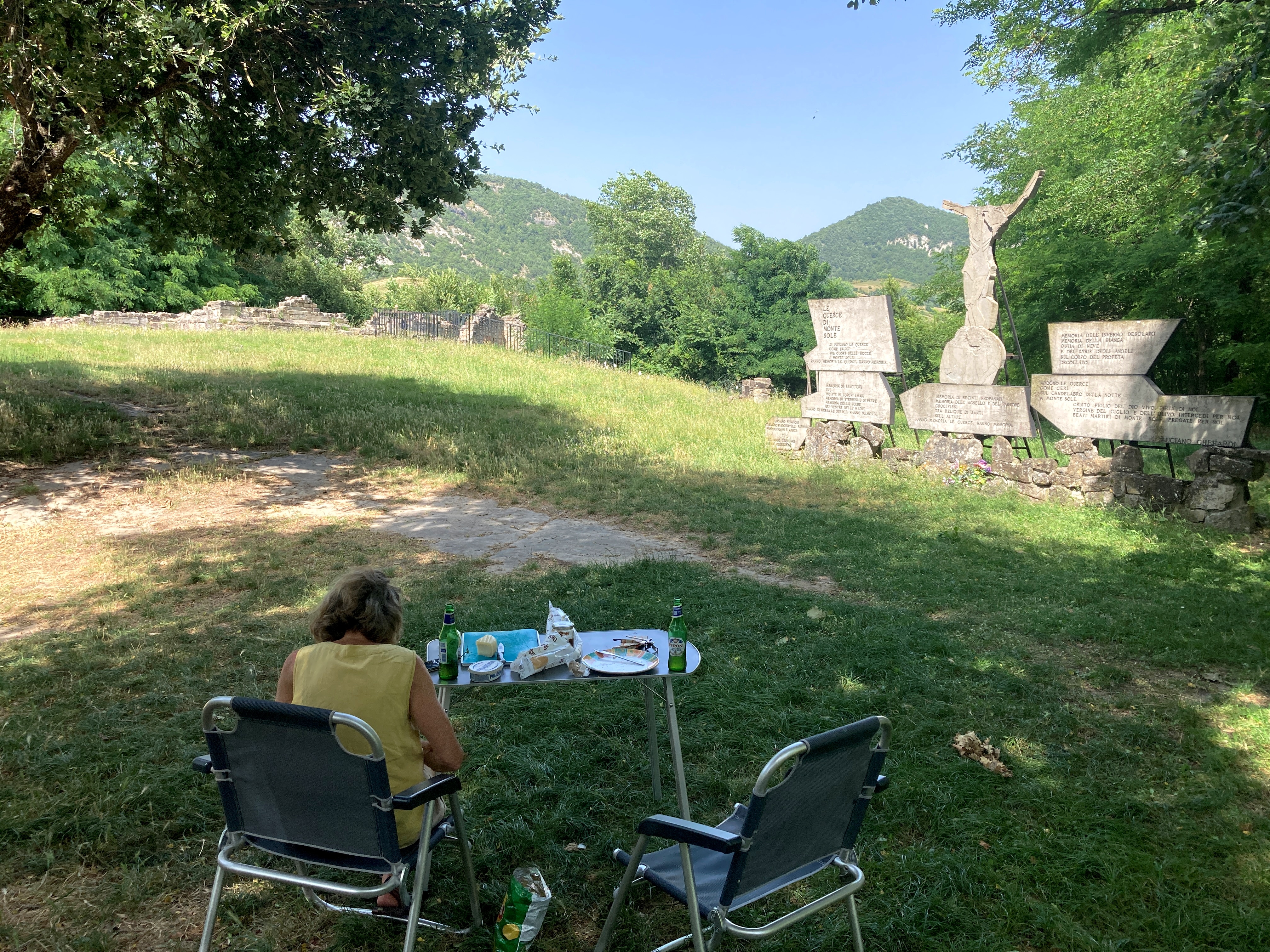
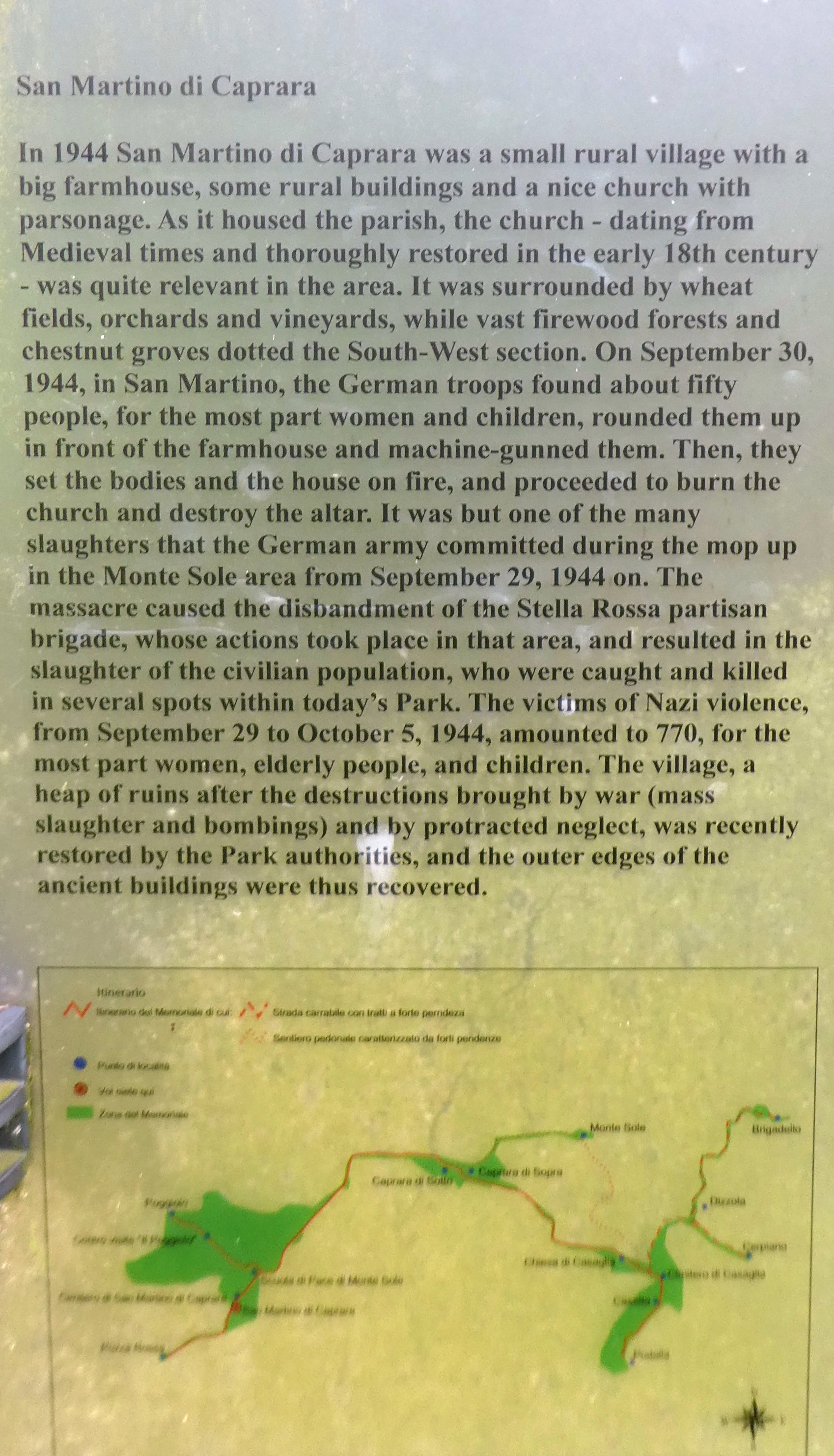 We drove back along the track to where it opened out onto the ridge. There were a lot of interpreted monuments and graves referring to Le Querce Di Monte Sole, The Oaks of Monte Sole.
From the 18th century on there was a thriving farming village community populating the hills along and below the ridge.
During World War II many men were off fighting and the villages operated a resistance to the occupying German Army with the children, old men and women .
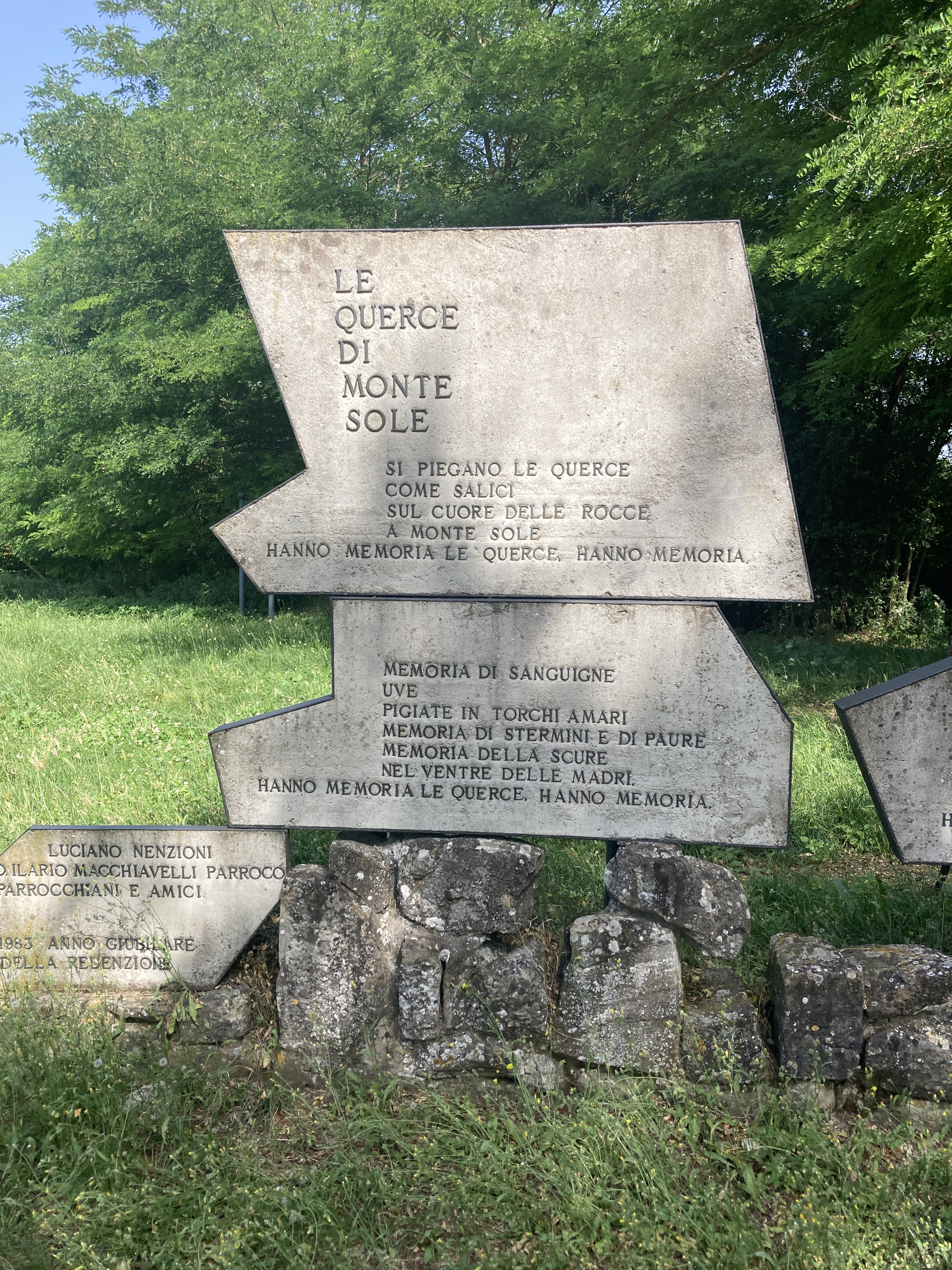
On the 30 September 1944 the retreating German troops massacred everyone they came across in the area,, mainly women and children many who had been part of the Italian resistance movement. In the Monte Sole area 770 were killed.
We felt moved and wondered how many other unknown massacres there had been in the area and how we seemed to have been following the tragedy of wars for much of the holiday.
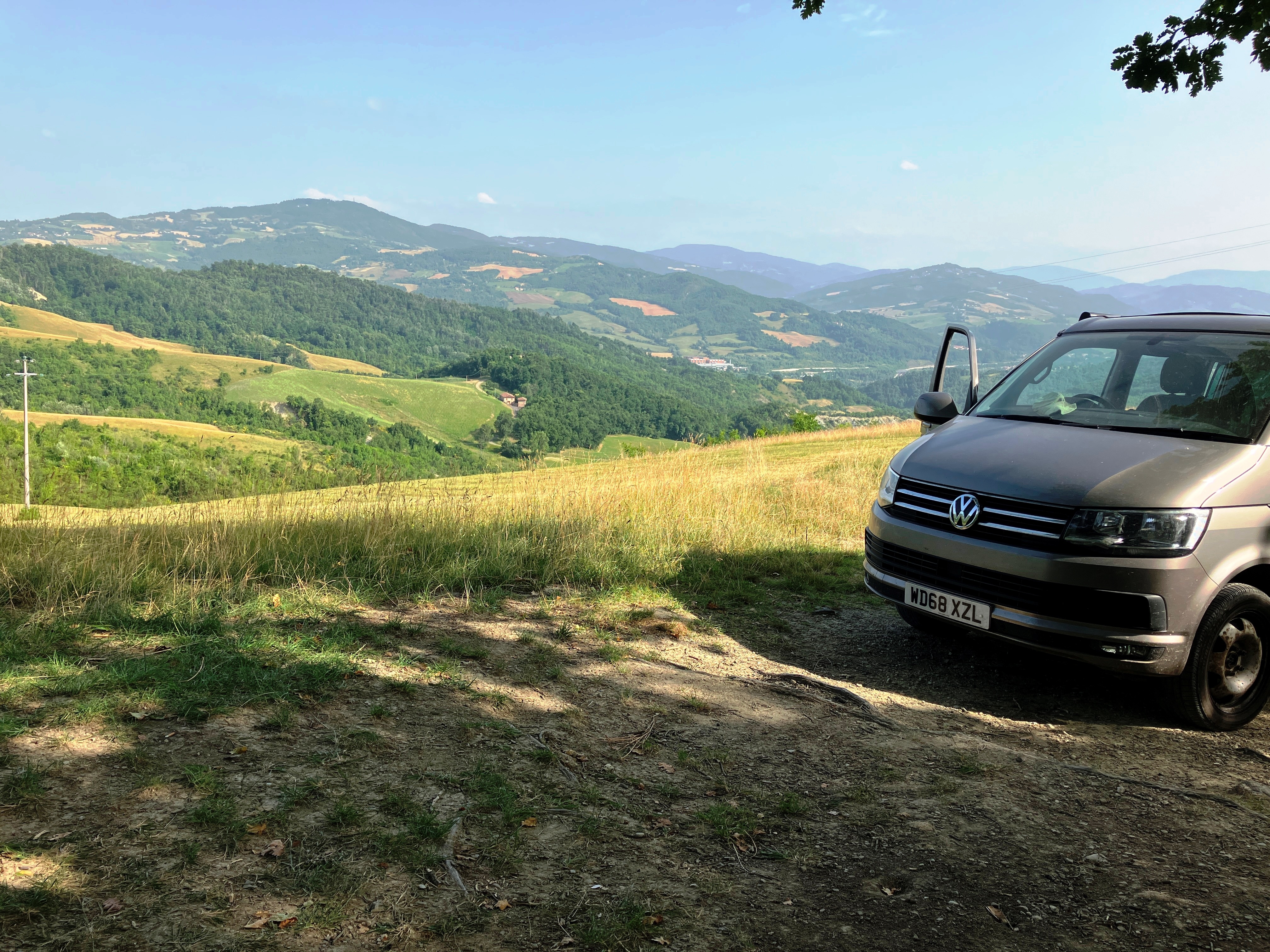
After a bite to eat we found some suggestions on the internet (Park4Night) for rough camping up in the immediate area.
We walked to the crossroads at the pass and up the road along the ridge and decided on a spot to camp and drove up.

High on the ridge and protected from an increasingly brisk wind it had lovely views and felt airy in temperatures topping 35 degrees and as a bonus it had a bench and a waste bin.
During the late afternoon and evening cars drove up and beyond as there was another memorial village and there were quite a few walkers around.
We pottered around and as it got colder walked up to see the ruined village that had been been kept as a memorial.
As it got later there were bursts of loud music from the Pizza Bar in the valley below and various people wandered up in the cool but it soon quietened down. Amazingly as it got dark and we saw all the settlement lights spring up around us and realised just how many people there were living in the countryside.

It was lovely and as a quite strong wind got up we went to bed and slept well which as the cool fresh air was a real contrast from the heat we had been experiencing. The wind became very strong and really buffeted the van all night.
Thursday 13th July – Monte Sole to Bologna to Pavia
Up early packed up with light grey skies and drove into Bologna.
 After navigating the one way streets we eventually found the car park we had been looking for only to find that it had a barrier across it at 2.1 metres, too low for the bikes.
We had intended to walk into the city from here but we made a virtue of necessity and took the bikes off parked the van and headed into the city.
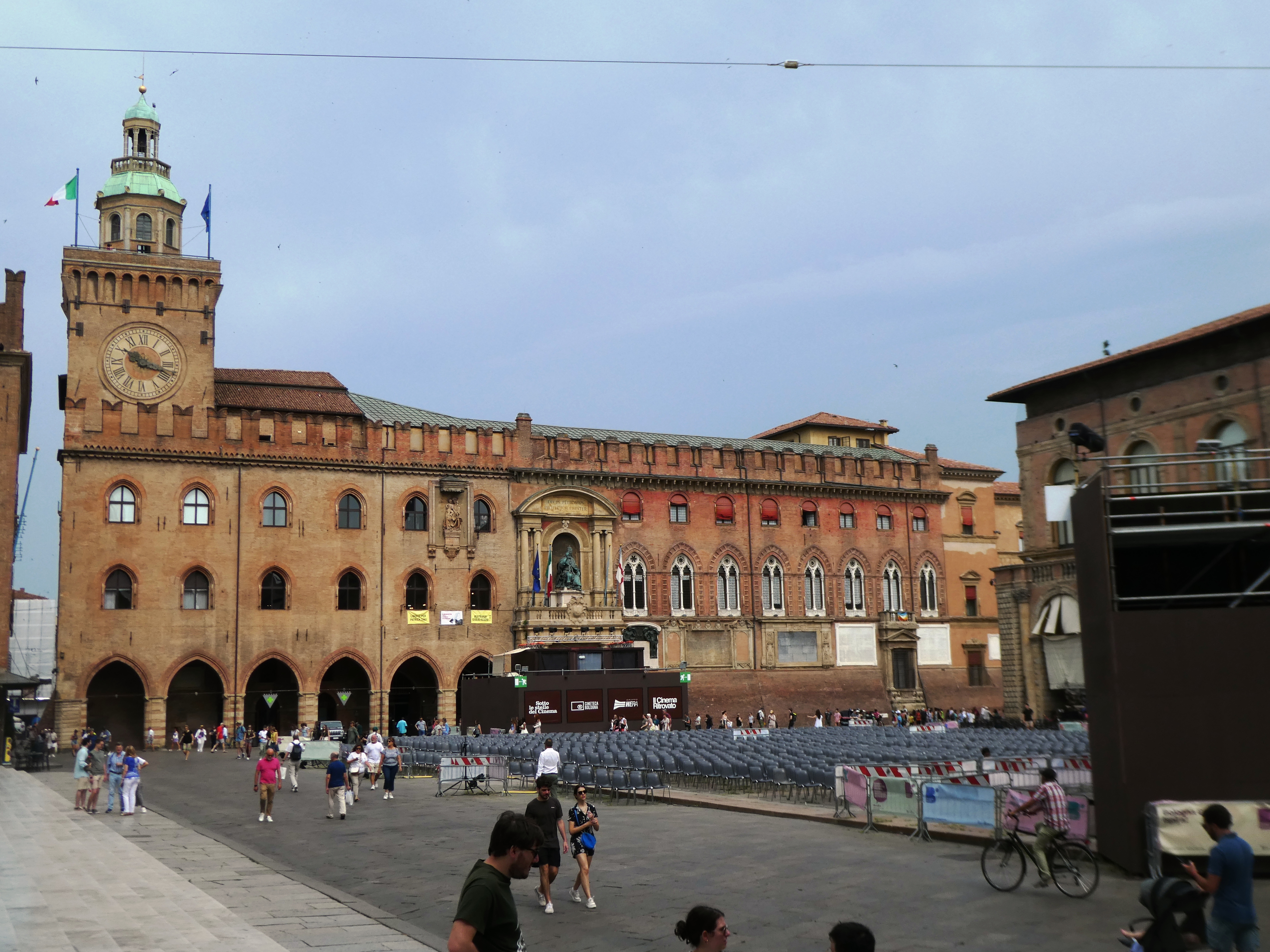
We then rode them the two kilometres into the centre and parked at the central square, Piazza Maggiorie. It was a large space surrounded by enormous buildings the lower half of each being quite elaborate but the upper stories being dull brown and simpler in architectural style with lots of holes that looks as though they could have held other earlier structures.
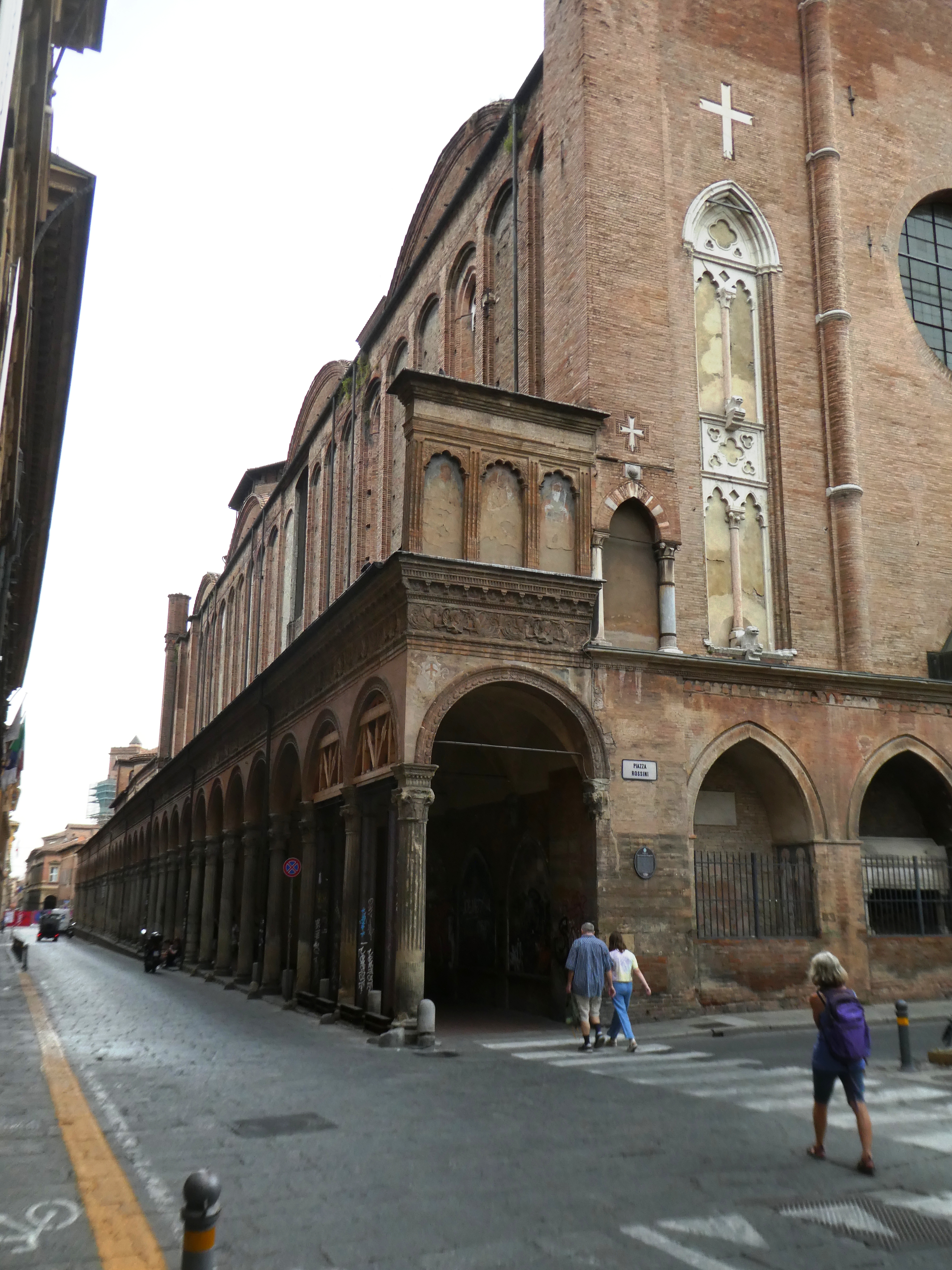
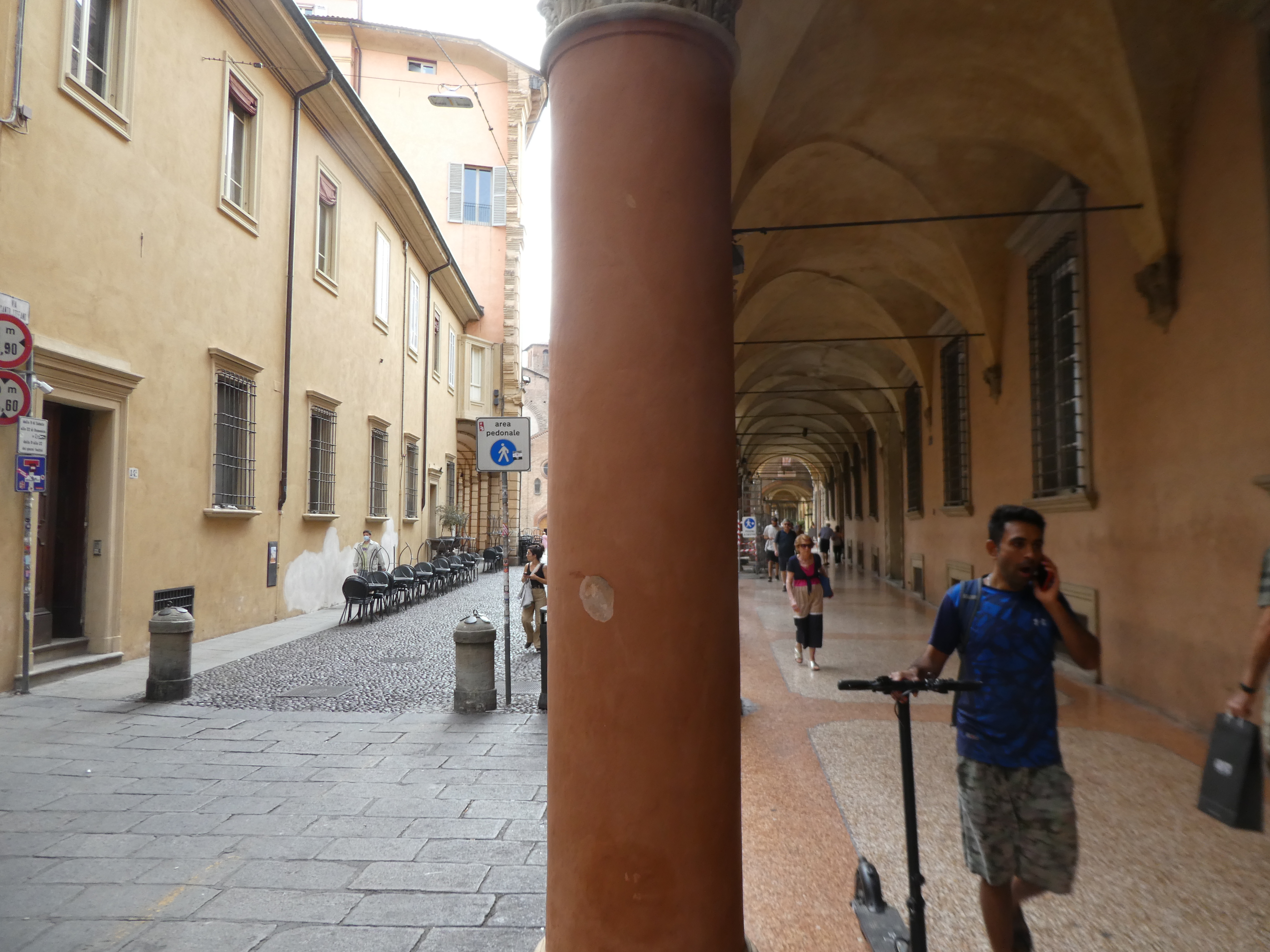

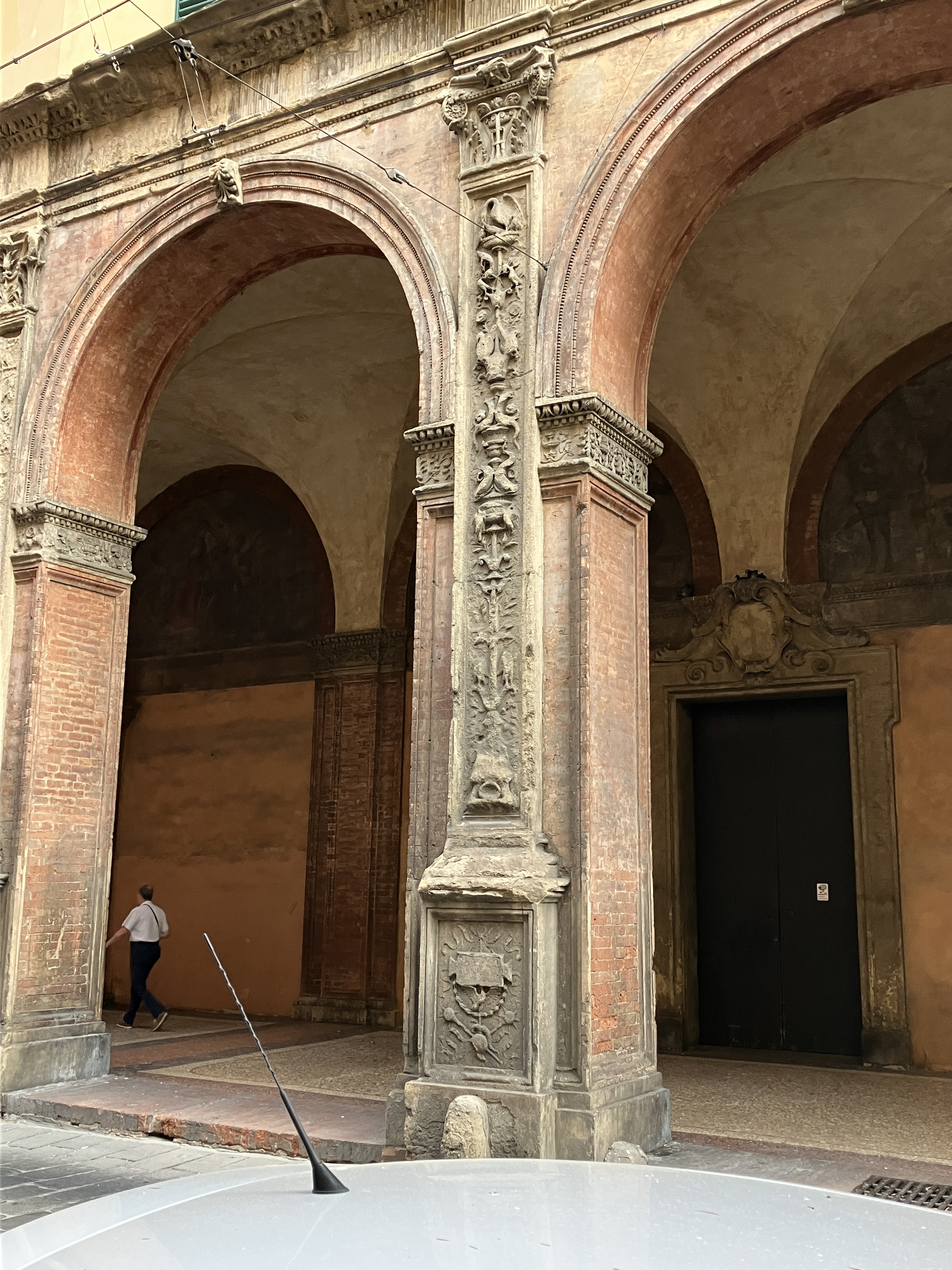
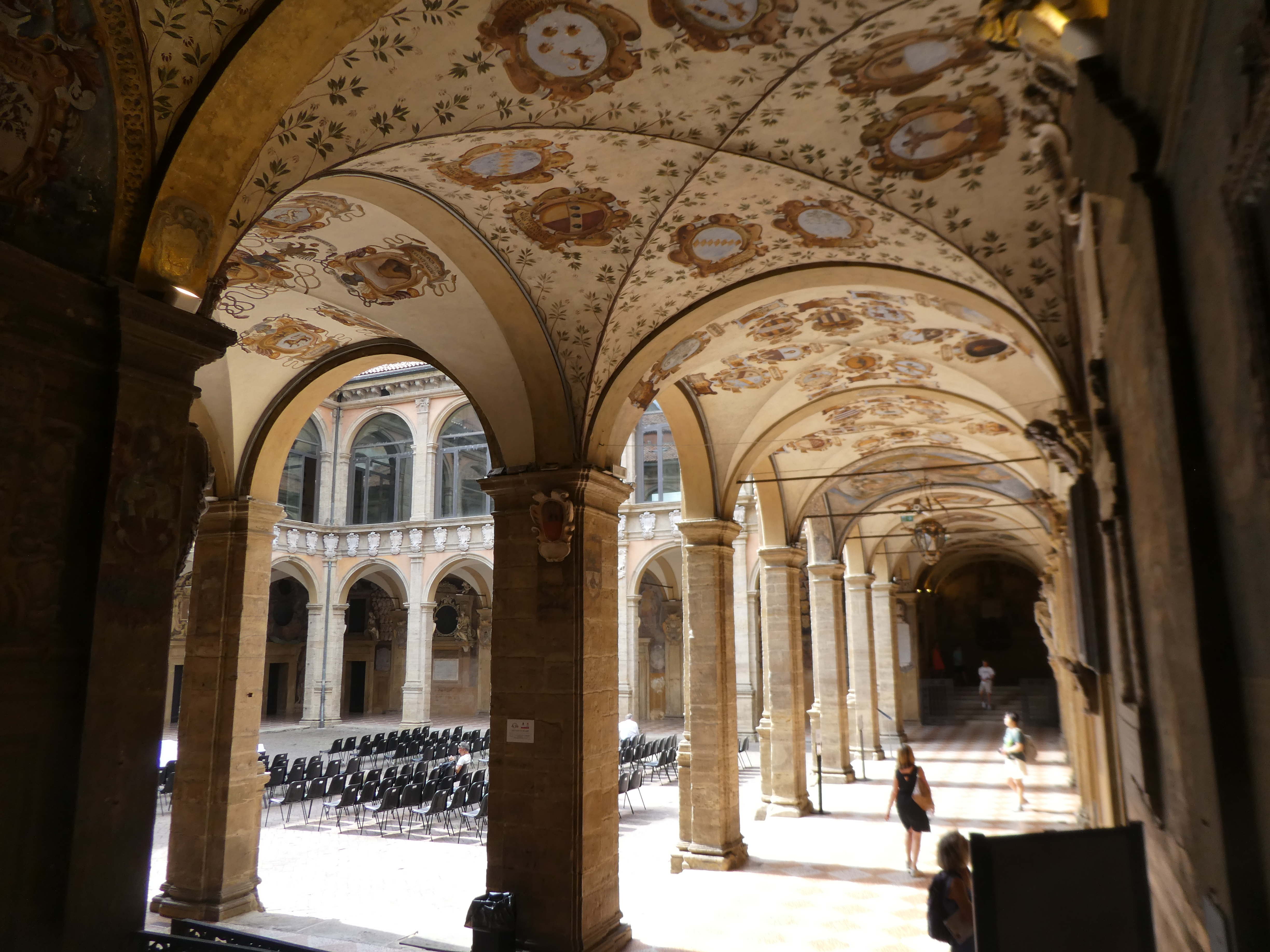 Above all else it was the numerous porticos, apparently 62 KMs of them in the city that defined Bologna and gave it its World Heritage Site status.
It also explained the dull upper stories of the buildings because who could see them if you were walking under porticoes.
The oldest portico dated from the Middle Ages and the newest are those incorporated into new buildings in the City Centre.
They provided shade as well as shelter from the rain (which we later experienced when a thunder storm struck). They were everywhere some with shops some just passageways.
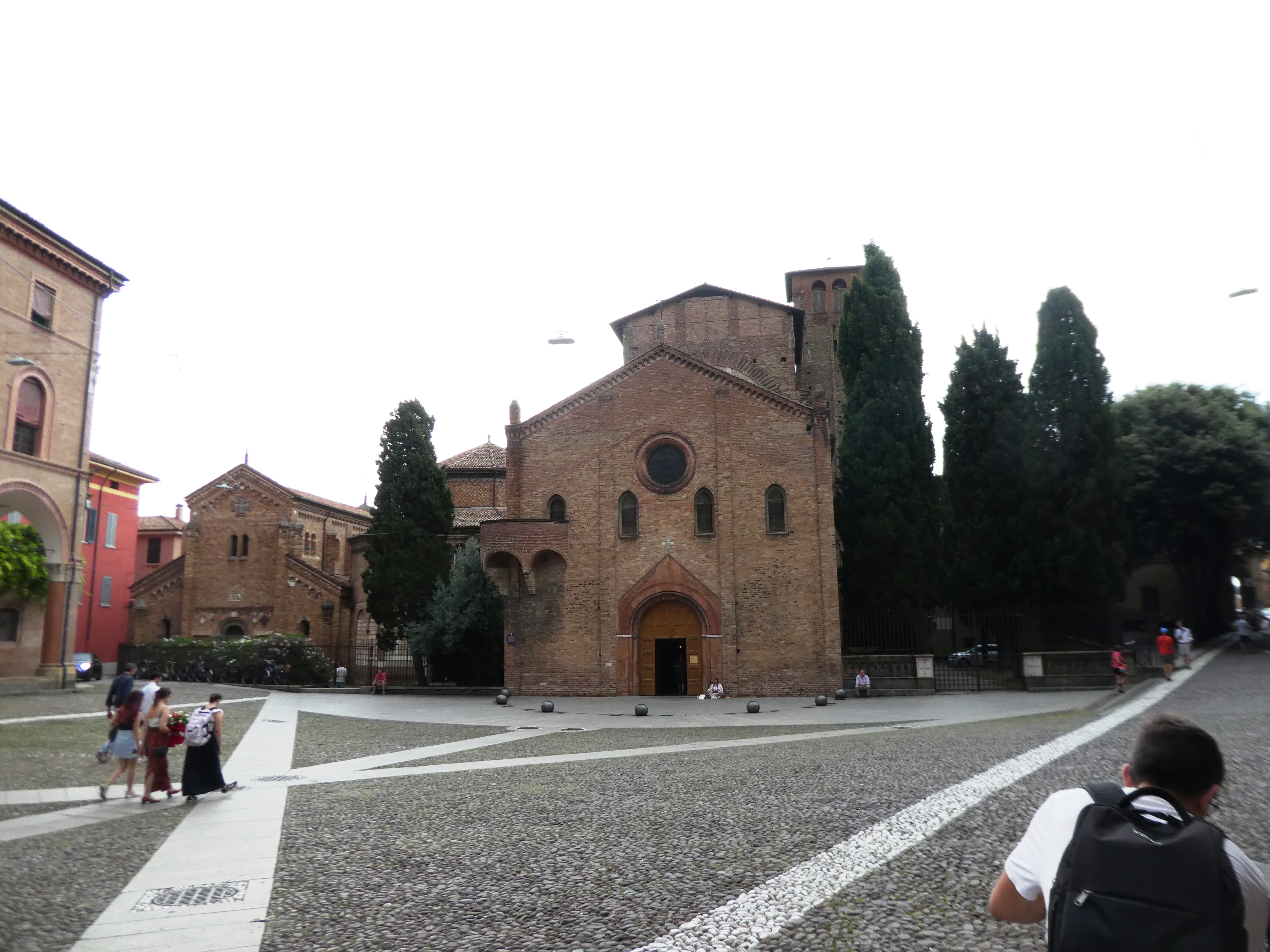
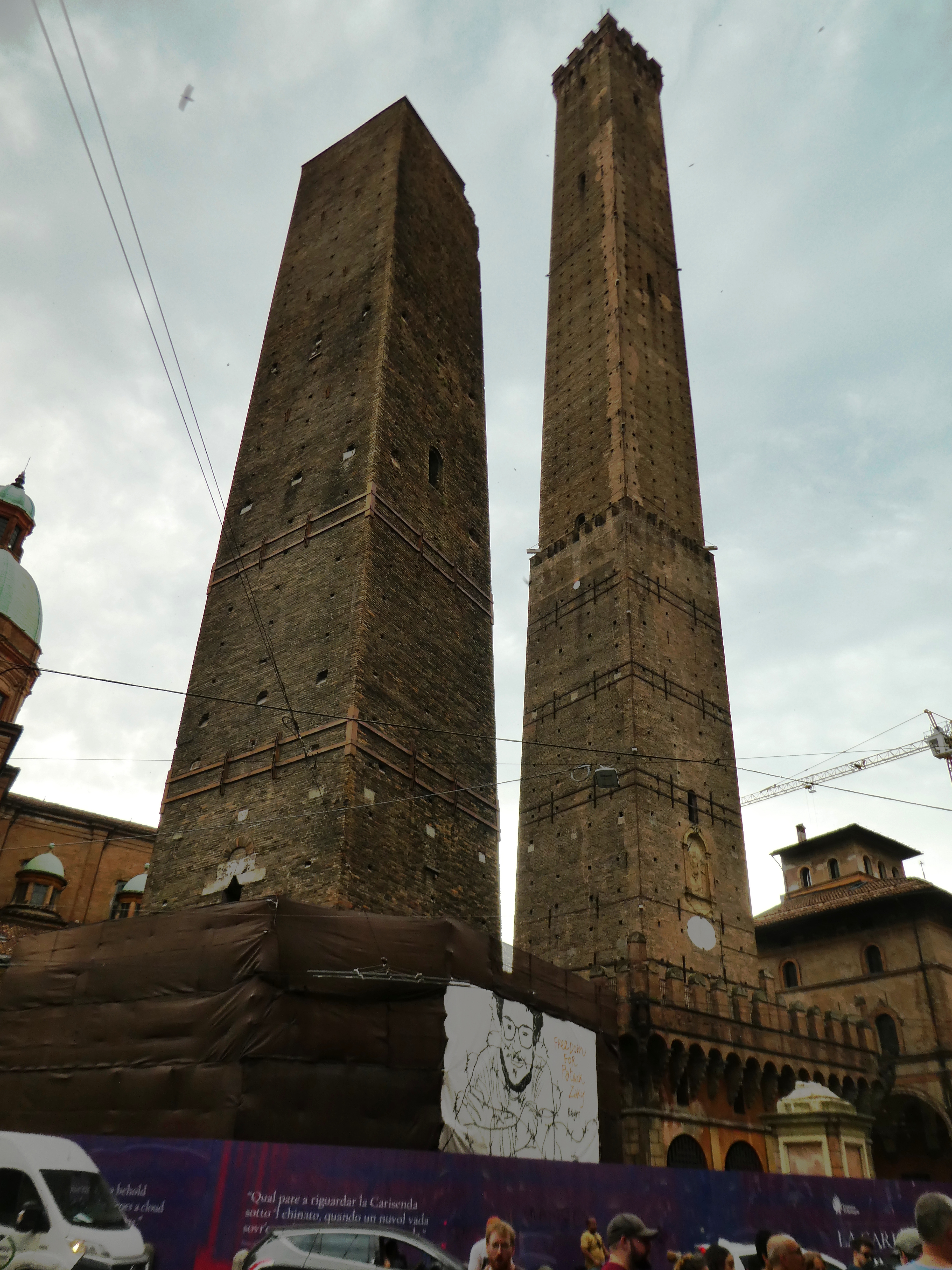 What else was interesting were the two leaning towers, the three in one churches standing side by side and the canalised river giving it a Venice feel.
 Having wandered and the rain eased we cycled out to one of the gateways by the stadium and followed the longest portico up the hill to the church.

The Portico devozionale di San Luca is over 2km long.

It is an amazing structure and the views from the church at the top are amazing.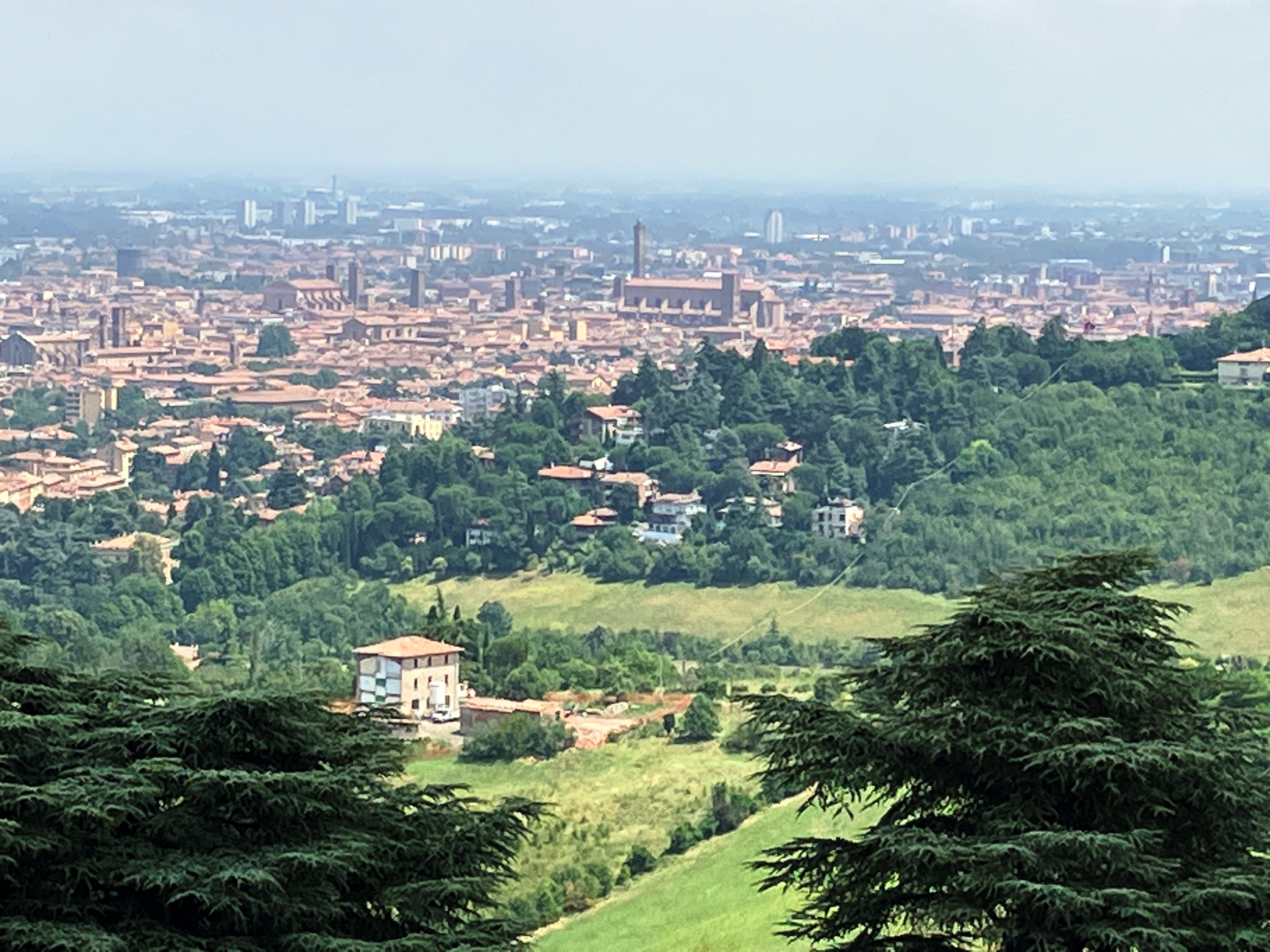
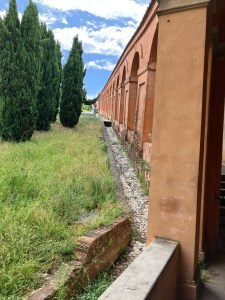

It was hard going up but going down you had momentum!
Back in the city we found a café that sold fresh pasta and enjoyed a filling meal before going back to the car park and putting the bikes back on the van.
We headed out of the city north west to Pavia and Camping Ticino arriving around half past five. A hot but nice quite crowded site which unfortunately had mosquitoes which kept us on our toes. Luckily it had a cool air conditioned open room where we spent the evening with other families.
Friday 14th July – Pavia to Pralognan La Vanoise
Wanting to get away from the humidity of the site as were up early and had left the campsite by half past seven.
We travelled on the autostrada south and then west around Turin and on towards towards Susa where stopped at a very odd service area for a bite to eat. In hindsight it was probably a service area used by the workers who had their autostrada maintenance depot on the site.

We then travelled through the Frejus Tunnel, a bit of a shock to pay €68 for an eight mile journey under the mountains.
We realised why in previous years we had headed up from Susa through the mountains to get into France!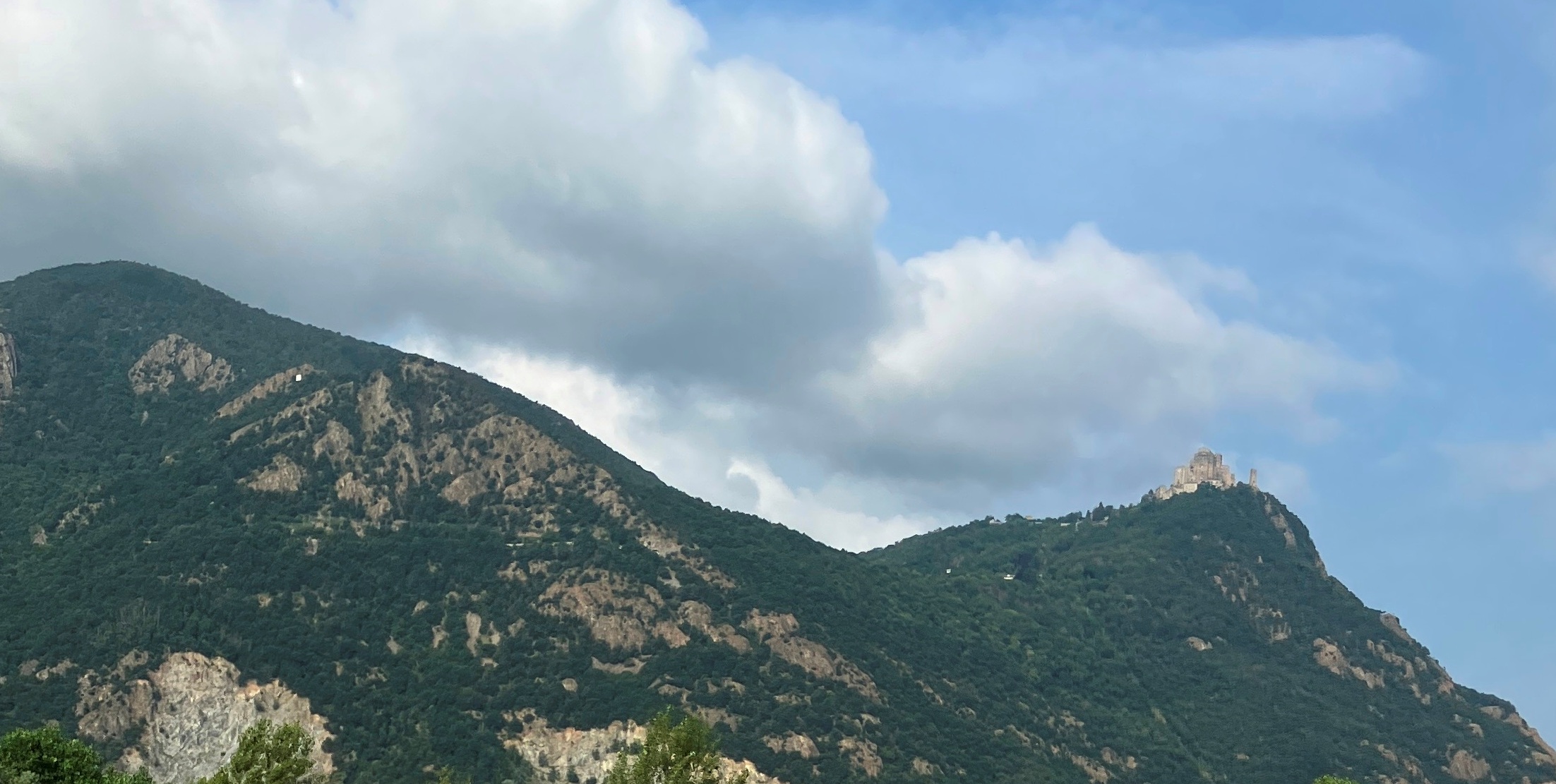
From there we went down and then up to Albertville and on up valley to Moutiers where we shopped at the Casino shopped and then went into the centre for something to eat.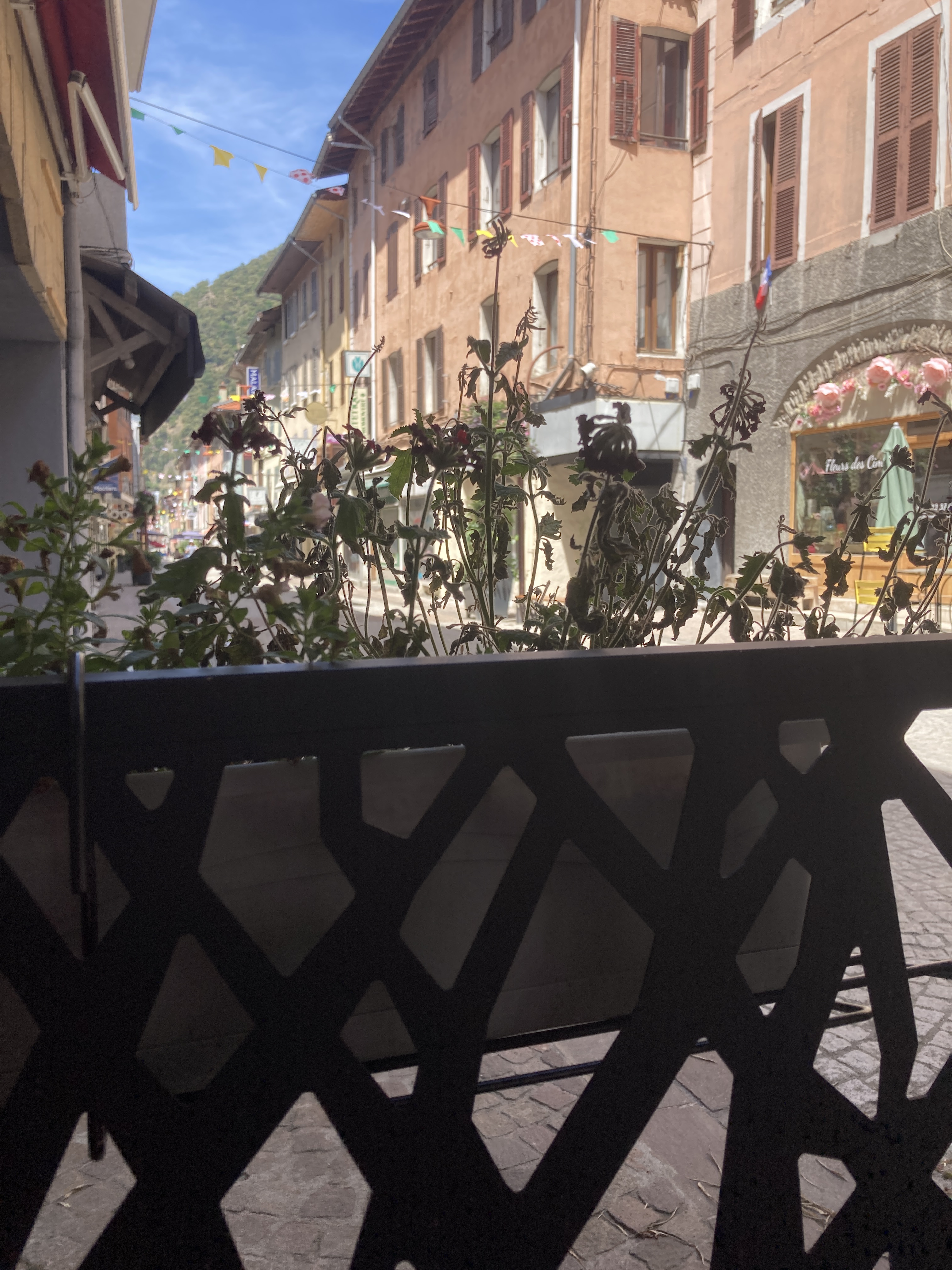
There wasn’t much happening in the town and so went in the restaurant that had the most buzz. Graham ordered a meat and cheese dish and Janet wanted a tarte that they didn’t have so went for the egg and tomato crumble.
When it arrived it was just some cooked tomato and peppers some savoury crumble and a very small poached egg for €18! Laughing but feeling a bit cheated, we left Moutiers.
We continued on up the valley to Pralognan La Vanoise where we got one of the few remaining spaces on Camping la Chamois, a nice large open site with access to paths and surrounded by beautiful mountains.

We had to wait to pitch as the previous occupiers were still there, which was annoying as in moving around waiting for them to go Graham had reversed the van into a post which had buckled the back wheels of the bikes!
Once pitched and shuffled around to get the best angle we chilled and ate before going for a wander around the valley.

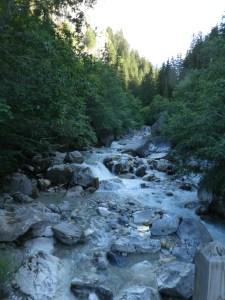
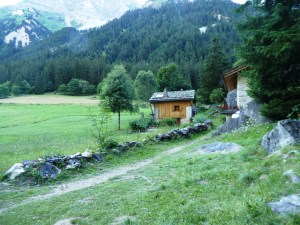
 Tired we went to bed early to read only to be woken around 10.30 when suddenly the valley lit up with a Bastille Day fireworks display.
We had an amazing view from lying in bed and watching.
It was brilliant!
Saturday 15th July – Pralognan La Vanoise
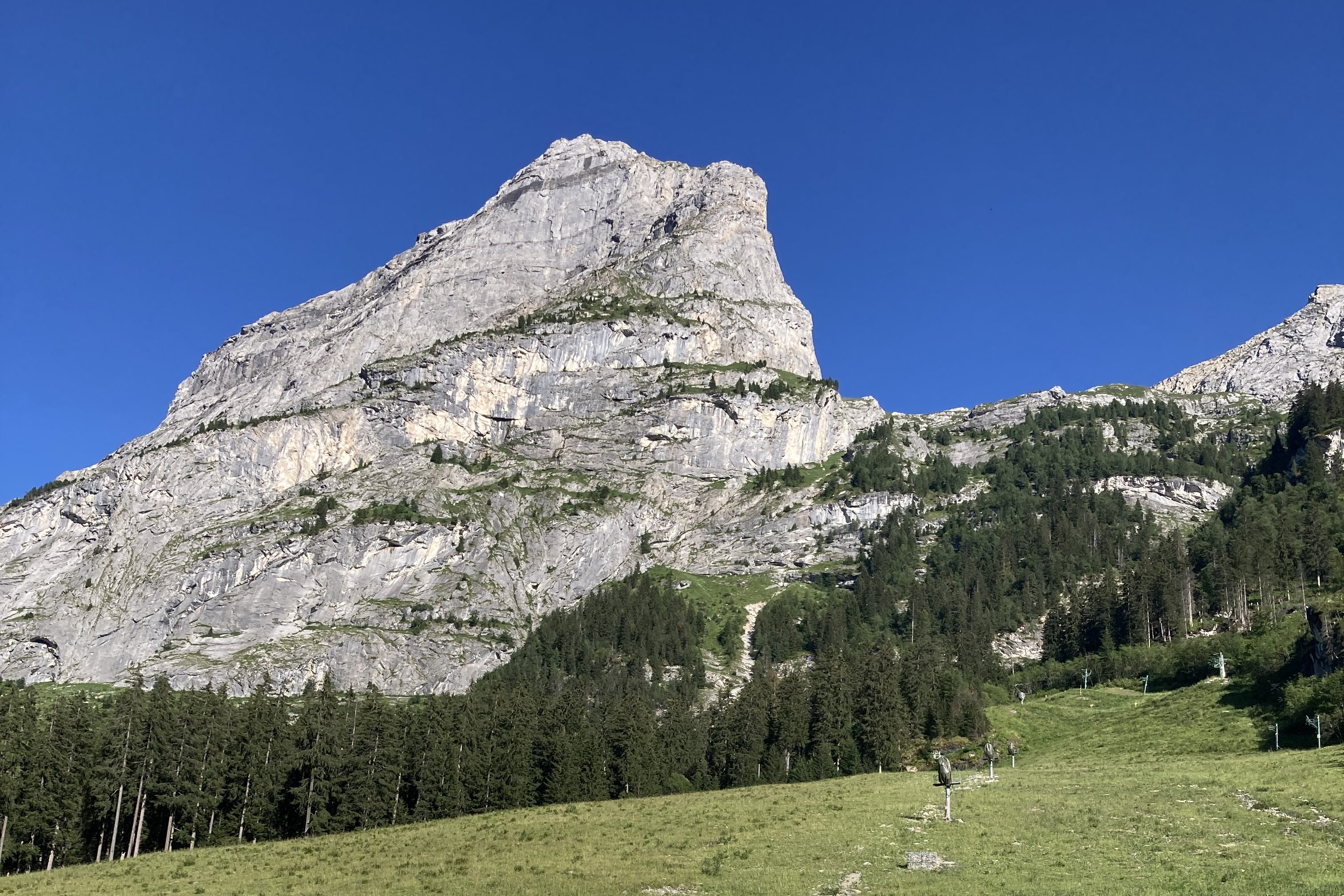
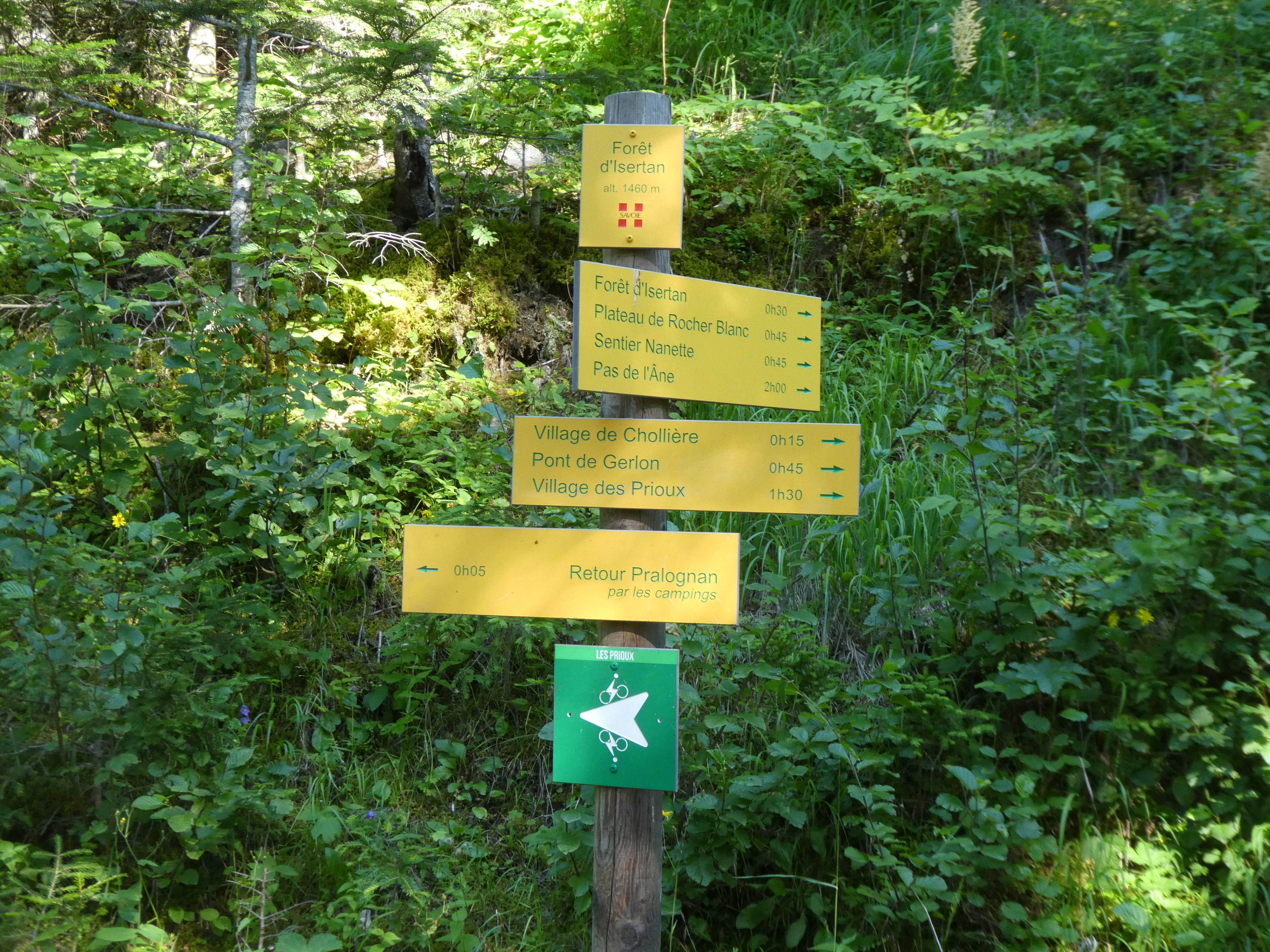 We were up early and having scouted out the footpath signs last night and photographed the map down at reception we felt confident to climb up to the Col de la Vanoise.
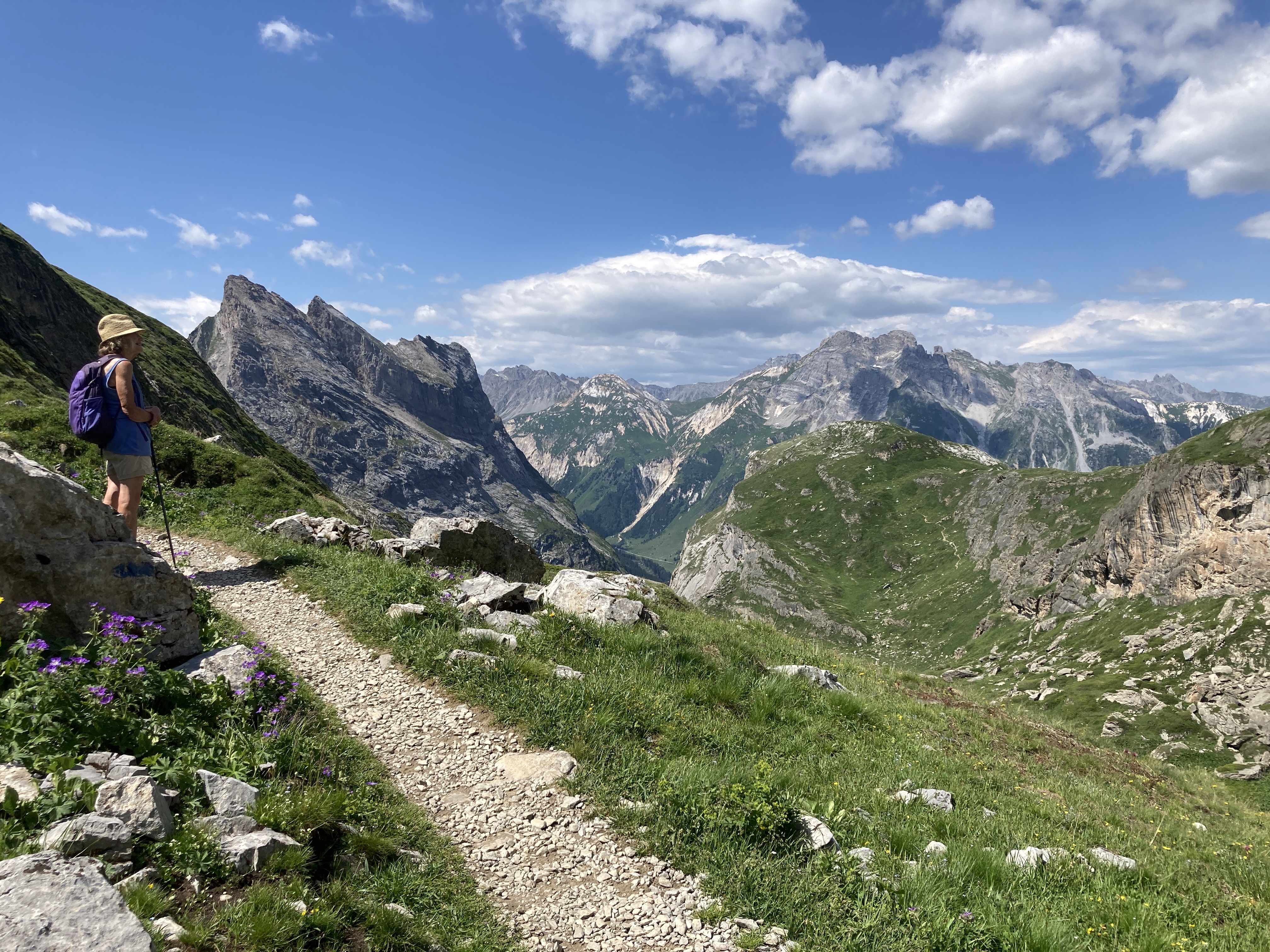
We were up climbing by a 9.15 am. and made our way steadily up to the Refuge du Col de la Vanoise at 2,551 metres.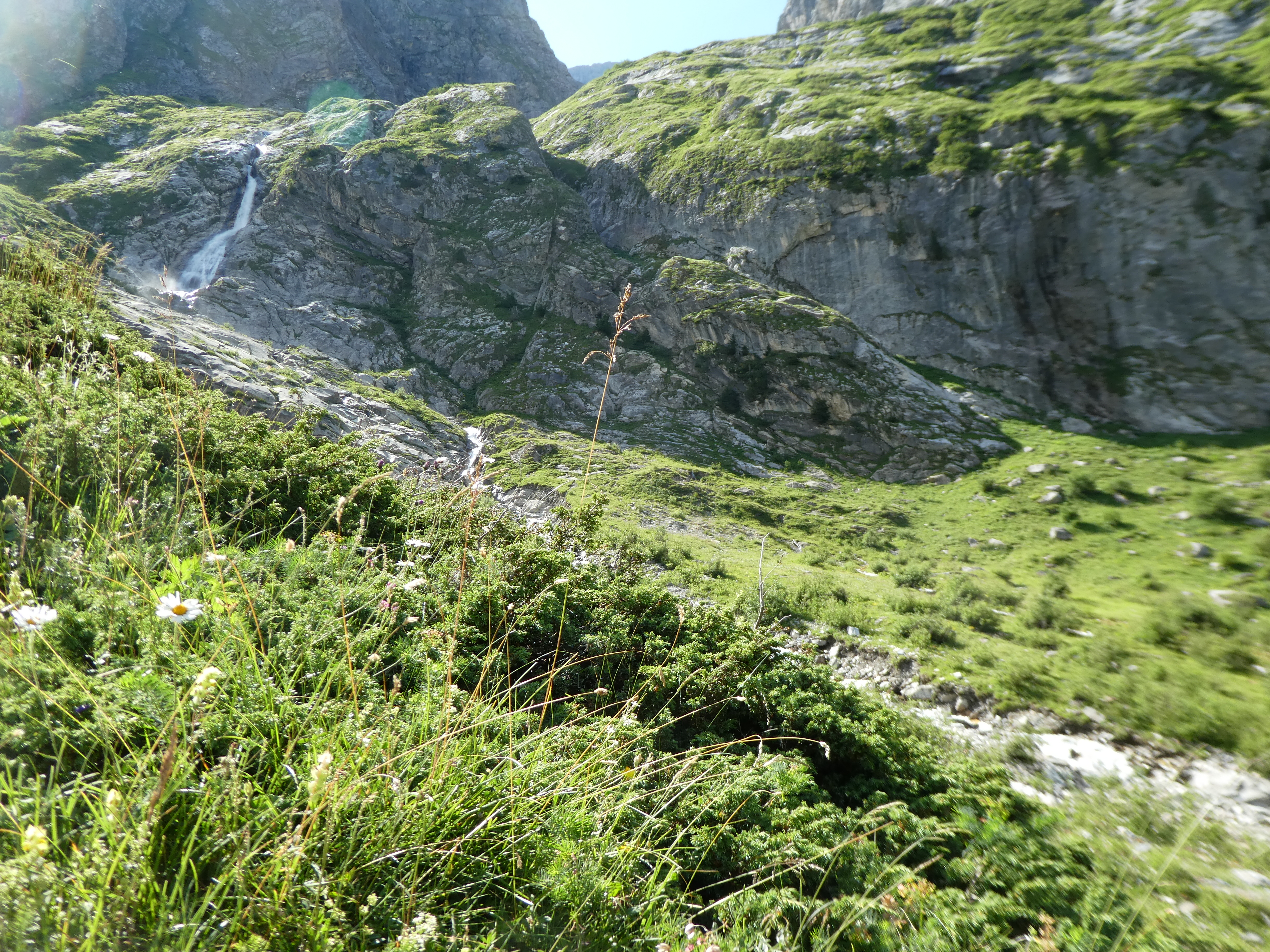
It was a lovely three and a half hour walk, gently uphill with the occasional steep bits, part in woodland part in the open.
There were marmots a plenty but no raptors which was disappointing.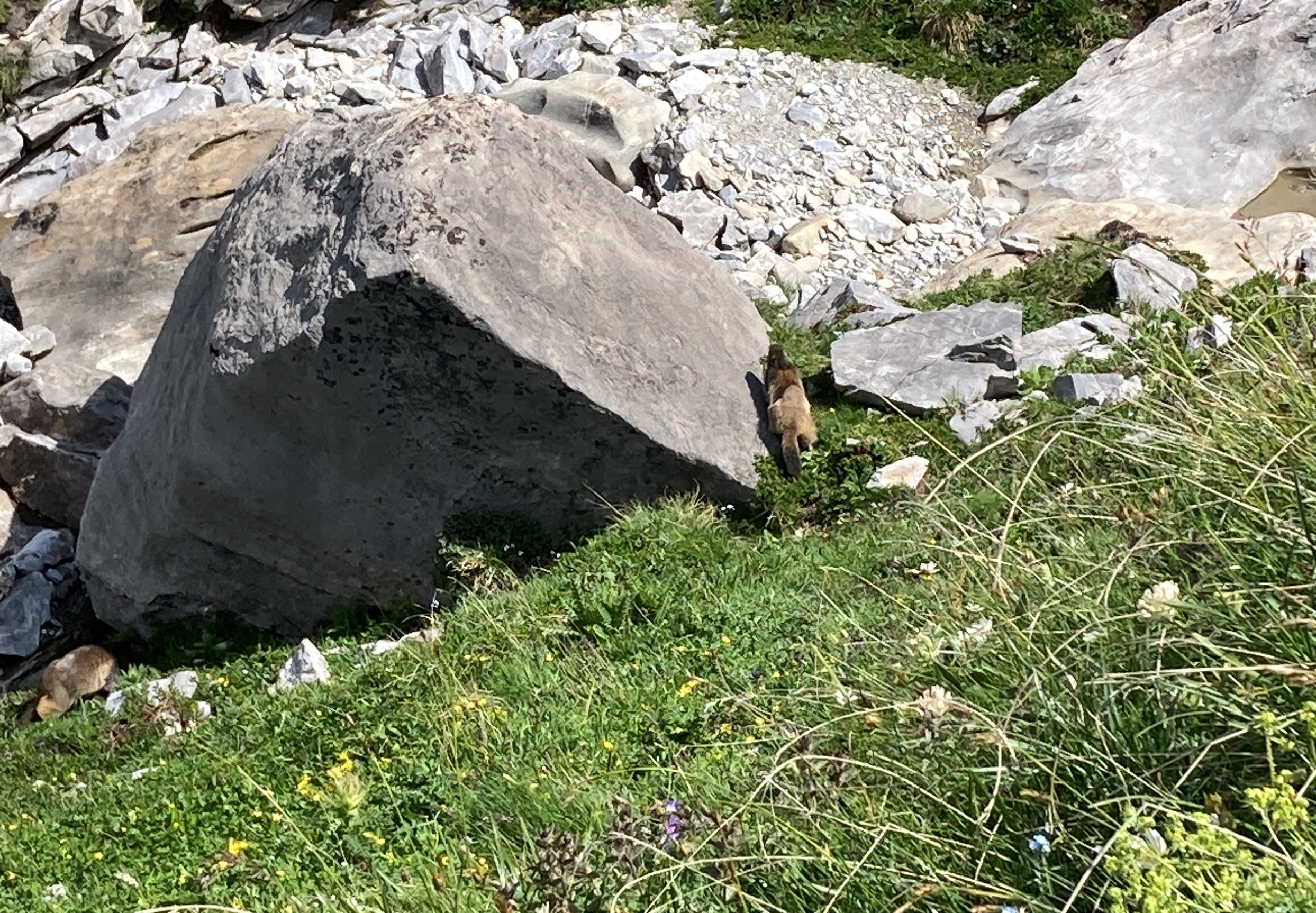
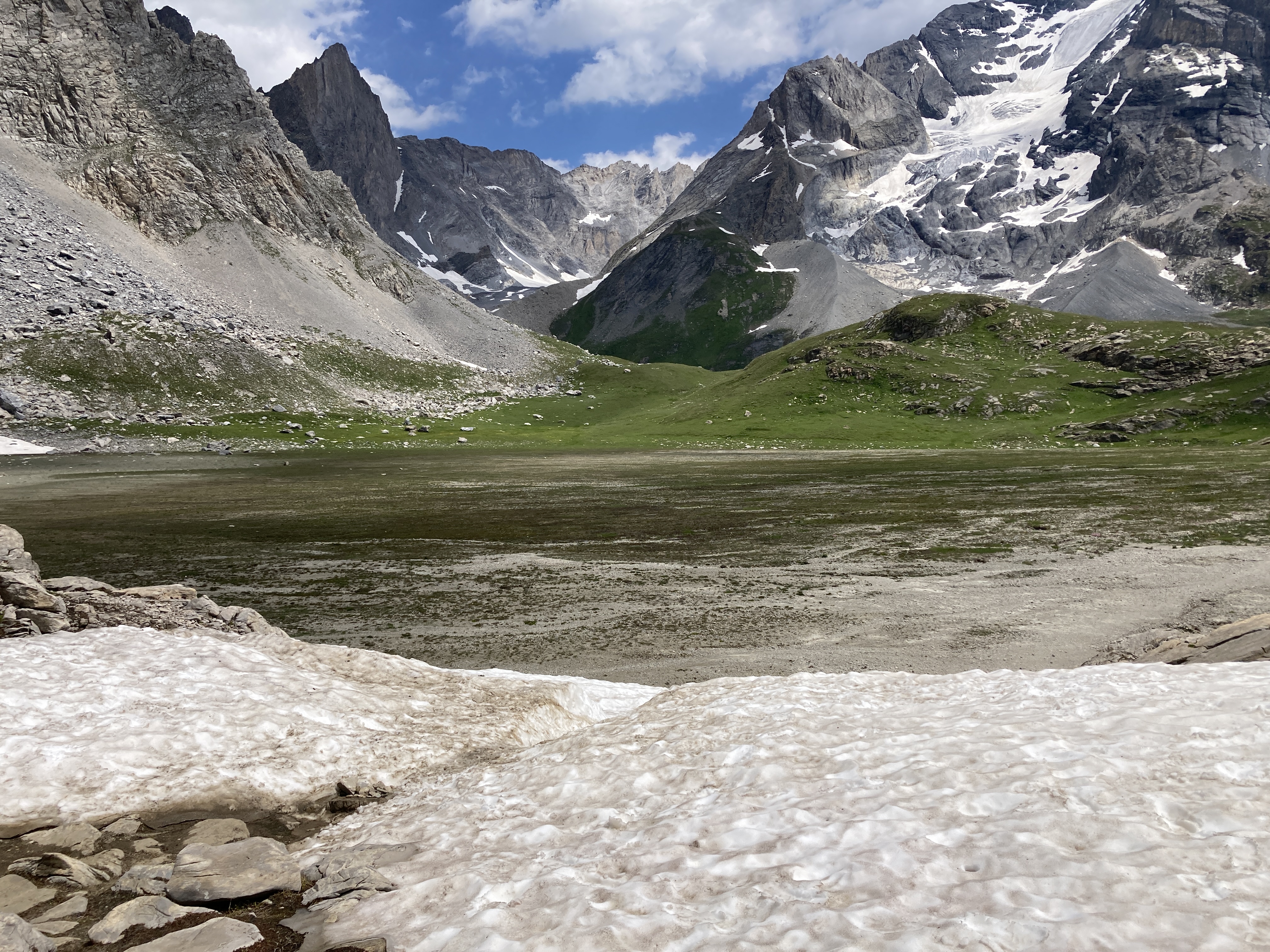
The col was large broad plateau with the refuge was busy with others that had gone before us and the last of their guests departing.
We had lunch looking down the valley to the east and enjoying the people watching opportunities at this busy place.
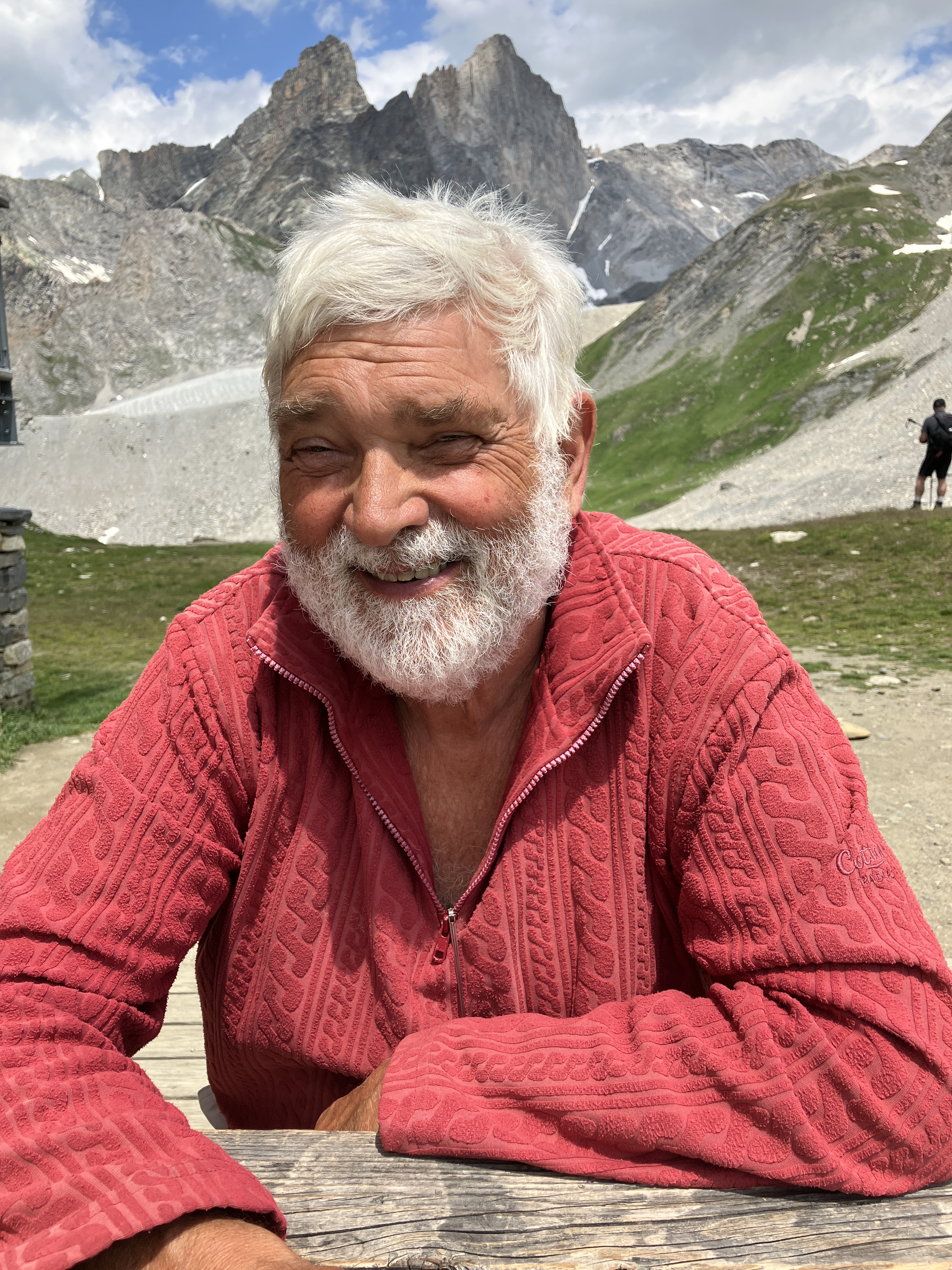

 Having eaten our lunch we had a welcome coffee and met Tom an American lecturer in environmental studies from Carolina who told us his life story in about three minutes, none of it memorable.
He was on a solo walking tour of the Alps and this refuge was his destination for the night.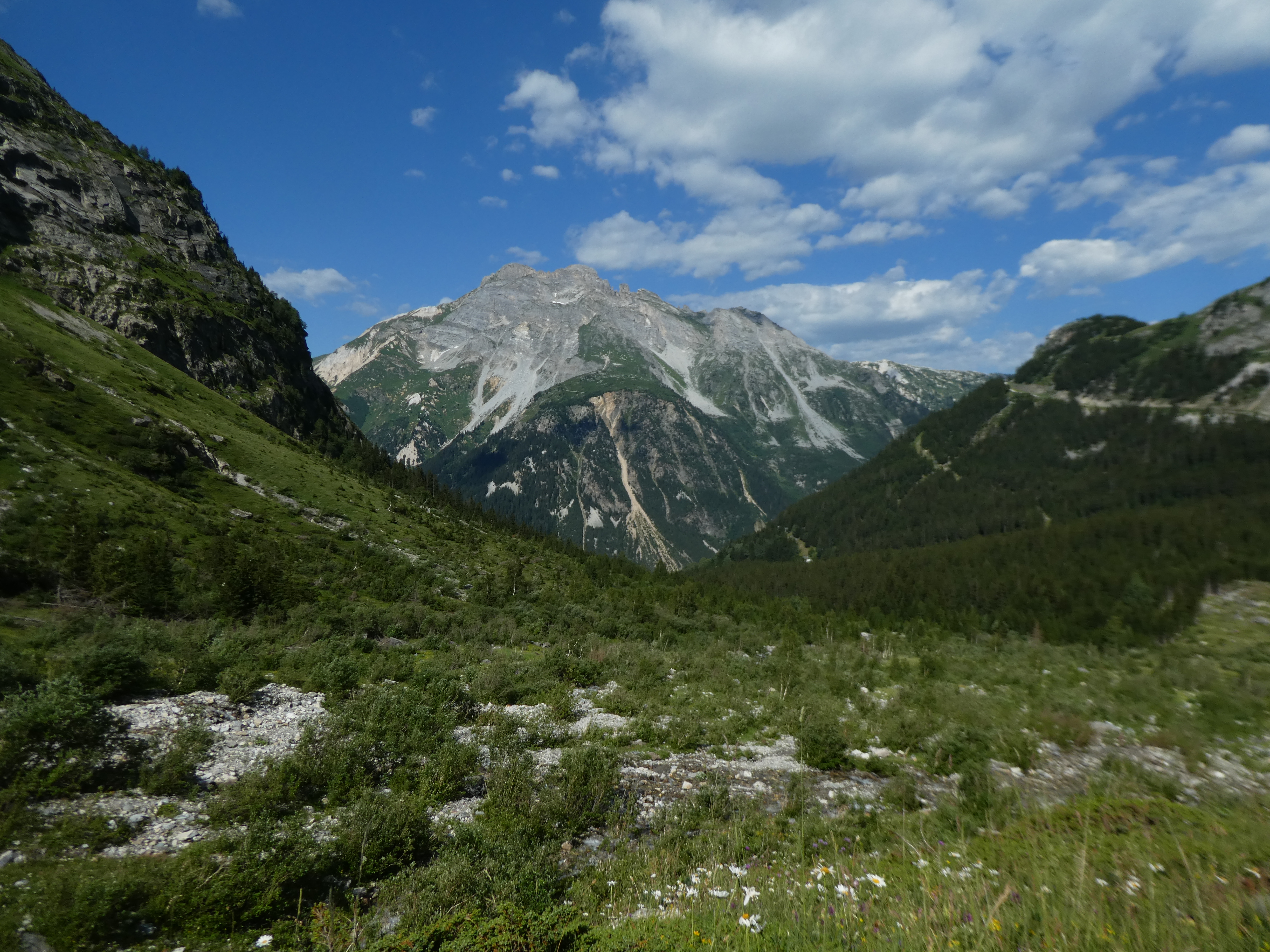
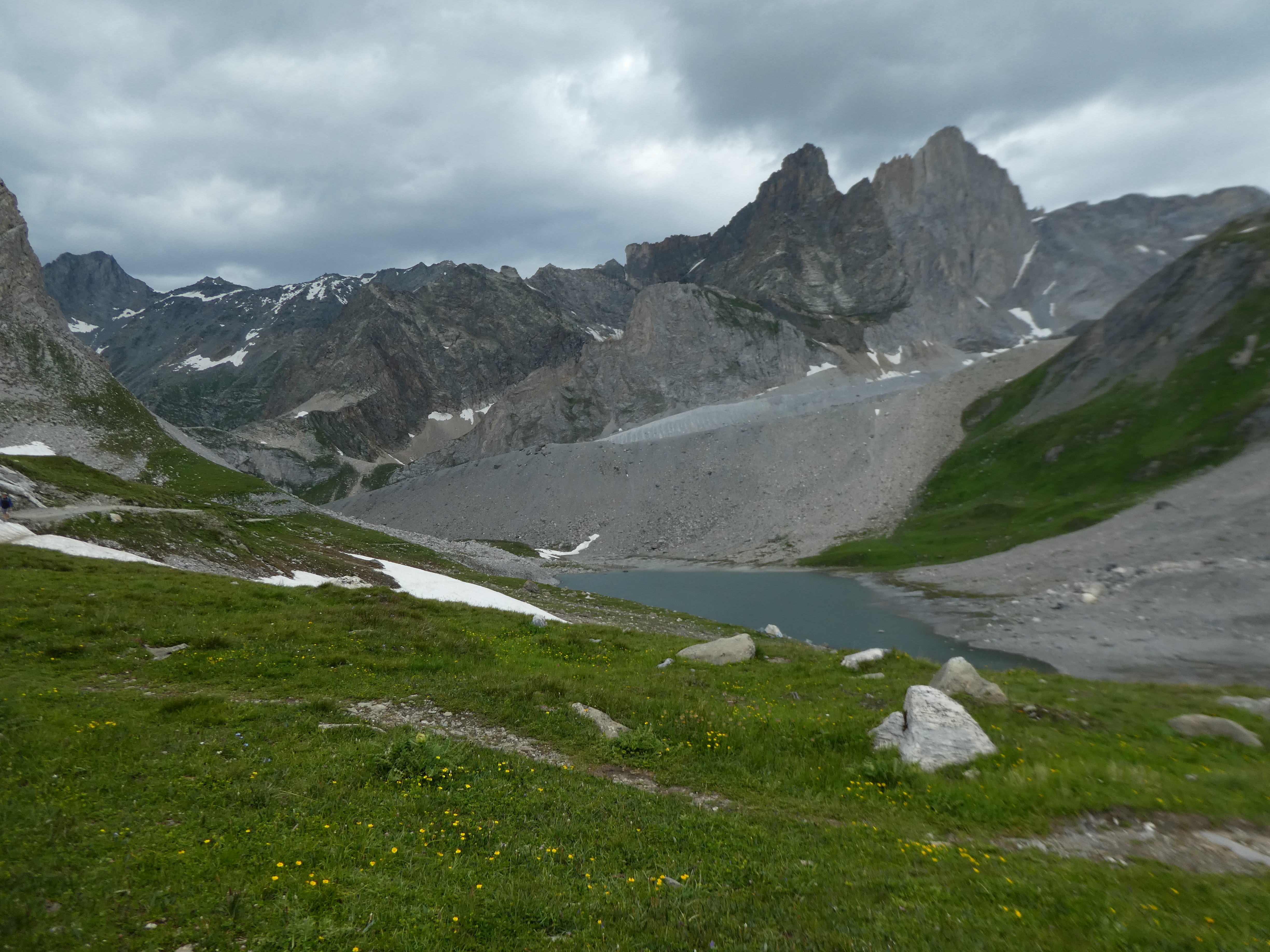
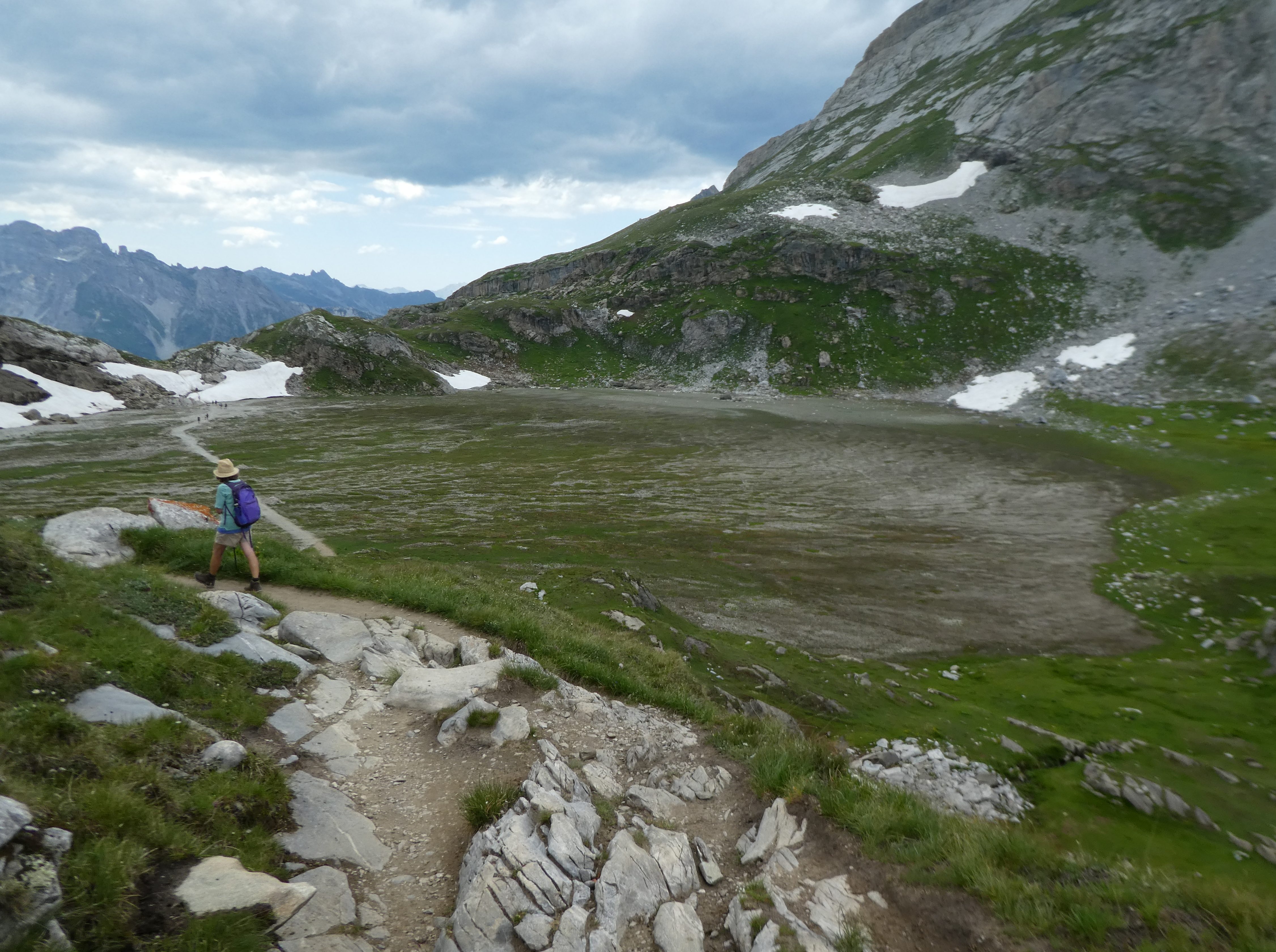
Having said our goodbyes to Tom we made our way down. An area of lakes dry except for a small amount of watery ice in a low depression reminded us just how much global warming was effecting water levels on lakes in the mountains.
 We went down more or less as we had come up finding a short cut at the end to take us directly back to the camp site.
We descended past zip lines and climbing walls and a via ferrata that climbed up beside a high waterfall.
Our camping neighbours, a young couple, were there, he climbing the rock wall and she watching and taking photos.
Sunday 16th July – Pralognon La Vanoise
Leisurely arising as a bit and mist and cloud were hanging around. Croissants from the camp shop made for a perfect breakfast.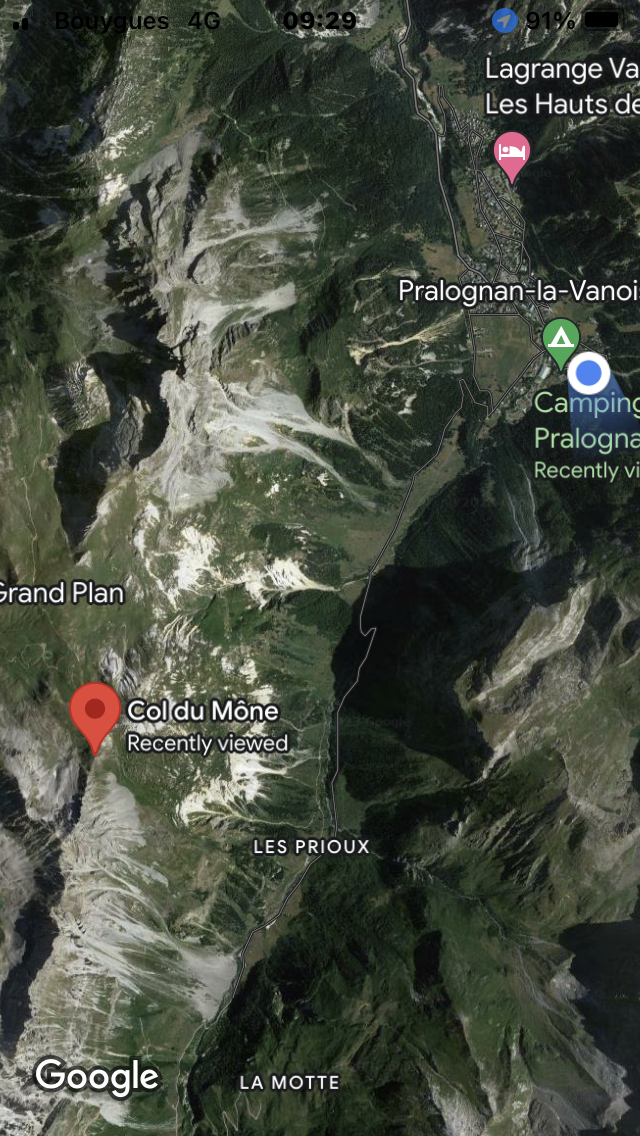
We wanted to walk up the valley south west on paths as far as cars could go at Les Prioux looking to see if we could climb up to Col du Mone and to Petite Mount Blanc.
We decided against climbing steeply in the heat across open mountainside or through steep forests that covered the mountain sides that such a route would have entailed.

Instead we took the easy option to continue up the popular valley to Les Prioux and on past Refuge du Roc de la Peche to Refuge Peclet Polset.
We stopped just short of the refuge and had lunch on a grassy outcrop above the river before returning to the Refuge de la Peche for coffee.
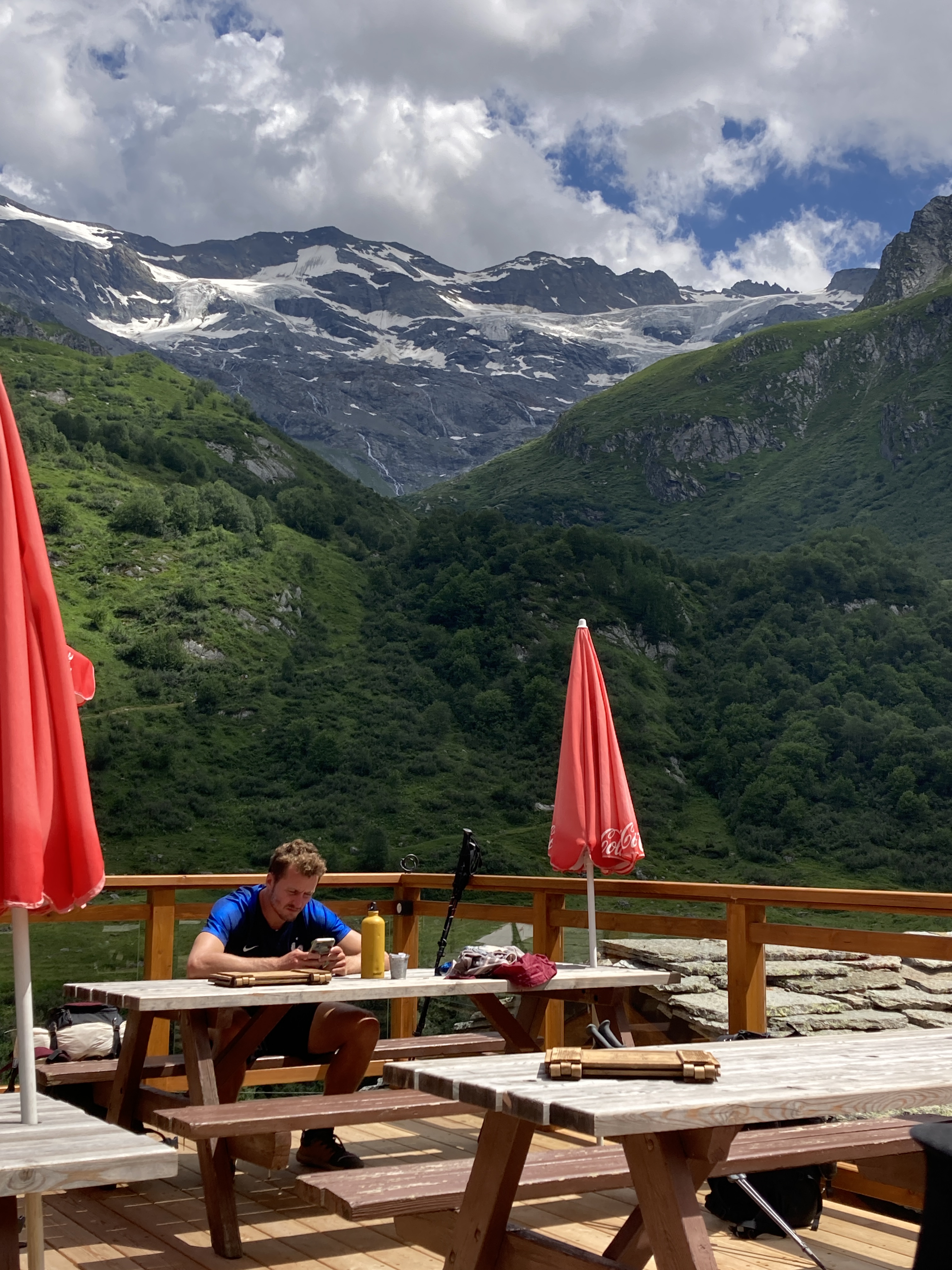
After a coffee and a visit to the small wayside chapel we crossed the river to the hamlet of La Motte which involved clambering down a small gorge onto the opposite side of the river. 
Here there was a parallel path to the one we had come up on taking us back to Les Prioux.
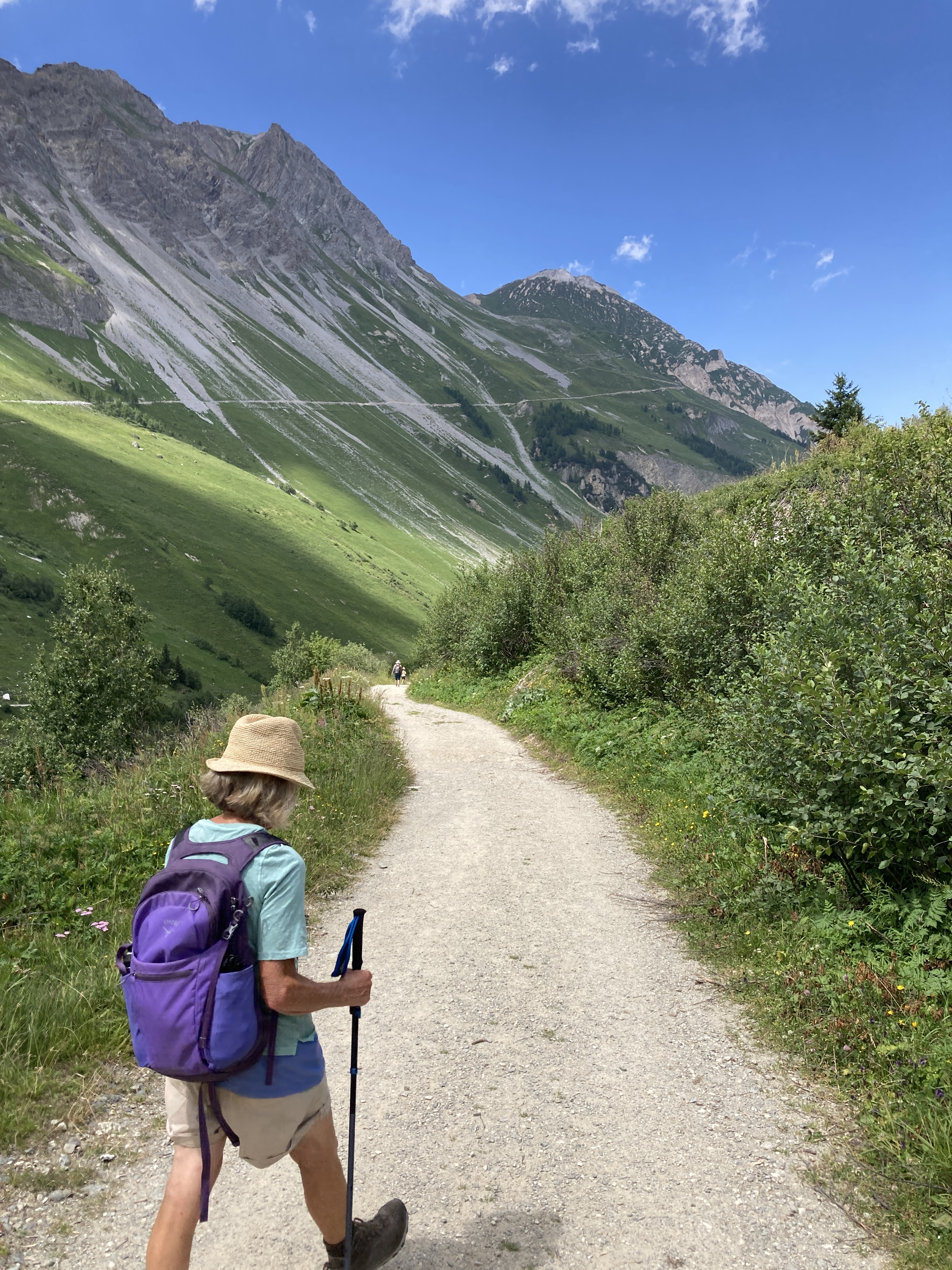
We made our way back to the site down the way we had come but deviating to take the road into Pralognan La Vanoise before making our way back to the site via the village.
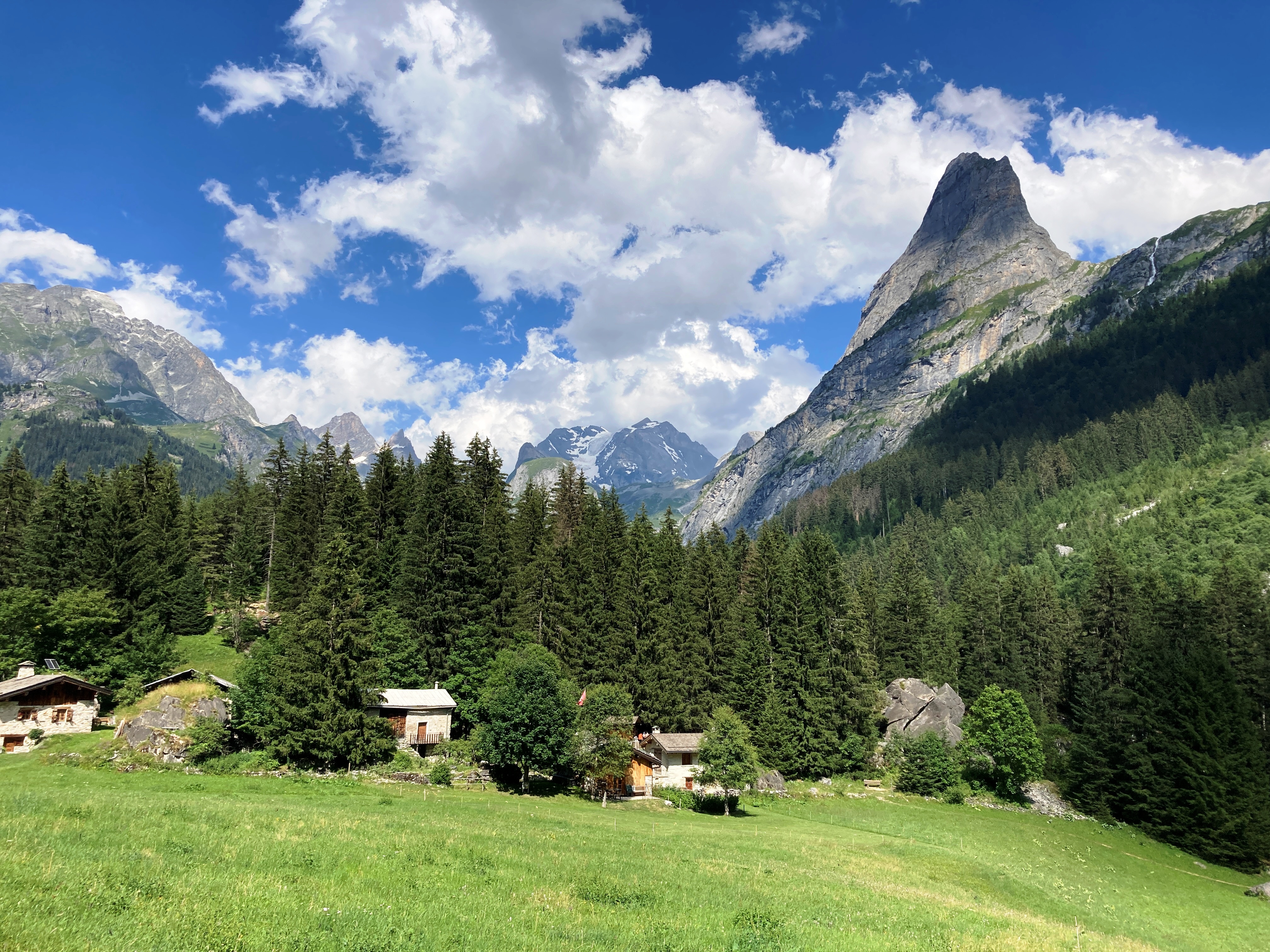
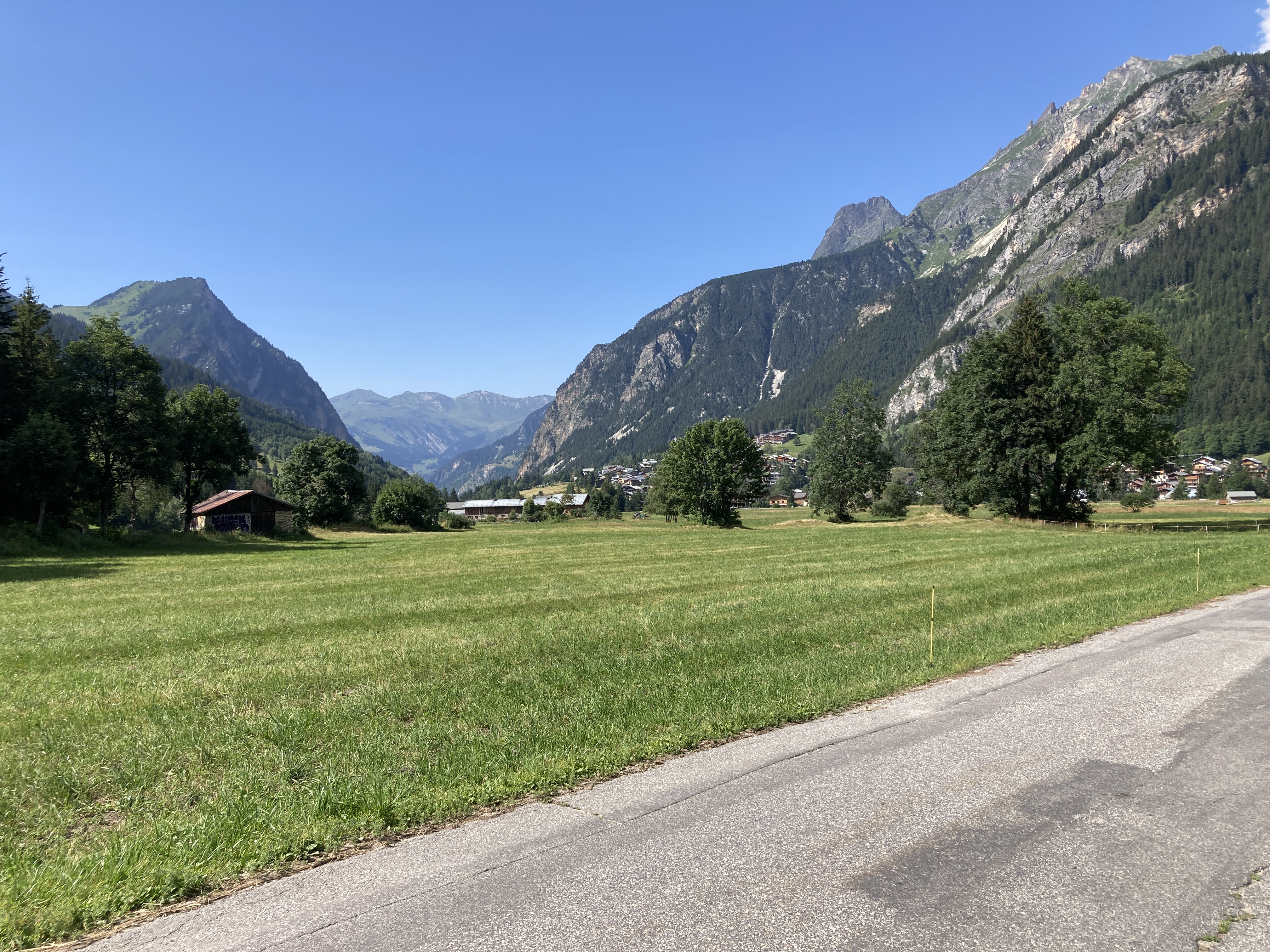
We hadn’t really seen the village apart from driving through and what we did see was mainly chalets and apartments.
A meal back at the van then a quiet evening with no fireworks but lots of stars
Monday 17th July – Pralognan La Vanoise to Chamonix
We left the site around 9.30 and travelled back down the autoroute to Albertville and then on the D1212 across the mountains through Ugine, Meeve, Servoz and Chamonix.
It was a very slow and busy route with local traffic, people and so many cyclists ( Tour de France goes through the area tomorrow).
We found the campsite that was nearest to where Martin and Anna are staying but it was full so being sensible we decided we needed to go to where Anna and Martin are staying and suss it out then look for the next nearest.
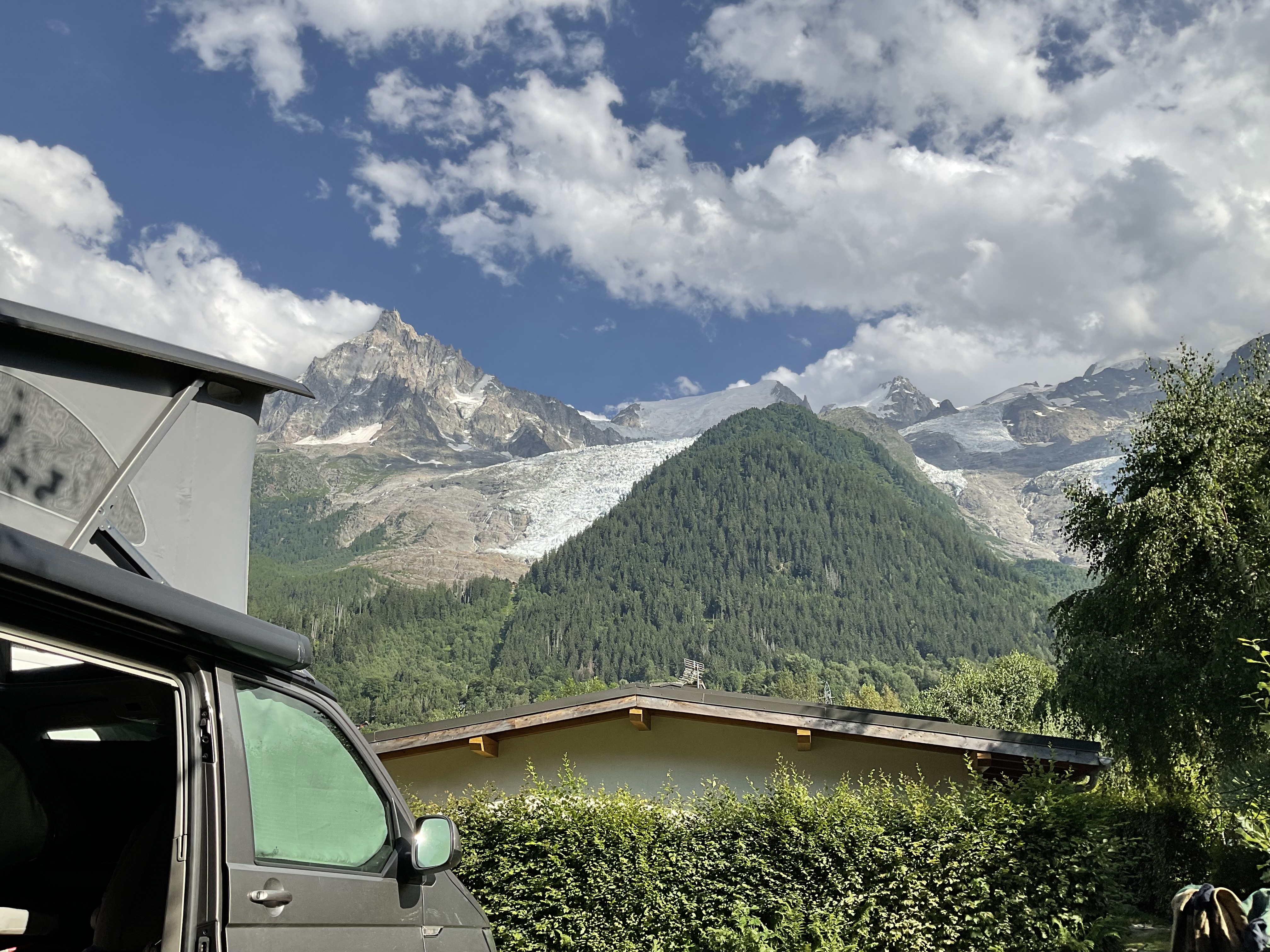 Unfortunately they were both full but the next one on Camping les Climes Chamonix had space so we opted for it.
It was cramped but ideal for what we wanted and was looking straight at Mont Blanc which was there somewhere behind the clouds.
As in the Tyrol the camp site offered us tourist passes for the public transport rather so after a break we took the free bus into Chamonix. We found a nice art nouveau café beside the river where we had coffee.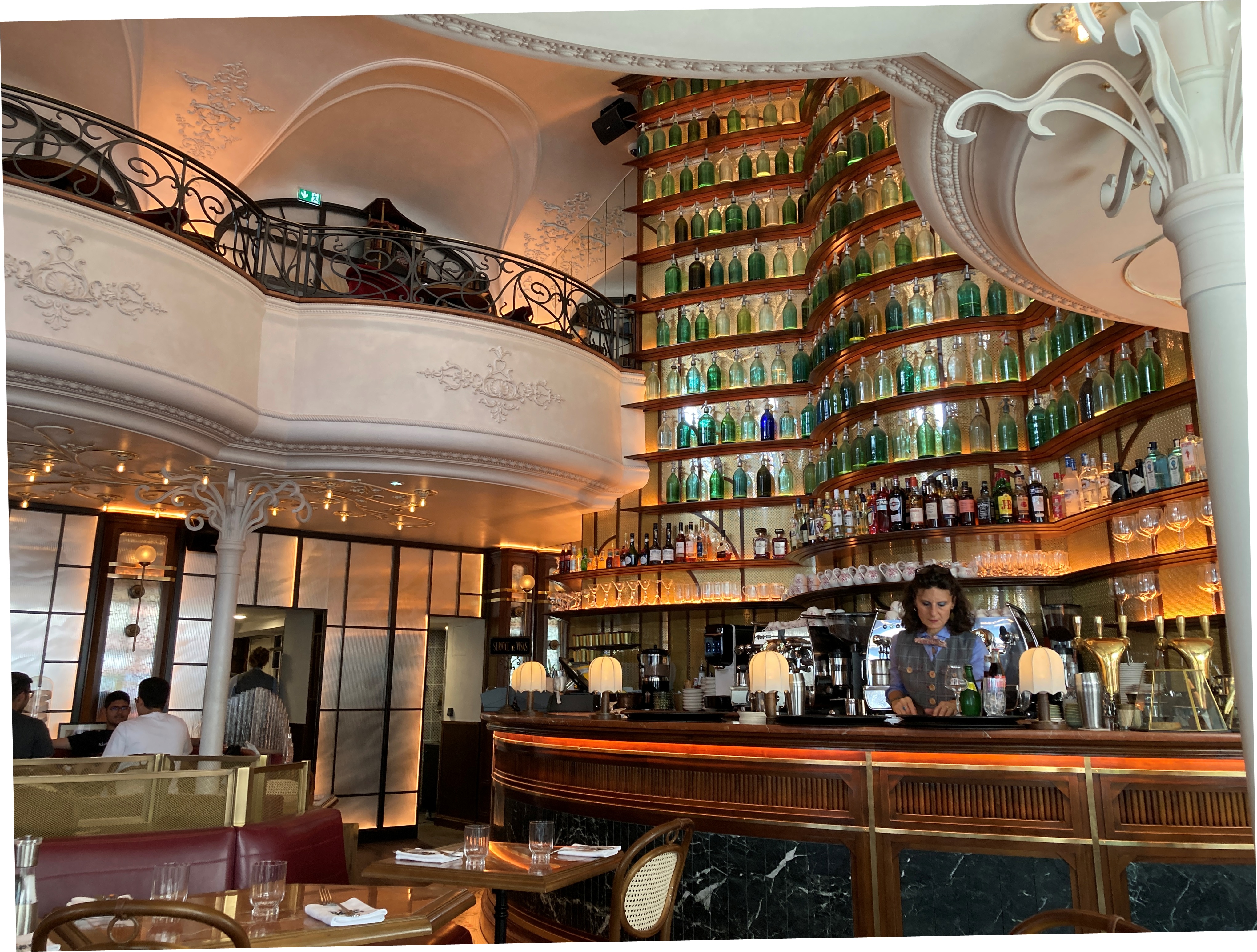
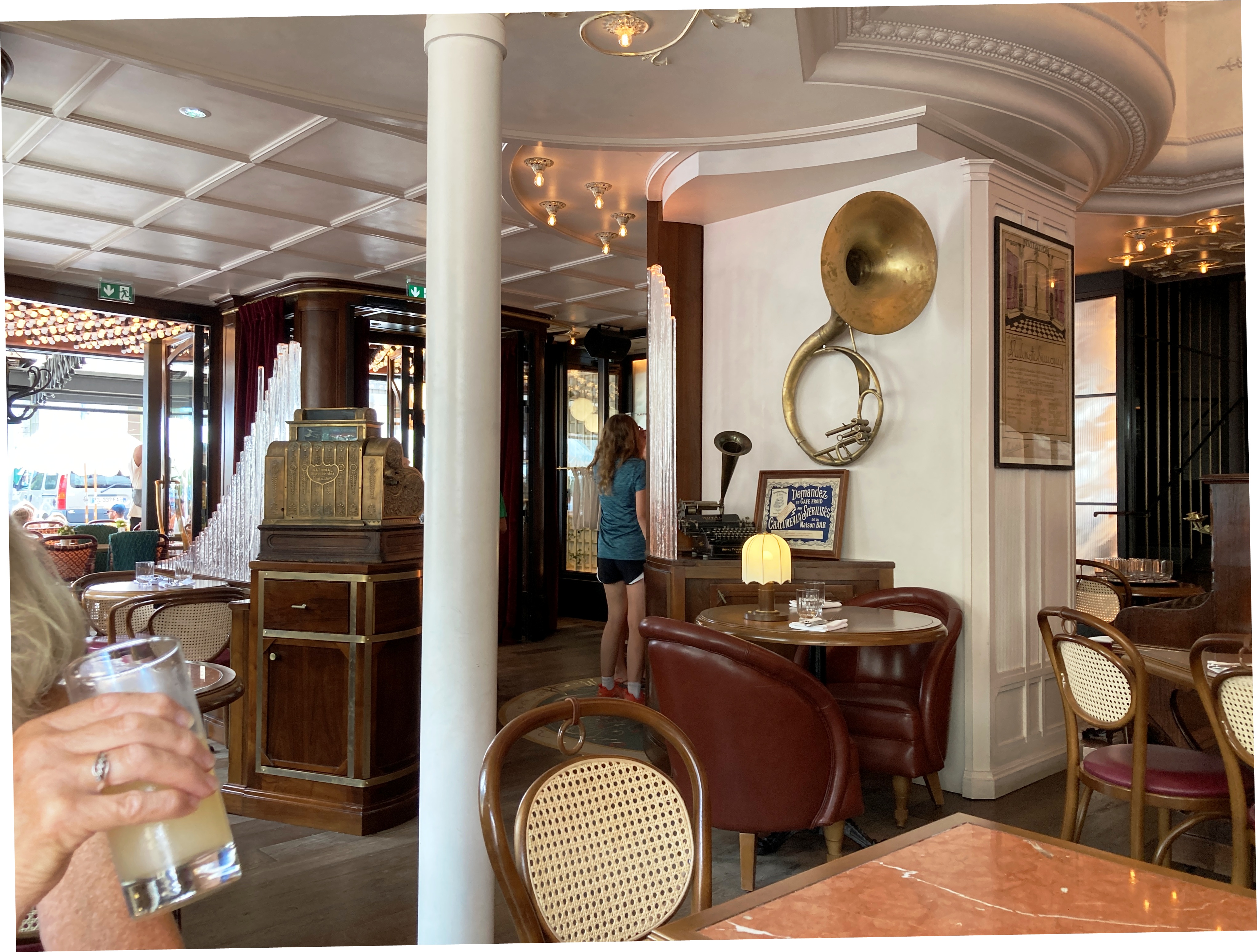
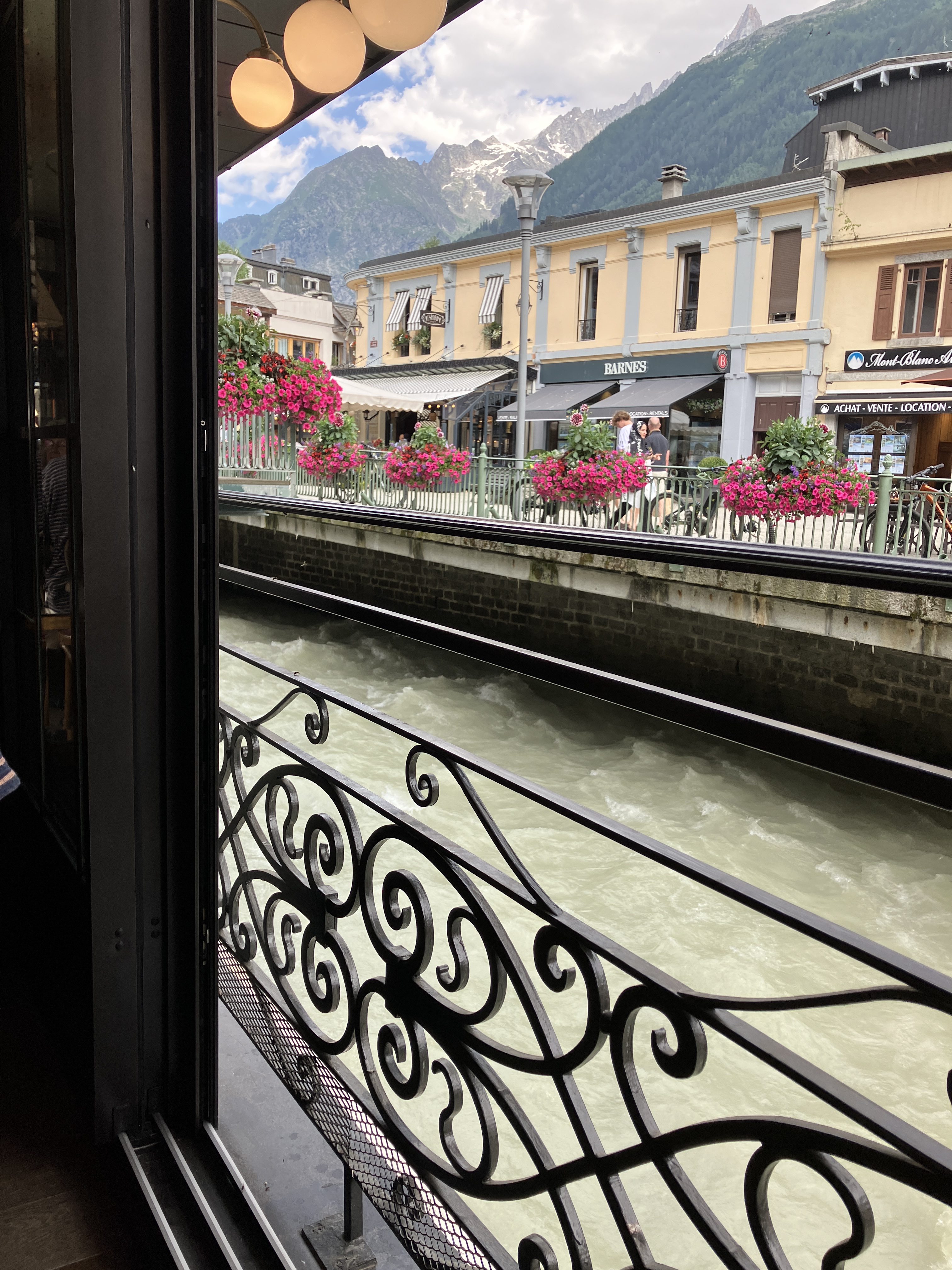
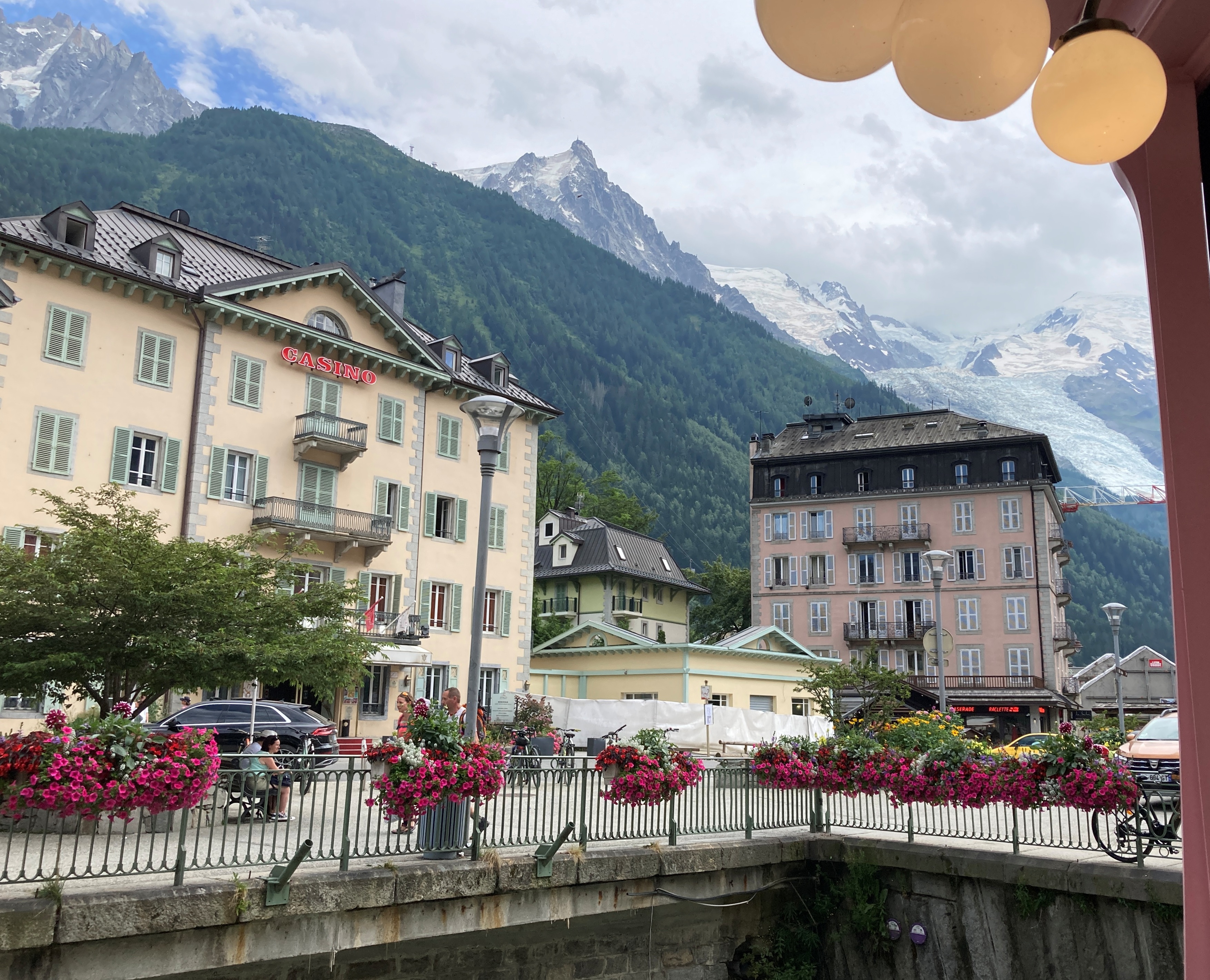

It was a bit of a shock as it was busily touristy but with lots to do if you have money. Skiing, hang gliding, eating and drinking or walking in the mountains which were made accessible by mountain railways and cable cars.


The view of the mountains from the town was amazing but how accessible will be interesting to discover tomorrow with Martin and Anna. We returned to the camp site for a meal as we watched the sun set over Mont Blanc.
Tuesday 18th July – Chamonix to Aire de Les Pelegrins near Laon.
Slept surprisingly well, left the camp site around 8am and found a very busy, trendy Boulangerie in the town so busy we had to queue and then put your cash in a machine. It was just over the river from where Martin and Anna were staying. Having sussed out how to park there yesterday we were soon with them.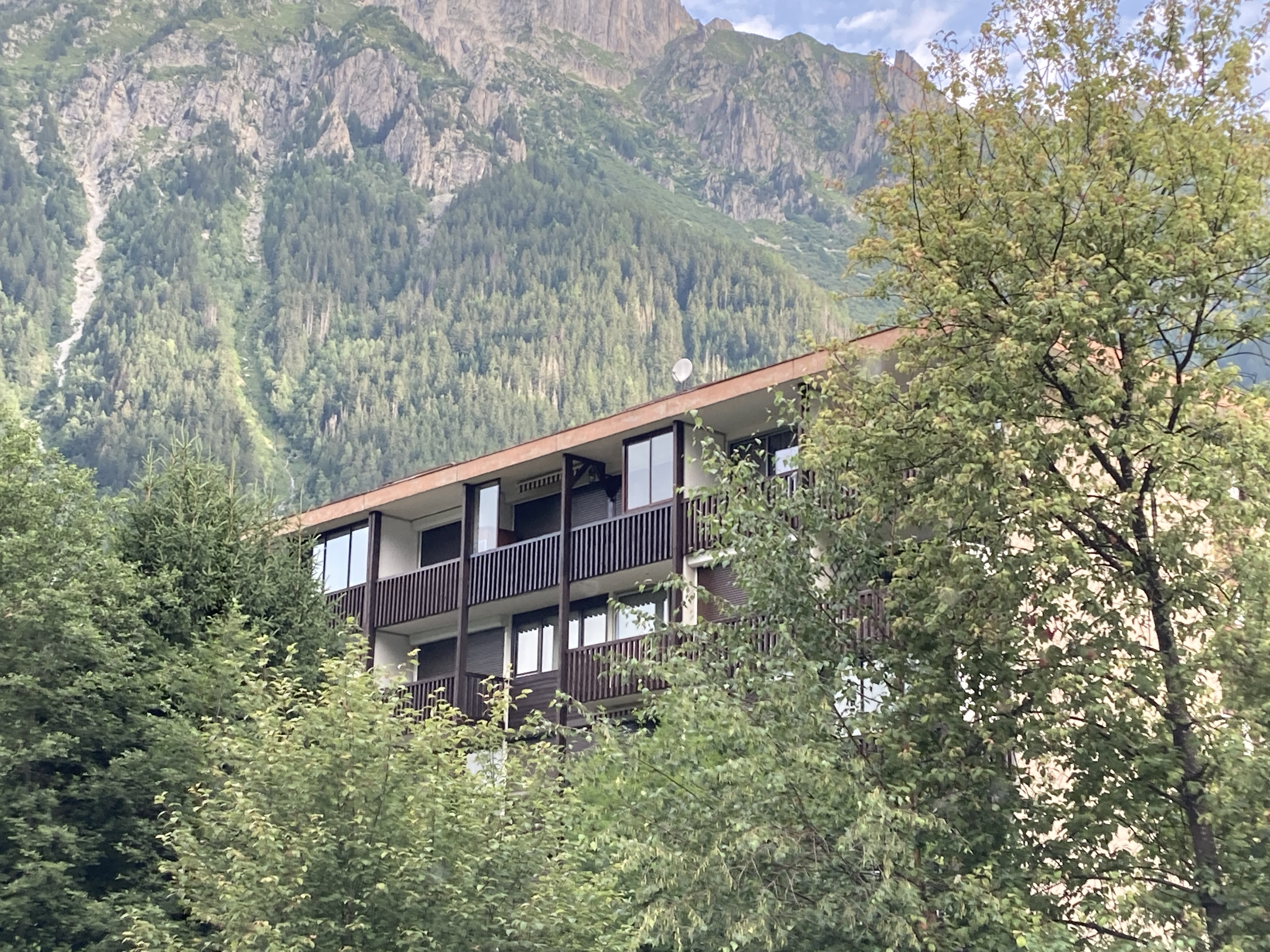
It was lovely to see Martin and Anna in their very small simple apartment where they had arrived at late the night before. We had coffee and croissants, coffee and fresh orange juice and Anna had her hard boiled egg.
We then drove to the station and parked and waited for the infamous Montenvers little red train that took us up with lots of others to 1800 metres. From the station at the tope there were amazing views of the eroding glaciers up towards the peaks to the east.


Anna had previously walked from here along the mountain side and was keen to take us on it.
We climbed up and walked along the ridge path to the restaurant/refuge and cable car, at the foot of the Aiguille de Chamonix.
It was amazing how quickly we lost the crowd but we hadn’t anticipated the climb which took us to over 2,200m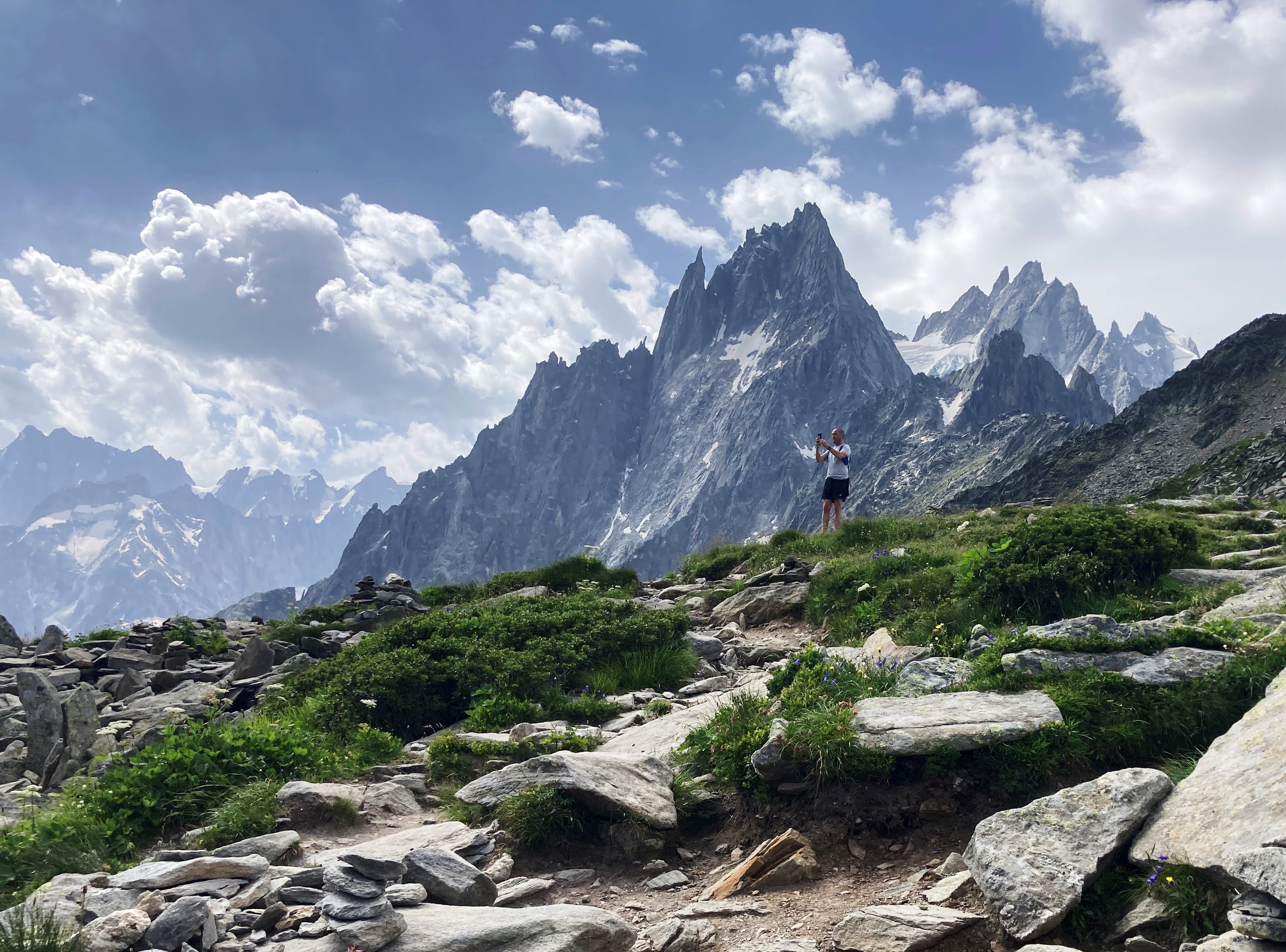 .
.
We then walked on the famous ridge path where the views down and across the Chamonix valley were amazing. 
Martin insisted when we got to the refuge we should have lunch which he ordered and consisted of a double omelette and a plate of meat, cheese, olives etc just what was needed washed down with beer.
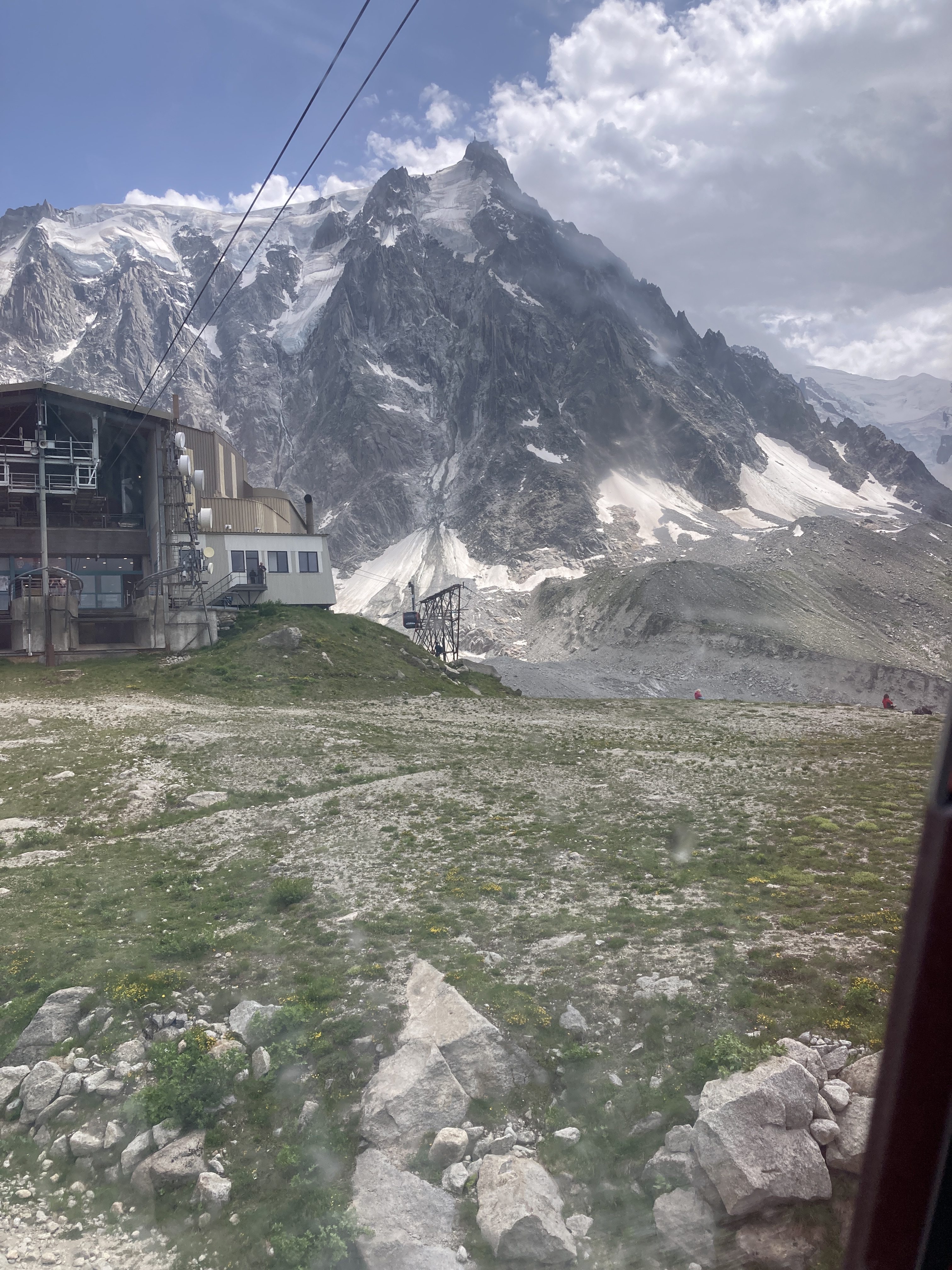 It was lovely being with them in such an amazing setting; they are so happy together.
Running out of time we then caught the cable car down whilst they decided to walk. (we heard later from Martin that the climb down had taken them a couple of hours so we were relieved we had taken the cable car)
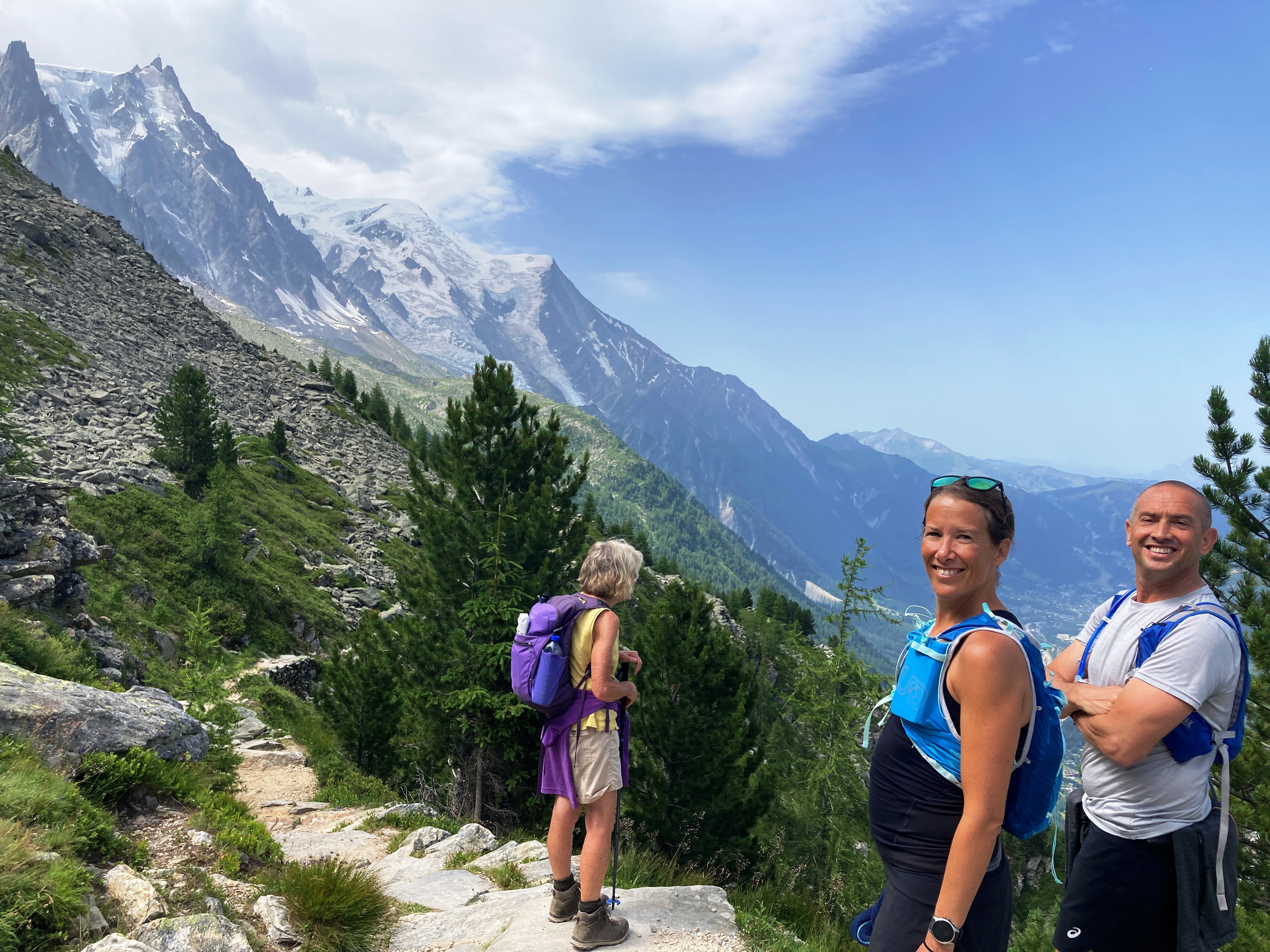 We were so pleased that we had seen Martin and Anna and experienced Chamonix a place we would never have visited.
It wasn’t as far as we expected from the cable car station to retrieve the van from the car park and we were on road by half past three heading north and home. We shared the driving out through the valley and north around Geneva on past Lyon towards Dijon. We drove into a rural area with a lake near Langres where we had located a restaurant L’Augerge du Lac at Saint Ciergues and booked for a meal at 8pm.
It was a beautiful area that we hope to go back and explore more. The restaurant was full and after initially fearing that the meal was going to take a long time and not understanding the menu, we had a nice meal before travelling on to an Aire de Les Pelerins east of Laon arriving about 12.30.
There was nobody in the large picnic area and we soon had the roof up and imagining the traffic noise was a river we managed to get five hours sleep.
Wednesday 19th July – From Aire de Les Pelegrins, Home
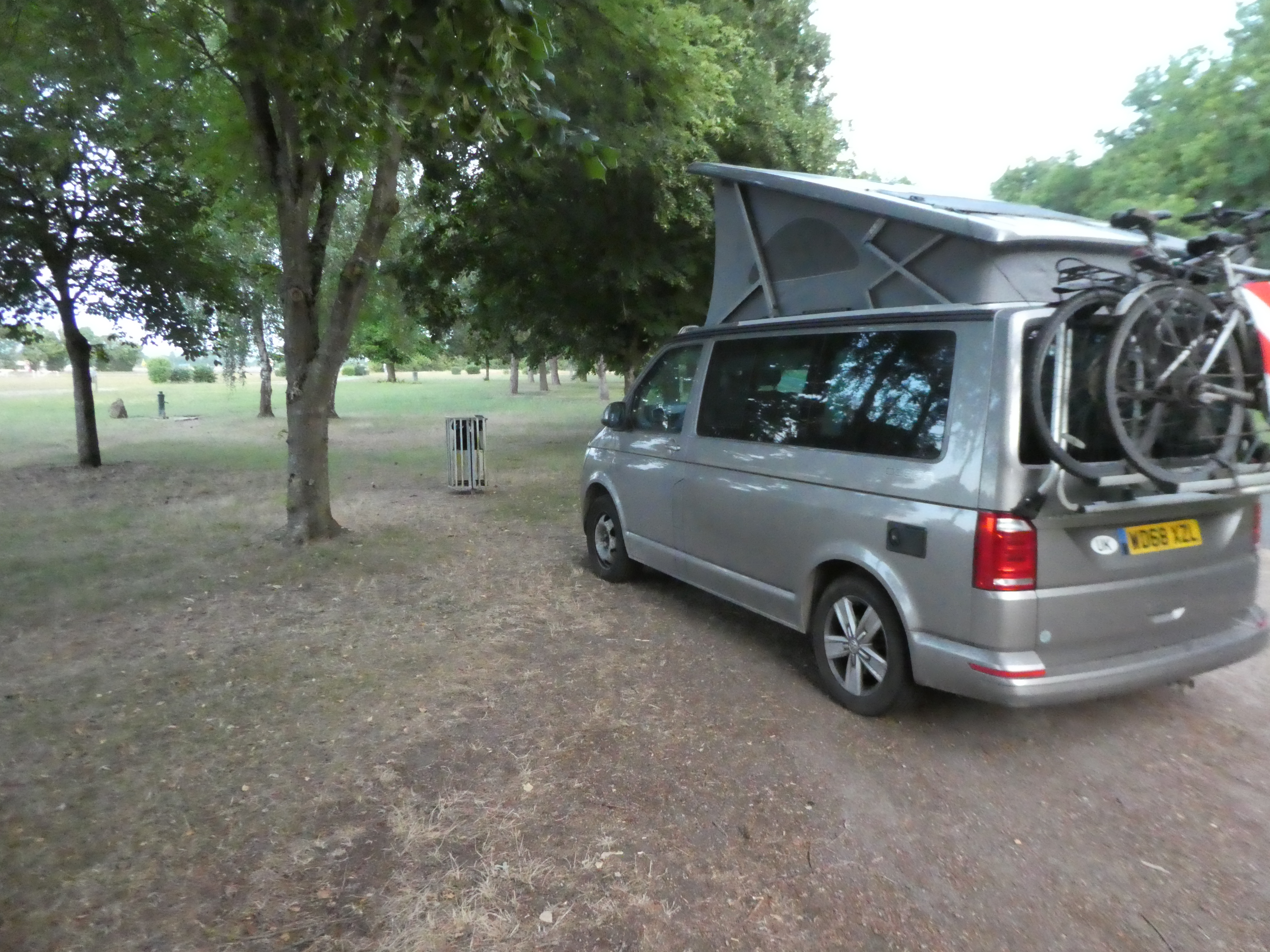
We awoke at 6am and were on the road by 6.30 arriving at Dunkerque by 9am to get the 10 o’clock ferry.
Thinking we had more time than we thought we drove cross country to Sissinghurst Castle.
Unfortunately we realised that actually we had ten minutes so with the ‘nice’ NT welcome we parked the van and walked to the outside of the castle to find the loos and went back and drove onto Tonbridge buying some Sissinghurst cherries on route
With warning Tricia was outside to let us in to the car park. It was lovely to see her and remember how nice her flat is. We ate a proper hot chicken lunch and tart and enjoyed sitting around and chatting until 3.30 when we hit the road again.
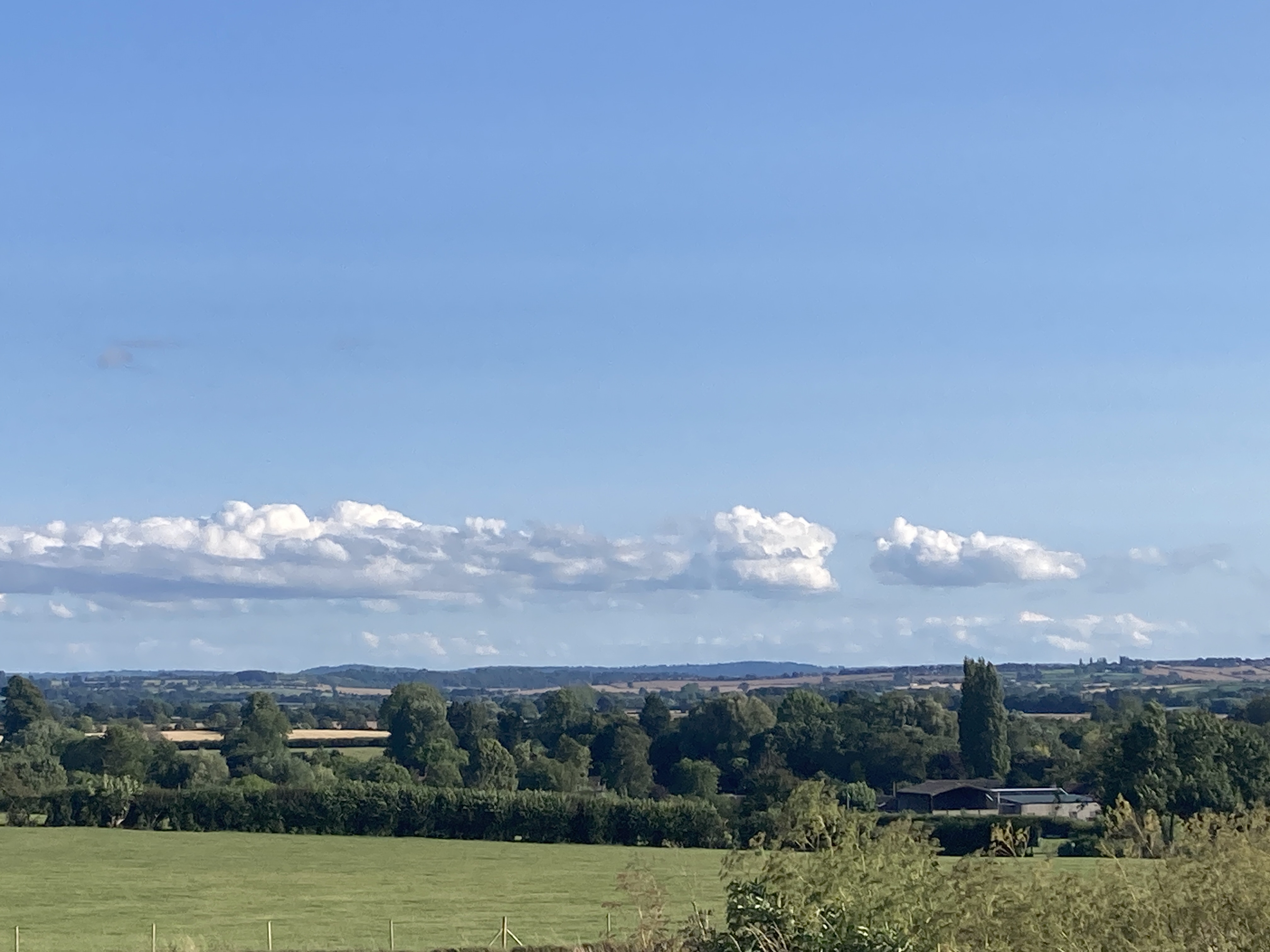 The M25 was as usual busy but once on the A303 things got better and we found that fine weather had ripened the grain and left the woodlands looking lush and cool.
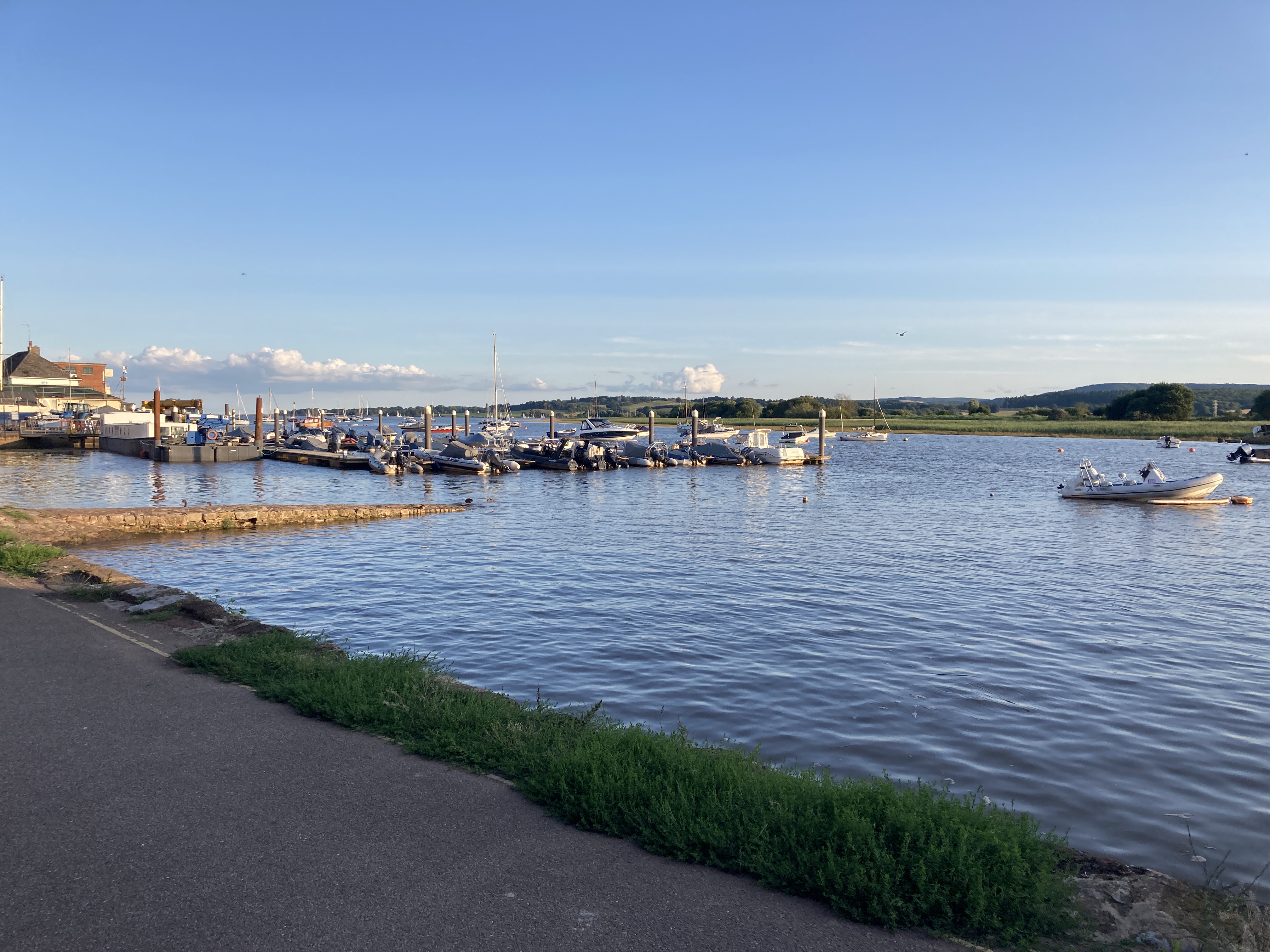
Passing Stonehenge and on to Exeter we stopped at Topsham and had a drink and some crackers and cheese before continuing on arriving home around 10.30pm
 What an amazing trip, 10 European countries, 3 areas of high mountains, 3 ferry trips, 1 boat trip, lots of major cities including Zagreb, Dubrovnik, Bologna, Mostar, and lots more, Adriatic peninsular coast and so many beautiful rural spots. With 12 different campsites, 4 rough camping spots and a hotel. What an adventure!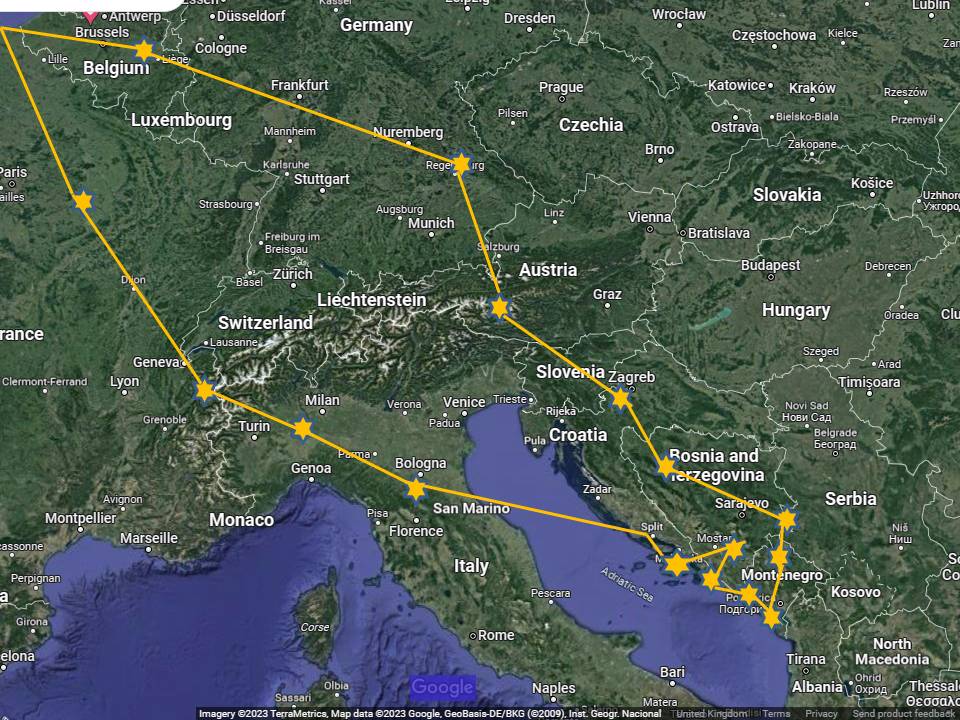
 World Wide Webbs