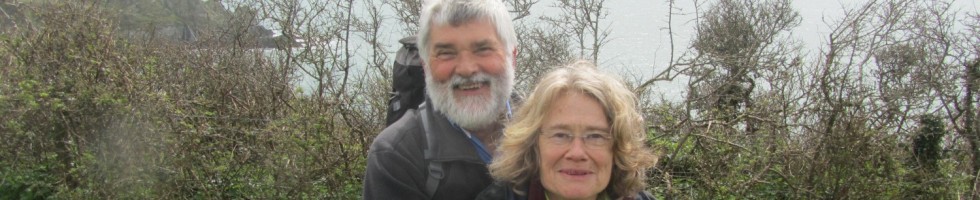
2017 – The Galapagos Islands
San Cristobal
Monday 30th January
We leave the hotel at 7am for a 10am flight to the Galapagos Islands. The flight stops at Guayaquil on the coast where a lot of people get off before we head out over the Pacific. Our group of mixed ages and circumstances seem to get on really well and we all get excited at what is ahead of us.
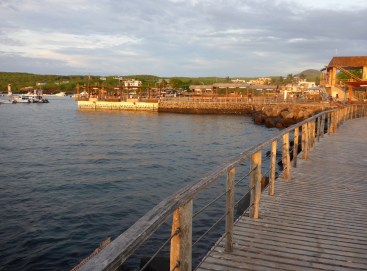 The flight takes us to Puerto Baquerizo Moreno on San Cristobal Island. A tiny airport where’ having cleared passport control and paid $100 to enter the National Park, we meet Pepe our guide. Very quickly we are transferred to the port a busy largely single storey town which is a short distance away. So in less than 10 minutes we are on the quayside.


Here while we stand waiting with many others for our transport, we are open-mouthed at the Sea Lions, Pelicans, Iguanas and bright orange Sally Lightfoot Crabs that are everywhere.
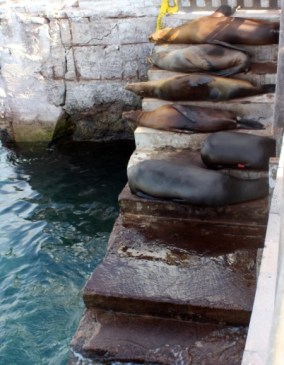
Avoiding the sea lions who occupy one of the harbour steps from the quay we get onto two zodiac inflatables, known locally as Panga’s, which take us to the Queen of the Galapagos our home for the next seven nights. It is a large catamaran with several outside decks and some very luxurious rooms. We eat in a dining room on the lower deck where the bar and comfy seats are located.
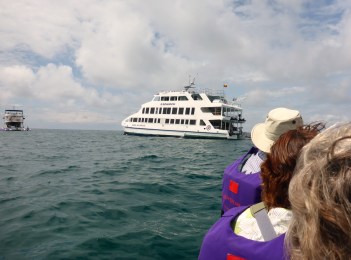 Here Pepe briefs us about the basic rules and behaviour when in the Islands and we were allotted cabins. The days will start with a 6.00 call a 7.00 breakfast and an 8.00 start to the excursions of the day. We will be travelling between islands over night so we will get maximum time on and around the islands.


We get a cabin on the top deck at the back with a huge double bed and windows all down one side of the room looking out over the sea. The bathroom and toilet also look out over the sea and the shower is in front of the window.
We have lunch and an alarm practice where we muster with life jackets from our room to the back of the boat. Ten minutes later we go back in the Panga’s to the shore and on a coach travelling to the La Galapaguera, a reserve for breeding giant tortoises. The reserve is high in the hills on the other side of the island.


There is misty rain in the air as we travel through the rocky shrubbed highlands. We walk along the path from the car park eagerly looking out for ….. anything!!
 After a time we spot a few huge tortoises with shiny shells. In the middle of the reserve are enclosures where the little tortoises are protected for two weeks to two years before being kept for another five years in an enclosure prior to release into the wild.
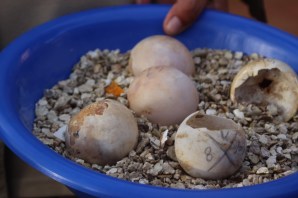
Tortoise eggs found on the islands are marked and transferred to an incubator where they are placed in exactly the same position so as not to damage the embryo by turning it on its side or its back. They are kept at a certain temperature for 100 days. Depending on what gender of tortoise you want, one and half degrees warmer will produce males rather than females.
 We travel back to the port and return to the Queen the whitest of the white boats at anchor here with a wonderful sunset. We have a ‘welcome’ drink, a short meeting and an excellent supper. Good company makes us feel that this should be an exciting week.
Santa Fe
Tuesday 31st January

The view from our bed when we awake is amazing. We have travelled through the night and awake in an isolated paradise.
Breakfasts are simple but adequate with fruit, some sort of fruit smoothie, potato cakes or pancakes with eggs or sausage. Coffee is freely available all the time as are snacks and sweets so we are not going hungry.


After breakfast it is into the Pangas and off to Santa Fe Island where we disembark onto a sandy cove where a female sea lion and its pup are lying on the sand guarded by honking bull sea lions. As we move off the beach more sea lions are around us on the rocks and paths.
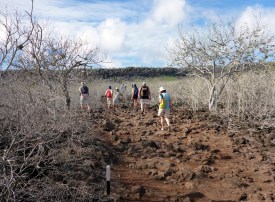
The volcanic nature of the Galapagos is quickly illustrated with broken lava and rough jagged rocks. We get used to this but our first sight of this landscape is memorable.


As we walk around the short trail we see various sized Land Iguanas both male and female and also Mocking Birds and Finches (each unique to their Island), and the blue eyed Galapagos Doves.


The islands are dry and scrubby with rough stone strewn land among which iguanas, lizards and some birds live and some hardy plants are to be found. The Incense Tree whose bark when scratched smelt of incense and the Prickly Pear which live for over 100 years and whose bark whilst spiky when young becomes smooth when mature and the Croton bush.


As with most of our excursions Pepe’s flow of information is endless. We learn that Sea Lions are different from Seals for a number of reasons. Sea Lions have separated flippers, ears and whiskers and their genitalia are external. They can move faster than humans and are the most dangerous creature we are likely to come across on the Islands because of their sharp teeth and claw like flippers. The Fur Seal is in fact a Sea Lion !
 You can tell a Land Iguanas which live up to 70 yrs from a Marine Iguana by the wider heads, longer tails, bigger lungs and slower heart rate.
The sexes of Lava Lizards can be determined by the presence of red lips on the female and during the mating season the orange neck of the male.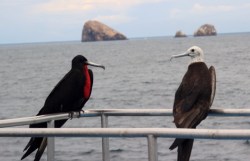
The Frigatebirds that fill the air and take rides on the Queen spend hours inflating their red chests which they puff out as a mating ritual.
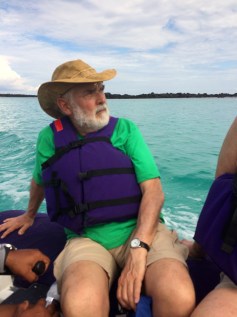
It is then back to the boat for a snack before we change into our swimming costumes to go snorkelling. Flippers and snorkels are provided and it is back into the Pangas to the small peninsular that protects the bay where we snorkel for a full hour along the peninsula and then across to the shore.
Near the rocks there are lots of colourful reef fish, prickly star fish and some saw flounders, rays and a turtle.
After an hour with wrinkly fingers and chilly we return to the boat that then sail off to the north of Santa Cruz Island and the mangrove swamps of Black Turtle Cove.
After a much too big lunch we laze on the boat until it anchors at Black Turtle Cove. Out at sea a large black Manta Ray leapt from the water like a kite and Storm Petrels and Manx Shearwaters skim the surface of the waves.
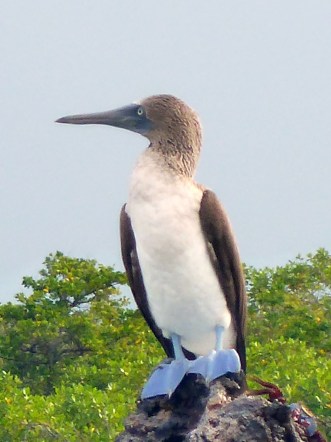
In the Pangas we head towards the shore and come across a Blue-footed Booby bird sitting on the lava.
Going further into the mango lagoon and taking the boats through narrow gaps we watch Pelicans, Frigatebirds, Blue –footed Booby’s, Nazca Booby’s, Great Blue Herons and Lava Herons flying around us.
In the water we see small tiger fish, sharks and various sized turtles coming up for air, all very exciting.
Santiago Island
Wednesday 1st February
We wake as the ship anchors to find ourselves just off the Isla Santiago facing a rocky volcanic red black cliff 50 m high with the strata clearly visible.
Here by Buccaneer Cove the cliffs taper down to short dusky beaches surrounded by pinnacles of lava.
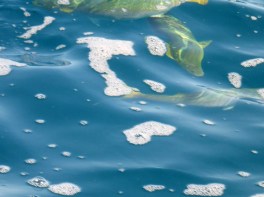
We see Green Mullet swimming in the clear water around the boat
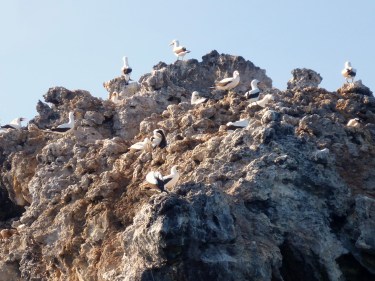
The sea is quite choppy as we clamber into the Pangas to explore at nearer range the rocks and cliffs and to find the colonies of Nazca Booby’s.


The geology so raw and legible you can almost feel the landscape evolving around you.


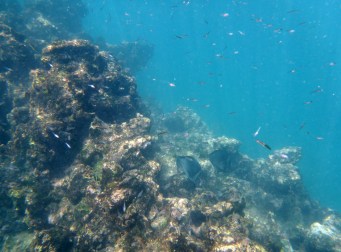 We then return, change and are out again on the Pangas snorkelling around the rocks to the west. Janet seems to have got more of a hang of it and Graham takes the underwater camera with him. We see a variety of star fish, small and medium sized brightly coloured patterned fish some of which we have not seen before and much to the group’s excitement a group of sharks snaking away on the sea bed.


 After lunch and a siesta we board the Pangas and head across James Bay to a black sandy beach. Charles Darwin had stayed here for a week in 1835 as a respite for his sea sickness and took the opportunity to study Tortoises and mocking birds.

Here also are the remains the former harbour, Port Egas. Its abandoned jetty that tells of a failed salt industry started in 1962 but failed by 1964. The remaining building above the beach is a model house made by Senor Egas as an incentive to workers.
After working for two years they would be offered free housing. In preparation 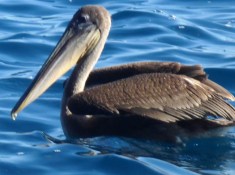 for this, thousands of cinder bricks were made but the scheme failed and the blocks redistributed about Santiago Island.


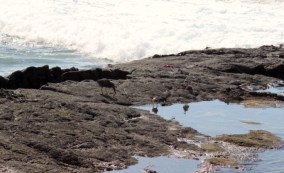
We leave our gear up by the rocks and walk west along the black basaltic lava seeing Brown Pelican Ruddy Turnstone, Noddy Tern, Yellow Finch, Lava Heron, Whimbrel and Oyster Catchers.
These dark American Oyster Catchers, Pepe tells us, are native but not endemic to the Galapagos Island and therefore cannot be called Galapagos Oyster Catchers.
Despite our presence right next to their nests the male stays brooding the two eggs, turning them and covering them with sand. The eggs are incubated for 34 days and the biggest threat is that the eggs will dry out in the heat if they are not kept shaded.
Whilst we watch the female appears and they change on the nest regardless of our presence and the male goes off. We are even able to take a short video.
 We watch a sea lion pup playing in a pool and another adult moving from an upper to lower pool to cool off. Lying under a shelf of rock is a mother with a pup just a few days old and other seal lions are all the way along the shoreline. There are also lots of marine iguanas that are in danger of being stepped on.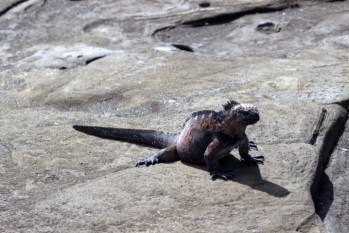
We see them swimming and Pepe tells us they can swim down 10 metres to feed on the algae. They face the sunrise in the morning and at night pile up on top of each other to keep warm for as long as possible. When mating the male circles round the female and grabs their neck tries to lift her tail to insert his penis before another male darts in. Incredibly the male has two penises.
 We also see Fur Seals, which although really a specie of Sea Lions too, are smaller than Sea Lions. They have shorter heads, look bear-like, their coat is made up of two layers, fine hair below and coarse hair above, ears stick out more than Sea Lions, their eyes are bigger and the front flippers are stronger.
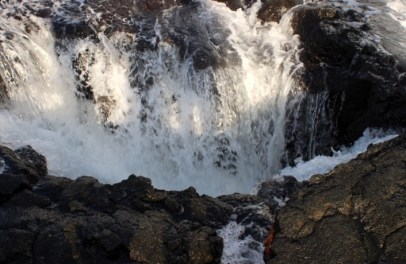 One of the pools at the end of a lava tube, dramatically fills as the waves came in and flushes away as the waves receded, it has been named Darwin’s toilet.
The wonders go on Great Blue Heron, Yellow Finches, Sally Light Foot Crabs and Grasshoppers.


We walk back across the Island to the beach where we have left our stuff by a Poison Apple Tree.

By this time the sea is quite rough so most of us abandon snorkelling and go for a swim which is lovely especially as it starts to rain.
After dinner we go out on the top deck, the half moon is shining on the water and there are lots of stars that we try to identify with others using Robert’s star identification software on his computer. It’s quite different being on the Equator.
Genovesa Island
Thursday 2nd February
 The bed is very comfortable and we resist the temptation to stay up to cross the equator as we head north for 100 km to Genovesa Island and back into the northern hemisphere.
  The passage is quite bumpy but we awoke to the ship mooring just off the Isla of Genovesa in a flooded volcanic crater.
After breakfast we are taken to a wet landing on the rough sandy shore where we follow a short trail.


Swallow- tailed Gulls are nesting on the beach and amongst the rocks. They are night feeders and we had seen them following the boat last night.
One of the reasons we are here is to see the Red –footed Boobies as they are only to be found breeding in Genovesa in the bushes along the shore. Whilst mostly brown there is a rare white form we also see. They are the smallest and most abundant Booby in the islands.


They nest among the bushes on the edge of the beach where their year long breeding season is free from predation.
Also breeding in the bushes behind the beach are Nazca Booby and Frigatebirds including the less common Magnificent Frigatebird with its green sheen to the wings.
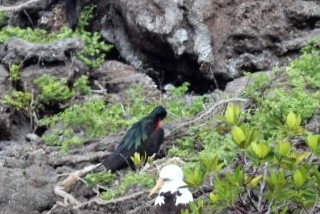
There are also the more abundant Greater Frigatebird which has been escorting us all around the islands.
It has got very hot. Back on the boat we collect our snorkelling gear and head off to a cliff. On the way dolphins are spotted so there is a bit of a haphazard chase.
By lying in the water and staying still, it is possible to see the female with its baby swim by as it seeks to avoid our company.
By the cliff edge there are shoals of fish, Hammerhead Shark, White spot Reef Shark and Golden Rays. Everyone is well pleased.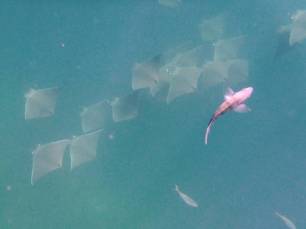
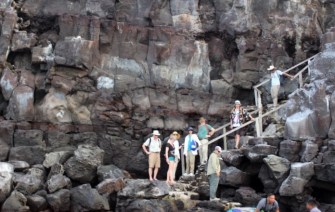
Lunch, siesta and out again to another part of the cliff where we climb up some steep rock steps to the plateau above.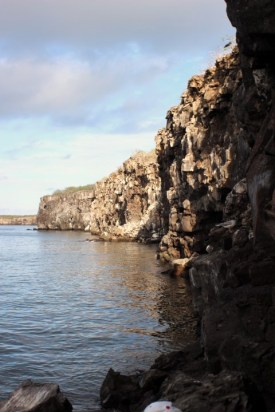
The rocky lava platform that we climb up onto is lightly covered in scrub and rent apart with fissures in the surface.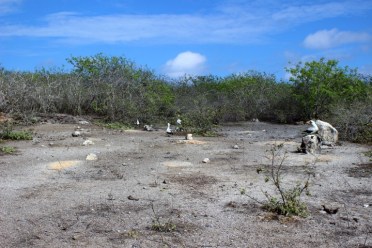

The lack of predators makes the nesting birds very relaxed as we had found already with the Swallow-tailed Gulls.
A white and black Nazca Booby with two eggs sits before us on the path.
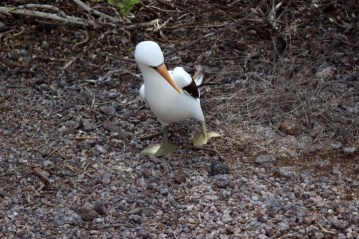
The Nazca Booby lays three eggs but one usually gets destroyed.
As we walk around this proved to be the case as each had just two eggs. The males have green webbed feet because they feed on sardines.
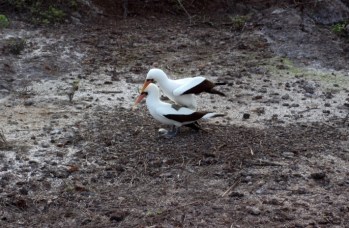
We watch a mating pair and take a video of their courtship manoeuvres which involves a movement known as ‘sky-pointing’ when they raise their beaks towards the sky and whistle through their nose.
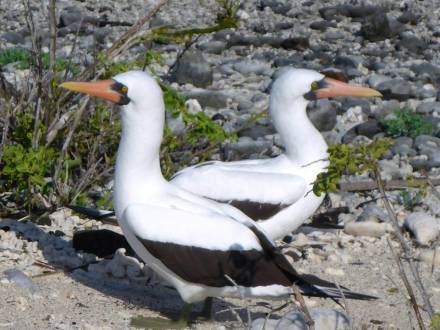
There are also red boobies and blue boobies sitting in the trees. Some are pointing down draining the salt from their noses.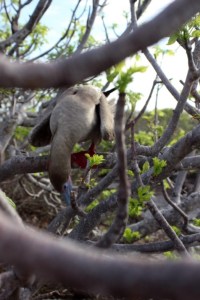
The island is home to the Galapagos Short Eared Owl and we set out to see the Storm Petrel colonies along the broken volcanic lava cliff tops to find one. These owls are day time hunters hunting on foot rather than in the air and feed primarily off the chicks of Storm Petrel and other sea bird

We soon see one standing like a sentry on the bare rock being mobbed by a variety of birds.
A bit further on we see another and another and eventually we come across one only a few feet away standing on the bare rock watching us. Owls seem a bit bizarre in this hot barren lava flow landscape with no trees or significant vegetation around and the likelihood of rodents and many insects remote: which is bad news for the nestlings.


Lava cactus looks like a fungal growth on the lava and green innocent trees and silver weed fill the crevices.


A swim off the boat, a nice dinner, a calm sunset and good conversation ends the day.
Isla Bartolemé
Friday 3rd February
We wake up at Isla Bartolomé another different sort of volcanic landscape, dominated by Pinnacle Rock, the jagged remnant of an old tuff cone.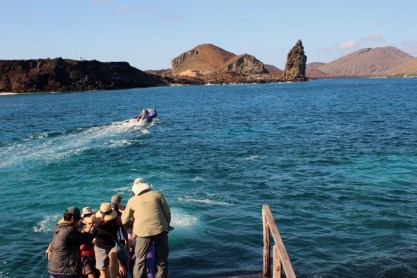
The Pangas take us to the jetty on the island from where we can access the summit. This is supposed to be a dry landing but the choppy sea and slippery rocks make it a little more challenging than that.


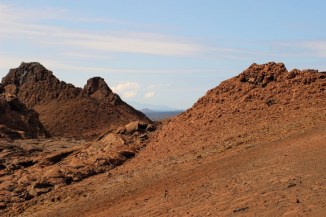
We follow a wooden walkway steadily upwards through a barren volcanic landscape dotted with the silvery shrubby herbs tequilia and the occasional lava cactus.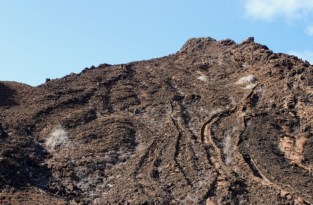
The volcanic lava tubes and pumice like rock gives the landscape a moon-like quality with large spatter cones and lava tunnels rising through it.


From the top there is a breathtaking vista with views of lava flow fields, volcanic cones, sandy beaches and other islands.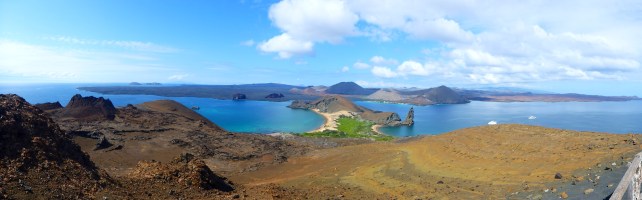
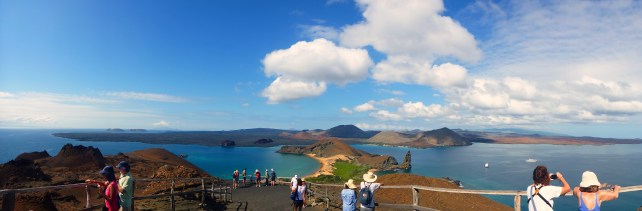 From the summit we can see the red and black lava fields of Sullivan’s Bay.


Here we learn about the volcanic heritage of the Galapagos and are in awe as to how vegetation establishes and then exists along with a few birds and lava lizards.


We then go snorkelling just off the rocks which was great. The highlight was swimming with a penguin. But we also saw White-tipped Reef Sharks, Turtles, Sting Ray, Flounder, different coloured Star Fish and large Sea Urchins. Brilliant!


Amongst all this are innumerable numbers of Fish and Sea Cucumbers. After lunch and a siesta we are off snorkelling again along the beach at Sullivan Bay. A bit murky and we are tired but we swim with a turtle, sharks and again lots of fish.


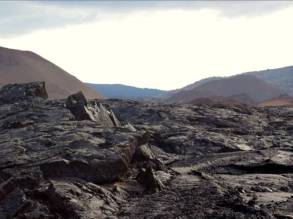
It cools down a bit by the time we go back onto the boat. We change and set off to take a walk on the black lava field in Sullivans Bay.
 Pepe explains the different forms of lava the ‘ouch ouch’ and the ‘ay ay’.
The names reflect whether the lava has been thick slow moving or thin fast moving and whether it has cooled quickly or slowly.
It is very clear when standing on the lava which one you are on.


Walking on the lava was amazing, it was like walking on cooled icing or toffee which had bubbled and curdled.
Back on the tenders we go to see the penguins at the base of Pinnacle Rock for a photo shoot.


That evening before the briefing Robert and Mustafa showed some of their photos on the TV screen and we settled down for a pleasant meal before bed.
Rabida and Cerro Dragon
Saturday 4th February
From our bed we watch the sun rise on the Isla Rabida where the boat has moved to overnight.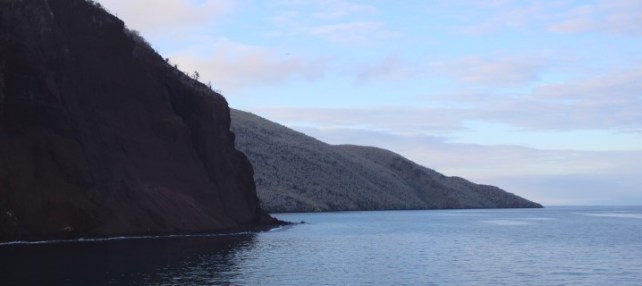
After breakfast we do a wet landing on the red beach of the island and see a lagoon behind the beach which had had Flamingos on it but because of the introduction of (now culled) goats is no longer visited by them.


We follow a trail, looking around the very dry landscapes with dormant acacias trees or cordia lutea bushes that produce yellow flowers in the wet season. It is very hot and humid and there is more insect life than we have previously noticed!


On the shore we see a carpenter bee, a female flycatcher and various finches including a lovely yellow one.


We watch Blue-footed Booby’s diving in the sea for fish and the mobbing of them by Frigate birds trying to force them to give up their fish for them to eat.


We see Brown Pelicans and Noddy birds which are reputed to be quick enough to steal fish from the beaks of Pelicans when they open them briefly to drain water out.


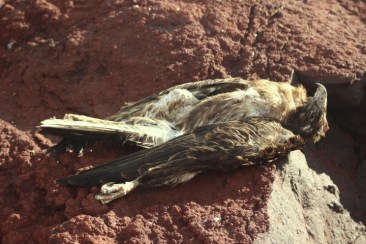
On the beach when we return to the Pangas there are lots of Hermit or Ghost Crab holes and along the strand line small yellow fish eggs, as well as a dead Galapagos Hawk.
Brown Pelicans nest at the far end of the beach.
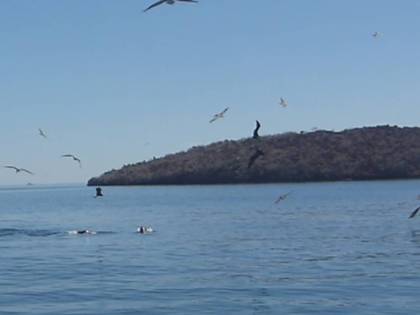 The grouping and diving of the birds and sea lions, sting ray, sharks, dolphin and turtle activity just off shore is a real spectacle.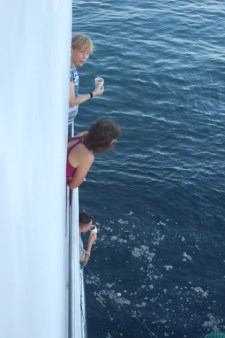
Back on board we have a snack before we snorkel again travelling down the beach to the rocky promontory.


Pepe finds a sea horse on the sea bed just off shore and there were several turtles to swim with as well as a menacing sting ray.
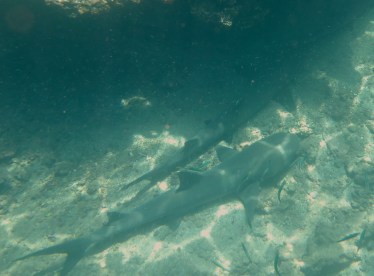
It isn’t until we reach the rocks that there are more fish and a group of five White-tipped Reef Sharks resting together.
 While we have lunch and rest the boat sails south to Cerrito Dragon (Dragon Hill) on NW tip of Santa Cruz .


We snorkel for a bit along the shore but find that the minute jelly fish are stinging us so we abandon the snorkelling and return to the boat.


After a shower we are on the Pangas again and back to the shore for a red muddy walk in the rain around a hill.


We see amazing terracotta and orange land iguanas.
Soaking wet and even a bit cold we return to the boat and have a relaxing evening watching people’s videos and photos of the day.
Santa Cruz Island
Sunday 5th February
 During the night head south to Port Ayora the main town of the Islands. So we wake up around lots of tourist boats and small fishing boats.
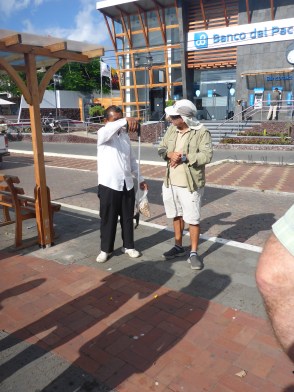 We go ashore and walk up to the Charles Darwin research station. On our way we stop whilst Pepe chats to an old man who was the captain of a boat that was abandoned a long time ago off Santa Cruz Island.
The lifeboat and crew had drifted for many months before being rescued off the coast of Panama. Now he collects cigarette butts to recycle into trinkets.

At the research centre we pass a burrowing land iguana on the drive. We look at the giant tortoise rearing pens at the station. We see how some tortoises have evolved to be able to eat higher vegetation.


What was interesting was the difference between the Dome-shelled and the Saddle-backed Tortoises that originate from different islands. The Dome-shelled is the only one endemic to Santa Cruz Island.
 The efforts to re-establish the saddle backed tortoises involved taking all specimens found on Espaňola in 1960 into captivity, just 14 adults, and breeding them here in the research centre.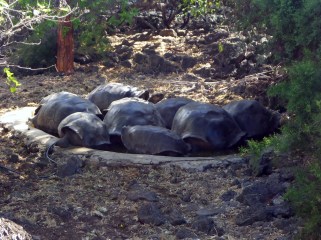
We watch a lot of giant Dome-shelled tortoises moving around in an enclosure. They have been kept as pets and donated to the Research Centre.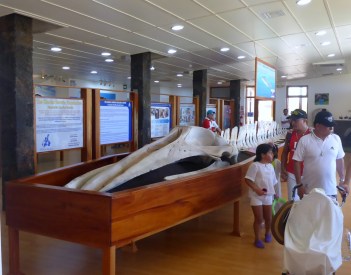
Our group split and we wander back slowly in heat looking at the ongoing research projects. Our overall feeling is that through current research projects they are stopping evolution in its tracks rather than allowing it to move forward naturally but one of the projects on mangrove finches was interesting.
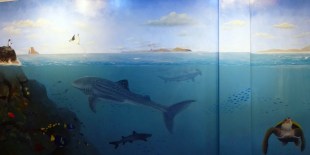
The museum was air conditioned and had some good displays and we felt pleased that we had seen most of the wildlife being displayed apart from Albatrosses and the Flightless Cormorant.


As we walk slowly back into town we visit an open air ceramic art display.
We wander down by the empty fish market watching a Sea Lion climbing onto a bench for a sleep. We then carry on into the town looking in some of the gift shops and having a beer before returning to the boat.
After lunch we go back on the pandas to the quay and take a bus to the Chato Tortoise Reserve a farm reserve on the SW corner of the Island where wild Giant Tortoises roam freely amongst cattle in open grasslands.
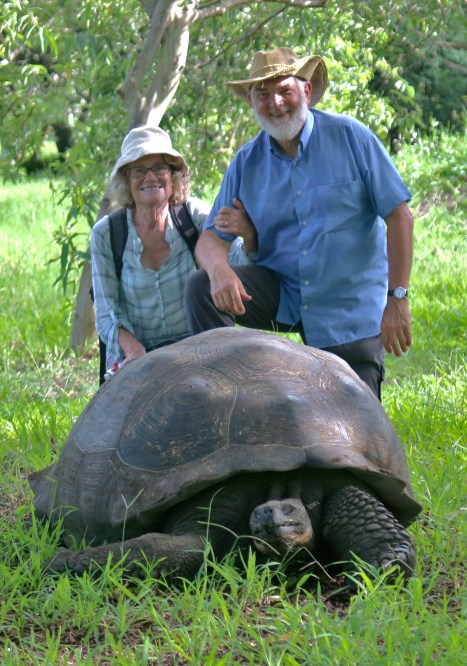
We wander around watching the awkward giant tortoises feeding and copulating. They were everywhere and it was barely credible that these were wild animals.
This does not stop us from taking the mandatory tourist photo beside one.


Another attraction was the lava tube that was accessible to follow in two places underground. In it we saw a Galapagos Barn Owl and marvel at the strata of the rock that had channelled the lava across the island to the sea.
We have our headlamps and go and explore both sections of the tube. It is a very different wildlife experience and a popular local attraction with the several groups of children enjoying the cave and the tortoises.


We then have a cup of coffee near the amazing reserve boot store.


Back on board we had our final night handing out gratuities to Pepe and the crew and with the crew presenting themselves in their uniforms. We were then served dinner by Wilson including some delicious ceviche which others had tasted in Puerto Ayora and settle our bar bills.
San Cristobel
Monday 6th February
We went to bed late and spent a restless night, with the ship rolling to and fro as we travel south to San Cristobel and Puerto Baquerizo Moreno. At one point during the night the boat stops and the lights all go out. We discover on the morning that they have been servicing a pump.
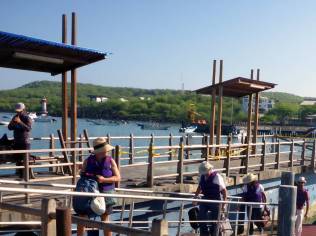
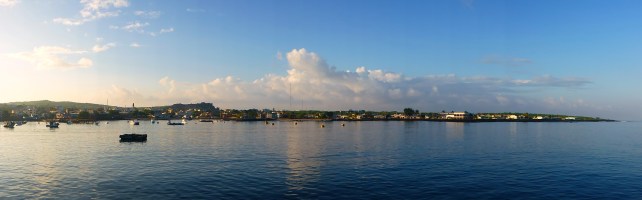
We anchor in the harbour bay by the town that we had sailed from eight days before. We leave our main luggage on the boat and have our last ride in the Pangas to the jetty.
We walk through the streets and find the bus which takes us to the Cristobel Interpretation Centre. The town is sleepier and less busy that Port Ayora.
As we make our way into the modern interpretation centre it was sunny and very hot.


This is a large modern centre which traces the history of the Galapagos people, of the discoveries of the Islands, the pioneers, various uses made of the islands and how the people nowadays survive.


It looks at history, culture, art and economics and brings together much of what we had been observing during the week.
 It was good to see it now. It would have meant much less at the beginning of our trip.
From here we go to the airport on the edge of the town and checked in our baggage before having two hours in the town.
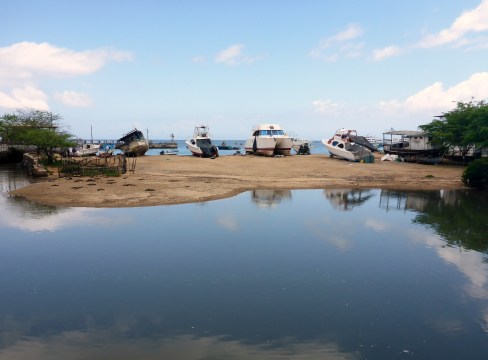
We walk along the sea front and across the beach where boats are being repaired.


Where a river crosses the beach Sea Lions were playing and we see a Marine Iguana and a Hermit Crab.
There is no one about and we have the shops to ourselves. We buy a beach bag and a tea towel for each of the children and their families and one for ourselves.


We then go to a small bar which Pepe had pointed out on the back road and have ceviche and beer. The ceviche is good, a lovely mix of seafood, lime juice and raw red onion, pepper, tomato accompanied by a basket of pop corn and banana chips as we had been served last night.
We meet up with the others on the quay and catch the bus the few hundred yards back to the airport. We board the plane which takes us back to Quito.
 World Wide Webbs